Israel Approves Settlement Project That Could Divide the West Bank 

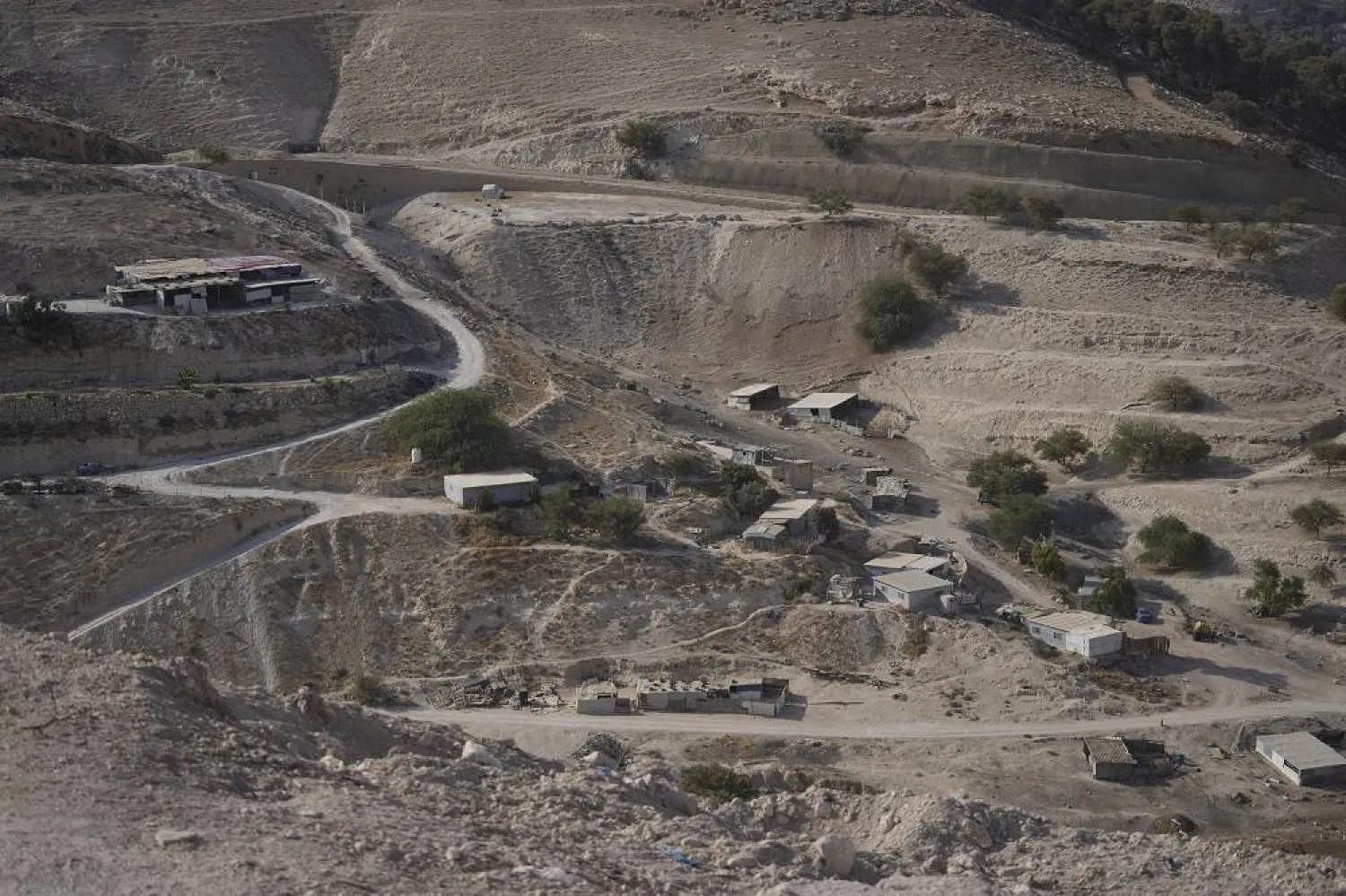
Palestinian hamlets are seen at the E1 area, an open tract of land east of Jerusalem, between the Israeli settlement of Maale Adumim and the occupied West Bank town of Eizariya Thursday, Aug. 14, 2025. (AP)
TT

Israel Approves Settlement Project That Could Divide the West Bank 

Palestinian hamlets are seen at the E1 area, an open tract of land east of Jerusalem, between the Israeli settlement of Maale Adumim and the occupied West Bank town of Eizariya Thursday, Aug. 14, 2025. (AP)

Israel gave final approval Wednesday for a controversial settlement project in the occupied West Bank that would effectively cut the territory in two, and that Palestinians and rights groups say could destroy hopes for a future Palestinian state.

Settlement development in E1, an open tract of land east of Jerusalem, has been under consideration for more than two decades, but was frozen due to US pressure during previous administrations. The international community overwhelmingly considers Israeli settlement construction in the West Bank to be illegal and an obstacle to peace.

Far-right Finance Minister Bezalel Smotrich, a former settler leader, cast the approval as a rebuke to Western countries that announced their plans to recognize a Palestinian state in recent weeks.

“The Palestinian state is being erased from the table not with slogans but with actions,” he said on Wednesday. “Every settlement, every neighborhood, every housing unit is another nail in the coffin of this dangerous idea.”

Israeli Prime Minister Benjamin Netanyahu rejects the idea of a Palestinian state alongside Israel and has vowed to maintain open-ended control over the occupied West Bank, annexed east Jerusalem, and the war-ravaged Gaza Strip — territories Israel seized in the 1967 war that the Palestinians want for their state.

Israel’s expansion of settlements is part of an increasingly dire reality for Palestinians in the occupied West Bank as the world’s attention focuses on the war in Gaza. There have been marked increases in attacks by settlers on Palestinians, evictions from Palestinian towns, Israeli military operations, and checkpoints that choke freedom of movement, as well as several Palestinian attacks on Israelis.

More than 700,000 Israelis settlers now live in the West Bank and east Jerusalem.

The location of E1 is significant because it is one of the last geographical links between the major West Bank cities of Ramallah, in the north, and Bethlehem, in the south.

The two cities are 22 kilometers (14 miles) apart, but Palestinians traveling between them must take a wide detour and pass through multiple Israeli checkpoints, spending hours on the journey. The hope was that, in an eventual Palestinian state, the region would serve as a direct link between the cities.

“The settlement in E1 has no purpose other than to sabotage a political solution,” said Peace Now, an organization that tracks settlement expansion in the West Bank. “While the consensus among our friends in the world is to strive for peace and a two-state solution, a government that long ago lost the people’s trust is undermining the national interest, and we are all paying the price.”

If the process moves quickly, infrastructure work in E1 could begin in the next few months and construction of homes could start in around a year. The plan includes around 3,500 apartments that would abut the existing settlement of Maale Adumim. Smotrich also hailed the approval, during the same meeting, of 350 homes for the settlement of Ashael near Hebron.

Israel’s government is dominated by religious and ultranationalist politicians, like Smotrich, with close ties to the settlement movement. The finance minister has been granted Cabinet-level authority over settlement policies and vowed to double the settler population in the West Bank.


Yemen Welcomes EU Terror Designation of Iran’s Revolutionary Guards

Iran’s Revolutionary Guards control the military activities of all Houthi units (EPA) 
TT

Yemen Welcomes EU Terror Designation of Iran’s Revolutionary Guards

Iran’s Revolutionary Guards control the military activities of all Houthi units (EPA) 

The Yemeni government welcomed a European Union decision to designate Iran’s Revolutionary Guards as a terrorist organization, saying the move marked a long-awaited shift toward confronting a central driver of instability and security threats across the region and beyond.

In an official statement, the government said the decision reflected growing European awareness of the destructive role the Guards had played over many years.

It said the group had fueled armed conflicts, systematically supported groups and militias operating outside national state institutions, repeatedly threatened international maritime routes, and persistently undermined the foundations of global stability and security.

The statement said classifying the Guards as a terrorist organization marked a qualitative shift in the international community’s approach to Iran’s behavior and brought to an end a long period of political leniency toward activities that have become a direct threat to collective security, both in the Middle East and beyond.

It added that Yemen’s Houthi group was nothing more than one of the Guards’ direct military arms, and that its project, based on violence, coups, and the imposition of faits accomplis by force, represented a straightforward extension of the destabilizing role led by the Iranian military body outside Iran’s borders.

The government said the Houthis’ record of targeting civilians, shelling civilian infrastructure, launching cross-border attacks, and threatening commercial shipping and maritime navigation in the Red Sea and the Gulf of Aden clearly demonstrated the group’s organic and operational links to the Guards, in terms of ideology, funding, armament, and military planning.

It said the obstruction of regional and international peace efforts in Yemen, the disruption of political tracks, and the use of organized violence as a negotiating tool were practices consistent with the model adopted by the Guards in managing their proxies in the region and turning them into tools of pressure and blackmail against the international community.

The Yemeni government called on the European Union to complete this step by taking a similar and decisive decision to designate the Houthis as a terrorist organization, in line with European laws and legislation and relevant UN Security Council resolutions, to help dry up the militias’ sources of funding, deter their aggressive behavior, and enhance prospects for a just and lasting peace in Yemen and the region.

Practical measures

In the same context, Information, Culture and Tourism Minister Muammar al-Eryani said the EU’s decision to classify the Guards as a terrorist organization was “a step in the right direction and a clear message that the international community has begun to deal seriously with one of the most dangerous sources of instability in the region, after years of overlooking its cross-border military and security roles.”

He said in an official statement that the importance of the decision lay not only in its political symbolism but also in the practical executive measures that must follow, including drying up funding sources, freezing assets, pursuing networks and fronts linked to the Guards, and cutting off channels of support, smuggling, and armament they manage across multiple countries and regions.

Eryani said the Guards had played a direct and organized role in Yemen by managing the Houthi coup project, noting that their involvement went beyond supplying weapons, experts, technology, and funding to include operational supervision and the management of military and security networks in areas under Houthi control.

He said this was proven by field evidence and by the roles played by Guards operatives, including Hasan Irlu and Abdul Reza Shahlai, whom he described as operational field managers of Iran’s project.

He said what happened in Yemen was not an exceptional case but part of a fixed regional pattern based on building armed militias parallel to the state, fueling conflicts, spreading chaos and terrorism, and using proxies to impose realities by force and blackmail the international community.

Historic decision

The Yemeni position follows what it described as a historic decision taken by EU foreign ministers on Jan. 29, 2026, to add Iran’s Revolutionary Guards to the bloc’s terrorist list, in a shift described as ending a phase of diplomatic caution and ushering in a new era of economic and legal confrontation with what it called the backbone of Iran’s ruling system.

The decision came in direct response to the violent crackdown by Iranian authorities on widespread protests in late 2025 and early 2026, which rights groups estimate resulted in the deaths of thousands of civilians, as well as the Guards’ expanding regional role, including supplying Russia with drones and threatening global energy security and international shipping.

The designation entails a package of strict legal and political consequences, including asset freezes, travel bans, and the criminalization of any form of cooperation or support, alongside tighter diplomatic isolation, limiting the Guards’ ability to operate under political or economic cover inside Europe.

The Yemeni government said the path to regional security and stability begins with ending the policy of impunity for actors that sponsor and manage cross-border armed militias, supporting national states and their legitimate institutions, and respecting countries’ unity, sovereignty, and territorial integrity.

It reiterated its full commitment to working closely with the international community, foremost the European Union, to achieve peace, combat terrorism, protect international navigation, and build a safe and stable future for the peoples of the region.


Lebanon-Israel Ceasefire Panel to Stay, French Role Remains Military

Lebanese President Joseph Aoun meets Armed Forces Commander General Rodolphe Haykal ahead of his departure for Washington (Lebanese Presidency)
TT

Lebanon-Israel Ceasefire Panel to Stay, French Role Remains Military

Lebanese President Joseph Aoun meets Armed Forces Commander General Rodolphe Haykal ahead of his departure for Washington (Lebanese Presidency)

A statement by the US embassy in Beirut has cut through weeks of Lebanese speculation over the fate of the committee monitoring the cessation of hostilities between Lebanon and Israel, following delays in its meetings.

The statement also signaled that no French civilian member would be added to the body, after sustained local media reports of US–French wrangling over its composition.

Notably, the embassy’s surprise statement, issued on Friday, emphasized the committee’s “military character” and set a date for its subsequent meetings in late February.

The developments come ahead of a visit by Lebanese Armed Forces Commander General Rodolphe Haykal to Washington, where he is due to meet several US officials over three days.

The three-day visit is scheduled for February 3-5.

Preparations for the visit were the focus of a meeting Haykal held with President Joseph Aoun, who was briefed on the arrangements and planned meetings, according to a statement from the presidency.

Military needs

According to ministerial sources, discussions centered on what Haykal will present in Washington, including the military’s needs at this sensitive stage, both logistical support and armaments.

This comes as the army’s responsibilities expand, particularly in southern Lebanon, where it has assumed increasing responsibilities for maintaining stability and protecting civilians.

Weapons exclusivity plan and obstacles

Sources told Asharq Al-Awsat that Haykal will brief US officials on the reality of the army’s deployment in the south under the weapons exclusivity plan, as well as the obstacles hindering its completion, especially south of the Litani River.

They said the continued Israeli occupation remains a direct impediment to the army’s ability to fully assert control and carry out its assigned missions under agreed mechanisms.

The army commander will also outline, the sources said, the measures the military has taken to implement the state’s weapons exclusivity plan, as well as the practical challenges it faces on the ground amid the prevailing security situation and the sensitivity of the current phase.

He will stress the need for comprehensive political and international backing to ensure the plan’s success.

Beyond south of the Litani

As anticipation grows in Lebanon and abroad over the next phase of weapons exclusivity north of the Litani, and amid objections voiced by Hezbollah officials, the sources said Haykal’s Washington visit will also address the post–south Litani phase.

He will explain the military’s vision for completing deployment, consolidating stability, and reactivating the “mechanism” committee, including the format of meetings and coordination procedures in the coming phase, on condition that Israel withdraws from occupied Lebanese territory.

In this context, ministerial sources said President Aoun stressed during the meeting the importance of Haykal focusing in his talks on the need for severe international pressure on Israel to withdraw, enabling the army to perform its role fully and paving the way for the release of Lebanese detainees and the restoration of lasting calm in the south.

Paris conference

The Paris conference expected on March 5 to support the Lebanese army will also feature in Haykal’s US meetings.

The conference has been postponed several times and is closely tied to the army’s implementation of the weapons exclusivity plan.

President Aoun had asked security agencies two weeks ago to prepare detailed reports on their needs so participants would be fully informed, helping the conference meet its objectives.

Haykal is scheduled to meet US Central Command (CENTCOM) Commander General Brad Cooper at the command’s headquarters in Tampa, Florida, to discuss military and security cooperation between Lebanon and the US. Discussions will also cover the mechanism committee.

He will then travel to Washington on Tuesday, February 3, to hold a series of security and diplomatic meetings with US officials, members of Congress, and White House officials through February 5.

Mechanism meeting on February 25

The developments come as Israeli attacks continued, including a strike that killed one person in the southern Lebanese town of Siddiqine after his car was targeted.

At the same time, the US embassy in Beirut announced that the mechanism committee will convene on February 25, following a one-month suspension of its meetings and reports suggesting it could be dissolved.

Writing on X, the embassy stated that the US Embassy in Beirut and US Central Command reaffirm that the military coordination framework, as established in the cessation of hostilities agreement announced on November 27, 2024, remains in place and fully operational, with the same objectives, participants, and leadership.”

The embassy added that the next mechanism meeting will be held in Naqoura on February 25, 2026, with subsequent meetings scheduled for March 25, April 22, and May 20, stressing that “these meetings serve as a core forum for military coordination among the participating parties.”


Lebanon Enforces Funds Checks Despite Hezbollah Objections

Lebanon’s Justice Minister Adel Nassar. (NNA)
TT

Lebanon Enforces Funds Checks Despite Hezbollah Objections

Lebanon’s Justice Minister Adel Nassar. (NNA)

A circular issued by Lebanon’s Justice Minister Adel Nassar, now in force, has placed notaries public on the front line of the country’s fight against money laundering, requiring them to verify the source of funds and the identities of parties involved in sales contracts, purchase agreements, and powers of attorney.

The measure, which took effect at the start of this year, is aimed at curbing the cash economy and boosting transparency in line with international standards on combating money laundering and terrorism financing.

It has also reignited and intensified a political campaign by Hezbollah, which says the move tightens pressure on the party and its support base.

The law requires notaries to carry out several key tasks, notably verifying that parties to transactions are not listed on national or international sanctions lists, refraining from completing any transaction if that proves otherwise, and notifying the Justice Ministry and the Special Investigation Commission at Lebanon’s central bank.

The circular also stresses the need to verify the source of funds and to state it explicitly in the transaction or contract, and to refrain from drafting or certifying any document if it is not possible to establish the identity of the beneficial owner.

The measure targets all those listed on the US sanctions lists and mainly affects Hezbollah, its officials, and its institutions. The party considers the step part of what it describes as a US blockade against it and says it strips citizens of their civil rights.

Hezbollah Secretary General Sheikh Naim Qassem said the justice minister was “not a judicial police officer for America and Israel” and should stop preventing citizens from completing their transactions.

Qassem asked: “Has Lebanon turned into a prison for its citizens under American management? Is the justice minister or the governor of the central bank an employee of the American administration in Lebanon’s American prison?”

The circular has moved beyond political and legal objections raised against it. The justice minister said all notaries had complied with its requirements since implementation began at the start of the year, noting ongoing coordination to address practical issues that emerged during execution.

Nassar told Asharq Al-Awsat that meetings had been held between representatives of notaries and the Special Investigation Commission at the central bank, during which mechanisms and standards were clarified.

He said an office within the commission had also been designated to respond to notaries’ inquiries and provide necessary information while transactions are being processed.

The minister said the measures put Lebanon on a path of transparency and would positively affect the Financial Action Task Force's view of the country’s situation.

He described the circular as part of a package of steps adopted by the state to exit the FATF gray list or at least avoid being placed on the blocklist, adding that the measure was a key factor in curbing money laundering without infringing on the civil rights of sellers or buyers.

Hezbollah continued its attack on those involved in the decision.

MP Ali Fayyad said in a speech to parliament during budget discussions that the justice minister, the foreign minister, and the central bank governor were “carrying out a systematic strangulation of our community, sheltering behind the law while overstepping it.”

“We are a people subjected to daily assassination by Israel, and there are those inside who are pouncing on us,” he said.

A number of those affected have filed an appeal before the Shura State Council seeking to annul the circular, arguing that its provisions are not practically applicable and that they impose responsibilities on notaries that exceed their legal authority.

The appellants warned that the circular could turn notaries into quasi-judicial police officers and entangle them in political and security matters unrelated to their work.

Despite objections that have reached the level of accusing anyone who complies with international anti-money laundering standards of treason, the justice minister said there would be no retreat from the circular.

He stressed that it meets international compliance requirements while providing notaries with a legal protective framework that shields them from future accountability if they adhere to the specified procedures.

Some notaries acknowledged that implementation has entered a practical phase, even if conditions and standards sometimes differ from one notary to another. One pointed to inconsistencies between notaries’ procedures and those of the land registry in property registration.

He told Asharq Al-Awsat that verifying the source of funds has become an established procedure, carried out in coordination with the Special Investigation Commission at the central bank.

“There is no doubt that many of the ambiguities that accompanied the issuance of the circular are gradually becoming clearer with implementation,” he said.