
Iran and Belarus Agree to Boost Bilateral Defense Ties

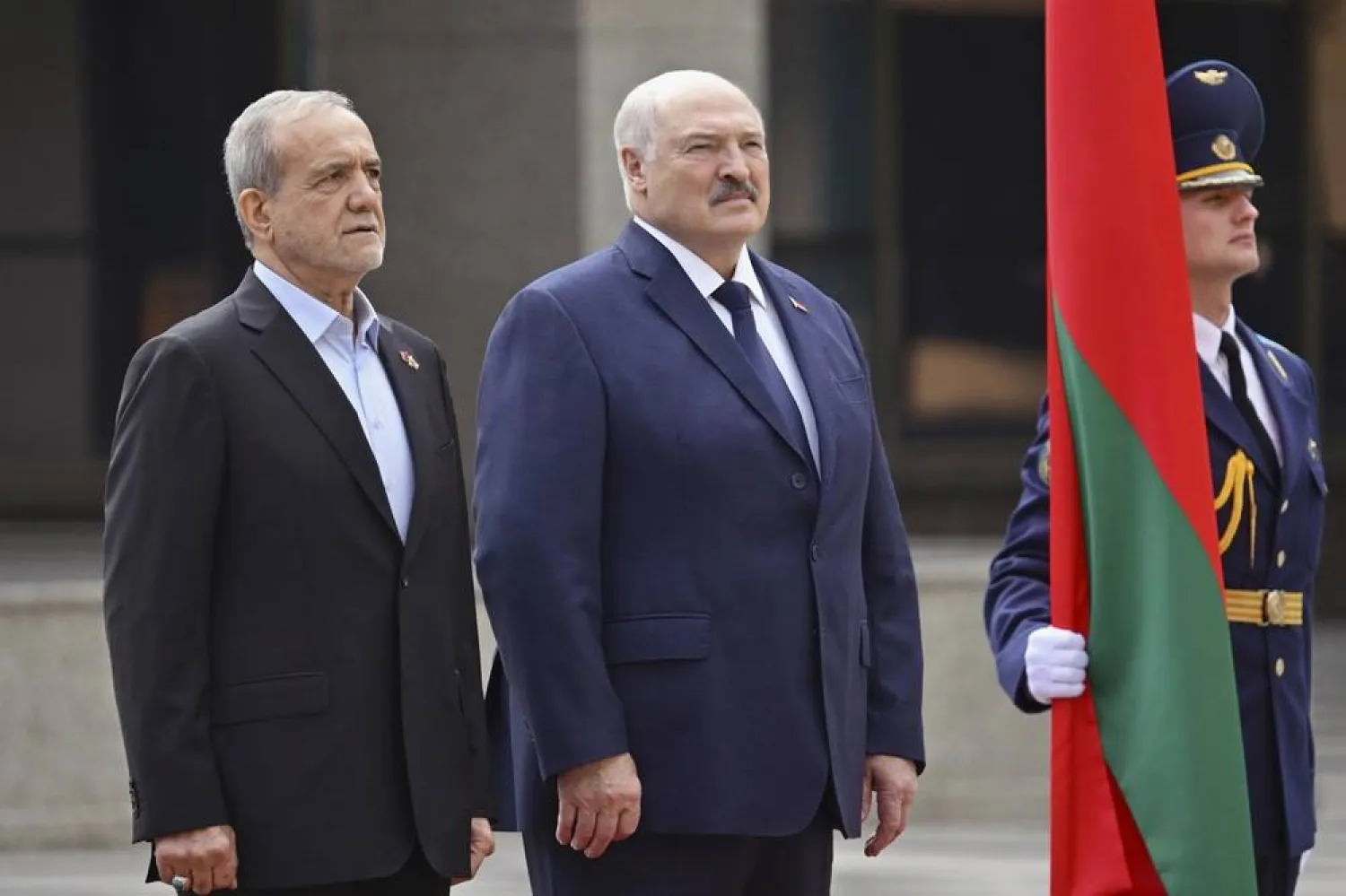
In this photo, released by Belarusian Presidential Press Service, Belarusian President Alexander Lukashenko, center, and Iranian President Masoud Pezeshkian, left, attend a welcome ceremony prior to their talks in Minsk, Belarus, Wednesday, Aug. 20, 2025. (Belarusian Presidential Press Service via AP)
TT

Iran and Belarus Agree to Boost Bilateral Defense Ties

In this photo, released by Belarusian Presidential Press Service, Belarusian President Alexander Lukashenko, center, and Iranian President Masoud Pezeshkian, left, attend a welcome ceremony prior to their talks in Minsk, Belarus, Wednesday, Aug. 20, 2025. (Belarusian Presidential Press Service via AP)

The leaders of Belarus and Iran signed new agreements on Wednesday to boost bilateral ties in key areas including defense, the two governments said.

Presidents Alexander Lukashenko and Masoud Pezeshkian signed a package of 13 documents in the Belarusian capital, Minsk.

Both governments have been placed under heavy sanctions, limiting potential trading partners. Pezeshkian said Iran would help Belarus to “neutralize” such measures, citing Tehran’s decades of experience circumventing Western economic restrictions.

Lukashenko told Pezeshkian that Belarus was “ready to cooperate with you on all issues — from providing your country with food to military-technical cooperation,” calling the Iranian president a “friend.”

The two parties did not disclose any further details on how the countries intend to cooperate in the defense sector. Other areas covered by the agreement include industry and tourism, as well as joint initiatives in science, technology and education.

Access to Belarus’ wood processing and chemical industry, as well as potash fertilizers, can all bring potential benefits to Iran.

The two presidents also said their countries would start work toward a strategic partnership treaty.

Lukashenko, a close ally of President Vladimir Putin, allowed Russia to use Belarusian territory as a staging ground for Moscow’ full-scale invasion of Ukraine and later allowed the deployment of Russian tactical nuclear missiles.

Iran has supplied Russia with drones for use in the war, and Pezeshkian signed a strategic cooperation treaty with Putin in January, although it did not include a mutual defense clause.

The Iranian president’s visit to Minsk has been postponed several times due to US strikes on Iran’s nuclear facilities. Lukashenko called the strikes on Iran’s nuclear infrastructure “a serious threat to regional and international stability and security.”

“We support Iran’s legitimate right to develop peaceful nuclear energy,” Lukashenko said.


Trump Says Had 'Productive' Call with Putin Ahead of Zelensky Meeting

US President Donald Trump takes part in a Christmas Eve dinner in the ballroom of his Mar-a-Lago club in Palm Beach, Florida, US, December 24, 2025. REUTERS/Jessica Koscielniak
TT

Trump Says Had 'Productive' Call with Putin Ahead of Zelensky Meeting

US President Donald Trump takes part in a Christmas Eve dinner in the ballroom of his Mar-a-Lago club in Palm Beach, Florida, US, December 24, 2025. REUTERS/Jessica Koscielniak

US President Donald Trump said he had a productive telephone call with his Russian counterpart Vladimir Putin on Sunday ahead of a planned meeting in Florida with Ukraine's leader Volodymyr Zelensky.

"I just had a very good and productive telephone call with President Putin of Russia" before the planned talks with Zelensky at Trump's Florida estate at 1:00 pm local time (1800 GMT), the US leader said on Truth Social.

Putin said Ukraine was in no hurry for peace and if it did not want to resolve their conflict peacefully, Moscow would accomplish all its goals by force.

Putin's remarks on Saturday, carried by state news agency TASS, followed a vast Russian drone and missile attack that prompted Zelensky to say Russia was demonstrating its wish to continue the war while Kyiv wanted peace.


Russia Sends 3 Iranian Satellites into Orbit, Report Says

In this photo released by Roscosmos space corporation on Thursday, Feb. 29, 2024, the Soyuz-2.1b rocket blasts off at the Vostochny cosmodrome outside the city of Tsiolkovsky, about 200 kilometers (125 miles) from the city of Blagoveshchensk in the far eastern Amur region, Russia. A Russian Soyuz rocket successfully put an Iranian satellite into orbit along with 18 Russian satellites on Thursday. (Roscosmos space corporation via AP)
TT

Russia Sends 3 Iranian Satellites into Orbit, Report Says

In this photo released by Roscosmos space corporation on Thursday, Feb. 29, 2024, the Soyuz-2.1b rocket blasts off at the Vostochny cosmodrome outside the city of Tsiolkovsky, about 200 kilometers (125 miles) from the city of Blagoveshchensk in the far eastern Amur region, Russia. A Russian Soyuz rocket successfully put an Iranian satellite into orbit along with 18 Russian satellites on Thursday. (Roscosmos space corporation via AP)

Russia on Sunday sent three Iranian communications satellites into orbit, the second such launch since July, Iranian state television reported.

The report said that a Russian rocket sent the satellites to circle the Earth on a 500-kilometer (310-mile) orbit from the Vostochny launchpad in eastern Russia. The three satellites are dubbed Paya, Kowsar and Zafar-2.

The report said that Paya, weighing 150 kilograms (330 pounds), is the heaviest satellite that Iran has ever deployed into orbit. Kowsar weighs 35 kilograms (77 pounds), but the report didn't specify how heavy Zafar-2 is.

The satellites feature up to 3-meter resolution images, applicable in the management of water resources, agriculture and the environment. Their life span is up to five years.

Russia occasionally sends Iran's satellites into orbit, highlighting the strong ties between the two countries. In July, a Russian rocket sent Iranian communications satellite Nahid-2 into orbit.

Russia, which signed a “strategic partnership” treaty with Iran in January, strongly condemned the Israeli and US strikes on Iran that came during a 12-day air war in June and killed nearly 1,100 Iranians, including military commanders and nuclear scientists. Retaliatory missile barrages by Iran killed 28 people in Israel.

As a long-standing project, Iran from time-to-time launches satellite carriers to send its satellites into space.

The United States has said that Iran’s satellite launches defy a UN Security Council resolution and called on Tehran to undertake no activity involving ballistic missiles capable of delivering nuclear weapons. UN sanctions related to Iran’s ballistic missile program expired in 2023.


Israel's Recognition of Somaliland 'Threat' to Regional Stability, Says Somali President

Man holding the Somaliland flag in front of the Hargeisa War memorial (AFP).
TT

Israel's Recognition of Somaliland 'Threat' to Regional Stability, Says Somali President

Man holding the Somaliland flag in front of the Hargeisa War memorial (AFP).

Israel's recognition of the breakaway region of Somaliland "is (a) threat to the security and stability of the world and the region," Somali President Hassan Sheikh Mohamud told an emergency parliamentary session Sunday.

Israeli Prime Minister Benjamin Netanyahu's Friday announcement, making his country the first to recognise Somaliland, "is tantamount to a blunt aggression against the sovereignty, independence, territorial integrity, and the unity of the people of the Somali Republic," Mohamud said.

Somaliland declared independence from Somalia in 1991 and has for decades pushed for international recognition.

A self-proclaimed republic, it enjoys a strategic position on the Gulf of Aden and has its own money, passports and army.

But it has been diplomatically isolated since its unilateral declaration of independence.

Somalia's government and the African Union reacted angrily Friday after Israel's announcement.

Mogadishu denounced a "deliberate attack" on its sovereignty, while Egypt, Türkiye, the six-nation Gulf Cooperation Council and Organization of Islamic Cooperation all condemned the decision.