

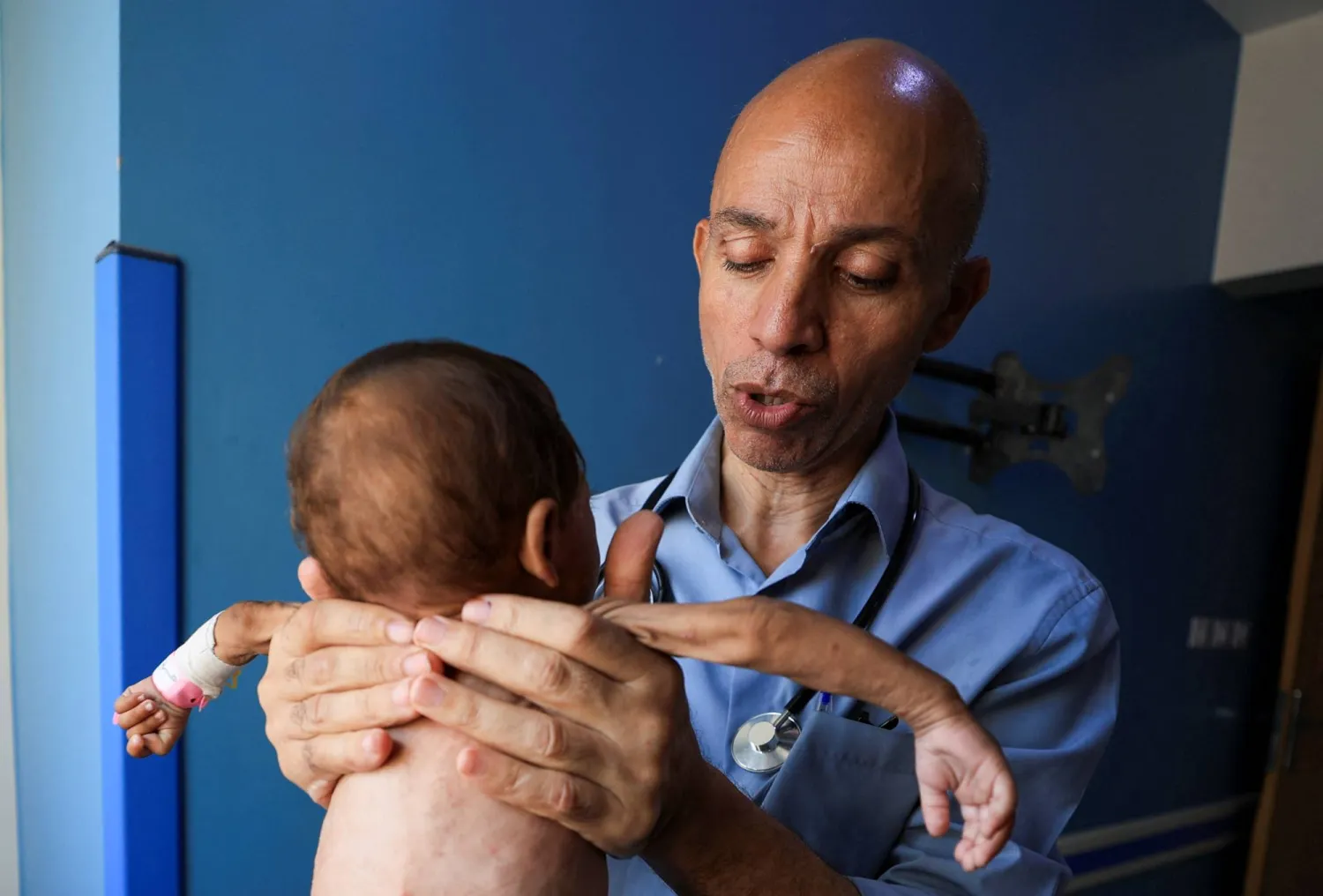

Gaza City Officially in Famine, with Hunger Spreading, Says Global Hunger Monitor

Palestinian doctor Ahmed Basal examines a child for malnutrition at Al-Rantisi Hospital in Gaza City, August 7, 2025. REUTERS/Dawoud Abu Alkas
TT

Gaza City Officially in Famine, with Hunger Spreading, Says Global Hunger Monitor

Palestinian doctor Ahmed Basal examines a child for malnutrition at Al-Rantisi Hospital in Gaza City, August 7, 2025. REUTERS/Dawoud Abu Alkas

Gaza City and surrounding areas are officially suffering from famine, and it will likely spread, a global hunger monitor determined on Friday, an assessment that will escalate pressure on Israel to allow more aid into the Palestinian territory. 

The Integrated Food Security Phase Classification (IPC) system said 514,000 people - close to a quarter of Palestinians in Gaza - are experiencing famine, with the number due to rise to 641,000 by the end of September. 

Some 280,000 of those people are in a northern region covering Gaza City - known as Gaza governorate - which the IPC said was in famine following nearly two years of war between Israel and Palestinian group Hamas. 

It was the first time the IPC has recorded famine outside of Africa, and the global group predicted that famine conditions would spread to the central and southern areas of Deir al-Balah and Khan Younis by the end of next month. 

It added that the situation further north could be even worse than in Gaza City, but that limited data prevented any precise classification. Reuters has previously reported on the IPC's struggle to get access to data required to assess the crisis. 

"It is a famine that we could have prevented had we been allowed," said UN humanitarian chief Tom Fletcher. "Yet food stacks up at borders because of systematic obstruction by Israel." 

Israel dismissed the findings as false and biased, saying the IPC had based its survey on partial data largely provided by Hamas, which did not take into account a recent influx of food. 

The report was an "outright lie", said Israeli Prime Minister Benjamin Netanyahu. 

"Israel does not have a policy of starvation," he said in a statement. "Israel has a policy of preventing starvation. Since the beginning of the war Israel has enabled 2 million tons of aid to enter the Gaza Strip, over one ton of aid per person." 

For a region to be classified as in famine at least 20% of people must be suffering extreme food shortages, with one in three children acutely malnourished and two people out of every 10,000 dying daily from starvation or malnutrition and disease. 

Previously, the IPC has only registered famines in Somalia, South Sudan and Sudan. UN Secretary-General Antonio Guterres said the Gaza famine was a "man-made disaster, a moral indictment, and a failure of humanity itself". 

He called for an immediate ceasefire, the release of all hostages still held by Hamas and unfettered humanitarian access. 

UN human rights chief Volker Turk warned that deaths from starvation could amount to a war crime. 

Turk's office said in June that "weaponization" of food for civilians in Gaza constitutes a war crime, while cautioning that a court of law would have to determine whether Israel was guilty of such a crime. Israel rejects war crimes charges in Gaza. 

DIPLOMATIC FALLOUT 

Israel controls all access to Gaza. COGAT, the arm of the Israeli military that oversees aid flows, said the IPC report ignored Israeli data on aid deliveries and was part of an international campaign aimed at denigrating Israel. 

"The IPC report is not only biased but also serves Hamas' propaganda campaign," the agency said. 

In Israel, Hebrew-language news websites highlighted the famine report on their front pages, with the liberal Haaretz focused on the severity of starvation in Gaza City, while Israel Hayom, N12 and ynet emphasized Israel's rejection of the report as biased and cited concerns over the possible diplomatic fallout. 

Underscoring those worries, Britain called the IPC report "utterly horrifying" and demanded that Israel immediately allow unhindered supplies of food, medicines and fuel. 

"The Israeli government's refusal to allow sufficient aid into Gaza has caused this man-made catastrophe. This is a moral outrage," British Foreign Secretary David Lammy said. Britain, Canada, Australia and many European states recently said the humanitarian crisis had reached "unimaginable levels". 

Israel has long counted on the US, its most powerful ally, for military aid and diplomatic support. A Reuters/Ipsos poll released this week found that 65% of Americans believe the US should help those starving in Gaza. 

An erosion of US public support would be a worrisome sign for Israel as it faces not only Hamas in Gaza but unresolved conflict with Iran, its regional arch-foe. 

US President Donald Trump last month said many people there were starving, putting him at odds with Netanyahu, who has repeatedly said there was no starvation. 

FAMINE CLASSIFICATION 

The IPC said its analysis only covered people living in Gaza, Deir al-Balah and Khan Younis governorates. It was unable to classify North Gaza governorate due to access restrictions and a lack of data and it excluded any remaining population in the southern Rafah region as it is largely uninhabited. 

The UN has complained of obstacles to delivering and distributing aid in Gaza, blaming impediments on Israel and lawlessness. Israel had criticized the UN-led operation and accuses Hamas of stealing aid, which the group denies. 

It is the fifth time in the past 14 years that a famine has been determined by the IPC - an initiative involving 21 aid groups, UN agencies and regional organizations that is funded by the European Union, Germany, Britain and Canada. 

The Gaza war was triggered on October 7, 2023, when Hamas killed 1,200 people in southern Israel and took some 250 hostages, according to Israeli tallies. Since then, Israel's military campaign has killed more than 62,000 Palestinians, according to Gaza health authorities. 

The United States, Qatar and Egypt have been trying to broker an end to the conflict. 


Moving ISIS Prisoners from Syria to Iraq Came at the Request of Baghdad, Officials Say

Local youth play atop of a damaged armored vehicle belonging to the Syrian Democratic Forces (SDF) at the site of clashes with Syrian government forces in the village of al-Hol in northeastern Syria’s Hasakeh province, Syria, Wednesday, Jan. 21, 2026. (AP Photo/Ghaith Alsayed)
TT

Moving ISIS Prisoners from Syria to Iraq Came at the Request of Baghdad, Officials Say

Local youth play atop of a damaged armored vehicle belonging to the Syrian Democratic Forces (SDF) at the site of clashes with Syrian government forces in the village of al-Hol in northeastern Syria’s Hasakeh province, Syria, Wednesday, Jan. 21, 2026. (AP Photo/Ghaith Alsayed)

The decision to move prisoners of the ISIS group from northeast Syria to detention centers in Iraq came after a request by officials in Baghdad that was welcomed by the US-led coalition and the Syrian government, officials said Thursday.

American and Iraqi officials told The Associated Press about the Iraqi request, a day after the US military said that it started transferring some of the 9,000 ISIS detainees held in more than a dozen detention centers in northeast Syria controlled by the Kurdish-led Syrian Democratic Forces, or SDF, in northeast Syria.

The move to start transferring the detainees came after Syrian government forces took control of the sprawling al-Hol camp — which houses thousands of mostly women and children — from the SDF, which withdrew as part of a ceasefire. Troops on Monday seized a prison in the northeastern town of Shaddadeh, where some ISIS detainees escaped and many were recaptured, state media reported.

The SDF said Thursday that government forces shelled al-Aqtan prison near the northern city of Raqqa with heavy weapons, while simultaneously imposing a siege around the prison using tanks and deployed fighters.

Al-Aqtan prison, where some ISIS prisoners are held, was surrounded by government forces earlier this week and negotiations were ongoing on the future of the detention facility.

With the push by government forces into northeast Syria along the border with Iraq, there have been concerns in Baghdad that some of the detainees might become danger to Iraq’s security, if they manage to flee from the detention centers amid the chaos.

An Iraqi security official said that the decision to transfer the prisoners from Syria to Iraq was an Iraqi decision, welcomed by the US-led coalition and the Syrian government. The official added that it was in Iraq’s security interest to detain them in Iraqi prisons rather than leaving them in Syria.

Also Thursday, a senior US military official confirmed to the AP that Iraq “offered proactively” to take the ISIS prisoners rather than the US requesting it of them.

Both the Iraqi and US officials spoke on condition of anonymity because they weren't authorized to comment publicly.

Over the past several years, the SDF has handed over to Iraqi authorities foreign fighters, including French citizens, who were put on trial and received sentences.

The SDF still controls more than a dozen detention facilities holding around 9,000 ISIS members, but is slated to hand the prisons over to government control under a peace process that also is supposed to eventually merge the SDF with government forces.

US Central Command said that the first transfer on Wednesday involved 150 ISIS members, who were taken from Syria’s northeastern province of Hassakeh to “secure locations” in Iraq. The statement said that up to 7,000 detainees could be transferred to Iraqi-controlled facilities.

ISIS declared a caliphate in 2014 in large parts of Syria and Iraq, attracting large numbers of fighters from around the world. The group was defeated in Iraq in 2017, and in Syria two years later, but its sleeper cells still carry out deadly attacks in both countries. The SDF played a major role in defeating ISIS.


Yemen: Coalition Steps Up Engagement with Aden’s Civil Society

Coalition to Restore Legitimacy oversees the normalization of life and improvement of services in Aden (Government Media) 
TT

Yemen: Coalition Steps Up Engagement with Aden’s Civil Society

Coalition to Restore Legitimacy oversees the normalization of life and improvement of services in Aden (Government Media) 

Amid rapidly evolving developments on the ground led by the leadership of the Coalition Forces to Restore Legitimacy in Yemen, efforts are continuing to normalize life in Aden, the country’s temporary capital, within a comprehensive vision aimed at restoring the city’s civil character and strengthening the role of the state and its service and security institutions.

Major General Falah Al-Shahrani, adviser to the Coalition Forces to Restore Legitimacy in Yemen, has intensified meetings with representatives of civil sectors, activists, and media professionals, seeking to build broad partnerships with Aden’s community and expand participation in shaping and implementing a plan to restore the city’s civil identity after years of conflict.

Alongside the daily follow-up of plans to remove military camps from Aden and restructure and integrate security units, the adviser to the joint forces is giving particular priority to basic services—especially electricity and water—viewed as a practical gateway to restoring public trust and improving living standards.

Al-Shahrani has also been holding regular meetings with journalists, activists, and community figures, listening to their views on the challenges facing the city and the aspirations of its residents in this new phase. Many hope this stage will restore Aden’s economic, cultural, and social standing as one of the oldest cities that embodied values of coexistence and openness.

Participants in these meetings stressed the importance of granting Aden’s residents a greater and more meaningful role in decision-making, noting that they had suffered marginalization in previous periods and that any successful plan to restore the city’s civil character must begin with their inclusion as direct stakeholders.

They also emphasized the need to give top priority to the education sector, describing it as the cornerstone of reconstruction and sustainable development and the primary foundation for rebuilding civic awareness and entrenching a culture of the rule of law.

Participants further called for directing support toward sustainable projects, foremost among them the rehabilitation of buildings damaged by the Houthi invasion of the city in 2015, given the direct impact of such projects on residents’ lives in terms of housing, services, and economic activity.

They noted that discussions with Al-Shahrani were marked by seriousness and transparency, reflecting the Coalition leadership’s determination to listen directly to public concerns beyond rigid official frameworks.

They affirmed that they sensed a genuine commitment and a clear vision to rebuild what the war had destroyed in Aden and other liberated provinces, in parallel with efforts to consolidate security and stability.


US Transfers ISIS Detainees from Syria to Iraq

 US soldiers at a military base north of Baghdad (Reuters – archive photo) 
 US soldiers at a military base north of Baghdad (Reuters – archive photo) 
TT

US Transfers ISIS Detainees from Syria to Iraq

 US soldiers at a military base north of Baghdad (Reuters – archive photo) 
 US soldiers at a military base north of Baghdad (Reuters – archive photo) 

US Central Command has launched a new operation to transfer ISIS detainees from northeastern Syria to Iraq, aiming to ensure that they remain in secure detention facilities and to reduce the risk of instability.

The operation began with the transfer of 150 ISIS militants from a detention facility in Hasakah, Syria, to a secure site in Iraq. US officials say the number of detainees moved from Syria to Iraqi-controlled prisons could eventually reach about 7,000.

Admiral Brad Cooper, the head of US Central Command, said: “We are closely coordinating with regional partners, including the Iraqi government, and we sincerely appreciate their role in ensuring the enduring defeat of ISIS.

“Facilitating the orderly and secure transfer of ISIS detainees is critical to preventing a breakout that would pose a direct threat to the United States and regional security.”

According to Reuters, the move follows the rapid collapse of the Kurdish-led Syrian Democratic Forces in northeastern Syria, which raised doubts about the security of roughly a dozen prisons and detention camps previously guarded by the group.

US officials also discussed the situation with Syrian President Ahmed al-Sharaa, focusing on ongoing tensions in Syria, the need for government forces to respect ceasefire arrangements with the Syrian Democratic Forces, and support for the coordinated transfer of ISIS detainees to Iraq.

The US side outlined plans to relocate thousands of detainees in a controlled manner and urged all parties to avoid actions that could disrupt the process.

An Iraqi official told Asharq Al-Awsat that the transfer would help ease growing concerns about possible escapes. He added that holding the detainees in prisons supervised by the Iraqi government, in direct coordination with the United States, would significantly reduce the chances of ISIS rebuilding its capabilities.

Syrian media reported that security forces recently arrested 90 group members who had escaped from al-Shaddadi prison south of Hasakah. The Syrian army later announced it had taken control of the city, imposed a curfew, and launched operations to secure the area and capture fugitives.

Recent government advances, combined with what appears to be a reduction in US support for the SDF, mark the most significant shift in territorial control since the fall of Bashar al-Assad 13 months ago.

The United States said this week that the main objectives of its partnership with the SDF have largely been achieved after years of fighting ISIS.
