


Allies, NGOs Condemn Israel Strike on Gaza Hospital

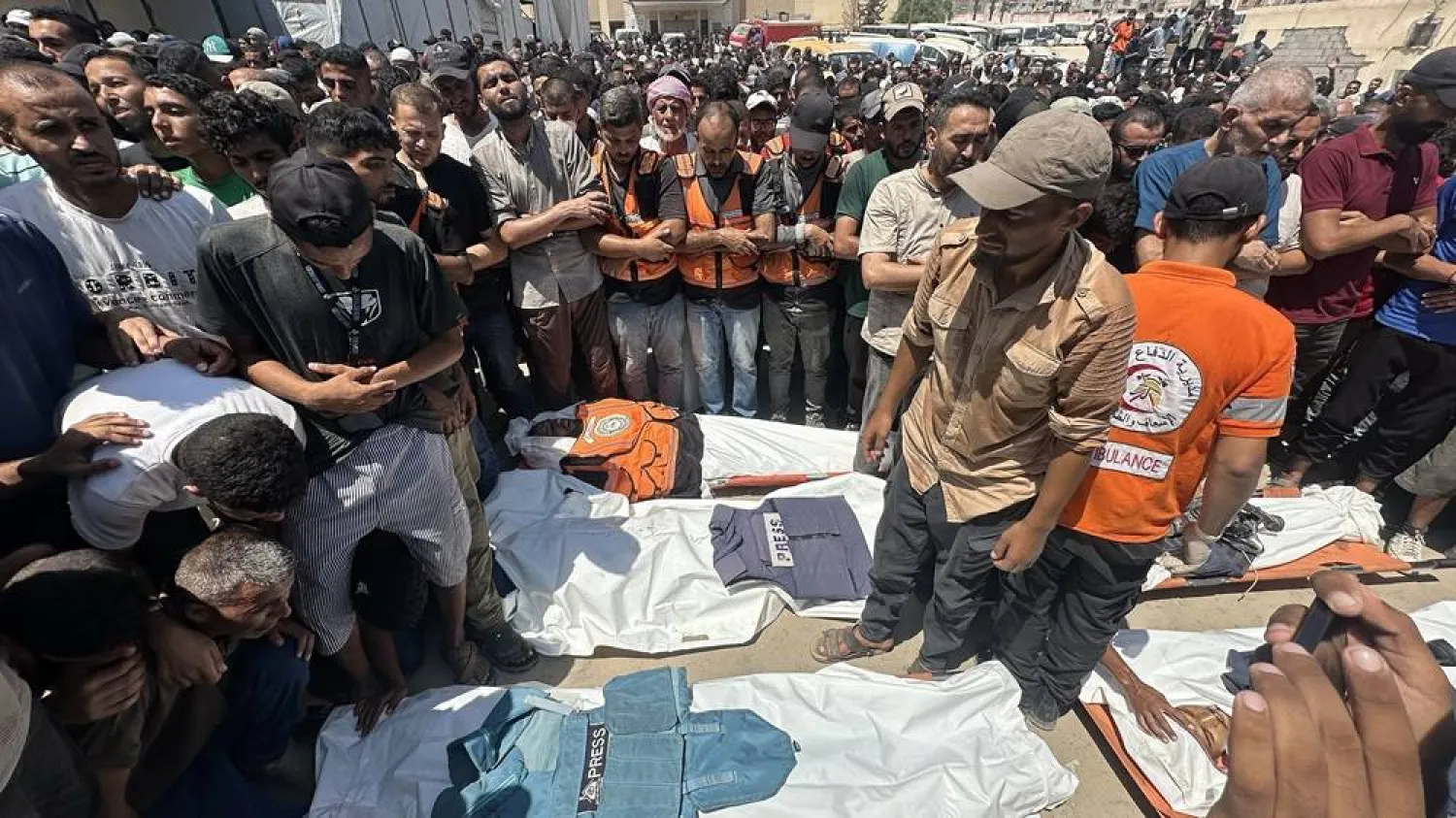
People pray in front of the bodies of Palestinians killed in an Israeli airstrike at Nasser Hospital in Khan Younis, southern Gaza Strip, 25 August 2025.
TT

Allies, NGOs Condemn Israel Strike on Gaza Hospital

People pray in front of the bodies of Palestinians killed in an Israeli airstrike at Nasser Hospital in Khan Younis, southern Gaza Strip, 25 August 2025.

World powers voiced shock at the killing of five journalists among 20 victims reported by Gaza's civil defense agency in an Israeli strike on a hospital on Monday.  

The Israeli military said it would investigate the strike in the area of Nasser Hospital, in the southern town of Khan Younis, adding that it "regrets any harm to uninvolved individuals and does not target journalists as such".  

Here is a roundup of world reactions so far.  

United Nations Secretary-General Antonio Guterres strongly condemns the killing of Palestinians in Israeli strikes that hit Nasser hospital in Gaza and calls for a prompt, impartial investigation, spokesperson Stephane Dujarric said on Monday. 

"The Secretary-General recalls that civilians, including medical personnel and journalists, must be respected and protected at all times. He calls for a prompt, impartial investigation into these killings," Dujarric told reporters. 

UN rights office spokeswoman Ravina Shamdasani said in a statement that journalists and hospitals should never be targeted. 

"The killing of journalists in Gaza should shock the world -- not into stunned silence but into action, demanding accountability and justice."  

The head of the UN's agency for Palestinian affairs UNRWA, Philippe Lazzarini, described the strike as "silencing the last remaining voices reporting about children dying silently amid famine", in a post on X.  

Questioned by reporters at the White House, US President Donald Trump said he had not yet received news of the strike but added: "I'm not happy about it. I don't want to see it." 

He said, "at the same time, we have to end that whole nightmare" in Gaza, where the Hamas group is holding hostages seized in Israel.  

In Israel's staunch European ally Germany, the foreign ministry said it was "shocked by the killing of several journalists, rescue workers, and other civilians" in the Nasser Hospital strike.  

"This attack must be investigated," the ministry said on X, also calling on Israel to "allow immediate independent foreign media access and afford protection for journalists operating in Gaza".  

UK foreign minister David Lammy said he was "horrified" by the hospital strike.  

"Civilians, healthcare workers and journalists must be protected. We need an immediate ceasefire," Lammy wrote on X.  

In Qatar, which has been trying to mediate a halt to the fighting in Gaza, the foreign ministry condemned the strike as "a new episode in the ongoing series of heinous crimes" by Israel. 

"The occupation's approach of targeting journalists and relief and medical workers requires urgent and decisive international action to provide the necessary protection for civilians and ensure that the perpetrators of these atrocities do not escape punishment," it said in a statement.  

Medical aid charity Doctors Without Borders (MSF) said it was "heartbroken" by the death in the strike of a freelance photographer who had previously worked for it, Mariam Abu Dagga.  

"As Israel continues to shun international law, the only witnesses of their genocidal campaign are deliberately being targeted. It must stop now," it said. 

The Foreign Press Association called for an "immediate explanation" from the Israeli military and prime minister's office.  

"We call on Israel once and for all to halt its abhorrent practice of targeting journalists," the group said in a statement. 


Palestinian Authority Condemns East Jerusalem Evictions

A Palestinian man (R) watch a settler family walks past a group of Israeli police officers as 11 Palestinian families in the Batan al-Hawa area of Silwan are evicted to make room for Israeli settlers, in the predominantly Arab neighbourhood of Silwan, in East Jerusalem on March 25, 2026. (Photo by Odd ANDERSEN / AFP)
TT

Palestinian Authority Condemns East Jerusalem Evictions

A Palestinian man (R) watch a settler family walks past a group of Israeli police officers as 11 Palestinian families in the Batan al-Hawa area of Silwan are evicted to make room for Israeli settlers, in the predominantly Arab neighbourhood of Silwan, in East Jerusalem on March 25, 2026. (Photo by Odd ANDERSEN / AFP)

The Palestinian Authority has condemned the recent eviction of multiple families from their homes in east Jerusalem and urged the international community to take "firm measures" to halt the displacements.

Several families were removed from their homes in the neighborhood of Silwan in Israeli-annexed east Jerusalem on Wednesday, AFP journalists saw.

Silwan has for decades been the target of a policy allowing Jews who lost property before the establishment of Israel in 1948 to reclaim it.

Israeli rights group B'Tselem said the evictions were the start of "a large wave of displacement affecting around 2,200 people" and were part of a policy aimed at "Judaizing the neighborhood".

In a statement released late on Friday by official news agency WAFA, the PA's foreign ministry "condemned the escalation by Israeli occupation authorities of forced eviction measures".

It said 15 families had been evicted from the hilltop neighborhood south of Jerusalem's Old City.

It also called on the international community to take "firm and more decisive steps to prevent the continuation of forced displacement against the Palestinian people".

Israeli authorities have evicted many Palestinian families from the area in recent years, while further families await the enforcement of eviction orders.

Hundreds of settlers, whose presence is illegal under international law, live among around 50,000 Palestinians in Silwan.

Their presence in the neighborhood dates back to the 1980s.

Israel captured east Jerusalem in 1967, later annexing it and declaring it part of its undivided capital, a move not recognized by the UN or most of the international community.

Palestinians aspire to make it the capital of a future Palestinian state.


Palestinian Brothers Killed in Israeli Strike on Gaza

Mourners react during the funeral of Palestinians killed in an Israeli strike, according to medics, in Gaza City, March 28, 2026. REUTERS/Dawoud Abu Alkas
TT

Palestinian Brothers Killed in Israeli Strike on Gaza

Mourners react during the funeral of Palestinians killed in an Israeli strike, according to medics, in Gaza City, March 28, 2026. REUTERS/Dawoud Abu Alkas

An Israeli airstrike killed two Palestinian brothers Saturday morning in the Gaza Strip, hospital authorities said.

The strike hit the men close to the Showa roundabout in Gaza City’s Shijaiyah neighborhood, according to the Al-Ahly hospital.

The area is close to the so-called Yellow Line which separates Israeli-controlled areas across the Gaza Strip from the rest of the enclave.

Israel’s military did not immediately respond to a request for comment.


Israel, Hezbollah Brace for Prolonged Fighting in South Lebanon

An Israeli soldier directs a tank near the Lebanese border (Reuters)
TT

Israel, Hezbollah Brace for Prolonged Fighting in South Lebanon

An Israeli soldier directs a tank near the Lebanese border (Reuters)

Hezbollah is preparing for a prolonged fight in south Lebanon and is insisting on an Israeli withdrawal from Lebanese territory before any ceasefire takes effect, to avoid a repeat of the last war’s outcome, Lebanese sources following the group’s talks with officials said.

Continued Israeli troop build-ups suggest the Israeli army is also bracing for a long battle.

Information in Lebanon on fighters targeted in airstrikes, reinforced by Israeli footage of operations in combat zones, points to a shift in Hezbollah’s military approach.

The group has reduced combat units to two or three fighters to limit attrition and granted field units authority to act independently, based on battlefield conditions.

Sources said Hezbollah is preparing for a long war and will not accept any political deal that does not guarantee an Israeli withdrawal before a ceasefire begins, to prevent Israel from using any pause to destroy more homes or entrench military positions inside Lebanon.

The group is telling officials its fighters will continue to resist Israeli incursions until a full withdrawal, however long that takes. Any political agreement, the sources said, would also ensure the return of prisoners, whose numbers have risen since the war began, and allow displaced residents to return to their homes.

Talks suspended

The leaks indicate Hezbollah has raised its conditions ahead of any potential agreement, although there are currently no negotiations or exchanged messages with Israel through any international mediator, the sources said.

Israel has also raised its demands, seeking political negotiations with the Lebanese state while fighting continues and while it holds Lebanese territory.

These demands are coupled with steps by the Lebanese government to disarm Hezbollah, secure northern Israel fully and eliminate any threat, diplomatic sources told Asharq Al-Awsat.

The stance mirrors Israeli statements. The Israeli military said, “If the Lebanese government does not disarm Hezbollah, we will do it.”

A UN official warned of “increasingly alarming rhetoric” from Israeli authorities and the military regarding southern Lebanon, adding that what is needed is full respect for Lebanon’s sovereignty and territorial integrity.

Advance of 10 kilometers

Israeli forces have made what is seen as a strategic advance along Lebanon’s coast, pushing nearly 10 kilometers from the border southwest of Naqoura toward Bayyada, about 12 kilometers from the coastal city of Tyre.

Local sources said progress on this axis has been relatively smooth, as Hezbollah’s defenses are positioned farther east, along the route the Israeli army would take to reach Shama and Tayr Harfa and seize the surrounding high ground.

That would allow it to overlook the valleys of Zibqin and Majdal Zoun, an area it failed to enter in the last war despite controlling Shama.

Elsewhere, Israeli forces have advanced further in Qantara, nearing the edges of Wadi al-Hujair, a strategic valley that marked Israel’s last point of control before its withdrawal from south Lebanon in 2000. Reaching it would cut Hezbollah's supply lines from the valley and the Litani River toward the interior.

In response, Hezbollah said it carried out a series of attacks targeting Israeli tanks and troop concentrations, and released images showing armored vehicles hit in Deir Siryan and Taybeh with guided missiles and drones. The group said its fighters were engaging Israeli forces at point-blank range in some areas of incursion and inside village neighborhoods.

The number of operations on Thursday reached nearly 90, announced in separate statements, the highest since the war began on Oct. 8, 2024, signaling a sharp escalation.

Israel now fully controls 11 villages across the first, second and third lines along the border.

At the same time, Israeli airstrikes hit the Zahrani area, causing casualties in Sarafand and Saksakiyeh.

Strikes also targeted Bazaliyah in the Bekaa in eastern Lebanon, as well as dozens of villages in the districts of Tyre, Nabatieh, Bint Jbeil, Marjayoun and Jezzine, in addition to attacks on Beirut’s southern suburbs.

Warnings over the humanitarian situation

On the humanitarian front, Karolina Lindholm Billing, UNHCR Representative in Lebanon, said about 150,000 people have been cut off after bridges over the Litani River were destroyed.

The situation remains deeply alarming, and there is a real risk of a humanitarian catastrophe, she said.

Marcoluigi Corsi, UNICEF Representative in Lebanon, said at a Friday press conference that displaced people in Lebanon are unable to find safe shelter even in the capital, Beirut, amid the Israeli offensive against Hezbollah.
