
Protesters in Israel Demand Release of Hostages as Israeli Strikes Kill 16 in Gaza, Hospitals Say

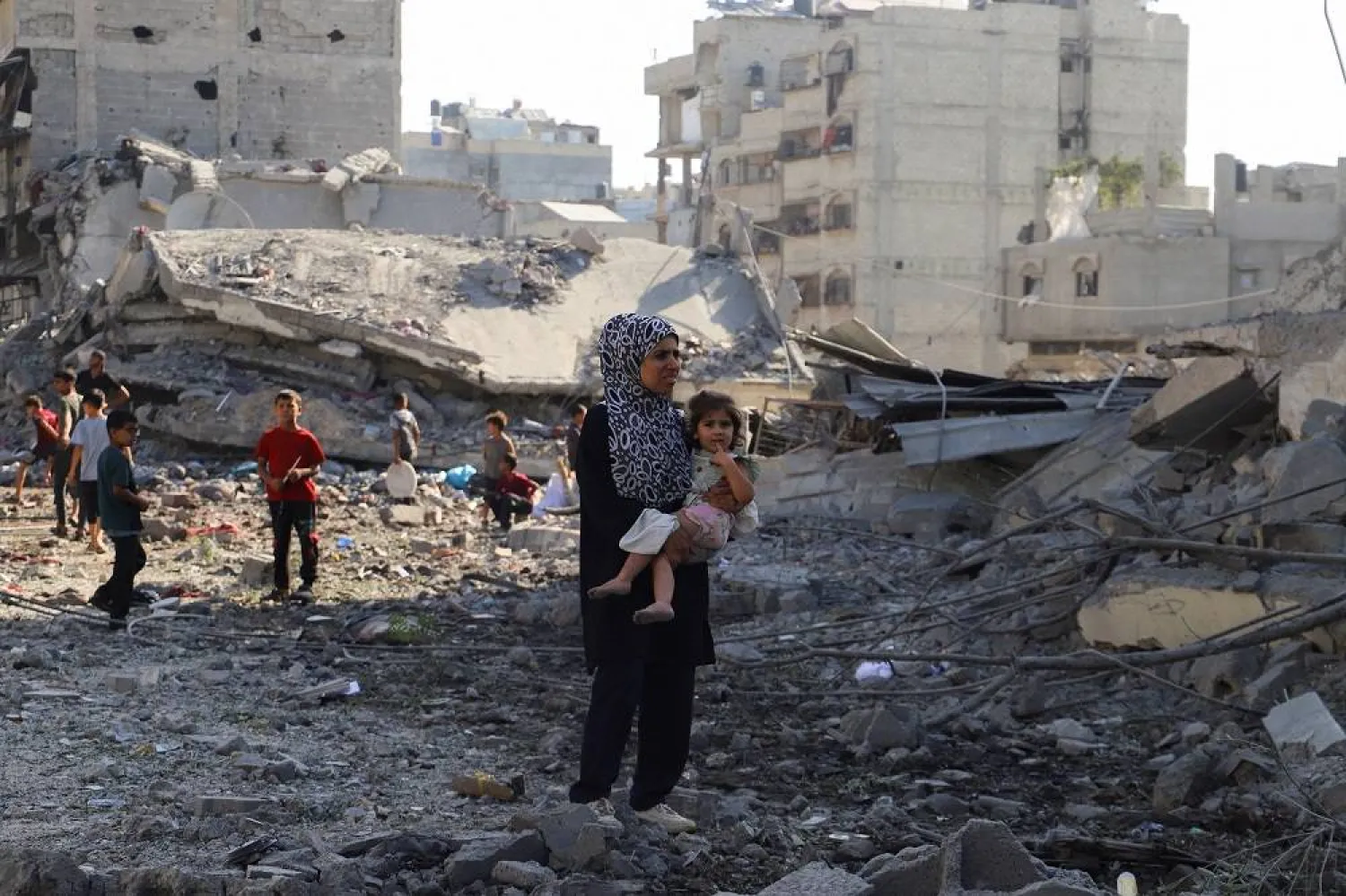
A Palestinian woman carries a child, as they inspect the site of an overnight Israeli strike on a house, in Gaza City, August 26, 2025. (Reuters) 
TT

Protesters in Israel Demand Release of Hostages as Israeli Strikes Kill 16 in Gaza, Hospitals Say

A Palestinian woman carries a child, as they inspect the site of an overnight Israeli strike on a house, in Gaza City, August 26, 2025. (Reuters) 

Protesters in Israel on Tuesday torched tires, blocked highways and clamored for a ceasefire that would free hostages still in Gaza, even as Israeli leaders moved forward with plans for an offensive which they argue is needed to defeat Hamas. 

The disruption came as Palestinians in Gaza braced for the expanded offensive against a backdrop of displacement, destruction and parts of the territory plunging into famine. It also followed deadly strikes a day earlier on Gaza’s main hospital which killed 20 people including medics and journalists. Among them was Mariam Dagga, a journalist who worked for The Associated Press. 

Prime Minister Benjamin Netanyahu was expected to convene a security cabinet meeting later Tuesday. However, the government said the meeting will not include discussion of ceasefire talks, according to an official with knowledge of the situation. The official, who spoke on the condition of anonymity because they were not authorized to speak on the matter, said there was a delegation from Egypt in Israel on Monday and they discussed the negotiations. 

Netanyahu has said that Israel will launch an expanded offensive in Gaza City while simultaneously pursuing a ceasefire, though Israel has yet to send a negotiating team to discuss a proposal on the table. Netanyahu has said the offensive is the best way to weaken Hamas and return hostages, but hostage families and their supporters have pushed back. 

"Go back to the negotiation table. There’s a good deal on the table. It’s something we can work with," said Ruby Chen, the father of 21-year-old Itay Chen, a dual Israeli-American citizen whose body is being held in Gaza. "We could get a deal done to bring all the hostages back." 

Hamas captured 251 hostages on Oct. 7, 2023, in the attack that triggered the current war. Most have been released during previous ceasefires. Israel has managed to rescue only eight hostages alive. Fifty remain in Gaza, and Israeli officials believe around 20 are still alive. 

Responding to a call from Israel’s Hostages and Missing Families Forum for a "National Day of Struggle," protesters waved banners that read "Hostage Deal Now." The relatives of hostages said they hope sustained public pressure can push Netanyahu and his security cabinet to commit to meaningful ceasefire talks. However far-right members of his coalition have threatened to resign if Israel agrees to a truce, dismissing the protesters’ demands. 

Israeli strikes continue after deadly hospital attack 

Calls for a ceasefire came a day after Israel struck southern Gaza’s main hospital, killing at least five journalists and 15 others, including Dagga, who had covered doctors treating children for starvation at the same facility days before. 

The strike, among the deadliest of the war against both journalists and hospitals, sparked shock and outrage among press freedom advocates and Palestinians, who mourned the dead at funerals on Monday. 

It was swiftly condemned across the globe. Netanyahu called it a "tragic mishap" and said the military would investigate. 

Most of those killed died after rushing to the scene of the first blast, only to be hit by a second strike — an attack captured on television by several networks. 

The southern Gaza strike came as Israel prepares to expand its offensive into densely populated areas of northern Gaza. Israel's military wants people in hospitals, displacement camps and Gaza City neighborhoods to evacuate southward to so-called safe zones so it can destroy Hamas and prevent attacks like the Oct. 7, 2023, assault that killed about 1,200 people and triggered the war. 

A day after the strike, Israeli strikes killed at least 16 Palestinians on Tuesday, hospitals said. 

Officials from Nasser Hospital, Shifa Hospital and Gaza City's Sheikh Radwan clinic reported that among the 16 were families, women and children. 

Gaza's Health Ministry also said on Tuesday that three more adults died of causes related to malnutrition and starvation, bringing the malnutrition-related death toll to 186 since late June, when the ministry started to count fatalities among this age category. The toll includes 117 children since the start of the war. 

Israel’s military offensive has killed 62,819, according to Gaza’s Health Ministry, which does not say how many were fighters or civilians but says around half were women and children. The ministry is part of the Hamas-run government and staffed by medical professionals. The UN and independent experts consider it the most reliable source on war casualties. Israel disputes its figures but has not provided its own. 

Israeli forces raid downtown Ramallah  

Lines of Israeli military vehicles entered downtown Ramallah on Tuesday afternoon in a rare daytime raid on one of the largest Palestinian cities in the Israeli-occupied West Bank. 

The Israeli military acknowledged an ongoing operation in the city but would not provide any information about the purpose of the raid. 

Ramallah is the headquarters of the Palestinian Authority, which has been largely sidelined since the start of the war. The city has faced similar raids before, including in May when Israeli forces targeted money transfer businesses there and in other Palestinian cities, alleging they had ties to armed groups. 

The Palestinian Red Crescent said there were 58 injuries during the raid, including injuries from live fire, rubber bullets, tear gas inhalation, and "live bullet shrapnel." Israeli armored vehicles entered a busy downtown intersection in the city, stopping traffic. A few dozen people attempted to throw rocks at the military vehicles. 

The war in Gaza has sparked a surge of violence in the West Bank, with the Israeli military carrying out large-scale operations targeting gunmen that have killed hundreds of Palestinians and displaced tens of thousands. That has coincided with a rise in settler violence and Palestinian attacks on Israelis. 

There have been more than 1,000 attacks by Israeli settlers throughout 2025, with 11 Palestinians killed and roughly 700 injured, according to the United Nations Office for the Coordination of Humanitarian Affairs. 


Syrian Army on Alert after SDF Armed Groups Detected East of Aleppo

People walk down a street as a car drives by following a ceasefire which ended days of fighting between Syrian security forces and Kurdish fighters in the Kurdish-majority Sheikh Maqsoud neighborhood, of the northern city of Aleppo on January 11, 2026. (AFP)
TT

Syrian Army on Alert after SDF Armed Groups Detected East of Aleppo

People walk down a street as a car drives by following a ceasefire which ended days of fighting between Syrian security forces and Kurdish fighters in the Kurdish-majority Sheikh Maqsoud neighborhood, of the northern city of Aleppo on January 11, 2026. (AFP)

The Syrian army went on alert on Sunday after detecting armed groups aligned with the Syrian Democratic Forces (SDF) east of Aleppo city.

In statements to the SANA state news agency, the Operations Command said that the nature and objectives of these military reinforcements and troop concentrations brought by the SDF to eastern Aleppo have not yet been identified.

The Command added that Syrian army forces have been placed on full alert, deployment lines east of Aleppo have been reinforced, and all necessary measures have been taken to be ready for all possible scenarios.

First responders on Sunday entered a contested neighborhood in the northern city of Aleppo after days of deadly clashes between government forces and Kurdish-led forces. Syrian state media said the military was deployed in large numbers.

The clashes broke out Tuesday in the predominantly Kurdish neighborhoods of Sheikh Maqsoud, Achrafieh and Bani Zaid after the government and the SDF, the main Kurdish-led force in the country, failed to make progress on how to merge the SDF into the national army. Security forces captured Achrafieh and Bani Zaid.

The fighting between the two sides was the most intense since the fall of then-President Bashar Assad to opposition groups in December 2024. At least 23 people were killed in five days of clashes and more than 140,000 were displaced amid shelling and drone strikes.

The Kurdish fighters have now evacuated from the Sheikh Maqsoud neighborhood to northeastern Syria, which is under the control of the SDF.

However, they said in a statement they will continue to fight now that the wounded and civilians have been evacuated, in what they called a “partial ceasefire.”


Hadhramaut Governor to Asharq Al-Awsat: Saudi Stance Was Decisive, Situation Is Calm

Governor of Yemen's Hadhramaut governorate Salem al-Khanbashi. (Asharq Al-Awsat)
TT

Hadhramaut Governor to Asharq Al-Awsat: Saudi Stance Was Decisive, Situation Is Calm

Governor of Yemen's Hadhramaut governorate Salem al-Khanbashi. (Asharq Al-Awsat)

Governor of Yemen's Hadhramaut Salem al-Khanbashi stressed that the situation in the governorate was returning to normal in wake of the recent developments and withdrawal of the Southern Transitional Council (STC) forces.

In remarks to Asharq Al-Awsat from his office in Mukalla, he said: "The general situation is calm and stable. Work is underway to resume operations at various public administrations."

"Security measures have also been intensified, especially over the possession of weapons," he added.

He revealed that several suspects involved in looting and the possession of heavy weapons have been arrested.

"Life is gradually returning back to normal and the situation will improve," he stressed.

On Saudi Arabia's role, Khanbashi credited the Kingdom with helping move forward the issue of the STC withdrawal from Hadhramaut in record time.

Coordination with the Kingdom continues, he added.

He also noted that a meeting was held with senior Hadhramaut officials with leaders of the "Hadhramaut elite brigades" to discuss returning the forces to their former military positions.

Coordination with Saudi Arabia is at a "very high level", he revealed. Hadhramaut has received pledges from senior Saudi officials that major projects will be implemented in the governorate to develop infrastructure.

On restructuring the local authority, Khanbashi stressed: "Measures have been taken against officials who had openly expressed their support to the STC or who had taken contentious political positions."

Commenting on the conference Riyadh will be hosting on the southern issue, he said the Hadhramaut leadership has met with several members of the Hadhramaut National Council to discuss the issue.

The details of the talks and mechanism to choose representatives have not taken shape yet, he told Asharq Al-Awsat.

Expanded meetings with various political and social figures will be held in the governorate in the coming days with the aim of coming up with a unified vision that represents Hadhramaut at the conference, he added.

He noted the historic differences that exist between Hadhramaut and other southern governorates that should be taken into consideration and discussed.

On the issue of the Hadhramaut airports, he said the Riyan Airport is ready and expected to resume operations in the next two days.


Yemen's Al-Alimi Urges Limiting Possession of Weapons to State to Focus on Confronting Houthis

Chairman of Yemen's Presidential Leadership Council (PLC) Dr. Rashad al-Alimi. (Saba)
TT

Yemen's Al-Alimi Urges Limiting Possession of Weapons to State to Focus on Confronting Houthis

Chairman of Yemen's Presidential Leadership Council (PLC) Dr. Rashad al-Alimi. (Saba)

Chairman of Yemen's Presidential Leadership Council (PLC) Dr. Rashad al-Alimi said on Sunday that his country has entered a new decisive phase in restoring state institutions and ending armed coups.

The process of handing over military camps in Hadhramaut and al-Mahra governorates to legitimate authorities is a step towards imposing state monopoly over weapons, he added.

He made his remarks during a meeting in Riyadh with British Ambassador to Yemen is Abda Sharif.

The formation of a supreme military council will help unify all armed forces and military and security formations under the defense and interior ministries, al-Alimi went on to say.

The formation of the committee sends a message that the state has not veered off its national priorities and that the process to hand over military camps was the right call in protecting the internal front, he stressed.

The move aims to protect the internal front and focus state efforts in confronting the Iran-backed Houthi coup either through peaceful means or war, he added.

He discussed with Sharif the latest local developments and efforts to restore order in the liberated governorates.

He hailed the positive role the UK has played in supporting Yemen's unity and legitimate authorities, as well as peace and humanitarian efforts.

Moreover, al-Alimi described as "brave" the Southern Transitional Council's decision to dissolve itself.

It marked a "pivotal moment that reflects a realization of the sensitivity of the current phase and the danger of sliding into internal conflicts that would weaken the internal front against the confrontation against the real threat," he said.

The next phase demands that all national, civilian and military forces align with the state and legitimate authorities and the rule of law, he demanded.

Al-Alimi also highlighted Saudi Arabia's central role in easing the escalation and sponsoring intra-southern Yemen dialogue. This is an extension of its economic and humanitarian support to Yemen.