
American diplomatic activity toward Damascus is accelerating ahead of the United Nations General Assembly in New York in September where Syrian interim President Ahmed al-Sharaa is expected to participate.
Washington is seeking a breakthrough in the Middle East by advancing security understandings between Israel and Syria, coupled with the easing of US economic sanctions and renewed momentum to lift the Caesar Act restrictions. These efforts, however, face complications from ongoing tensions in northeastern Syria and the unrest in Sweida.
Syrian officials remain firm on the central issue of sovereignty. Qutaiba Idlbi, director of US affairs at the Syrian Foreign Ministry, stated that there is no space for solutions that undermine the authority of the Syrian state or pave the way to division.
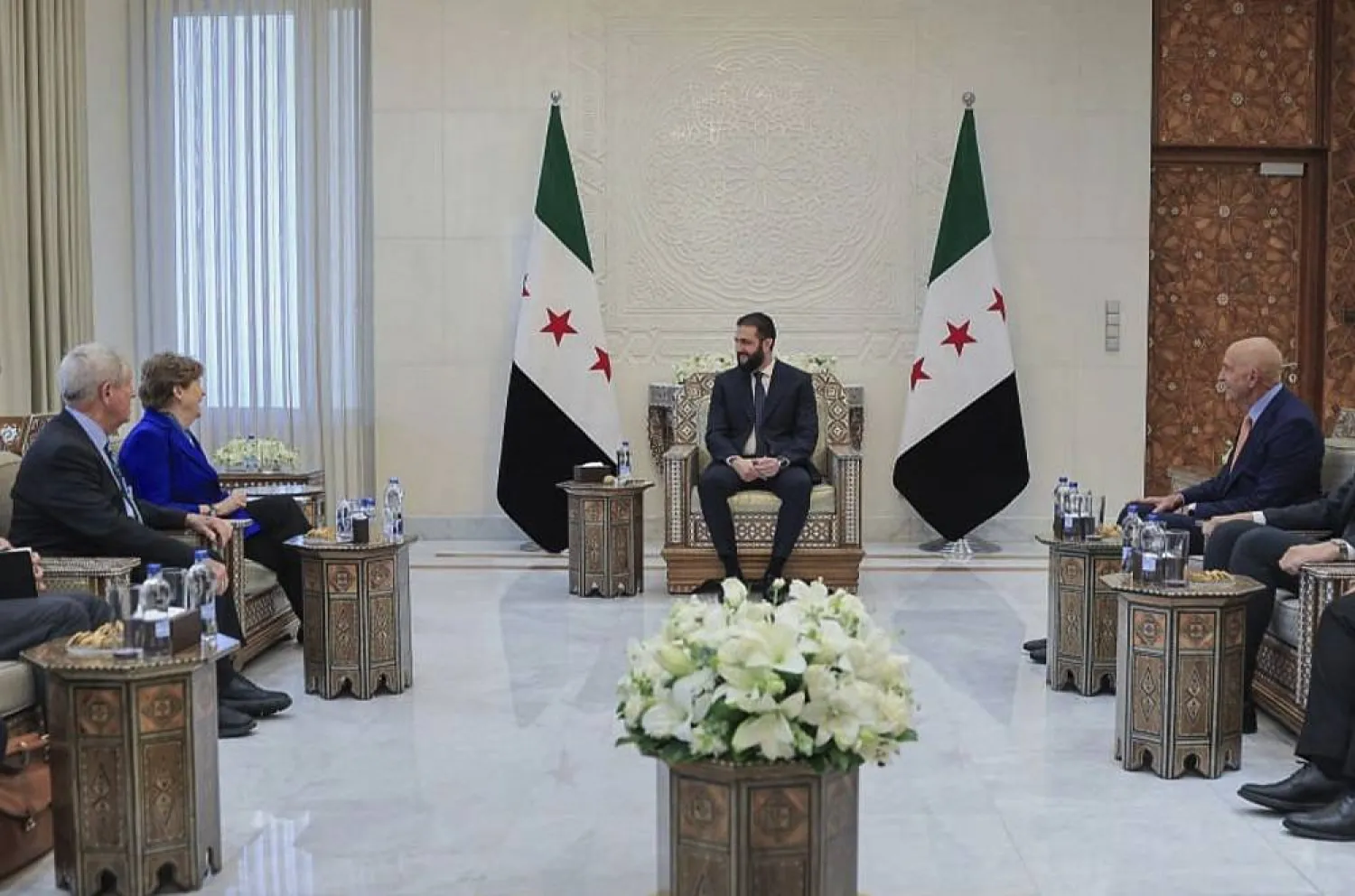
Sharaa met in Damascus with US Senator Jeanne Shaheen of New Hampshire, Rep. Joe Wilson of South Carolina, and US Special Envoy Tom Barrack. The American delegation pushed for progress on security arrangements between Syria and Israel, amid reports of advanced negotiations.
The visit coincided with Druze leader Hikmat al-Hijri escalating his demands in Sweida, moving from calls for humanitarian corridors to openly calling for separating the region from Syria.
Following the talks, Idlbi told Asharq Al-Awsat that discussions with international partners were aimed primarily at reducing tensions in southern Syria, reaffirming the 1974 disengagement agreement, and preventing violations of Syrian sovereignty.
On the humanitarian front, he noted that aid flows exclusively through Damascus, highlighting that the government had responded to requests from residents of the Israeli-occupied Golan to send assistance to families in Sweida, which he described as a sovereign matter that does not concern foreign parties.
Barrack, for his part, underlined that a united, stable, and prosperous Syria requires broad-based representation. He pointed to bipartisan support from Shaheen and Wilson as evidence of Washington’s commitment to this goal, and stressed that dialogue, not violence, is the path to resolving differences.
On the issue of decentralization, Idlbi reaffirmed Syria’s position that reforms to local administration are possible, but only under the authority of the state and in ways that enhance national unity.
Syria is committed to the continuous development of local governance to allow wider citizen participation, but solely within the framework of Syrian institutions, he stressed.
The Washington Post reported that Barrack urged Syrians to consider alternatives to an overly centralized system in light of Sweida’s unrest. He suggested a model short of federalism that would allow diverse communities to preserve their identities, cultures, and languages while avoiding ideological or sectarian extremism.
Sanctions eased
In a related development, the US Treasury removed Syria’s name from certain federal sanctions lists.
Damascus welcomed the move as a positive step that coincided with the congressional delegation’s visit, interpreting it as an indication of a possible new chapter in bilateral relations built on mutual respect and constructive dialogue.
Idlbi confirmed that sanctions and economic measures were raised during the talks. Damascus stressed that such restrictions are illegal, represent a direct burden on the Syrian people, and that lifting them is the natural starting point for any credible process toward stability.
The Caesar Act remains the central obstacle to Syria’s reconstruction. Congress is expected to debate its future after the summer recess.
During his visit to Damascus, Wilson argued that the time had come for the full repeal of the law, calling it a priority for the administration of President Donald Trump.
He reiterated his commitment to this bipartisan objective, maintaining that Syria’s unity, stability, and prosperity depend on representation that includes all segments of society.