


Lebanon: Hezbollah Ban Faces Legal, Security Test

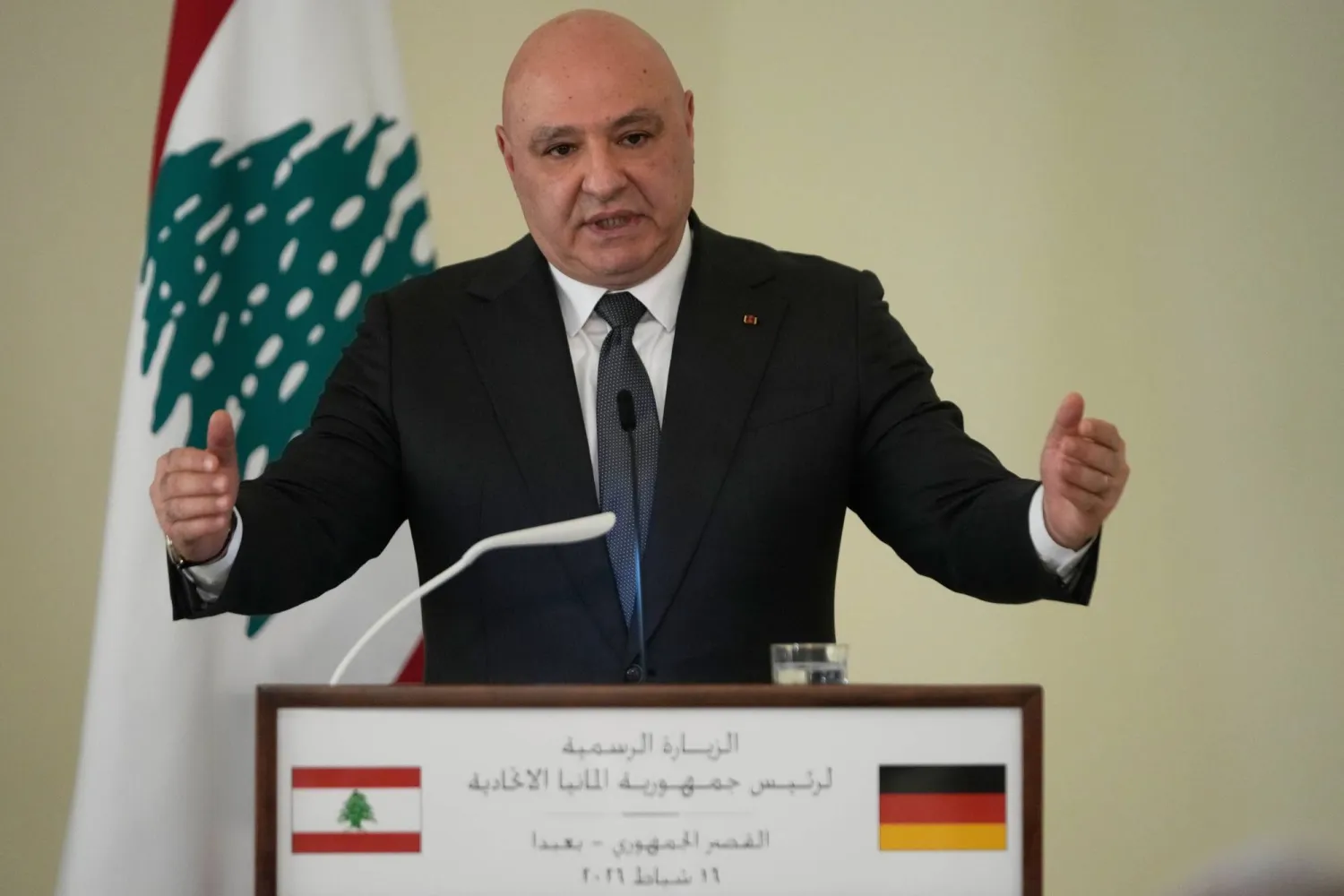
Lebanese President Joseph Aoun speaks during a joint press conference with his German counterpart Frank-Walter Steinmeier, not pictured, at the presidential palace in Baabda, east of Beirut, Lebanon, Monday, Feb. 16, 2026. (AP Photo/Hussein Malla)
TT

Lebanon: Hezbollah Ban Faces Legal, Security Test

Lebanese President Joseph Aoun speaks during a joint press conference with his German counterpart Frank-Walter Steinmeier, not pictured, at the presidential palace in Baabda, east of Beirut, Lebanon, Monday, Feb. 16, 2026. (AP Photo/Hussein Malla)

Lebanon’s government has entered a decisive test phase after banning the military and security activities of Hezbollah, a move President Joseph Aoun on Tuesday described as “sovereign and final, with no turning back,” despite open rejection from the group and rising domestic pressure for swift enforcement.

Aoun said the Lebanese army and security forces had been tasked with implementing the decision across all Lebanese territory. The judiciary has begun pursuing those responsible for launching rockets from Lebanon.

Calls are mounting for the move to go further, extending to everything linked to Hezbollah militarily, politically and financially.

Israel announced on Tuesday "broad-scale strikes" against Hezbollah after the group fired missiles on Israel to avenge the killing of Iran’s supreme leader Ali Khamenei during US-Israeli strikes on Saturday.

Ministerial sources said implementation of the decision targeting Hezbollah’s military wing is underway, adding that enforcement now covers all armed manifestations of any kind across Lebanon. Previous discussions had focused only on areas south and north of the Litani River.

A judicial source told Asharq Al-Awsat that authorities had identified the missile launch site, specifically north of the Litani, and were tracking those behind the attack. Their names and identities have not yet been determined, the source said, although their affiliation is known.

Hezbollah rejected what it called the government’s “reckless decision.”

The head of its parliamentary bloc, MP Mohammed Raad, in a statement issued hours after reports indicated he had been assassinated in an Israeli strike on Monday, described it as a “decision to ban the rejection of aggression,” accusing the government of failing to carry out the “decision of war and peace.”

Criminal prosecutions and administrative action

Constitutional expert Dr. Saeed Malek said the government’s move “does not become fully effective unless followed by implementing decrees and measures issued by the competent ministries.”

Declaring a ban, he said, effectively places the party’s military and security wings outside the law, with all the consequences that entails.

Malek told Asharq Al-Awsat that the decision requires immediate criminal prosecutions before the Public Prosecutor at the Court of Cassation on charges including crimes against state security, forming an association aimed at undermining state authority, membership in an illegal armed organization, possession of military weapons without a license, and exposing Lebanon to hostile acts outside state authority.

These steps could lead to arrest warrants, travel bans and precautionary measures in line with legal procedures.

He said the move also requires administrative action by the Interior Ministry, including dissolving and closing headquarters and offices affiliated with the military and security wings, withdrawing licenses from linked associations and bodies, revoking the legal status of entities operating for their benefit directly or indirectly, and banning any related organizational activity under any name.

Administrative, political and financial impact

Implementation extends to the administrative and political spheres, Malek said, by treating affiliation with wings deemed outside the law as a legal obstacle to holding public office, running for elections or occupying ministerial and administrative posts, subject to due judicial process.

Financially, he said, it requires assigning Banque du Liban and the Special Investigation Commission to freeze accounts and assets, block any direct or indirect financing, subject linked individuals to special financial scrutiny when illicit funding is suspected, and bar any contracting or support from public institutions, municipalities and official bodies.

Pressure to move fast

Political pressure to enforce the decision immediately is intensifying.

Sami Gemayel, head of the Kataeb Party and an MP, said after meeting Aoun that while the decisions were “historic,” the real test lay in implementation.

Gemayel demanded that all military and security forces be placed at the disposal of the judiciary to enforce the decisions by force; otherwise, these judicial decisions remain without follow-up.

“The test is mobilizing all state capabilities to implement the decision, starting with arresting any Hezbollah security cell that may move in the coming period,” he said.

He called for activating army intelligence to monitor any such cells.

Lebanese Forces party chief Samir Geagea urged security and judicial authorities to take immediate, clear, practical steps to enforce the decision, warning of the dangerous consequences of hesitation.

MP Michel Moawad, after meeting Aoun, said “the state has effectively begun initial steps,” citing the arrest of individuals and the dismantling of some weapons depots.

Former MP Fares Soaid questioned whether arrest warrants in absentia should be issued against party leaders if rocket launches continue. MP Fadi Karam said there could be no state or stability under “consensual security,” urging security and judicial authorities to assume their responsibilities.



Hezbollah, Israel Trade Evacuation Warnings as Ground Campaign Remains Unclear

A Lebanese man walks near the rubble of buildings destroyed by Israeli air strikes in Beirut’s southern suburbs (Reuters)
TT

Hezbollah, Israel Trade Evacuation Warnings as Ground Campaign Remains Unclear

A Lebanese man walks near the rubble of buildings destroyed by Israeli air strikes in Beirut’s southern suburbs (Reuters)

Hezbollah and the Israeli military have entered a new phase of the conflict in southern Lebanon, marked by a sharp escalation in missile fire that began late Wednesday.

Israel responded by widening evacuation warnings in southern Lebanon to areas north of the Litani River and south of the Zahrani River, as Israeli ground operations over the past 10 days have consisted of limited incursions followed by withdrawals.

Israel also issued evacuation warnings in central Beirut, specifically in the Bashoura area adjacent to downtown Beirut, triggering major disruption in the capital.

The area is hosting tens of thousands of displaced people from southern Lebanon and Beirut’s southern suburbs. The Israeli military enforced the warning by striking a building with two heavy air raids following two warning strikes.

Later, the Israeli military said Hezbollah had stored hundreds of millions of dollars beneath the targeted building and that armed guards were stationed there. It said access to the storage site was through the parking lot.

The military then issued another warning for a building dozens of meters away in the Zoqaq al-Blat area and struck it in an air raid.

The escalation reached a new level when a precision strike targeted the Lebanese University’s Faculty of Sciences, killing two professors inside the building.

In Israel, Defense Minister Israel Katz said in a statement that he and Prime Minister Benjamin Netanyahu had instructed the Israeli military to “prepare to expand operations in Lebanon and restore calm and security to the northern communities.”

Katz said he warned Lebanon’s president, Joseph Aoun, that if the Lebanese government cannot control its territory and prevent Hezbollah from threatening the northern communities and firing rockets toward Israel, it will do so itself, and it will seize territory.

Hezbollah escalation

Hezbollah launched a heavy rocket barrage late Wednesday, with most of the projectiles fired from north of the Litani River toward Israel. The rockets targeted northern border settlements as well as military sites deeper inside Israel, according to Israeli media and Hezbollah.

More than 200 rockets were fired in successive barrages over nearly four hours, causing no deaths or injuries, according to Israeli authorities.

Hezbollah appeared to escalate after days of heavy Israeli bombardment targeting Beirut’s southern suburbs.

Lebanese sources monitoring Hezbollah said the decision to escalate “appears to have been taken after Israel announced it would not evacuate the northern settlements, so that displaced residents would not create pressure on it.”

The sources said Hezbollah was therefore trying to pressure Tel Aviv by forcing evacuations in northern Israel.

Northern Israel was expected to remain largely insulated from the fighting after Hezbollah vacated the area south of the Litani following the 2024 war, and after the Lebanese army and UN peacekeepers cleared and destroyed Hezbollah rocket depots south of the river.

However, most of the rockets targeting northern Israel were launched from north of the Litani.

A Lebanese security source said 95% of the rockets fired at Israel during the latest escalation overnight Wednesday originated north of the Litani.

The Israeli military said Thursday that Hezbollah had launched “around 200 rockets and around 20 drones, in addition to ballistic missiles that were being launched from Iran at the same time,” describing it as the largest barrage Hezbollah has fired since the start of the war.

It vowed to respond forcefully, while Hezbollah rockets struck areas in Tel Aviv and Israeli military facilities in Haifa, Tiberias and Safed.

Evacuation warnings

Israel quickly responded Thursday by issuing what it described as the broadest evacuation warning since the war began, covering the area between north of the Litani River and south of the Zahrani River, extending to western Bekaa.

Avichay Adraee, the Israeli military’s Arabic-language spokesperson, said on X that residents should move north of the Zahrani River, which lies about 56 kilometers from the Israeli border at its midpoint.

The warning covers the Zahrani district and part of Nabatieh district, particularly the Iqlim al-Tuffah area, which is entirely included in the evacuation order, as well as villages in western Bekaa.

Local sources in southern Lebanon told Asharq Al-Awsat that the area north of the Litani came under very heavy air strikes overnight Wednesday-Thursday, with bombardment lasting for hours in villages where Hezbollah was launching rockets.

Ground battle

The shape of the ground battle remains unclear, with Israeli forces carrying out incursions inside Lebanese territory without establishing permanent positions.

A Lebanese security source told Asharq Al-Awsat that Israeli incursions have been taking place for 10 days, ranging from a few hundred meters to 3 kilometers inside Lebanon.

The source said the Israeli military “has not established any new military position inside Lebanese territory,” but instead enters areas and then withdraws.

According to the sources, incursions have occurred on several axes. In the east, they included the area south of Kfar Shouba, as well as the villages of Adaisseh, Markaba, Kfar Kila and south of Khiam, extending to the outskirts of Tall al-Nahas.

Other incursions took place farther south in Aitaroun, Yaroun, Maroun al-Ras and Qawzah.

The sources stressed that what is happening “is not an invasion, but incursions after which Israeli forces withdraw beyond the border.”

At the same time, Hezbollah said its fighters carried out large-scale missile and drone attacks targeting strategic military bases in the suburbs of Tel Aviv and elite training centers, as well as “pounding Zionist settlements and barracks with swarms of attack drones and precision rocket salvos.”

The death toll from Israeli strikes on Lebanon has risen to 687 since the war between Israel and Hezbollah began on March 2, 2026, Lebanese Information Minister Paul Morcos said. He added that the dead include “98 children and 52 women.”


Iran, Hezbollah ‘Parallel Missile War’: Tactic to Confuse Israel or War of Attrition?

A damaged building in Beirut’s southern suburbs after an Israeli strike on the area, with a large portrait of Iran’s late Supreme Leader Ali Khamenei displayed on it (Reuters)
TT

Iran, Hezbollah ‘Parallel Missile War’: Tactic to Confuse Israel or War of Attrition?

A damaged building in Beirut’s southern suburbs after an Israeli strike on the area, with a large portrait of Iran’s late Supreme Leader Ali Khamenei displayed on it (Reuters)

The war in the region is showing a striking military shift, with Iran and Hezbollah launching missiles simultaneously toward Israel, signaling a move from sporadic attacks to coordinated fire across two fronts.

The step reflects an effort to impose new military equations and generate simultaneous pressure across multiple arenas.

Experts say the confrontation is effectively being run as a single front led by Tehran, with the Lebanese front appearing as a direct extension of the battle Iran is fighting.

Hezbollah underscored that when it said its missile attacks were in retaliation for the killing of Iran’s late Supreme Leader Ali Khamenei, while Iran’s Islamic Revolutionary Guard Corps said in a statement Wednesday evening that it had joined Hezbollah in what was called “Operation Al-Asf Al-Makoul.”

Lebanese government summons Iranian embassy official

The Iranian statement triggered a response in Lebanon. The cabinet decided to summon the Iranian embassy’s charge d’affaires, linking the move to a recent decision banning any activity by Iran’s Revolutionary Guards in Lebanon.

Information Minister Paul Morcos said that after the Revolutionary Guards’ statement referring to a joint operation with Hezbollah, Prime Minister Nawaf Salam asked Foreign Minister Youssef Rajji to “summon the appropriate official from the Iranian embassy.”

Rajji subsequently summoned the Iranian charge d’affaires and tasked the secretary-general of the Foreign Ministry with meeting him on Friday morning to convey Lebanon’s position rejecting any Iranian interference in the country’s internal affairs.

One front managed between Tehran and Beirut

Since the start of the US-Iran war, near-daily barrages have been launched from Iranian territory toward Israel’s interior, alongside dozens of rockets fired from southern Lebanon toward northern Israel.

The synchronized attacks deliver both a political and military message. Air raid sirens have sounded across wide areas from northern to central Israel during the barrages.

The latest operation was what Hezbollah called “Operation Al-Asf Al-Makoul,” which the Revolutionary Guards also said it had joined alongside the group.

Israeli military spokesperson Nadav Shoshani said Thursday that Hezbollah, in coordination with Iran, launched an overnight attack involving missiles and drones targeting cities and communities across Israel.

About 200 rockets and 20 drones were fired, he said, in addition to ballistic missiles launched from Iran at the same time.

Shoshani described it as the largest barrage Hezbollah has fired since the start of the war, but said Israeli air defenses and a rapid response limited the damage.

A security source told Asharq Al-Awsat the parallel strikes leave “no room for doubt that the military order comes from the same source,” adding that Iran views the war as “one front, not two,” managed from Tehran and Beirut alike.

The source said that view is also reflected in Israeli assassinations targeting Revolutionary Guard commanders, adding that those carrying out operations tied to that source “must execute the orders.”

Tactic aimed at Israeli air defenses

Retired Brigadier General Yaroob Sakher said the parallel launches reflect a tactic aimed primarily at confusing Israel’s air defense systems.

He said barrages fired by Hezbollah from southern Lebanon, given the group’s geographic proximity to Israel, serve to occupy defense systems and disperse their ability to respond to threats, opening a time window for long-range Iranian missiles attempting to penetrate those defenses.

Hezbollah as an ‘attrition front’

Sakher said the approach relies on synchronized barrages: closer-range rockets serve as a defensive distraction, while missiles launched farther away aim to exploit the resulting confusion.

But he said the tactic’s results remain limited, succeeding at times but failing often because of the density and sophistication of Israeli air defenses.

Sakher places the approach within what he describes as a broader Iranian strategy. In his view, Tehran sees the war as a major confrontation that could threaten its future and is therefore deploying all available tools.

That includes expanding regional tension while activating its regional allies, foremost Hezbollah, which forms the front closest to Israel.

However, he said Hezbollah no longer possesses all its previous capabilities after the blows it has sustained, leaving its role closer to a front of attrition or distraction than a decisive battlefield.

Israel strikes across multiple fronts

Sakher said Israel, in turn, is pursuing a parallel strategy by spreading its strikes across multiple fronts.

As Iran operates simultaneously from Tehran and Beirut, Israel is balancing its attacks between Iran and Hezbollah, backed by significant military and logistical capabilities, along with a US military presence in the region and the continued arrival of cargo aircraft carrying weapons to Israel.

He said the ongoing strikes have begun to affect Iran’s missile capabilities by targeting production sites and storage facilities above and below ground, gradually reducing its ballistic missile stockpile.

Hezbollah’s missile arsenal, he added, is also being depleted under sustained Israeli strikes.

In Sakher’s assessment, the balance of power clearly favors the United States and Israel because of the wide gap in military technology.

Iran, he said, relies on less advanced capabilities than those of the opposing side, including technologies based on artificial intelligence.

“In the short term, the battle does not appear to be moving in Tehran’s favor,” Sakher said, pointing to the continuing strikes on Iran’s missile capabilities.

He added that this could accelerate the confrontation's resolution, unless new political or military developments emerge.


Strike Kills 2 Academics at Lebanese University as Israel Bombs Central Beirut

People stand amid debris in front of damaged buildings in the aftermath of a reported Israeli strike in Zuqaq al-Blat, central Beirut, Lebanon March 12, 2026. REUTERS/Mohamed Azakir
TT

Strike Kills 2 Academics at Lebanese University as Israel Bombs Central Beirut

People stand amid debris in front of damaged buildings in the aftermath of a reported Israeli strike in Zuqaq al-Blat, central Beirut, Lebanon March 12, 2026. REUTERS/Mohamed Azakir

An Israeli strike that hit in the vicinity of Lebanon’s only public university killed the director of the faculty of sciences Hussein Bazzi and professor Mortada Srour.

The campus is in Hadath, on the outskirts of Beirut’s southern suburbs, which Israel had warned last week should be evacuated.

It was not clear whether the campus was directly targeted, but smoke could be seen rising near the building’s courtyard in the aftermath.

Lebanese President Joseph Aoun condemned the bombing, which he said targeted the campus, as a crime and a “violation of international laws and norms that prohibit attacks on educational institutions and civilians.”

Israel’s military said Thursday night it had begun another wave of strikes on Lebanon’s capital, saying it was targeting Hezbollah sites.

Israeli strikes hit two buildings in busy residential and commercial districts near central Beirut.