
Archaeologists in Georgia Unearth 1.8-million-year-old Human Jawbone

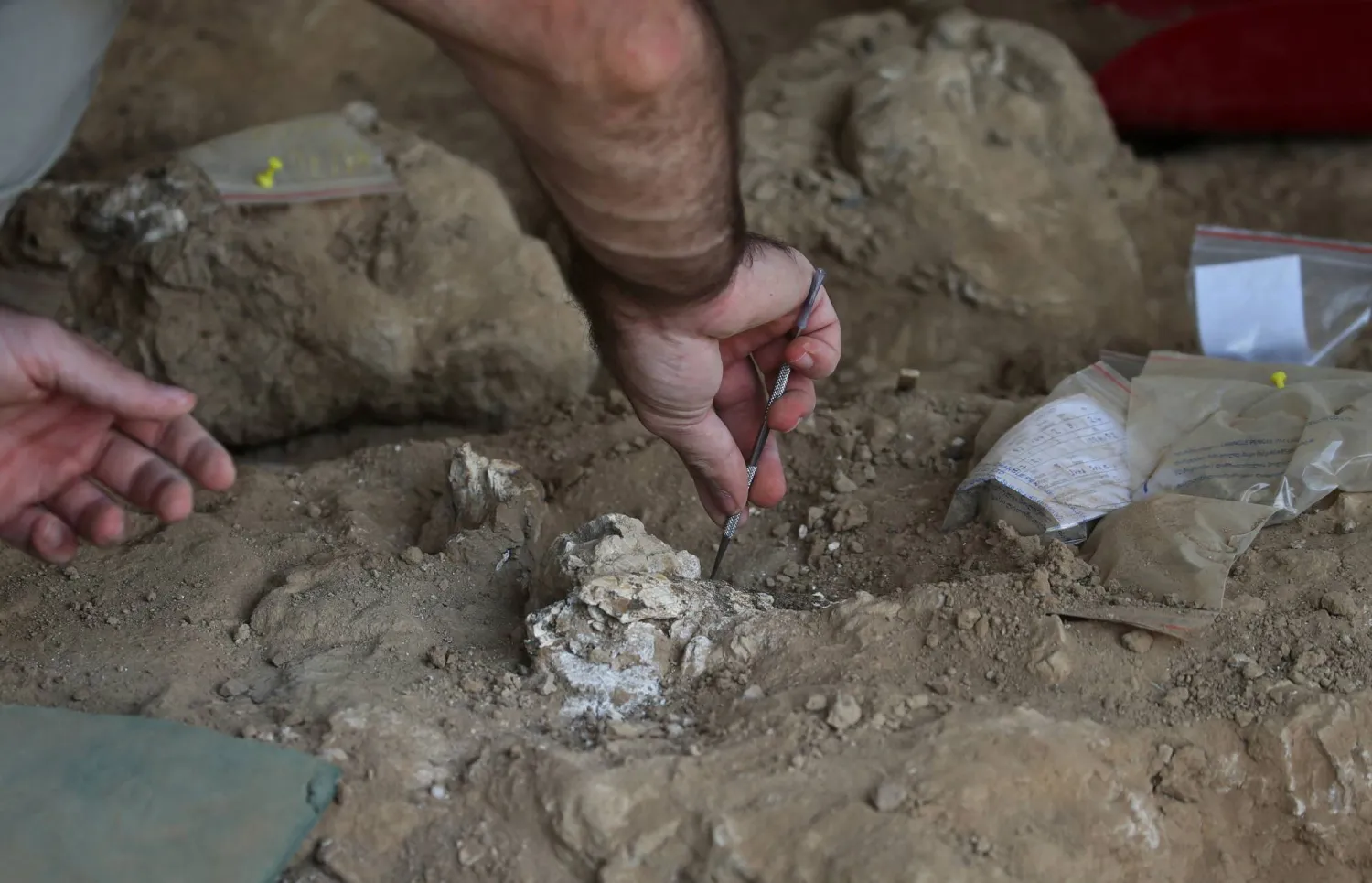
An archaeologist works at the excavation site where a presumably dated 1.8-million-year-old lower jawbone belonging to an early species of human was found, in the village of Kvemo Orozmani, Georgia August 15, 2025. REUTERS/Irakli Gedenidze
TT

Archaeologists in Georgia Unearth 1.8-million-year-old Human Jawbone

An archaeologist works at the excavation site where a presumably dated 1.8-million-year-old lower jawbone belonging to an early species of human was found, in the village of Kvemo Orozmani, Georgia August 15, 2025. REUTERS/Irakli Gedenidze

Archaeologists in Georgia have unearthed a 1.8-million-year-old jawbone belonging to an early species of human that they say will shed light on some of the earliest prehistoric human settlements on the Eurasian continent.

The Georgian site at Orozmani - smaller than two parking spaces but rich in history - has brought to light the oldest remains of early humans yet excavated outside Africa and offers clues to the patterns of Homo erectus, a hunter-gatherer species that scientists believe started migrating around two million years ago.

"The study of the early human and fossil animal remains from Orozmani will allow us to determine the lifestyle of the first colonizers of Eurasia," said Giorgi Bidzinashvili, a professor of stone age archaeology at Ilia State University in Tbilisi.

"We think Orozmani can give us big information about humankind."

The lower jawbone was found around 100 km (62 miles) southwest of the Georgian capital of Tbilisi, where archaeologists in 2022 excavated a tooth from early humans of the same era. In the nearby village of Dmanisi, 1.8-million-year-old human skulls have previously been found.

In this latest discovery, archaeologists also found fossils from animals including a saber-toothed tiger, elephant, wolf, deer and giraffe, as well as a cache of stone tools.

Close study of the jawbone and the animal fossils can yield crucial answers about how early humans evolved after they left Africa, including what they ate and what the climate was like, scientists say.

At the Orozmani excavation site, archaeologists discover new remains of Homo erectus every year.

"My second day (on the dig) I found a nice little ankle bone," said Miles Alexandre, a recent anthropology graduate from the University of Rhode Island in the US.

"You go down five centimeters...there's a good chance you're going to find something."


Louvre Museum Says Shutting for the Day Due to Strike

People walk next to the Louvre Museum covered in snow in Paris, France, 07 January 2026. (EPA)
TT

Louvre Museum Says Shutting for the Day Due to Strike

People walk next to the Louvre Museum covered in snow in Paris, France, 07 January 2026. (EPA)

The Louvre Museum was forced to close on Monday due to strike action from staff in the latest disruption at the world's most-visited museum, management said.

"Due to public strikes, the Musee du Louvre is closed today," the museum said in a message posted on its website, informing disappointed tourists and art lovers that their entry tickets would be automatically reimbursed.

The museum closed for a full day last month and has been only partially open on several other days since.

Nearly three months after an embarrassing daylight heist, which has heaped pressure on Louvre bosses, staff are calling for more recruitment and better maintenance of the vast former royal palace.

Questions continue to swirl since the October 19 break-in over whether it was avoidable and why thieves were able to steal crown jewels worth more than $100 million.

Two intruders used a truck-mounted extendable platform to access a gallery containing the jewels, slicing through a glass door with disk-cutters in front of startled visitors before stealing eight priceless items.

As well as the robbery, two other recent incidents have highlighted maintenance problems inside the building, which chief architect Francois Chatillon has described as "not in a good state".

A water leak in November damaged hundreds of books and manuscripts in the Egyptian department, while management had to shut a gallery housing ancient Greek ceramics in October because ceiling beams above it risked giving way.


20-Year-Olds Gathering in Kimonos for Coming of Age Day Ceremony in Japan

Kimono-clad Japanese young women take pictures after attending a Coming-of-Age Day ceremony in Yokohama, near Tokyo, Japan, 12 January 2026. EPA/FRANCK ROBICHON
TT

20-Year-Olds Gathering in Kimonos for Coming of Age Day Ceremony in Japan

Kimono-clad Japanese young women take pictures after attending a Coming-of-Age Day ceremony in Yokohama, near Tokyo, Japan, 12 January 2026. EPA/FRANCK ROBICHON

Young women in brightly colored long-sleeved kimonos and young men in formal suits or traditional hakama and haori gathered Monday at Yokohama Arena to mark Coming-of-Age Day, an annual celebration for those who have turned 20.

The ceremonies, which are a widely observed public rite of passage in Japan, lasted less than an hour. Before and after the events, young adults gathered near the arena entrance, sidewalks and nearby train stations, greeting friends they had not seen for a long time. Smartphones were raised repeatedly as participants took pictures of each other and themselves.

Among the many participants wearing black and navy suits, a large number of young men chose traditional hakama trousers and haori jackets.

Legally, adulthood in Japan now begins at 18, following a revision of the Civil Code in April 2022. Even so, most local governments continue to hold Coming-of-Age ceremonies for 20-year-olds.

Inside Yokohama Arena, participants stood for the national anthem, then sang Yokohama’s city song together. Many then switched on the lights of their mobile phones, illuminating the hall.


Saudi Pavilion at Makkah's Global Village Showcases the Kingdom’s Culture

Saudi Pavilion at Makkah's Global Village Showcases the Kingdom’s Culture
TT

Saudi Pavilion at Makkah's Global Village Showcases the Kingdom’s Culture

Saudi Pavilion at Makkah's Global Village Showcases the Kingdom’s Culture

The Saudi pavilion at Global Village in Makkah, part of the Makkah winter season, reflects the richness and uniqueness of the Kingdom's culture and heritage.

It features interactive and engaging sections that introduce visitors to the Kingdom’s cultural heritage, including live demonstrations of traditional handicrafts and artwork inspired by the local environment, SPA reported.

The pavilion’s presence at Global Village reflects ongoing efforts to highlight the nation’s cultural heritage, promote its civilizational legacy, and strengthen its cultural presence at major events.