

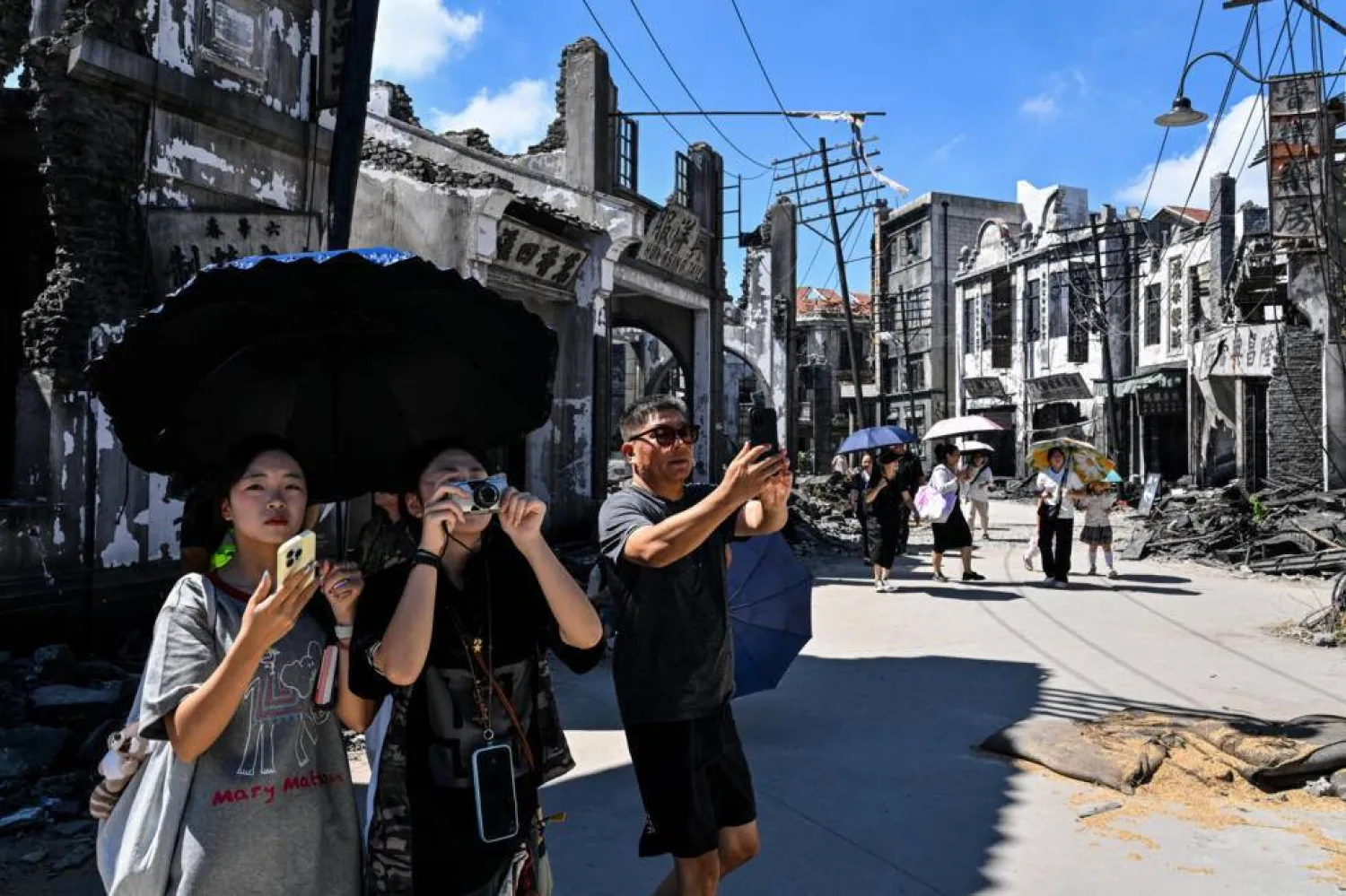

Nanjing Massacre Film Set Becomes China School Holiday Hotspot

China has no film rating system, and it is not uncommon for children to watch content that might be considered overly violent elsewhere. Hector RETAMAL / AFP
TT

Nanjing Massacre Film Set Becomes China School Holiday Hotspot

China has no film rating system, and it is not uncommon for children to watch content that might be considered overly violent elsewhere. Hector RETAMAL / AFP

The sound of machine gun fire rattled around collapsed buildings as schoolchildren eagerly explored the ravaged streets of 1930s Nanjing, delighted to be visiting the set of a Chinese blockbuster about a historic massacre.

Slickly produced and star-studded, "Dead to Rights" is set in Nanjing, then China's capital, during six weeks of mass murder, rape and looting by the Japanese army in 1937 that killed tens if not hundreds of thousands.

In keeping with other films about the slaughter, "Dead to Rights" does not shy away from portraying the atrocities, but that hasn't deterred viewers. It has topped the Chinese box office since late July.

Its set at a suburban Shanghai film park is now open to the public, and was thronged with enthusiastic fans -- many of them young children -- when AFP visited this week.

An enormous, bullet-ridden mural of China's former leader, Chiang Kai-shek, stared down from a bombed-out building as visitors poured in, taking selfies and livestreaming excitedly.

Beneath the levity, the film had provoked strong emotions.

"It's a deep pain that comes from within, a feeling of profound hatred," said a woman surnamed He, describing her feelings towards Japan.

"History is something that can't be erased in the heart, no matter what happens in the future."

One man told AFP he had travelled almost 2,000 kilometers from northern Ningxia with his five-year-old son, who had watched the film.

Another young boy holding a Chinese flag struck a triumphant pose on a charred mound of rubble and broken glass, as his parents snapped pictures of him against the blue summer sky.

'Stoking fires'?

The film's plot revolves around a group of Nanjing residents hiding in a photo studio, who are forced to develop Japanese photograph "souvenirs" of war crimes.

A South China Morning Post review called the movie "thunderously powerful" but said some violent scenes were "as though engineered to stoke the fires of anti-Japanese sentiment".

"Dead to Rights" is one of several summer releases about the war with Japan, which killed millions of Chinese, and which many feel Tokyo has never properly atoned for.

The country is gearing up for a major military parade next week to mark 80 years since Japan's defeat and World War II's end.

The "Dead to Rights" poster reads: "No Chinese person will ever forget."

"I don't think (films like this) represent hatred. It's because we need to restore history," said 37-year-old visitor Jiang Xiang.

The death toll of the massacre -- the Chinese put it at 300,000 -- remains a source of debate, and some Japanese arch-conservatives have denied it took place at all, despite overwhelming international evidence.

Jiang said awareness of China's suffering should be passed down the generations -- to teach that "we need to rely on ourselves, keep growing stronger".

'Understand history'

In the on-set photo studio, a visitor's book was completely full of comments both patriotic and profane.

"Japan is the stupidest country in the world," read one in a childish scrawl.

Almost all of the parents AFP met said their children had watched the movie, with one mother from Nanjing saying their school had encouraged it.

China has no film rating system, and it is not uncommon for children to watch content that might be considered overly violent elsewhere.

"Look, that's where the head was hanging (in the film)!" a child giggled to a friend as they passed a wooden post.

Tourist He said war films "teach children how our ancestors fought for us".

The aim was to help "the children understand history -- not to make them hate or anything".

Middleschooler Li Xinyi said she found the Japanese "dislikeable" but cautioned against bitterness.

"Even though they did many cruel things to us, we still need to respect them, because now we must focus on peace."



Ariane 6 Lifts Off with 2 European Navigation Satellites

The European Space Agency (ESA) Ariane 6 rocket carrying two Galileo satellites for the the EU's Global Navigation Satellite System (GNSS) launches at the Guiana Space Center in Kourou, on the French overseas department of Guiana, on December 17, 2025. (Photo by Ronan LIETAR / AFP)
TT

Ariane 6 Lifts Off with 2 European Navigation Satellites

The European Space Agency (ESA) Ariane 6 rocket carrying two Galileo satellites for the the EU's Global Navigation Satellite System (GNSS) launches at the Guiana Space Center in Kourou, on the French overseas department of Guiana, on December 17, 2025. (Photo by Ronan LIETAR / AFP)

A European Ariane 6 rocket blasted off from France's Kourou space base in French Guiana early Wednesday, carrying two Galileo global navigation satellites, according to an AFP correspondent.

Lift-off was at 2:01 am local time (0501 GMT) for the fourth commercial flight of the Ariane 6 launch system since the expendable rockets came into service last year.

The rocket was carrying two more satellites of the European Union's Galileo program, a global navigation satellite system that aims to make the bloc less dependent on the US's Global Positioning System (GPS).

The two satellites were set to be placed in orbit nearly four hours after lift-off.

They will bring to 34 the number of Galileo satellites in orbit and "will improve the robustness of the Galileo system by adding spares to the constellation to guarantee the system can provide 24/7 navigation to billions of users. The satellites will join the constellation in medium Earth orbit 23, 222 km (14,429 miles) above Earth’s surface," according to the European Space Agency (ESA) which oversees the program.

Previous Galileo satellites were primarily launched by Ariane 5 and Russian Soyuz rockets from Kourou.

After Russia's invasion of Ukraine, Europe halted space cooperation with Moscow.

Before the Ariane 6 rocket entered into service in July 2024, the EU contracted with Elon Musk's SpaceX to launch two Galileo satellites aboard Falcon 9 rockets in September 2024 from the Kennedy Space Center in Florida.


Delhi Restricts Vehicles, Office Attendance in Bid to Curb Pollution

Children ride a bicycle across a field on smoggy winter morning in New Delhi on December 17, 2025. (Photo by Arun SANKAR / AFP)
TT

Delhi Restricts Vehicles, Office Attendance in Bid to Curb Pollution

Children ride a bicycle across a field on smoggy winter morning in New Delhi on December 17, 2025. (Photo by Arun SANKAR / AFP)

Authorities in India's capital Delhi rolled out strict measures on Wednesday in an attempt to curb pollution, including a ban on vehicles not compliant with latest emission control norms and regulating attendance in private and government offices.

The air quality index (AQI) in the Delhi region, home to 30 million people, has been in the 'severe' category for the past few days, often crossing the 450-mark. In addition, shallow fog in parts of the city worsened visibility that impacted flights and trains.

This prompted the Commission for Air Quality Management to invoke stage four, the highest level, of the Graded Response Action Plan for Delhi and surrounding areas on Saturday.

The curbs ban the entry of older diesel trucks into the city, suspend construction, including on public projects, and impose hybrid schooling, Reuters reported.

Kapil Mishra, a minister in the local government, announced on Wednesday that all private and government offices in the city would operate with 50% attendance, with the remaining working from home.

Additionally, all registered construction workers, many of them earning daily wages, will be given compensation of 10,000 rupees ($110) because of the ban, Mishra said at a press conference in Delhi.

On Tuesday, the government enforced strict anti-pollution measures for vehicles in the city, banning vehicles that are not compliant with the latest emission control standards.

"Our government is committed to providing clean air in Delhi. We will take strict steps to ensure this in the coming days," Delhi's Environment Minister Manjinder Singh Sirsa said late on Tuesday.

Pollution is an annual winter problem in Delhi and its suburbs, when cold, dense air traps emissions from vehicles, construction sites and crop burning in neighboring states, pushing pollution levels to among the highest in the world and exposing residents to severe respiratory risks.

The area, home to 30 million people, gets covered in a thick layer of smog with AQI touching high 450-levels. Readings below 50 are considered good.


Saudi Ministry of Defense Showcases Media Heritage at Jeddah Book Fair 

The pavilion traces the evolution of military publishing, from early traditional printing through technological and editorial transformations to its modern form. (SPA)
TT

Saudi Ministry of Defense Showcases Media Heritage at Jeddah Book Fair 

The pavilion traces the evolution of military publishing, from early traditional printing through technological and editorial transformations to its modern form. (SPA)

The Saudi Ministry of Defense is participating in the Jeddah International Book Fair, featuring a pavilion that documents a key aspect of its cultural and media history, reported the Saudi Press Agency on Wednesday.

The pavilion traces the evolution of military publishing, from early traditional printing through technological and editorial transformations to its modern form as a trusted reference for defense-related content.

The participation builds on the ministry’s presence at national cultural events. It marks its debut at the Jeddah Book Fair, expanding the reach of its documentary content to a broader audience interested in military media history.