


US Makes it Harder for SK Hynix, Samsung to Make Chips in China

 A Samsung Electronics logo and a computer motherboard appear in this illustration taken August 25, 2025. (Reuters)
A Samsung Electronics logo and a computer motherboard appear in this illustration taken August 25, 2025. (Reuters)
TT

US Makes it Harder for SK Hynix, Samsung to Make Chips in China

 A Samsung Electronics logo and a computer motherboard appear in this illustration taken August 25, 2025. (Reuters)
A Samsung Electronics logo and a computer motherboard appear in this illustration taken August 25, 2025. (Reuters)

The United States is making it more difficult for chipmakers Samsung and SK Hynix to produce chips in China by revoking authorizations that allowed the companies to receive American semiconductor manufacturing equipment there, according to the Federal Register.

The US Commerce Department had given the companies exemptions to sweeping restrictions created in 2022 on the sale of US semiconductor equipment to China.

The companies will now need to obtain licenses to buy the equipment for China. The federal filing also included Intel among the companies who lost their authorization for China, but Intel sold its Dalian China unit in a deal that was finalized earlier this year.

The Commerce department said in a statement that the United States plans to grant license applications to allow the companies to operate their existing facilities in China, but does not intend to grant licenses to expand capacity or upgrade technology.

The companies did not immediately respond to requests for comment.

The licensing change will likely reduce sales to China by US equipment makers KLA Corp, Lam Research and Applied Materials. The companies did not immediately respond to requests for comment.

Shares of Lam fell 4%, Applied Materials dropped 2.8% and KLA shares were down 2.4%.

In June, when the Commerce Department raised the possibility of revoking the authorizations, a White House official said the United States was "just laying the groundwork" in case the truce in trade talks between the two countries fell apart.

The United States and China are now operating under a tariff truce, with levies of 30% on Chinese imports to the US and 10% Chinese duties on US goods locked in until November. The trade war between the world's two largest economies has affected everything from rare earths needed by US industry to China's purchase of US soybeans.

The White House did not have an immediate comment.

Thousands of license applications by US companies to export goods and technology to China also have been in limbo in recent months, creating a massive backlog, as Reuters reported earlier this month, including for billions of dollars' worth of semiconductor manufacturing equipment.

The revocations will not take effect for 120 days, according to the posting.

Foreign chipmakers like Samsung and Hynix now have what is known as Validated End User status, which allows US suppliers to ship goods to them "more easily, quickly and reliably," as the Commerce Department says on its website, than they would if export licenses were required. That VEU status will be removed.

The move may help domestic Chinese equipment makers, whose tools can fill gaps. It also may help Micron, a major US competitor to South Korea's Samsung and SK Hynix in the memory chip sector.

Saudi Arabia, Japan Explore AI and Digital Government Collaboration

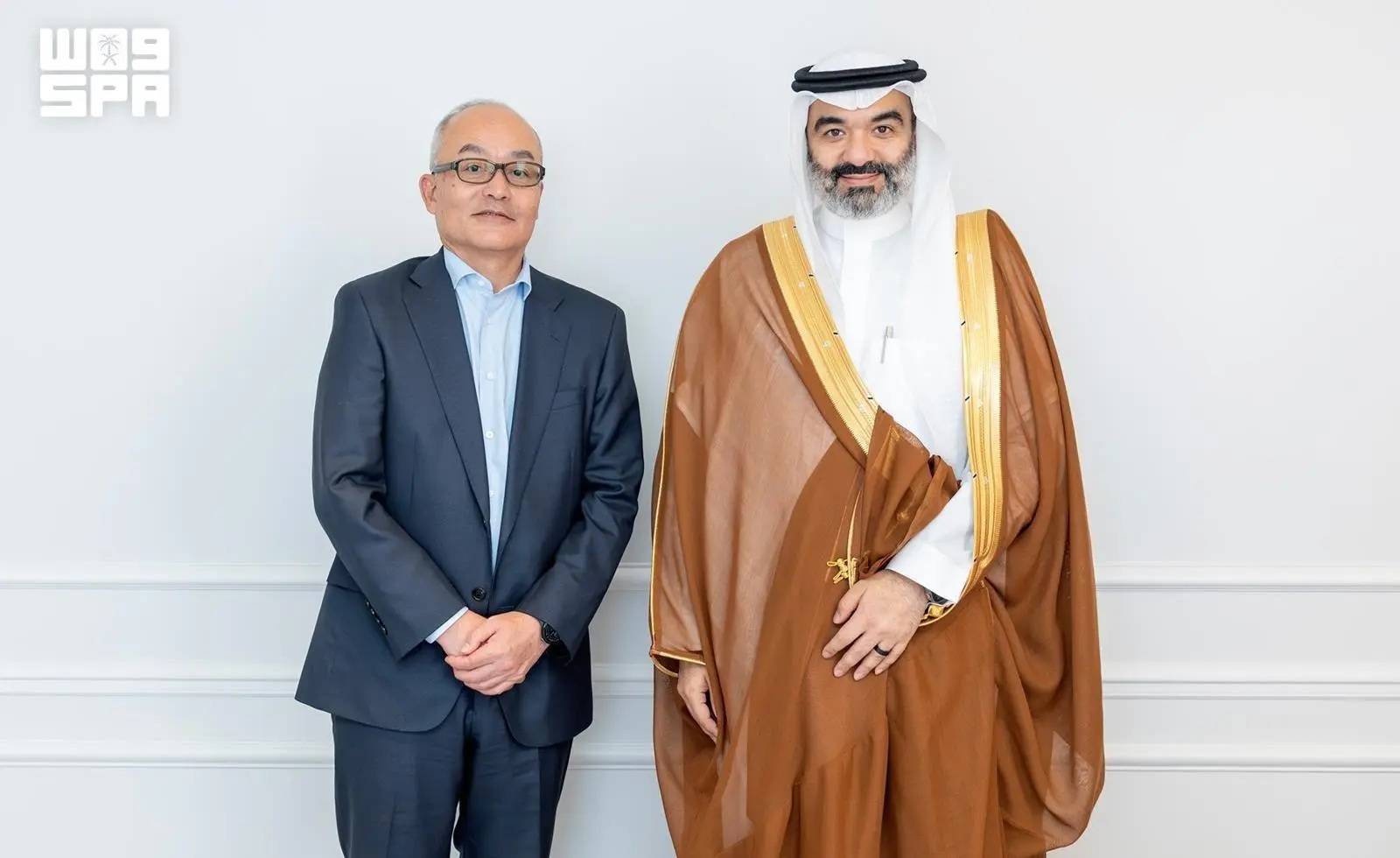
The Saudi Minister of Communications and Information Technology met with Japan's Minister for Digital Transformation in Davos. SPA
TT

Saudi Arabia, Japan Explore AI and Digital Government Collaboration

The Saudi Minister of Communications and Information Technology met with Japan's Minister for Digital Transformation in Davos. SPA

Saudi Minister of Communications and Information Technology Abdullah Alswaha met with Japan's Minister for Digital Transformation Hisashi Matsumoto during the Kingdom's participation in the World Economic Forum (WEF) in Davos.

The meeting focused on expanding the partnership between the two countries in digital government, AI, digital capability development, and the empowerment of entrepreneurship.


Taiwan Says It Will Lead ‘Democratic’ High-Tech Supply Chain with US

Taiwan's Vice Premier Cheng Li-chiun speaks at a press conference about US-Taiwan trade deal in Taipei, Taiwan, January 20, 2026. (Reuters)
TT

Taiwan Says It Will Lead ‘Democratic’ High-Tech Supply Chain with US

Taiwan's Vice Premier Cheng Li-chiun speaks at a press conference about US-Taiwan trade deal in Taipei, Taiwan, January 20, 2026. (Reuters)

Taiwan aims to build a "democratic" high-tech supply chain ​with the United States and form a strategic AI partnership under the new tariffs deal it sealed with Washington last week, Taipei's top negotiator in the talks said on Tuesday.

US President Donald Trump has pushed the major producer of semiconductors, which runs a large trade surplus with the United States, to invest more in the US, specifically in chips that power AI.

Under the terms of the long-negotiated deal, chipmakers like TSMC that expand US production will incur a lower tariff on semiconductors or related manufacturing equipment and products they import into the US and will ‌be able ‌to import some items duty-free. Broad tariffs that apply to most ‌other Taiwanese ⁠exports ​to ‌the US will fall from 20% to 15%.

Taiwan companies will also invest $250 billion to boost production of semiconductors, energy and artificial intelligence in the US, while Taiwan will also guarantee an additional $250 billion in credit to facilitate further investment.

Speaking to reporters in Taipei, Vice Premier Cheng Li-chiun said the deal was not about hollowing out Taiwan's chip industry, which is so important for the economy it is widely referred to as the "sacred mountain protecting the country".

"This is not supply-chain relocation; rather, it is ⁠support for Taiwan's high-tech industries to extend their strength abroad - through addition, and even multiplication - to expand a strong international footprint in ‌the United States," she said.

CHIPMAKER INVESTMENTS

Under the agreement, chipmakers that ‍expand in the US will be able ‍to import up to 2.5 times their new capacity of semiconductors and wafers with no ‍extra tariffs during an approved construction period. Preferential treatment would apply to chips that exceed that quota.

Cheng said Taiwan has secured preferential treatment in advance under any future Section 232 measures on semiconductors, which is an ongoing US national security investigation into imports of key products like chips and pharmaceuticals.

"As for what the actual ​Section 232 semiconductor tariff will be in the future, (US Commerce) Secretary Lutnick recently mentioned a possible rate of 100%, but this remains undecided," Cheng said.

"Regardless, under any ⁠future tariff scenario, we have ensured that the US will grant Taiwan the most favorable treatment: zero tariffs within the quota and preferential tariffs even outside the quota."

In an interview with CNBC last week, US Commerce Secretary Howard Lutnick said that if companies do not build in the US, a tariff would likely be 100%.

"In the past we said, 'Taiwan can help'," Cheng added, referring to Taiwan's past efforts to help the international community during the COVID pandemic and other crises.

"We hope in the future it will be "Taiwan-US can lead,' with the two sides joining forces and, under the wave of AI, working together to build a high-tech supply chain for the democratic camp. This is our strategic objective."

The US is Taiwan's most important backer and arms supplier, despite the lack of formal diplomatic ‌ties. Beijing claims the democratically governed island as its own and has not ruled out the use of force to achieve its goals.


OpenAI Introducing Ads to ChatGPT

FILE PHOTO: OpenAI logo is seen in this illustration taken May 20, 2024. REUTERS/Dado Ruvic/Illustration/File Photo
TT

OpenAI Introducing Ads to ChatGPT

FILE PHOTO: OpenAI logo is seen in this illustration taken May 20, 2024. REUTERS/Dado Ruvic/Illustration/File Photo

OpenAI announced Thursday it will begin testing advertisements on ChatGPT in the coming weeks, as the wildly popular artificial intelligence chatbot seeks to increase revenue to cover its soaring costs.

The ads will initially appear in the United States for free and lower-tier subscribers, the company said in a blog post outlining its long-anticipated move into advertising.

The integration of advertising has been a key question for generative AI chatbots, with companies largely reluctant to interrupt the user experience with ads.

But the exorbitant costs of running AI services may have forced OpenAI's hand.
Only a small percentage of its nearly one billion users pay for subscription services, putting pressure on the company to find new revenue sources.

Since ChatGPT's launch in 2022, OpenAI's valuation has soared to $500 billion in funding rounds -- higher than any other private company. Some expect it could go public with a trillion-dollar valuation.

But the ChatGPT maker burns through cash at a furious rate, mostly on the powerful computing required to deliver its services.

With its move, OpenAI brings its business model closer to tech giants Google and Meta, which have built advertising empires on the back of their free-to-use services.

Unlike OpenAI, those companies have massive advertising revenue to fund AI innovation -- with Amazon also building a solid ad business on its shopping and video streaming platforms.

"Ads aren't a distraction from the gen AI race; they're how OpenAI stays in it," said Jeremy Goldman, an analyst at Emarketer.

"If ChatGPT turns on ads, OpenAI is admitting something simple and consequential: the race isn't just about model quality anymore; it's about monetizing attention without poisoning trust," he added.

OpenAI's pivot comes as Google gains ground in the generative AI race, infusing services including Gmail, Maps and YouTube with AI features that -- in addition to its Gemini chatbot -- compete directly with ChatGPT.

To address concerns about its pivot into advertising, OpenAI pledged that ads would never influence ChatGPT's answers and that user conversations would remain private from advertisers.

"Ads do not influence the answers ChatGPT gives you," the company stated, according to AFP. "Answers are optimized based on what's most helpful to you. Ads are always separate and clearly labeled."

In an apparent reference to Meta, TikTok and Google's YouTube -- platforms accused of maximizing user engagement to boost ad views -- OpenAI said it would "not optimize for time spent in ChatGPT."

"We prioritize user trust and user experience over revenue," it added.

The commitment to user well-being is a sensitive issue for OpenAI, which has faced accusations of allowing ChatGPT to prioritize emotional engagement over safety, allegedly contributing to mental distress among some users.
