

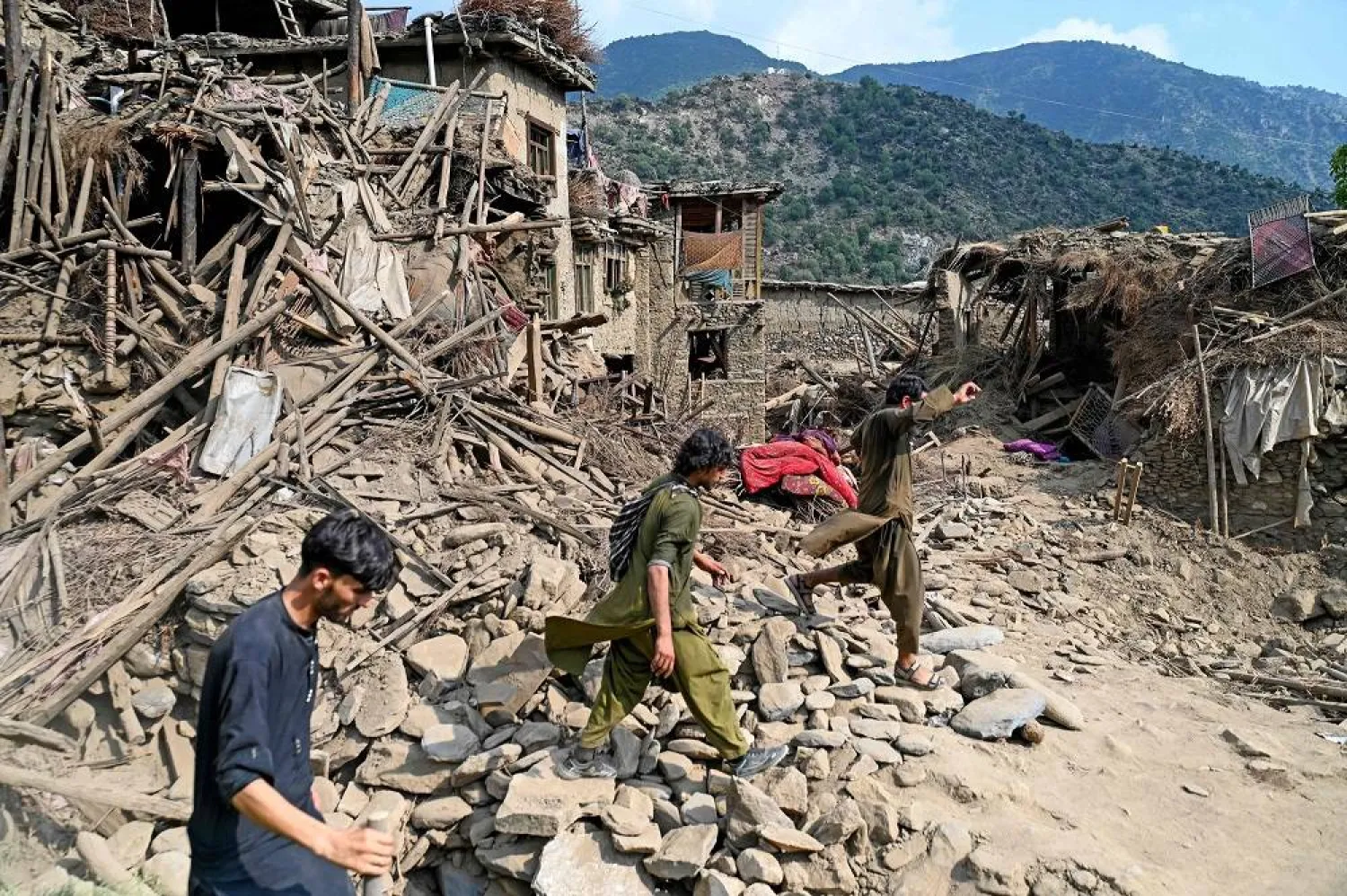

New Quake Shakes Devastated Afghan Region as Death Toll Exceeds 1,400

Afghans walk past damaged houses, after earthquakes at Mazar Dara village in Nurgal district, Kunar province, in Eastern Afghanistan, on September 1, 2025. (AFP)
TT

New Quake Shakes Devastated Afghan Region as Death Toll Exceeds 1,400

Afghans walk past damaged houses, after earthquakes at Mazar Dara village in Nurgal district, Kunar province, in Eastern Afghanistan, on September 1, 2025. (AFP)

An earthquake of magnitude 5.5 shook southeastern Afghanistan on Tuesday, sparking fears of further damage and destruction almost two days after a large quake in the same region killed more than 1,400 people and injured thousands more. 

Tuesday's quake occurred at a relatively shallow depth of 10 km (6 miles), the same level as the one that struck at midnight on Sunday with a magnitude of 6. That was one of Afghanistan's worst quakes in years, flattening houses in remote villages. 

The aftershock caused panic and halted rescue efforts as it sent rocks sliding down mountains, cutting off roads further and making it dangerous to dig through rubble, said Safiullah Noorzai, who works with Aseel, a humanitarian tech platform with networks around Afghanistan. 

Noorzai, whose organization has sent teams to the mountainous region, said more people had been injured, likely pushing the death toll higher. 

The difficult terrain has badly hindered rescue workers' relief efforts in the isolated villages. 

A Reuters journalist who reached the area on Tuesday, before the latest tremors, saw every home had been damaged or destroyed, with locals still digging through the rubble for survivors. A lot of people were still trapped. Some partially damaged homes were destroyed by the second earthquake, according to residents. 

At least 1,411 people are known to have died so far, 3,124 have been injured and more than 5,400 houses destroyed, Taliban administration spokesperson Zabihullah Mujahid said. 

The UN coordinator in Afghanistan said the death toll was sure to rise further. 

Aid group Save the Children called on the international community to urgently release emergency funds. The earthquake has disrupted sources of clean water, raising fears of disease, and restricted access to food, it said. 

"This is now a race against time to save lives – to get injured people out of remote villages cut off by massive rock falls and to get clean water, food, and shelter in," said Samira Sayed Rahman, Programs and Advocacy Director at Save the Children. 

Afghanistan is prone to deadly earthquakes, particularly in the Hindu Kush mountain range, where the Indian and Eurasian tectonic plates meet. 

The eastern provinces of Kunar and Nangarhar were worst hit in Sunday night's earthquake. 

On Tuesday, a line of ambulances was on the damaged mountain road trying to reach Kunar villages, as helicopters flew in, bringing aid supplies and taking the injured to hospitals, according to a Reuters reporter. 

Thousands of children were at risk, the United Nations Children's Fund warned on Tuesday. 

UNICEF said it was sending medicines, warm clothing, tents and tarpaulins for shelter, and hygiene items such as soap, detergent, towels, sanitary pads, and water buckets. 

Taliban soldiers were deployed in the area, providing help and security. The disaster has further stretched the war-torn nation's Taliban administration, already grappling with a sharp drop in foreign aid and deportations of hundreds of thousands of Afghans by neighboring countries. 

"Damaged roads, ongoing aftershocks, and remote locations of many villages severely impede the delivery of aid," the World Health Organization said, adding that over 12,000 people had been affected by the quake. 

"The pre-earthquake fragility of the health system means local capacity is overwhelmed, creating total dependence on external actors," it said. 

Food and tents were desperately needed, said Aseel's Noorzai. With their houses in ruins, many people were living in the open amid a fear of aftershocks, Noorzai added. 

AID CUTS 

The rescue and relief work has struggled in the face of tight resources in the impoverished nation of 42 million people and limited global help in the aftermath of the tragedy. 

So far, Britain has allocated 1 million pounds ($1.35 million) to support the efforts of the UN and the International Red Cross. 

India delivered 1,000 tents and was moving 15 tons of food supplies to Kunar, with more relief to be sent on Tuesday. 

Other nations such as China, the United Arab Emirates, the European Union, Pakistan and Iran have pledged help, but aid is yet to arrive. 

Afghanistan has been badly hit by US President Donald Trump's decision in January to cut funding to its humanitarian arm USAID and reductions in other foreign aid programs. 

Crises elsewhere in the world, along with donor frustration over the Taliban's policies toward women and curbs on aid workers have been a factor in funding cuts, according to diplomats and aid officials. 


Trump Urges other Nations to Send Ships to Secure Hormuz

FILE PHOTO: A map showing the Strait of Hormuz and Iran is seen in this illustration taken June 22, 2025. REUTERS/Dado Ruvic/Illustration/File Photo
TT

Trump Urges other Nations to Send Ships to Secure Hormuz

FILE PHOTO: A map showing the Strait of Hormuz and Iran is seen in this illustration taken June 22, 2025. REUTERS/Dado Ruvic/Illustration/File Photo

US President Donald Trump on Saturday urged other nations to send ships to help secure the Strait of Hormuz, the critical chokepoint for global oil supplies disrupted by the Mideast war.

Trump, who has said the United States will soon start escorting tankers through the strait, posted on Truth Social that "Many countries, especially those who are affected by Iran's attempted closure of the Hormuz Strait, will be sending War Ships, in conjunction with the United States of America, to keep the Strait open and safe."

The US president added: "Hopefully China, France, Japan, South Korea, the UK, and others, that are affected by this artificial constraint, will send Ships to the area."

Iranian strikes have all but halted maritime traffic in the strait, through which a fifth of global crude oil and liquefied natural gas normally pass. It is just 54 kilometers (34 miles) wide at its narrowest point.

With oil prices spiking, Trump was asked Friday when the US Navy would begin escorting tankers through the Strait of Hormuz. "It'll happen soon, very soon," he said.

In his post on Saturday, Trump asserted that Iran's military capability had been eliminated but he conceded that it was still able to attack the strait.

"We have already destroyed 100% of Iran's Military capability, but it's easy for them to send a drone or two, drop a mine, or deliver a close range missile somewhere along, or in, this Waterway, no matter how badly defeated they are," he wrote.

As he urged nations to send ships to the strait, he added that "the United States will be bombing the hell out of the shoreline, and continually shooting Iranian Boats and Ships out of the water. One way or the other, we will soon get the Hormuz Strait OPEN, SAFE, and FREE!"


Israeli Defense Minister Says War with Iran Entering 'Decisive Phase'

Smoke rises following an explosion during a protest marking the annual al-Quds Day (Jerusalem Day) on the last Friday of the holy month of Ramadan, amid the US-Israeli conflict with Iran, in Tehran, Iran, March 13, 2026. Elahe Asiabai/Fars News/WANA (West Asia News Agency) via REUTERS
TT

Israeli Defense Minister Says War with Iran Entering 'Decisive Phase'

Smoke rises following an explosion during a protest marking the annual al-Quds Day (Jerusalem Day) on the last Friday of the holy month of Ramadan, amid the US-Israeli conflict with Iran, in Tehran, Iran, March 13, 2026. Elahe Asiabai/Fars News/WANA (West Asia News Agency) via REUTERS

Israel said the war against Iran was entering its "decisive phase" on Saturday, as explosions rocked cities across the Middle East, with strikes on the US embassy in Baghdad and a major Emirati energy facility.

Washington's embassy in Iraq was hit by a drone, security sources told AFP, the second time it has been targeted since February 28, when the United States and Israel attacked Iran and plunged the Gulf into a conflict that has sent shockwaves through the global economy.

Millions have been displaced by waves of drone, missile and aerial bombing, while more than 1,200 people have reportedly been killed in Iran, with little sign of the conflict slowing as it entered its third week.

Oil prices have surged by 40 percent as Iran chokes off the vital Strait of Hormuz with threats to shipping and strikes on Gulf energy facilities.

Clouds of black smoke rose Saturday over Fujairah, home to a major Emirati oil storage and export terminal, shortly after Iran's military warned UAE civilians to avoid port areas.

President Donald Trump said Friday that US forces had struck Iran's Kharg Island, its biggest oil export hub, and "obliterated every MILITARY target", though sparing its energy facilities.

Iranian media confirmed the island's oil facilities were unaffected. Iran had threatened US-linked oil and energy firms would be "turned into a pile of ashes" if they were hit.

The strike could be a "turning point" with both sides escalating in a bid to force a surrender, said analyst Vali Nasr of John Hopkins University in a social media post. "The end will likely not be Iranian backing off but inflaming the Gulf."

Trump said the US Navy would start escorting tankers through the Strait of Hormuz "very soon", but governments around the world fear a prolonged blow to their economies.

Israel's Defense Minister Israel Katz said the strikes on Kharg showed the war was entering a "decisive phase", though he cautioned it would "continue as long as necessary".

Yet, despite facing superior US and Israeli firepower, Iran appears determined to fight on.

Blasts were heard by AFP journalists over Jerusalem on Saturday after the army detected missiles fired from Iran.

Iran has launched missile and drone attacks against at least 10 of its neighbors.

The Palestinian Islamist movement Hamas urged Iran to refrain from targeting Gulf neighbors.

Qatar said it intercepted two missiles over the capital's downtown area on Saturday and evacuated key areas after blasts were heard by AFP journalists in Doha.

Strikes continue in Iran, with heavy blasts shaking Tehran late Friday and local media reporting strikes in several provinces through Saturday.

Israel's army warned people in an industrial zone of Tabriz in northern Iran to evacuate, signalling an imminent attack.

Iran's health ministry says more than 1,200 people have been killed by US and Israeli attacks, numbers that could not be independently verified.

Up to 3.2 million people have been displaced inside Iran, according to the UN refugee agency.

Trump described Iran as "totally defeated" and in search of a deal he was unwilling to consider.

More than 15,000 targets in Iran have been hit by the US and Israel in two weeks, the Pentagon said.

A report this week said the first six days alone cost the US $11.3 billion and it has lost 13 military personnel.

US media raised the possibility of a ground invasion, with the New York Times and Wall Street Journal reporting the Pentagon had dispatched the Japan-based amphibious assault ship USS Tripoli to the region with some 2,500 Marines.

Iran's rulers appear intent on showing they will survive the war and maintain control, despite their supreme leader Ali Khamenei being killed on day one.

Khamenei's son Mojtaba Khamenei was named the new supreme leader, but has been absent from public view and is reportedly wounded.

Reza Pahlavi, the US-based son of Iran's last shah, said on social media Saturday that he was ready to lead a transition "as soon as the Islamic Republic falls".

But Iran's Revolutionary Guards have threatened a heavy crackdown on any anti-government protests. Thousands were killed in mass demonstrations in January, and a near-total internet blackout has been imposed since since the war began.


Iranian Official Says Kharg Oil Exports 'Normal', after US Strikes

A satellite image of Iran's Kharg Island (AFP)
TT

Iranian Official Says Kharg Oil Exports 'Normal', after US Strikes

A satellite image of Iran's Kharg Island (AFP)

Oil export operations from Iran's Kharg island in the Gulf were proceeding as normal Saturday after US strikes on the crude export hub which caused no casualties, a regional official said.

Activities of oil companies "at this export terminal are continuing as normal", said Ehsan Jahaniyan, deputy governor of Iran's southern Bushehr province, quoted by the IRNA news agency.

The Fars news agency, citing sources on the island, earlier reported there had been no damage to oil facilities after President Donald Trump said US strikes had destroyed only military targets, AFP reported.

Trump had threatened to target oil infrastructure on the island, a crucial hub for Iran, if Tehran continues to block the strategic Strait of Hormuz.

Iran has, in turn, threatened to target US-linked oil infrastructure.

Deputy governor Jahaniyan said that after the attacks "daily life and routine activities of the residents are also fully maintained."

The attack "did not cause any casualties among military personnel, company employees, or residents of Kharg island, he added.

According to Fars, the US operation "tried to damage the army's defenses, the Joshan naval base, the airport control tower and the helicopter hangar of the Iran Continental Shelf Oil Company."

Kharg Island, a scrubby stretch of land in the northern Gulf around 30 kilometres (19 miles) off the Iranian mainland, handles roughly 90 percent of Iran's crude exports.
