


Iran Paves over Mass Grave of 1979 Revolution Victims, Turning It into a Parking Lot

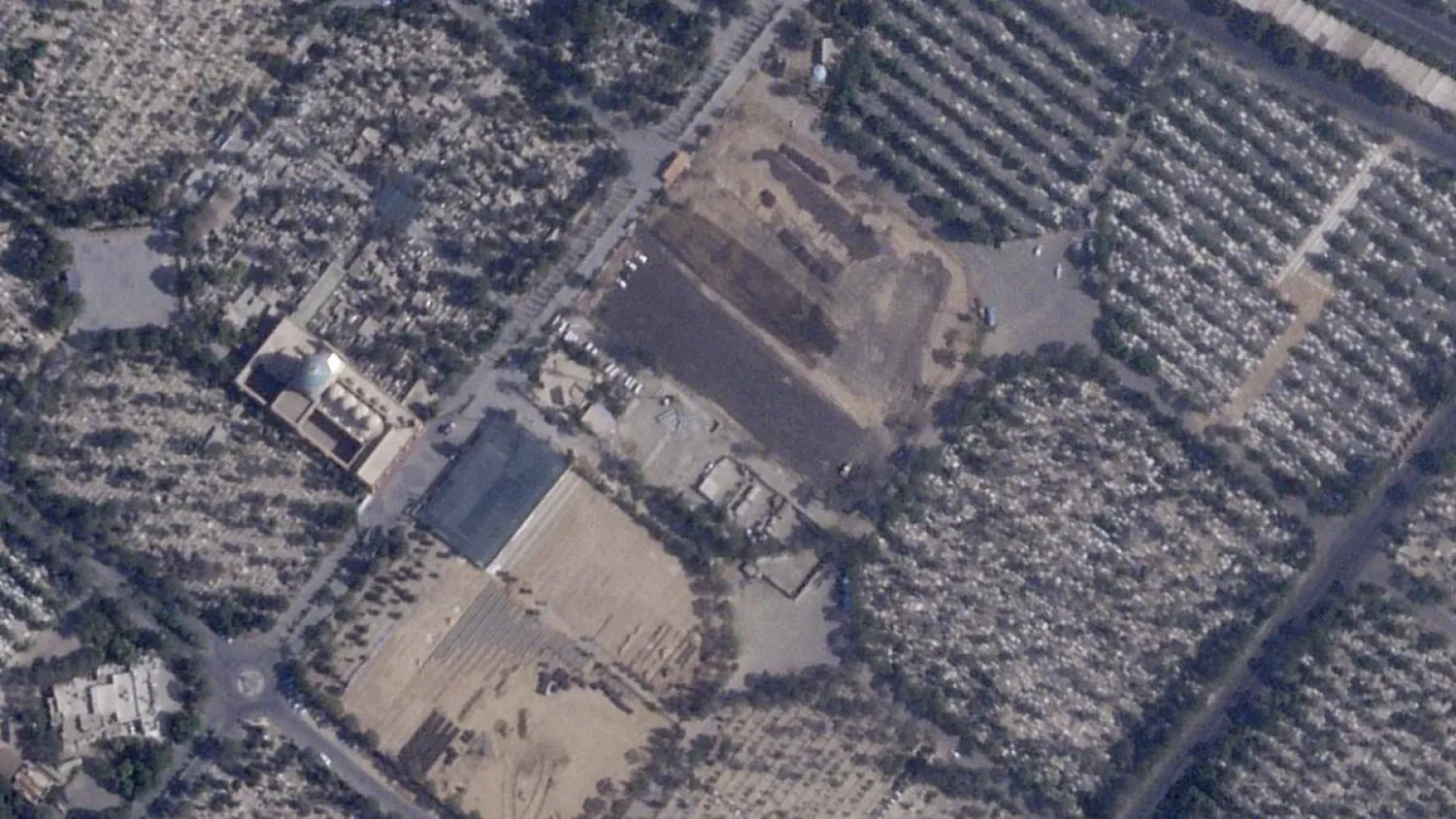
This satellite photo provided by Planet Labs PBC shows Iran paving over Lot 41, where some of those executed in the chaos after Iran’s 1979 Iranian  Revolution were buried, at Behesht-e Zahra cemetery outside of Tehran, Iran, on August 18, 2025. Photo Credit: AP via Planet Labs PBC
This satellite photo provided by Planet Labs PBC shows Iran paving over Lot 41, where some of those executed in the chaos after Iran’s 1979 Iranian Revolution were buried, at Behesht-e Zahra cemetery outside of Tehran, Iran, on August 18, 2025. Photo Credit: AP via Planet Labs PBC
TT

Iran Paves over Mass Grave of 1979 Revolution Victims, Turning It into a Parking Lot

This satellite photo provided by Planet Labs PBC shows Iran paving over Lot 41, where some of those executed in the chaos after Iran’s 1979 Iranian  Revolution were buried, at Behesht-e Zahra cemetery outside of Tehran, Iran, on August 18, 2025. Photo Credit: AP via Planet Labs PBC
This satellite photo provided by Planet Labs PBC shows Iran paving over Lot 41, where some of those executed in the chaos after Iran’s 1979 Iranian Revolution were buried, at Behesht-e Zahra cemetery outside of Tehran, Iran, on August 18, 2025. Photo Credit: AP via Planet Labs PBC

A desert-like patch of sand and scrawny trees in the largest cemetery in Iran's capital has been the final resting place for decades for some of the thousands killed in the mass executions that followed Iran's 1979 Iranian Revolution.

Now, Lot 41 at the sprawling Behesht-e Zahra cemetery in Tehran is becoming a parking lot, with their remains likely beneath asphalt.

Images from Planet Labs PBC show the parking lot being laid over the site, where opponents of Iran's nascent theocracy and others were rapidly buried following their executions at gunpoint or by hanging.

The site, long monitored by surveillance cameras searching for any sign of dissent or remembrance at what officials have referred to as the “scorched section," has seen state-sponsored demolition in the past, with grave markers vandalized and overturned. Iranian officials have acknowledged the recent decision to build the parking, without going into detail about those buried there.

That's as a United Nations special rapporteur in 2024 described Iran's destruction of graveyards as an effort to “conceal or erase data that could serve as potential evidence to avoid legal accountability” over its actions.

“Most of the graves and gravestones of dissidents were desecrated, and the trees in the section were deliberately dried out,” said Shahin Nasiri, a lecturer at the University of Amsterdam who has researched Lot 41. “The decision to convert this section into a parking lot fits into this broader pattern and represents the final phase of the destruction process.”

Last week, both a Tehran deputy mayor and the cemetery’s manager acknowledged the plans to create a parking lot on the site.

“In this place, hypocrites of the early days of the revolution were buried and it has remained without change for years,” Tehran's deputy mayor Davood Goudarzi told journalists in footage aired by state television. "We proposed that the authorities reorganize the space. Since we needed a parking lot, the permission for the preparation of the space was received. The job is ongoing in a precise and smart way.”

Satellite images show construction

The satellite photos show the work began in earnest at the start of August. An Aug. 18 image shows about half of Lot 41 freshly paved over, with construction material still on site. Trucks and piles of asphalt can be seen at the site, suggesting work continued.

The reformist newspaper Shargh quoted Mohammad Javad Tajik, who oversees the Behesht-e Zahra cemetery, as saying the parking lot would help people visit a neighboring lot, where authorities plan to bury those killed in the Iran-Israel war in June.

A major airstrike campaign by Israel killed prominent military generals and others, with government officials putting the death toll at more than 1,060 people killed, with an activist group putting it at over 1,190.

The decision to repurpose the graveyard appears to clash with Iran's own regulations, which allow for a cemetery to repurpose land where internments took place after more than 30 years — as long as families of the dead agree with the decision.

An outspoken lawyer in Iran, Mohsen Borhani, publicly criticized the decision to pave over the graveyard as neither moral nor legal in an interview with Shargh.

"The piece was not only for executed and political people. Ordinary people were buried there, too,” he reportedly said.

It remains unclear whether human remains sit beneath the layer of asphalt or if Iranian authorities moved the bones of the dead there. However, Iran has destroyed other graveyards in recent years for those killed in its 1988 mass execution that saw thousands put to death, leaving their bones there.

Authorities have also vandalized cemeteries for the Baha'i, a religious minority in the country long targeted, and those home to protesters who have died in recent nationwide protests against Iran's theocracy from the 2009 Green Movement to the 2022 Mahsa Amini demonstrations.

“Impunity for atrocities and crimes against humanity has been building for decades in the Islamic Republic," said Hadi Ghaemi, the executive director of the New York-based Center for Human Rights in Iran. “There is a direct line between the massacres of the 1980s, the gunning down of demonstrators in 2009, and the mass killings of protesters in 2019 and 2022."

Massive cemetery is the final resting place for many Behesht-e Zahra, or the “Paradise of Zahra,” opened in 1970 on what was then the rural outskirts of Tehran. As hundreds of thousands of Iranians flooded into the capital under the shah as the country's oil wealth skyrocketed, pressure on Tehran's cemeteries had grown to a point that the burgeoning metropolis needed a place for all of its dead as well.

The cemetery has long been a resting place for some of the most famous Iranians since — and a point where history turned for the country.

On his return to Iran in 1979 after years in exile, Grand Khomeini traveled first to the cemetery, where some of those killed in the uprising against the shah had been buried. Khomeini's cleric courts later issued death sentences for those now interred at Lot 41.

After his death in 1989, Iran built a towering, golden-domed mausoleum for Khomeini connected to the cemetery. As Behesht-e Zahra grew, Lot 41 found itself surrounded by an ever-expanding number of lots for burials.

Nasiri said his research with others suggests there are 5,000 to 7,000 burial sites within Lot 41 of those Iran “considered religious outlaws,” whether communists, militants, monarchists or others.

“Many survivors and family members of the victims are still searching for the graves of their loved ones,” Nasiri said. “They seek justice and aim to hold the perpetrators accountable. The deliberate destruction of these burial sites adds an additional obstacle to efforts of truth-finding and the pursuit of historical justice.”



Russia: Man Suspected of Shooting Top General Detained in Dubai

An investigator works outside a residential building where the assassination attempt on Russian Lieutenant General Vladimir Alexeyev took place in Moscow, Russia February 6, 2026. REUTERS/Anastasia Barashkova
TT

Russia: Man Suspected of Shooting Top General Detained in Dubai

An investigator works outside a residential building where the assassination attempt on Russian Lieutenant General Vladimir Alexeyev took place in Moscow, Russia February 6, 2026. REUTERS/Anastasia Barashkova

Russia's Federal Security Service (FSB) said on Sunday that the man suspected of shooting top Russian military intelligence officer Vladimir Alexeyev in Moscow has been detained in Dubai and handed over to Russia.

Lieutenant General Vladimir Alexeyev, deputy head of the GRU, ⁠Russia's military intelligence arm, was shot several times in an apartment block in Moscow on Friday, investigators said. He underwent surgery after the shooting, Russian media ⁠said.

The FSB said a Russian citizen named Lyubomir Korba was detained in Dubai on suspicion of carrying out the shooting.

Russian Foreign Minister Sergei Lavrov accused Ukraine of being behind the assassination attempt, which he said was designed to sabotage peace talks. ⁠Ukraine said it had nothing to do with the shooting.

Alexeyev's boss, Admiral Igor Kostyukov, the head of the GRU, has been leading Russia's delegation in negotiations with Ukraine in Abu Dhabi on security-related aspects of a potential peace deal.


Factory Explosion Kills 8 in Northern China

Employees work on an electric vehicle (EV) production line at the Volkswagen Anhui factory in Hefei, Anhui province, China, February 4, 2026. REUTERS/Florence Lo
TT

Factory Explosion Kills 8 in Northern China

Employees work on an electric vehicle (EV) production line at the Volkswagen Anhui factory in Hefei, Anhui province, China, February 4, 2026. REUTERS/Florence Lo

An explosion at a biotech factory in northern China has killed eight people, Chinese state media reported Sunday, increasing the total number of fatalities by one.

State news agency Xinhua had previously reported that seven people died and one person was missing after the Saturday morning explosion at the Jiapeng biotech company in Shanxi province, citing local authorities.

Later, Xinhua said eight were dead, adding that the firm's legal representative had been taken into custody.

The company is located in Shanyin County, about 400 kilometers west of Beijing, AFP reported.

Xinhua said clean-up operations were ongoing, noting that reporters observed dark yellow smoke emanating from the site of the explosion.

Authorities have established a team to investigate the cause of the blast, the report added.

Industrial accidents are common in China due to lax safety standards.
In late January, an explosion at a steel factory in the neighboring province of Inner Mongolia left at least nine people dead.


Iran Warns Will Not Give Up Enrichment Despite US War Threat

Traffic moves through a street in Tehran on February 7, 2026. (Photo by ATTA KENARE / AFP)
TT

Iran Warns Will Not Give Up Enrichment Despite US War Threat

Traffic moves through a street in Tehran on February 7, 2026. (Photo by ATTA KENARE / AFP)

Iran will never surrender the right to enrich uranium, even if war "is imposed on us,” its foreign minister said Sunday, defying pressure from Washington.

"Iran has paid a very heavy price for its peaceful nuclear program and for uranium enrichment," Abbas Araghchi told a forum in Tehran.

"Why do we insist so much on enrichment and refuse to give it up even if a war is imposed on us? Because no one has the right to dictate our behavior," he said, two days after he met US envoy Steve Witkoff in Oman.

The foreign minister also declared that his country was not intimidated by the US naval deployment in the Gulf.

"Their military deployment in the region does not scare us," Araghchi said.