
Wave of Drone Strikes Hit Targets Near Sudan Capital 

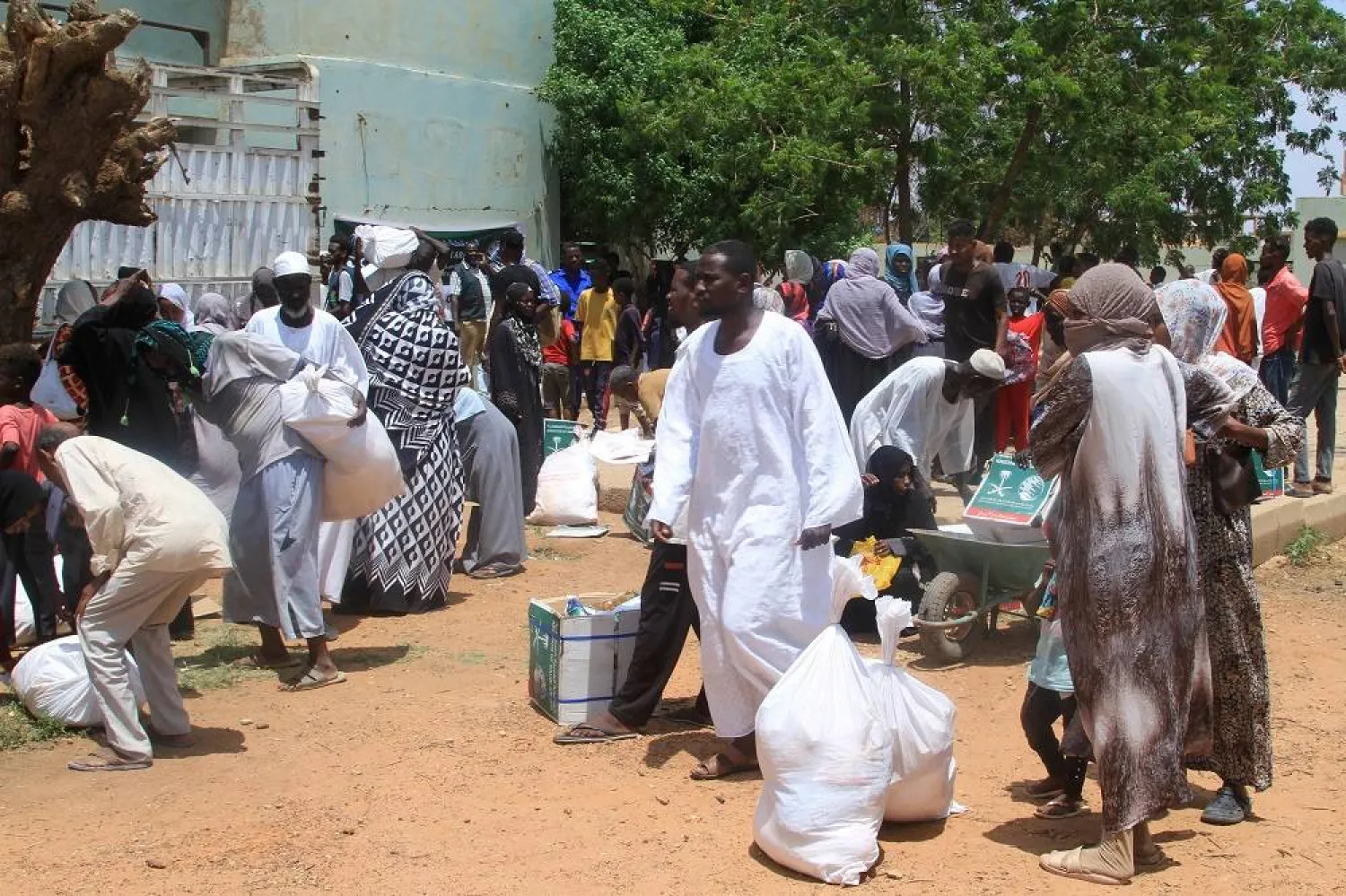
Sudanese queue to receive humanitarian aid in the Al-LaMap district of Khartoum on September 8, 2025. (AFP) 
TT

Wave of Drone Strikes Hit Targets Near Sudan Capital 

Sudanese queue to receive humanitarian aid in the Al-LaMap district of Khartoum on September 8, 2025. (AFP) 

A wave of drone strikes hit key infrastructure and military targets near Sudan's army-held capital Tuesday, witnesses and officials told AFP, bringing to an abrupt end a period of relative calm in the area.

Strikes hit a power station, a weapons factory and an oil refinery near Khartoum, witnesses at the sites said on condition of anonymity, while a military source said an air base had also been targeted.

The assault came months after the military ousted the paramilitary Rapid Support Forces from the area in May, a key battleground in the war that erupted in April 2023.

It came as the army-backed government pressed a major reconstruction bid in the Khartoum area, after millions of people fled fighting in the city earlier in the conflict.

The attacks occurred at around 5:00 am (0300 GMT), with witnesses telling AFP by phone, on condition of anonymity, that they had seen strikes hit the Al-Jaili oil refinery, the Al-Markhiyat substation in Omdurman and the Yarmuk weapons factory.

Four drones targeted the power station and sparked a fire, the witnesses said, with images posted on social media appearing to show the site in flames.

A source at the national electricity company told AFP that the damage had been minor.

The military source, also speaking on condition of anonymity, said the strike on Wadi Seidna air base had been intercepted.

"Our air defense intercepted and shot down the drones that were targeting the base," the source told AFP.

Another drone strike hit an army building in Kafuri, wounding several troops, another military source said.

The RSF has in recent months been accused of widespread drone attacks in several army-controlled areas of Sudan, striking critical infrastructure and causing blackouts for millions.

Efforts to mediate between Sudan's army chief and de facto leader Abdel Fattah al-Burhan and his deputy turned rival, RSF commander Mohamed Hamdan Daglo, have failed to yield a sustained ceasefire, with the military vowing to fight until victory.

The army-backed provisional government has launched a vast reconstruction program in Khartoum, with around 600,000 people displaced earlier in the conflict heading back to their homes, according to the UN.

The war devastated the capital and forced around half of its nine million residents to flee.

The conflict has killed tens of thousands of people and forced around 14 million others to flee their homes, seeking refuge in other parts of the country or beyond its borders.

While Khartoum and the coastal city of Port Sudan have seen a return of relative calm in recent months, the El-Fasher area of Darfur, under paramilitary siege since May 2024, has been subjected to the fiercest attacks since the start of the war.

Hundreds of people are believed to have been killed in the area in recent months.


Bulgarian Court Rejects Lebanon's Extradition Request for Russian Over Beirut Blast

Igor Grechushkin, a Russian businessman based in Cyprus, is escorted by police before the start of his trial on the possible extradition to Lebanon, in Sofia, Bulgaria, December 10, 2025. REUTERS
TT

Bulgarian Court Rejects Lebanon's Extradition Request for Russian Over Beirut Blast

Igor Grechushkin, a Russian businessman based in Cyprus, is escorted by police before the start of his trial on the possible extradition to Lebanon, in Sofia, Bulgaria, December 10, 2025. REUTERS

A Bulgarian court has rejected Lebanon's request to extradite a Russian shipowner linked to the 2020 Beirut port blast, citing insufficient security guarantees from Lebanese authorities.

Igor Grechushkin, a Cyprus-based Russian businessman whose vessel transported the explosive material that detonated at Beirut port in August 2020, killing more than 220 people, was detained in Bulgaria in September for possible extradition to Lebanon, where he is wanted over his role in the disaster, Reuters reported.

"According to the court, Lebanon did not provide sufficient evidence to ensure that the death penalty will not be imposed on him or, if imposed, will not be carried out," Ekaterina Dimitrova, Grechushkin's lawyer, told reporters after the hearing which was closed to media.

The blast, one of the largest non-nuclear explosions in history, devastated large parts of Beirut and left tens of thousands homeless. Grechushkin was placed on Interpol’s wanted list at Lebanon's request in 2020.

PROSECUTOR TO APPEAL RULING

Angel Kanev, the supervising prosecutor, said he would appeal the ruling, arguing that Lebanon’s justice minister, Supreme Court and Prosecutor General had all provided the required guarantees.

"Given that they have been given by such an authority ... I believe that the grounds for extradition exist," Kanev told reporters.

In response to a question about Bulgaria's objection to a possible death penalty for Grechushkin, a Lebanese judicial source said Beirut "could not change its laws on a case-by-case basis", but that it was working on a way to reassure Bulgaria and that it intended to appeal Wednesday's decision.

The source said the investigative judge presiding over the probe would still have the opportunity to question Grechushkin in person in Bulgaria.

"It's a victory for the time being because the most important thing is that he is questioned so we can find out the truth and have accountability," the source told Reuters.

Lebanon's probe into the causes of the blast and possible negligence by top Lebanese officials has dragged on for years, with families of the explosion's victims blaming political interference.

The first investigative judge was removed after charging top officials. His successor, Tarek Bitar, also charged senior politicians, who refused questioning, denied wrongdoing and froze his probe.

Bitar resumed his investigation earlier this year and has questioned several officials in recent months but he has yet to issue a long-awaited preliminary indictment.


Israeli Druze Leader Seeks US Security Guarantees for Syrian Minority

Leader of the Druze community in Israel, Sheikh Mowafaq Tarif, speaks with Reuters at his house in Julis, northern Israel July 28, 2025. REUTERS/Ali Sawafta
TT

Israeli Druze Leader Seeks US Security Guarantees for Syrian Minority

Leader of the Druze community in Israel, Sheikh Mowafaq Tarif, speaks with Reuters at his house in Julis, northern Israel July 28, 2025. REUTERS/Ali Sawafta

Israeli Druze leader Sheikh Mowafaq Tarif urged the United States to guarantee the security of the Druze community in Syria to prevent a recurrence of intense violence earlier this year in Sweida.

Washington needed to fulfill its "duty" to safeguard the rights of Syria's minorities in order to encourage stability, Tarif told Reuters on Tuesday during an official visit to the UN in Geneva, adding that US support would also remove the need for Israeli intervention in Syria's south.

"We hope that the United States, President Trump, and America as a great power, we want it to guarantee the rights of all minorities in Syria ... preventing any further massacres," he said.
US President Donald Trump vowed in November to do everything he can to make Syria successful after landmark talks with Syrian President Ahmed al-Sharaa.

BLOODY CLASHES IN JULY

The Druze are a minority group whose faith is an offshoot of Islam and have followers in Israel, Syria and Lebanon.

In July, clashes between Druze and Bedouin residents broke out in Sweida after tit-for-tat kidnappings, leading to a week of bloodletting that shattered generations of fragile coexistence.

The violence worsened when government forces dispatched to restore order clashed with Druze militiamen, with widespread reports of looting, summary killings and other abuses. Israel entered the fray with encouragement from its Druze minority, attacking government forces with the stated aims of protecting Syrian Druze and keeping its borders free from militants. Tens of thousands of people from both communities were uprooted, with the unrest all but ending the Bedouins’ presence across much of Sweida.

In the aftermath, Druze leaders called for a humanitarian corridor from the Israeli-occupied Golan to Sweida and demanded self-determination, which the government rejects.

'NEED TO REBUILD TRUST'

Asked about proposals by influential Druze Sheikh Hikmat al-Hajari to separate Sweida from Syria, Tarif took a different stance, stressing the need for internal autonomy or self-governance within Syria as a way of protecting minorities and their rights and pointing to federal systems in Switzerland and Germany as examples.

It was inconceivable to ask the Druze to surrender their weapons, he said. Talks to bring Sweida's former police force onto Damascus' payroll — while allowing the Druze to retain wide local autonomy — had been making steady progress until July's bloodshed derailed them.

Al-Sharaa has vowed to protect the Druze. However, Hajari insists he poses an existential threat to his community and in September rejected a 13-point, US-brokered roadmap to resolve the conflict, according to Reuters.

Asked if talks should be revived, Tarif said trust had to be rebuilt by allowing residents to return to their homes, and permitting full humanitarian access to Sweida.

"There is no trust today ... Trust must be rebuilt," he said.


Aid Flow Into Gaza Falls Short of Ceasefire Terms, Analysis of Israeli Figures Shows

Displaced Palestinians repair their tents at a tent camp on the beach after a stormy weather in Gaza City, Wednesday, Dec. 10, 2025. (AP Photo/Jehad Alshrafi)
TT

Aid Flow Into Gaza Falls Short of Ceasefire Terms, Analysis of Israeli Figures Shows

Displaced Palestinians repair their tents at a tent camp on the beach after a stormy weather in Gaza City, Wednesday, Dec. 10, 2025. (AP Photo/Jehad Alshrafi)

Aid deliveries into Gaza are falling far short of the amount called for under the US-brokered ceasefire, an Associated Press analysis of the Israeli military’s figures showed.

Under the October ceasefire deal between Israel and Hamas, Israel agreed to allow 600 trucks of aid into Gaza each day. But an average of around 459 trucks a day have entered Gaza between Oct. 12, when flow of the aid restarted, and Dec. 7, according to an AP analysis of latest figures by COGAT, the Israeli military body in charge of coordinating aid entry.

By all accounts, aid has fallen short in Gaza COGAT said that roughly 18,000 trucks of food aid had entered Gaza between the ceasefire taking effect and Sunday. It said that figure amounted to 70% of all aid that had entered the territory since the truce.

That means COGAT estimates that a total of just over 25,700 trucks of aid have entered Gaza — well under the 33,600 trucks that should have entered by Sunday, under the terms of the ceasefire.

In response to the AP analysis, COGAT insisted Wednesday that the number of trucks entering Gaza each day was above the 600 mark. But when asked, it refused to elaborate why the figures it gave did not reach that amount or provide raw data on truck entry.

Throughout most of the war, COGAT gave detailed figures of daily trucks entering Gaza but stopped doing so when the ceasefire began. Rights groups say that because it controls the crossings, it is the only entity with the access and visibility necessary to track how much aid and commercial goods are entering Gaza.

The UN and aid groups have often said the amount of aid entering Gaza is far lower than COGAT claims.

The UN says only 6,545 trucks have been offloaded at Gaza crossings between the ceasefire and Dec. 7, amounting to about 113 trucks a day. That's according to its online database. The UN figures do not include aid trucks sent bilaterally by organizations not working through the UN network.

A Hamas document on Saturday provided to the AP put the amount of aid trucks that have entered at 7,333.

This week, United Nations Office for the Coordination of Humanitarian Affairs stressed a “dire” need for more aid to enter Gaza, saying Israeli restrictions on aid have bottlenecked recovery efforts.

Food remains scarce in Gaza, aid groups say Humanitarian groups say lack of aid has had harsh effects on many of Gaza's 2 million residents, most of whom were forcibly displaced by war. Food remains scarce as the Palestinian territory struggles to bounce back from famine, which hit parts of Gaza during the war. Starving mothers in Gaza are giving birth to malnourished babies, some of whom have died in hospital, according to a recent report by UNICEF. As winter rains pick up, displaced families living in tents have been left exposed to the elements and without supplies to cope with floods and the biting cold.

“Needs far outpace the humanitarian community’s ability to respond, given persistent impediments,” the agency wrote in a report on Monday. “These obstacles include insecurity, customs clearance challenges, delays and denials of cargo at the crossings, and limited routes available for transporting humanitarian supplies within Gaza.”

Israel temporarily stopped all aid entry at least once in response to alleged Hamas violations of the truce. Israel said that Hamas has failed to return the bodies of the hostages in the time period established by the ceasefire, while Hamas has said it struggled to find the bodies due to the destruction left by Israel in the Palestinian territory.

Hamas has also accused Israel of violating the ceasefire terms because of the slow flow of aid, continued closure of the Rafah crossing and ongoing deadly strikes on Gaza.

Dispute over remains of final hostage Meanwhile, Israel says it is demanding the return of the final hostage, Ran Gvili.

The Office of Prime Minister Benjamin Netanyahu told the AP on Wednesday that Gvili’s remains must be returned, a condition of the first phase of the ceasefire.

“Once phase one is completed, phase two will begin,” the office said in a statement.

Hamas militants and Red Cross crews continued to comb the ruins of Gaza City for the final body this week, while the militant group Islamic Jihad claimed it had handed over the last hostage body in its possession.

On Tuesday, Hamas called for more international pressure on Israel to open key border crossings, cease deadly strikes on the territory and allow more aid into the strip.

The accusations mark the latest road bump at what regional leaders have described as a critical time for the ceasefire agreement, as mediators seek to push the truce into its second, more complicated phase.