


North Korea Says to Boost Nuclear Arsenal, Conventional Military

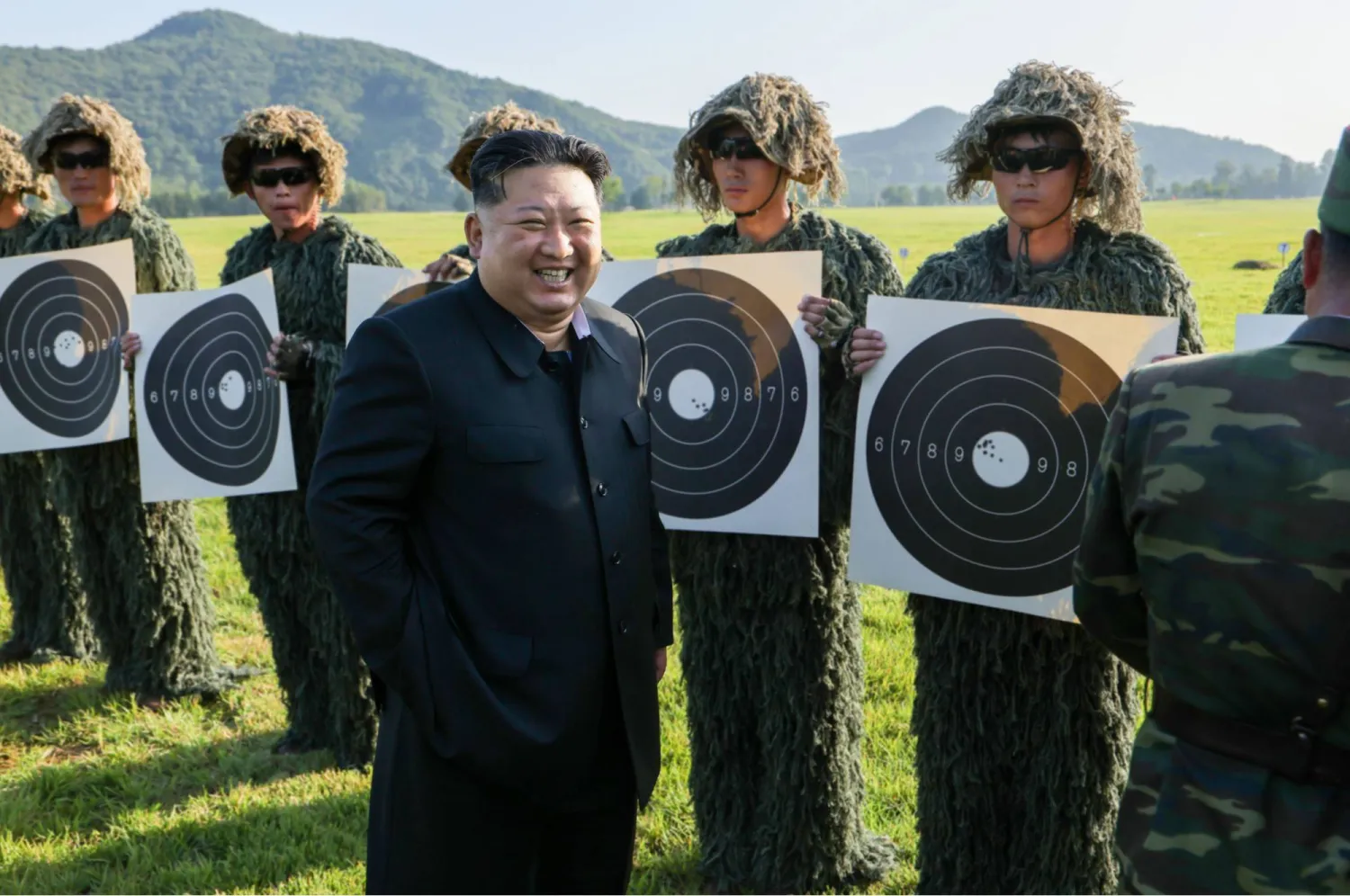
HANDOUT - 13 September 2025, North Korea, --: A photo released by the North Korean State News Agency (KCNA) on September 12, 2025 shows North Korean leader Kim Jong-un (C) overseeing a shooting contest between troops of the sniper subunits belonging to the metropolitan garrison command and the special mobile force of the central security organ. Photo: -/KCNA/KNS/dpa
TT

North Korea Says to Boost Nuclear Arsenal, Conventional Military

HANDOUT - 13 September 2025, North Korea, --: A photo released by the North Korean State News Agency (KCNA) on September 12, 2025 shows North Korean leader Kim Jong-un (C) overseeing a shooting contest between troops of the sniper subunits belonging to the metropolitan garrison command and the special mobile force of the central security organ. Photo: -/KCNA/KNS/dpa

North Korean leader Kim Jong Un said Pyongyang will unveil a policy to advance both its nuclear arsenal and conventional military power at an upcoming key ruling party meeting, state media said Saturday.

Since a failed summit with the United States in 2019, North Korea has repeatedly said it will never give up its nuclear weapons and declared itself an "irreversible" nuclear state.

While visiting weapons research facilities this week, Kim said Pyongyang "would put forward the policy of simultaneously pushing forward the building of nuclear forces and conventional armed forces,” according to the state-run Korean Central News Agency.

Kim also emphasized the need to "modernize" the country's conventional armed forces, without specifying the date of the party meeting.

The North Korean leader has been emboldened by the war in Ukraine, securing critical support from Russia after sending thousands of North Korean troops to fight alongside Moscow.

Moscow and Pyongyang signed a mutual defense pact last year when Russian President Vladimir Putin visited the reclusive state.

Seoul has repeatedly warned that Russia is stepping up support for Pyongyang, including the potential transfer of sensitive Russian military technology, in return for North Korea's assistance in fighting Ukraine.

"In essence, it reflects (Kim's) view that nuclear forces alone have limits as a deterrent, and that Pyongyang is seeking to boost its war-fighting capability by modernizing its conventional arsenal," Hong Min, a senior analyst at the Korea Institute for National Unification, told AFP.

"North Korea's military technology cooperation with Russia seems to be also expanding into the conventional arms sector, and modernization plans tailored to 'modern warfare' are likely to be laid out as a mid- to long-term agenda" at the upcoming meeting, he added.

At the last party congress in January 2021, Kim unveiled an ambitious military agenda, pledging to develop advanced weapons such as military spy satellites and solid-fuel intercontinental ballistic missiles.

Analysts say they expect the upcoming meeting to be held early next year.

Kim and Putin flanked China's President Xi Jinping at a massive parade in Beijing this month, drawing an acidic response from US President Donald Trump, who accused the three leaders of plotting against the United States.



12 Schoolchildren Killed in South Africa Crash

File photo: A general view of the scene of a bus accident in Ekurhuleni on March 11, 2025. (AFP)
TT

12 Schoolchildren Killed in South Africa Crash

File photo: A general view of the scene of a bus accident in Ekurhuleni on March 11, 2025. (AFP)

A minibus carrying school students collided with a truck south of Johannesburg on Monday, killing 12 pupils, police said.

It was the latest in a string of deadly crashes in a country whose modern road network is undermined by rampant speeding, reckless driving and poorly maintained vehicles.

The crash happened near the industrial city of Vanderbijlpark, about 60 kilometers (40 miles) south of Johannesburg.

Police said the driver of the minibus appeared to have lost control while attempting to overtake other vehicles.

Eleven students died at the scene and another in hospital, provincial education minister Matome Chiloane told reporters at the scene.

He did not know the ages of the children involved but said they were from primary schools, where pupils are aged from six years, and also high schools.

Images on social media showed the crushed minibus on the roadside with distraught parents gathered behind the police tape. Some broke down in wails when they were allowed to see the bodies.

"It is a terrible scene," Gauteng premier Panyaza Lesufi said.

More than 11,400 lives were lost on South African roads in 2025, according to the latest data from the transport ministry.

Many South African parents have to rely on private minibuses to get their children to school.

In October, 18 children were badly hurt when their minibus lost control and overturned on a highway in KwaZulu-Natal.

At least five students were killed and eight others injured in September when a school minibus ploughed into a creche in a KwaZulu-Natal township.


Glitch Delays Restart of World's Biggest Nuclear Plant in Japan

Local Japanese authorities have approved the restart of the world's biggest nuclear power facility, the Kashiwazaki-Kariwa Nuclear Power Plant, for the first time since the 2011 Fukushima disaster. STR / JIJI Press/AFP
TT

Glitch Delays Restart of World's Biggest Nuclear Plant in Japan

Local Japanese authorities have approved the restart of the world's biggest nuclear power facility, the Kashiwazaki-Kariwa Nuclear Power Plant, for the first time since the 2011 Fukushima disaster. STR / JIJI Press/AFP

A technical glitch pushed back the restart of the world's biggest nuclear reactor in Japan, its operator said on Monday, a day before local media reported it would go online.

Tokyo Electric Power Company (TEPCO) said it would need another day of two to check the equipment at the Kashiwazaki-Kariwa plant, which media reports said was set to restart on Tuesday.

The plant was taken offline when Japan pulled the plug on nuclear power after a colossal earthquake and tsunami sent three reactors at the Fukushima plant into meltdown in 2011.

The Kashiwazaki-Kariwa facility would be the first nuclear plant that Fukushima operator TEPCO restarts since the disaster.

The company has never publicly announced a date to switch on the plant.

TEPCO has decided to run more checks after detecting a technical issue on Saturday related to an alarm linked to one of the reactors at Kashiwazaki-Kariwa, company spokesman Isao Ito told AFP.

The alarm issue had been fixed by Sunday, he added.

After the final checks, the utility will explain to nuclear authorities what had happened and proceed to restart the plant, the spokesman said, without providing an exact timeline.

More than a decade since the Fukushima accident, Japan now wants to revive atomic energy to reduce its dependence on fossil fuels, achieve carbon neutrality by 2050 and meet growing energy needs from artificial intelligence.

But it is a divisive issue, with many residents worried about nuclear safety.

About 50 people gathered Monday outside TEPCO's headquarters in the capital Tokyo, chanting "No to the restart of Kashiwazaki-Kariwa!"

"TEPCO only mentions a possible delay. But that's not enough," said Takeshi Sakagami, president of the Citizens' Nuclear Regulatory Watchdog Group.

"A full investigation is needed, and if a major flaw is confirmed, the reactor should be permanently shut down," he said at the rally.

The reactor has cleared the nation's nuclear safety standard.

Prime Minister Sanae Takaichi has voiced her support for the use of nuclear power.

Japan is the world's fifth-largest single-country emitter of carbon dioxide, and is heavily dependent on imported fossil fuels.


Trump Says 'World Is Not Secure' Unless US Controls Greenland

Danish soldiers walk in front of Joint Arctic Command in Nuuk, Greenland, January 16, 2026. REUTERS/Marko Djurica
TT

Trump Says 'World Is Not Secure' Unless US Controls Greenland

Danish soldiers walk in front of Joint Arctic Command in Nuuk, Greenland, January 16, 2026. REUTERS/Marko Djurica

President Donald Trump told the Norwegian prime minister in a message published Monday that the world would not be secure unless the US controlled the Danish autonomous territory of Greenland.

"The World is not secure unless we have Complete and Total Control of Greenland," Trump said in the message to Jonas Gahr Store.

The authenticity of the message was confirmed to AFP by Store's office.