

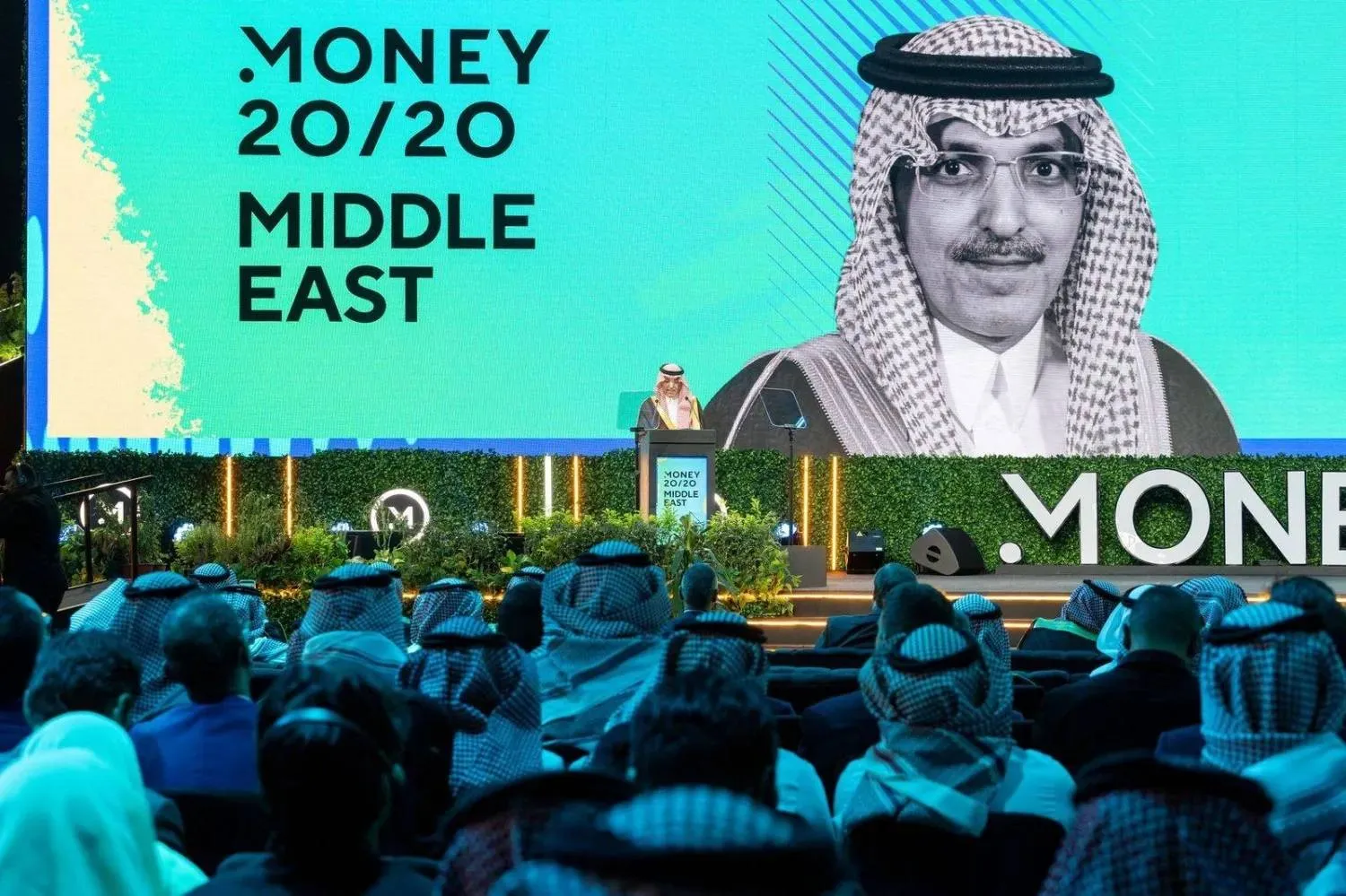

Al-Jadaan: Saudi Arabia’s Financial Market Is Fastest-Growing Worldwide 

Finance Minister Mohammed al-Jadaan speaks at Monday's conference in Riyadh. (Asharq Al-Awsat)
TT

Al-Jadaan: Saudi Arabia’s Financial Market Is Fastest-Growing Worldwide 

Finance Minister Mohammed al-Jadaan speaks at Monday's conference in Riyadh. (Asharq Al-Awsat)

Saudi Arabia’s financial market has surged past $2.4 trillion, making it the fastest-growing globally, as the Kingdom doubles down on fintech, digital payments and artificial intelligence to diversify its economy and cement its role as a financial center.

Finance Minister Mohammed al-Jadaan used the opening of the Money20/20 Middle East conference in Riyadh to reassure investors amid recent market declines, pointing to sharp gains in electronic payments, which climbed to 79% of total transactions last year from 18% in 2016, as evidence of progress toward a cashless economy.

“This growth reflects tangible progress in diversifying the economy and opening new horizons for investors,” said al-Jadaan, who also chairs the Financial Sector Development Program.

The Riyadh event, which drew ministers, regulators, and investors managing assets of more than $7 trillion, comes at a turbulent time for global markets. Geopolitical tensions and rising interest rates have clouded the outlook and pushed up the cost of capital.

Against that backdrop, al-Jadaan said Saudi Arabia is not merely adapting but contributing to shaping financial innovation.

“The Kingdom seeks to play an active role in shaping the future of finance through fintech and AI,” he stressed.

Riyadh as a financial hub

The minister said hosting Money20/20 highlighted Saudi Arabia’s emergence as a global financial hub, reflecting its deep commitment to innovation and entrepreneurship. The push forms part of Crown Prince Mohammed bin Salman’s Vision 2030, which aims to diversify the economy, boost resilience and build private-sector partnerships.

Global growth remains below historic levels, Jadaan said, with high borrowing costs and geopolitical frictions fueling uncertainty. But Saudi Arabia, he argued, is positioning itself as a provider of solutions, citing the digital revolution, AI and emerging sectors offering “unprecedented opportunities” for investment.

Fintech surge

The number of active fintech firms in Saudi Arabia has more than doubled in recent years, reaching 280 by mid-2025 compared with fewer than 20 a decade ago. The insurance sector expanded by 16.3% last year, while regulatory sandboxes have tested experimental financial products.

Al-Jadaan highlighted steps to deepen capital markets, including the launch of Saudi Arabia’s first mortgage-backed securities program. He also noted JP Morgan’s move to put Saudi riyal-denominated sovereign sukuk under review for possible inclusion in its benchmark Emerging Market Bond Index, a development that could expand investor access and broaden funding channels. “Youth are our most important investment,” al-Jadaan added, pointing out that more than 70% of Saudis are under 35, forming the driving force of Vision 2030 and the source of financial innovation.

Central bank: beyond supervision

Saudi Central Bank Governor Ayman al-Sayari said the fintech sector has tripled since 2022, attracting more than 9 billion riyals ($2.4 billion) in global investment.

He credited Saudi Arabia’s strategic location, tech-savvy population and supportive regulatory environment for luring innovators and investors.

The central bank, he said, is moving beyond oversight to actively foster innovation through initiatives such as its regulatory sandbox, Fintech Saudi, and instant payments platforms.

“Opportunities and risks in fintech cross borders,” he said, stressing the need for global cooperation and standardized frameworks to ensure sustainable growth.

According to al-Sayari, financial services will increasingly be shaped by artificial intelligence, tokenization and other technologies, with the Saudi central bank aiming to remain an open, forward-looking and trusted partner.

From retail-heavy to balanced markets

Capital Market Authority chairman Mohammed al-Kuwaiz noted that Saudi Arabia’s market had shifted from one dominated by retail investors to a more balanced mix of individuals and institutions.

“Before Vision 2030, retail investors accounted for 80–90% of trades. That brought liquidity but also volatility and herd behavior,” he said.

Today, institutional participation and a wider mix of investors – domestic and foreign, fundamental and technical – have reduced volatility.

While the market has fallen about 10% so far this year, al-Kuwaiz said overall swings had narrowed over the past eight years.

New digital services

The Riyadh gathering also marked the launch of new digital payment services. Google Pay and China’s Alipay+ announced their entry into the Saudi market, in cooperation with the central bank, expanding options for consumers and underlining the Kingdom’s bid to become a fintech hub.

Separately, the central bank unveiled the start of operations at Vision Bank, a new digital lender. The move is part of efforts to strengthen competition, reinforce financial stability, boost economic growth and enhance transparency and trust in the banking system.

Global backdrop

The conference took place against a global backdrop of uncertainty, with geopolitical tensions and trade disputes adding to the pressure of high interest rates. Al-Jadaan said these shifts had redefined the cost of capital and underscored the need for innovative financial solutions.

He stressed that Saudi Arabia is not merely weathering these global changes but actively shaping responses, including through digital transformation and AI.

“The future of finance will be built on innovation, technology and public-private partnerships,” he said.




China Passes Revised Foreign Trade Law to Bolster Trade War Capabilities

Containers are seen at the port in Shanghai, China, Oct. 13, 2025. (AFP)
TT

China Passes Revised Foreign Trade Law to Bolster Trade War Capabilities

Containers are seen at the port in Shanghai, China, Oct. 13, 2025. (AFP)

China on Saturday passed revisions to a key piece of legislation aimed at strengthening Beijing's ability to wage trade war, curb outbound shipments from strategic minerals, and further open its $19 trillion economy.

The latest revision to the Foreign Trade Law, approved by China's top legislative body, will take effect on March 1, 2026, state news agency Xinhua reported on Saturday.

The world's second-largest economy is overhauling its trade-related legal frameworks partly to convince members of a major trans-Pacific trade bloc created to counter China's growing influence that the manufacturing powerhouse ‌deserves a seat at ‌the table, as Beijing seeks to reduce ‌its ⁠reliance on the US.

Adopted ‌in 1994 and revised three times since China joined the World Trade Organization in 2001, most recently in 2022, the Foreign Trade Law empowers policymakers to hit back against trading partners that seek to curb its exports and to adopt mechanisms such as "negative lists" to open restricted sectors to foreign firms.

The revision also adds a provision that foreign trade should "serve national economic and social development" and help build China ⁠into a "strong trading nation", Xinhua said.

It further "expands and improves" the legal toolkit for countering external challenges, according ‌to the report.

The revision focuses on areas such ‍as digital and green trade, along ‍with intellectual property provisions, key improvements China needs to make to meet the ‍standards of the Comprehensive and Progressive Agreement for Trans-Pacific Partnership, rather than the trade defense tools the 2020 revamp honed in on following four years of tariff war with the first Trump administration.

Beijing is also sharpening the wording of its powers in anticipation of potential lawsuits from private firms, which are becoming increasingly prominent in China, according to trade diplomats.

"Ministries have become more concerned about private sector criticism," ⁠said one Western trade diplomat with decades' of experience working with China. "China is a rule-of-law country, so the government can stop a company's shipment, but it needs a reason."

"It's not totally lawless here. Better to have everything written out in black and white," they added, requesting anonymity, as they were not authorized to speak with media.

China's private exporting firms attracted global attention in November after the French government moved to suspend the Chinese e-commerce platform Shein.

The Chinese government increasingly could also find itself at odds with private enterprise when seeking to carry out sweeping bans, ‌such as Beijing's prohibition of all Japanese seafood imports, as Asia's top two economies continue to feud over Taiwan, trade diplomats say.


Lebanese Cabinet Approves Draft Law on Financial Crisis Losses

A photograph released by the Lebanese Government Press Office on December 26, 2025, show Prime Minister Nawaf Salam speaking during a press conference after a cabinet session in Beirut on December 26, 2025. (Photo by Handout / Lebanese Government Press Office / AFP)
TT

Lebanese Cabinet Approves Draft Law on Financial Crisis Losses

A photograph released by the Lebanese Government Press Office on December 26, 2025, show Prime Minister Nawaf Salam speaking during a press conference after a cabinet session in Beirut on December 26, 2025. (Photo by Handout / Lebanese Government Press Office / AFP)

Lebanon's government on Friday approved a draft law to distribute financial losses from the 2019 economic crisis that deprived many Lebanese of their deposits despite strong opposition to the legislation from political parties, depositors and banking officials.

The draft law will be submitted to the country's divided parliament for approval before it can become effective.

The legislation, known as the "financial gap" law, is part of a series of reform measures required by the International Monetary Fund (IMF) in order to access funding from the lender.

The cabinet passed the draft bill with 13 ministers in favor and nine against. It stipulates that each of the state, the central bank, commercial banks and depositors will share the losses accrued as a result of the financial crisis.

Prime Minister Nawaf Salam defended the bill, saying it "is not ideal... and may not meet everyone's aspirations" but is "a realistic and fair step on the path to restoring rights, stopping the collapse... and healing the banking sector.”

According to government estimates, the losses resulting from the financial crisis amounted to about $70 billion, a figure that is expected to have increased over the six years that the crisis was left unaddressed.

Depositors who have less than $100,000 in the banks, and who constitute 85 percent of total accounts, will be able to recover them in full over a period of four years, Salam said.

Larger depositors will be able to obtain $100,000 while the remaining part of their funds will be compensated through tradable bonds, which will be backed by the assets of the central bank.

The central bank's portfolio includes approximately $50 billion, according to Salam.

The premier told journalists that the bill includes "accountability and oversight for the first time.”

"Everyone who transferred their money before the financial collapse in 2019 by exploiting their position or influence... and everyone who benefited from excessive profits or bonuses will be held accountable and required to pay compensation of up to 30 percent of these amounts," he said.

Responding to objections from banking officials, who claim components of the bill place a major burden on the banks, Salam said the law "also aims to revive the banking sector by assessing bank assets and recapitalizing them.”

The IMF, which closely monitored the drafting of the bill, previously insisted on the need to "restore the viability of the banking sector consistent with international standards" and protect small depositors.

Parliament passed a banking secrecy reform law in April, followed by a banking sector restructuring law in June, one of several key pieces of legislation aimed at reforming the financial system.

However, observers believe it is unlikely that parliament will pass the current bill before the next legislative elections in May.

Financial reforms in Lebanon have been repeatedly derailed by political and private interests over the last six years, but Salam and Lebanese President Joseph Aoun have pledged to prioritize them.


Türkiye Says Russia Gave It $9 Billion in New Financing for Akkuyu Nuclear Plant

Türkiye’s Energy Minister Alparslan Bayraktar talks during a meeting in Ankara, Türkiye, September 14, 2023. (Reuters)
TT

Türkiye Says Russia Gave It $9 Billion in New Financing for Akkuyu Nuclear Plant

Türkiye’s Energy Minister Alparslan Bayraktar talks during a meeting in Ankara, Türkiye, September 14, 2023. (Reuters)

Türkiye's energy minister said Russia had provided new financing worth $9 billion for the Akkuyu nuclear power plant being built by ​Moscow's state nuclear energy company Rosatom, adding Ankara expected the power plant to be operational in 2026.

Rosatom is building Türkiye's first nuclear power station at Akkuyu in the Mediterranean province of Mersin per a 2010 accord worth $20 billion. The plant was expected ‌to be operational ‌this year, but has been ‌delayed.

"This (financing) ⁠will ​most ‌likely be used in 2026-2027. There will be at least $4-5 billion from there for 2026 in terms of foreign financing," Alparslan Bayraktar told some local reporters at a briefing in Istanbul, according to a readout from his ministry.

He said ⁠Türkiye was in talks with South Korea, China, Russia, and ‌the United States on ‍nuclear projects in ‍the Sinop province and Thrace region, and added ‍Ankara wanted to receive "the most competitive offer".

Bayraktar said Türkiye wanted to generate nuclear power at home and aimed to provide clear figures on targets.