Oil Prices Little Changed as Russia, Mideast Concerns Offset by Oversupply Worryhttps://english.aawsat.com/business/5188997-oil-prices-little-changed-russia-mideast-concerns-offset-oversupply-worry
Oil Prices Little Changed as Russia, Mideast Concerns Offset by Oversupply Worry
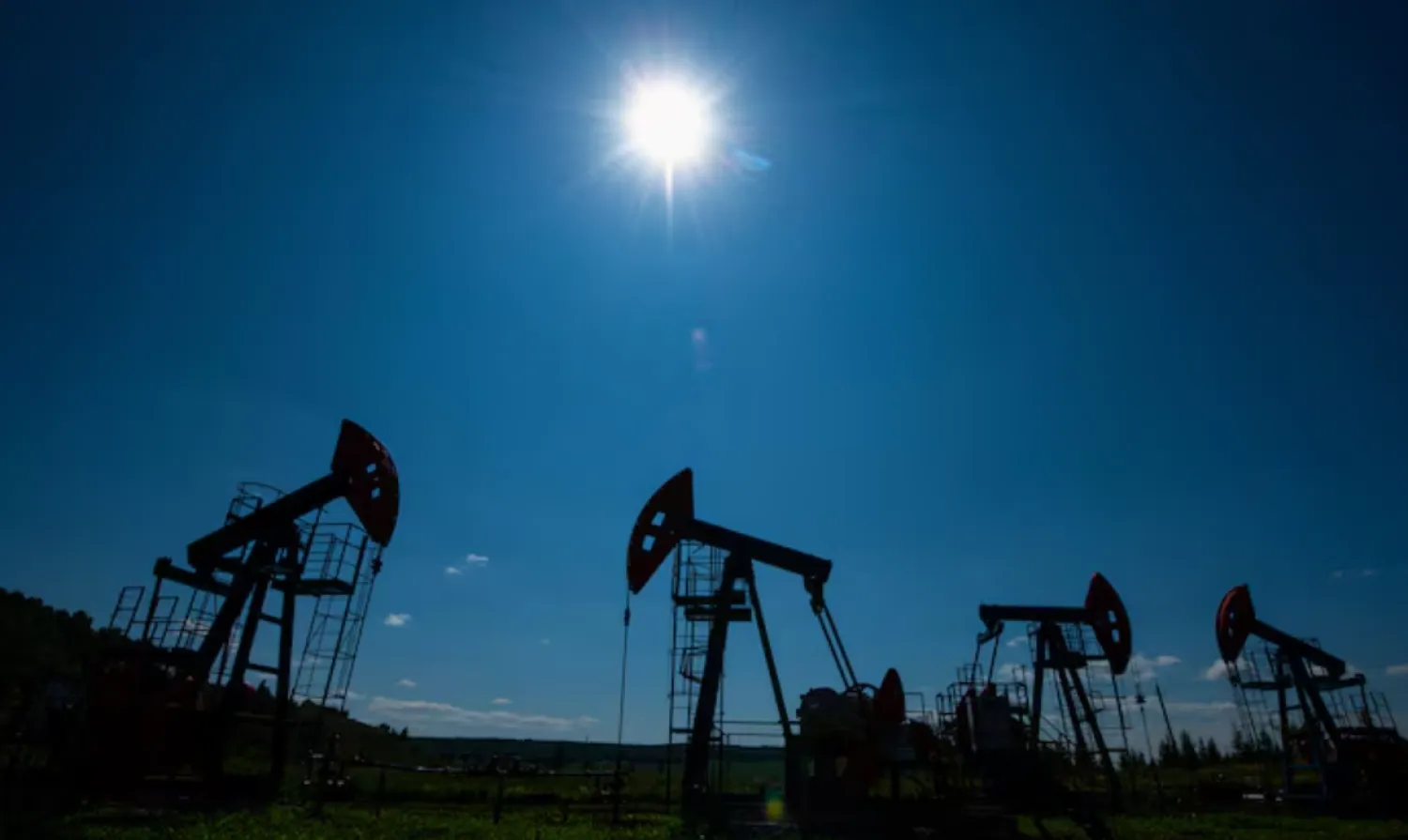
A view shows oil pump jacks outside Almetyevsk, in the Republic of Tatarstan, Russia July 14, 2025. REUTERS/Stringer/File Photo
Oil prices were little changed on Monday as concerns over Russia and the Middle East were countered by oversupply jitters.
Brent crude oil futures, which have traded between around $65.50 and $69 a barrel since early August, dipped 12 cents, or 0.2%, to $66.56 a barrel by 1000 GMT while the US West Texas Intermediate crude contract for October was at $62.65 a barrel, down 3 cents, or 0.1%.
The October WTI contract expires on Monday and the more active November contract fell 18 cents, or 0.3%, to $62.22 a barrel, Reuters reported.
Polish and allied aircraft were deployed early on Saturday to ensure the safety of Polish airspace after Russia launched airstrikes targeting western Ukraine near the border with Poland, armed forces of the NATO-member country said.
The deployment came after three Russian military jets violated NATO Estonia's airspace for 12 minutes on Friday.
In the Middle East, four Western nations recognised a Palestinian state, prompting a furious response from Israel and adding to jitters in the key oil-producing region.
Brent and WTI settled down more than 1% on Friday to mark a slight decline last week as worries about large supplies and declining demand weighed on sentiment.
"The setup for the oil market is that global oil demand is set to taper off from Q3 to Q4 and again to Q1-26. At the same time production by OPEC+ is on a rising path," said SEB analysts.
"The big question is of course if China will stockpile the increasing surplus or whether the oil price will be pushed lower into the 50ies. We believe the latter."
Iraq, OPEC's second-largest producer, has increased oil exports under an OPEC+ agreement, state oil marketer SOMO said on Sunday.
SOMO expects September's average exports to range from 3.4 million to 3.45 million bpd.
Iraq has also given preliminary approval to a plan to resume pipeline oil exports from its semi-autonomous Kurdistan region through Türkiye following delays to a hoped-for restart, sources familiar with the talks told Reuters.
IFAD to Asharq Al-Awsat: Repercussions of Hormuz Closure Trigger Global Food Security Shockhttps://english.aawsat.com/business/5264575-ifad-asharq-al-awsat-repercussions-hormuz-closure-trigger-global-food-security
IFAD to Asharq Al-Awsat: Repercussions of Hormuz Closure Trigger Global Food Security Shock
A container ship is seen in the Strait of Hormuz off the coast of Qeshm Island, Iran, Saturday, April 18, 2026. (AP Photo/Asghar Besharati)
The International Fund for Agricultural Development (IFAD) said the repercussions of the closure of the Strait of Hormuz have triggered a global food security shock, warning that disruptions to fertilizer and fuel supplies, rising input costs, and declining purchasing power are threatening production at a critical point in the agricultural season. This is driving food prices higher and will severely affect the world’s most vulnerable populations.
Gerardine Mukeshimana, Vice President of IFAD, told Asharq Al-Awsat that the repercussions of the US-Israeli-Iranian conflict have led to a global food security shock that has already begun to manifest in local food crises, particularly for small-scale producers and rural populations.
On this Mukeshimana said “The ripple effects of the conflict have triggered a global food security shock that is already translating into local food crises, particularly for small-scale producers and rural populations. While it is too early to quantify a precise global ‘food gap,’ nor foresee all possible consequences, we do know that many of the women and men who produce our food are already under pressure.”
Critical timing and heightened risks
Mukeshimana stressed the seriousness of the timing, as farmers across nearly half the world are entering critical agricultural seasons between March and June. Any shortage of inputs at this stage will inevitably lead to lower yields and reduced food availability in the coming months.
“Between March and June, farmers across nearly half the world enter critical planting seasons, meaning that input shortfalls and price spikes today risk lower harvests and tighter food availability in the months ahead. As past crises have shown, these shocks do not originate at the farm level, but they ultimately land there, among those with the least capacity to absorb them.”
Impact of shipping disruptions on agricultural production
On the repercussions of the closure of the Strait of Hormuz on the passage of ships carrying agricultural inputs and fertilizers, and estimates of losses over the past 40 days, Mukeshimana said: “The abrupt halt and severe disruption of shipping through the Strait of Hormuz and Bab el-Mandeb has had immediate repercussions for fertilizers, fuel and other agricultural inputs. While exact volume losses over the past 40 days vary by commodity and route, evidence from IFAD investments points to significant shipment delays, curtailed exports and cascading market effects, from reduced planting to distorted farm-gate prices and declining rural incomes, as gathered in detail by the position paper, ‘Global shock, local crisis,’ published by Alvaro Lario, President of IFAD this week.”
She noted that these impacts are clearly reflected in shrinking cultivated areas, distortions in agricultural price structures, and a deterioration in farmers’ net incomes, as documented in the position paper issued this week by IFAD President Alvaro Lario titled “Global shock, local crisis,” which warned that international logistical disruptions are translating into severe local livelihood crises.
Vice-President of IFAD Gerardine Mukeshimana (Asharq Al-Awsat)
Import-dependent countries in a double bind
“The supply chain disruptions are cutting off farmers’ access to markets to both purchase inputs – such as seeds, veterinary medicines, and equipment – and sell their products both domestically and as exports. The result: farmers’ expenses rise as their income drops.”
Mukeshimana said this represents a global risk, as small-scale farmers produce about one-third of the world’s food, and up to 70 percent in Africa. When their production declines due to input shortages, it leads to reduced output, higher prices, deeper vulnerability, and rising hunger.
She warned that these repercussions directly translate into lower production levels, rising prices, and worsening economic vulnerability, ultimately expanding the scope of hunger.
Mukeshimana added that countries that rely on imports face a double bind, as fertilizer shortages and rising costs compound existing pressures from climate shocks, armed conflict, and accumulated debt, making it extremely difficult for these countries to withstand the current crisis.
“In import-dependent countries, fertilizer shortages and price spikes amplify existing pressures from climate shocks, conflict, and debt. Left unaddressed, these shocks can drive wider development setbacks, hunger, increasing humanitarian needs, forced migration, conflict and political instability.”
Inflation Woes and Firmer Dollar Drag Gold Lower as US-Iran Tensions Revivehttps://english.aawsat.com/business/5264513-inflation-woes-and-firmer-dollar-drag-gold-lower-us-iran-tensions-revive
Inflation Woes and Firmer Dollar Drag Gold Lower as US-Iran Tensions Revive
A display of gold bars, each weighing 1000 grams, at a gold and silver refinery in Vienna (AFP)
Gold prices fell on Monday owing to a stronger US dollar and renewed inflation fears after another closure of the Strait of Hormuz pushed oil prices higher.
Spot gold was down 0.8% at $4,790.59 per ounce, as of 1103 GMT, after hitting its lowest since April 13 earlier in the session.
US gold futures for June delivery fell 1.4% to $4,811.
"Oil's surge after the weekend's chaotic events surrounding the Strait of Hormuz ensure that inflation risks remain palpable, offsetting gold's allure as a safe-haven asset. The precious metal has taken a backseat to the dollar's role as the preferred safe haven throughout the conflict so far," said Han Tan, chief market analyst at Bybit, Reuters reported.
"Barring meaningful and sustained de-escalations in the ongoing conflict, spot gold is expected to keep treading water in these sub-$5,000 levels."
The US said on Sunday that it had took over an Iranian cargo ship that tried to break through its blockade while Iran said it would retaliate, heightening fears of a resumption of hostilities.
Oil prices jumped around 5% on fears that the ceasefire between the United States and Iran could collapse and traffic through the Strait of Hormuz remained largely halted.
The dollar index strengthened, making greenback-priced bullion more expensive for holders of other currencies. Benchmark 10-year US Treasury yields gained, increasing the opportunity cost of holding non-yielding bullion.
Although gold is considered an inflation hedge and a safe haven during geopolitical and economic uncertainty, rising energy costs stemming from the war in Iran have stoked inflation concerns and pushed the yellow metal lower on expectations of monetary tightening by the US Federal Reserve.
"Nonetheless, gold retains the ability to extend its recent rebound as structural demand drivers persist. Central bank buying, de-dollarization and currency debasement trends may have faded but remain alive and can support bullion," said Nikos Tzabouras, senior market analyst at Jefferies-owned Tradu.com.
Among other metals, spot silver lost 2.1% to $79.07 per ounce, platinum fell 1.7% to $2,066.90, and palladium was down 1.6% at $1,533.64.
European Shares Slip as Hopes for US-Iran Peace Fadehttps://english.aawsat.com/business/5264461-european-shares-slip-hopes-us-iran-peace-fade
The German share price index DAX graph is pictured at the stock exchange in Frankfurt, Germany, April 17, 2026. (Reuters)
TT
TT
European Shares Slip as Hopes for US-Iran Peace Fade
The German share price index DAX graph is pictured at the stock exchange in Frankfurt, Germany, April 17, 2026. (Reuters)
European shares declined on Monday, as hopes for peace in the Middle East ebbed with tensions reigniting after Washington seized an Iranian cargo ship that tried to run its blockade and Tehran vowed to retaliate.
Investors have grown increasingly jittery as the US-Iran ceasefire, set to expire Tuesday, appears fragile.
Iran rejected fresh peace talks with the US just hours after President Donald Trump said he would dispatch envoys to Pakistan while threatening new strikes unless Tehran accepts his terms.
The pan-European STOXX 600 index was down 0.8% to 621.52 points as of 0717 GMT.
Major regional markets also fell, with France's CAC and Germany's DAX down 0.9% and 1%, respectively.
The uncertainty marks a sharp reversal from Friday's optimism, when the STOXX 600 jumped more than 1% and secured its fourth consecutive weekly gain after Iran declared the Strait of Hormuz open.
Energy shares gained 1.9% as crude prices surged., while utilities and telecommunication stocks rose 0.7% and 0.2%, respectively.
Travel and leisure sector led the declines, bearing, down 2%. Banks and automobile stocks dropped 1.8% each.
Among other movers, cash logistics company Loomis was top loser on the European benchmark index after Goldman Sachs downgraded the stock to "neutral" from "buy".
The setback in the Middle East conflict comes despite tentative signs of normalization at the Strait of Hormuz.
Although Iran has reimposed a closure of the critical waterway, Kpler data revealed more than 20 vessels carrying oil, metals, gas, and fertilizer passed through on Saturday - the busiest traffic day since March 1.
Elevated oil prices continue to weigh heavily on energy-dependent European economies, keeping investors cautious.
The strait is a conduit for one-fifth of global energy shipments. Brent crude futures advanced 5.3% to $95.19 a barrel after tumbling 9% on Friday.
لم تشترك بعد
انشئ حساباً خاصاً بك لتحصل على أخبار مخصصة لك ولتتمتع بخاصية حفظ المقالات وتتلقى نشراتنا البريدية المتنوعة