Saudi FM Meets with Turkish Counterpart

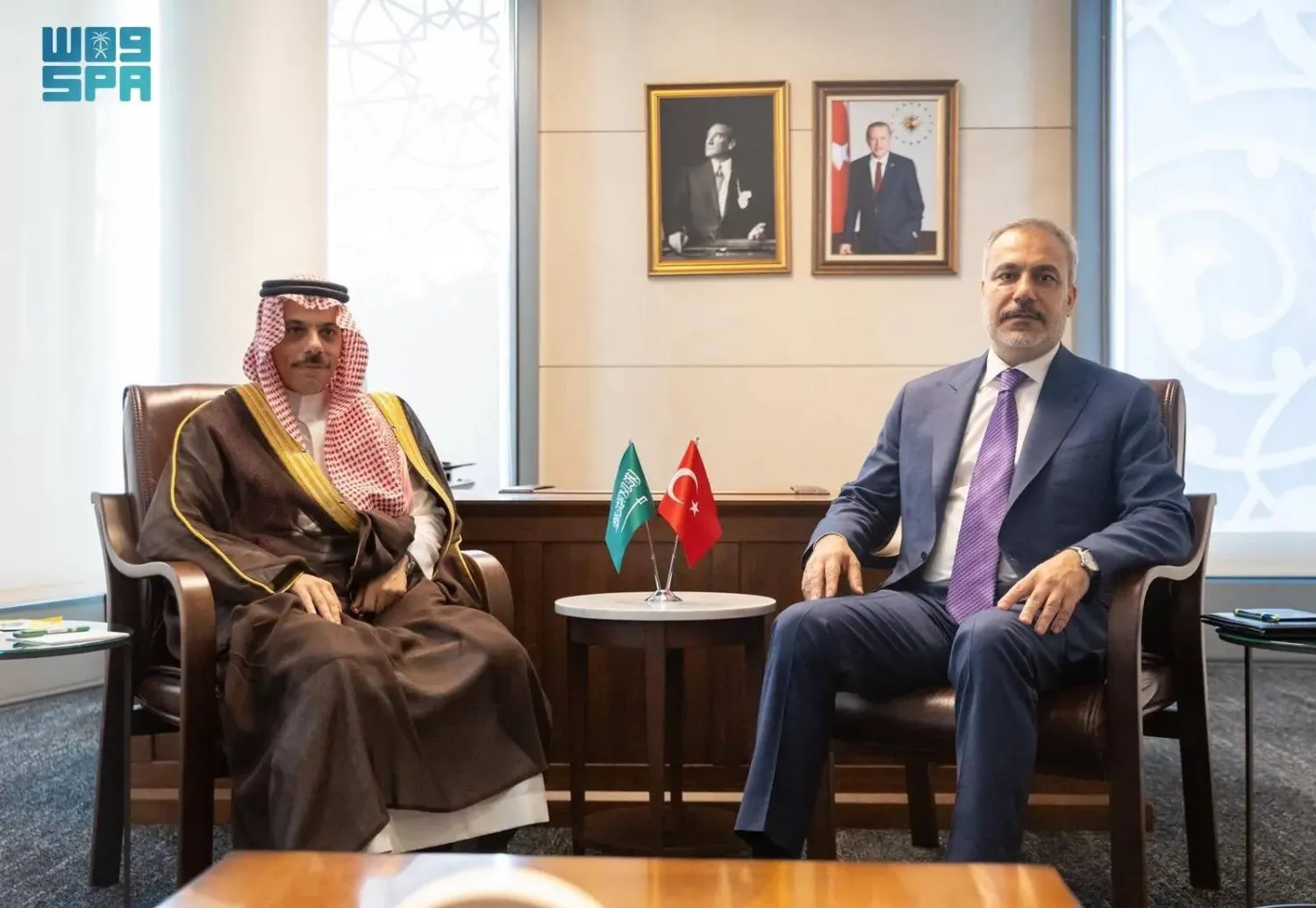
Saudi Minister of Foreign Affairs Prince Faisal bin Farhan bin Abdullah met with Turkish Minister of Foreign Affairs Hakan Fidan. (SPA)
TT

Saudi FM Meets with Turkish Counterpart

Saudi Minister of Foreign Affairs Prince Faisal bin Farhan bin Abdullah met with Turkish Minister of Foreign Affairs Hakan Fidan. (SPA)

Saudi Minister of Foreign Affairs Prince Faisal bin Farhan bin Abdullah met on Monday with Turkish Minister of Foreign Affairs Hakan Fidan on the sidelines of the 80th session of the United Nations General Assembly.

The two officials reviewed relations between their two countries and ways to promote them at various levels.

They also discussed regional and international developments, the Saudi Press Agency said on Tuesday.


Al-Mahrami: Saudi Arabia Backs the Solution for Southern Yemen without Preconditions

Officials are seen at the consultative meeting on southern Yemen in Riyadh on Sunday. (Asharq Al-Awsat)
TT

Al-Mahrami: Saudi Arabia Backs the Solution for Southern Yemen without Preconditions

Officials are seen at the consultative meeting on southern Yemen in Riyadh on Sunday. (Asharq Al-Awsat)

A consultative meeting on southern Yemen kicked off in Riyadh on Sunday. The meeting brings together leaderships, elders and senior figures from southern Yemen. 

In a statement, the gatherers said the meeting reflects the South’s “collective will to search for a just, secure and guaranteed solution” to the southern cause “away from escalation or attempts to create secondary conflicts that do not serve the South and its future.” 

They praised Saudi Arabia’s “clear” support for their cause as demonstrated in direct meetings with its leaders and officials, said the statement that was read by member of Yemen’s Presidential Leadership Council (PLC) Abou Zaraa Al-Mahrami. 

Saudi Arabia’s positions “align completely with the just demands of the people of the South and back their right to reach a comprehensive political solution that guarantees their dignity, security, stability and future without preconditions or political demands.” 

These positions allow the people to determine their political fate and destiny, including reclaiming full sovereignty, added the statement. 

Al-Mahrami said the upcoming Saudi-sponsored intra-southern dialogue “is a rare historic opportunity that should not be squandered or undermined through sparking internal southern disputes.” 

He cautioned against antagonizing the Kingdom or creating disputes with it, saying this “serves the parties that are opposed to our cause.” 

Furthermore, he stressed that no one will be marginalized, explaining that the dialogue is based on the greatest possible partnership and representation of the South. 

“Since arriving in Riyadh, we sensed clear and sincere support for the southern cause. Our presence here played a direct role in meeting the demands of our people and forces,” he continued. 

Al-Mahrami noted the Kingdom’s keenness on supporting the Yemeni people’s daily needs, as well as the country’s economy. 

“We also received direct assurances from Saudi officials that support for the southern forces will continue,” he added. The forces are protecting the South and its security and are deployed at battlefronts. 

The support will consolidate the stability of the South and block attempts to weaken the southern front or raise doubts about its people, he went on to say. 

The statement said Saudi Arabia’s economic and development support “are the pillars for the future partnership” between the South and the Kingdom. 

“Today’s meeting will pave the way for a real strategic future based on security, stability and development,” it stressed. 

Moreover, the statement noted that Saudi Arabia had been at the forefront in protecting the South against all threats. “It is the main partner in maintaining its security and stability and backing its just cause,” it added. 

“Saudi Arabia’s stances have proven that the Kingdom has and continues to be a sincere supporter and guarantor of the South’s security and stability,” it said. 

“The real danger against the South lies in the Houthi militias and their expansionist agendas against the South and entire region,” it warned. The statement also warned against the threat of ISIS and al-Qaeda. 

“We therefore categorically reject any attempts that aim to raise doubts against the Kingdom’s role,” it said, while also dismissing campaigns against the southern military and security forces led by the Giants Brigades and National Shield forces. 


Saudi FM Discusses Regional Developments in Phone Calls with Counterparts

Saudi Foreign Minister Prince Faisal bin Farhan (Asharq Al-Awsat)
TT

Saudi FM Discusses Regional Developments in Phone Calls with Counterparts

Saudi Foreign Minister Prince Faisal bin Farhan (Asharq Al-Awsat)

Saudi Foreign Minister Prince Faisal bin Farhan bin Abdullah discussed the latest regional developments on Saturday in separate phone calls with his counterparts from Iraq, Jordan, Türkiye and Spain.

Prince Faisal received phone calls from Iraqi Deputy Prime Minister and Foreign Minister Fuad Hussein; Jordanian Deputy Prime Minister, Minister of Foreign Affairs and Expatriates Ayman Safadi; Turkish Foreign Minister Hakan Fidan; and Spanish Foreign Minister José Manuel Albares.

Prince Faisal and Safadi also reviewed coordinated efforts aimed to promote security and stability in the region.


With Saudi Backing, Yemen Moves to Forge Southern Consensus and Restore State Authority in the North

Members of Yemen’s Presidential Leadership Council meet with the Saudi Defense Minister. Saba
TT

With Saudi Backing, Yemen Moves to Forge Southern Consensus and Restore State Authority in the North

Members of Yemen’s Presidential Leadership Council meet with the Saudi Defense Minister. Saba

Yemen’s Presidential Leadership Council took a series of far-reaching decisions on Thursday, including changes to its membership and the appointment of a new prime minister tasked with forming a new government, in a move aimed at reshaping power dynamics within the anti-Houthi camp and strengthening unified sovereign decision-making under declared Saudi support.

In a rapid sequence of decisions, the council revoked Faraj Al-Buhsani's membership, filled the resulting vacancies by appointing Lieutenant General Mahmoud Al-Subaihi and Dr. Salem Al-Khanbashi, accepted the resignation of Prime Minister Salem bin Braik’s government, and named Shaea Mohsen Al-Zandani to form a new cabinet.

The steps, which officials said were taken with Saudi Arabia playing a “decisive” role, are intended to normalize conditions in southern provinces, particularly Hadhramaut, and pave the way for a comprehensive south-to-south dialogue to be hosted in Riyadh.

The decision to strip Al-Buhsani of his membership in the Presidential Leadership Council was not merely a change in personnel, according to the legal reasoning published by official media, but a firm political and legal message.

The decision accused him of “breaching the principle of collective responsibility” and “challenging sovereign decisions.”

It said Al-Buhsani had “exploited his constitutional position to provide political and legal cover for illegal military movements” carried out by what it described as the dissolved Southern Transitional Council, including justifying the mobilization of forces from outside Hadhramaut to attack the province.

He was also accused of endorsing “unilateral measures” led by Aidarous al-Zubaidi, who has been referred to the public prosecutor on charges of high treason, actions that the decision said had contributed to undermining national unity.

The language of the ruling framed those actions as an “armed rebellion outside the framework of the state,” shifting the southern dispute from a political disagreement into a question of allegiance to state institutions and legitimacy.

The move was seen as a heavy blow to the dissolved Transitional Council and its supporters, reaffirming that southern demands must be pursued through constitutional and legal channels and through negotiations under Saudi sponsorship, rather than unilateral military action.

Rebalancing power

The appointment of Dr. Salem Al-Khanbashi, the governor of Hadhramaut, as a member of the Presidential Leadership Council while retaining his local post underscored the priority placed on stability in the oil-rich province.

In a previous interview with Asharq Al-Awsat, Al-Khanbashi said the Saudi position had been “decisive” in the rapid withdrawal of Southern Transitional Council forces from Hadhramaut.

His elevation to the council is seen as recognition of his recent efforts and is expected to strengthen the government camp’s ability to manage political and security conditions in Hadhramaut and across southern Yemen.

The appointment of Lt. Gen. Mahmoud Al-Subaihi, a veteran military commander, was viewed as bolstering the representation of the professional military establishment within the council and sending a reassuring message to forces fighting on the front lines against the Houthis.

Officials said it could also be a step toward unifying military formations under the Ministry of Defense, a key Saudi and international demand.

Accepting the government's resignation and appointing Al-Zandani to form a new cabinet was aimed at renewing government performance to meet the demands of a new phase, shifting from crisis management to rebuilding institutions and improving services.

The move coincided with Saudi Arabia’s announcement of $90 million in financial support to pay salaries, in addition to covering military wages starting Sunday.

Broader context

The latest Yemeni moves cannot be separated from Saudi Arabia’s regional role. Alongside the internal decisions, Riyadh announced a new development package for Yemen worth 1.9 billion Saudi riyals, or about $500 million, and preparations to host a south-to-south dialogue conference, while continuing efforts to reunify military forces.

The Saudi strategy, according to officials, centers on supporting Yemen’s legitimate authority to impose control, unify armed forces, end armed activity outside the state, and facilitate inclusive southern dialogue under its sponsorship to reach a unified vision addressing the southern issue.

Saudi Arabia has also continued its development and humanitarian efforts, linking political stability in Yemen to improved services and living conditions to restore public confidence in state institutions.

These developments come as UN envoy Hans Grundberg has warned of the truce's fragility, stressing that the future of the south cannot be imposed by force.

The changes appear aimed at forging a more cohesive and unified southern leadership capable of entering decisive negotiations over the shape of Yemen’s future state, before turning to the long-delayed settlement in the north, where the Houthis continue to obstruct regional and international efforts to end the conflict and re-enter a peace process to restore stability across Yemen.