


Lebanon Confronted with Political and Israeli Escalation

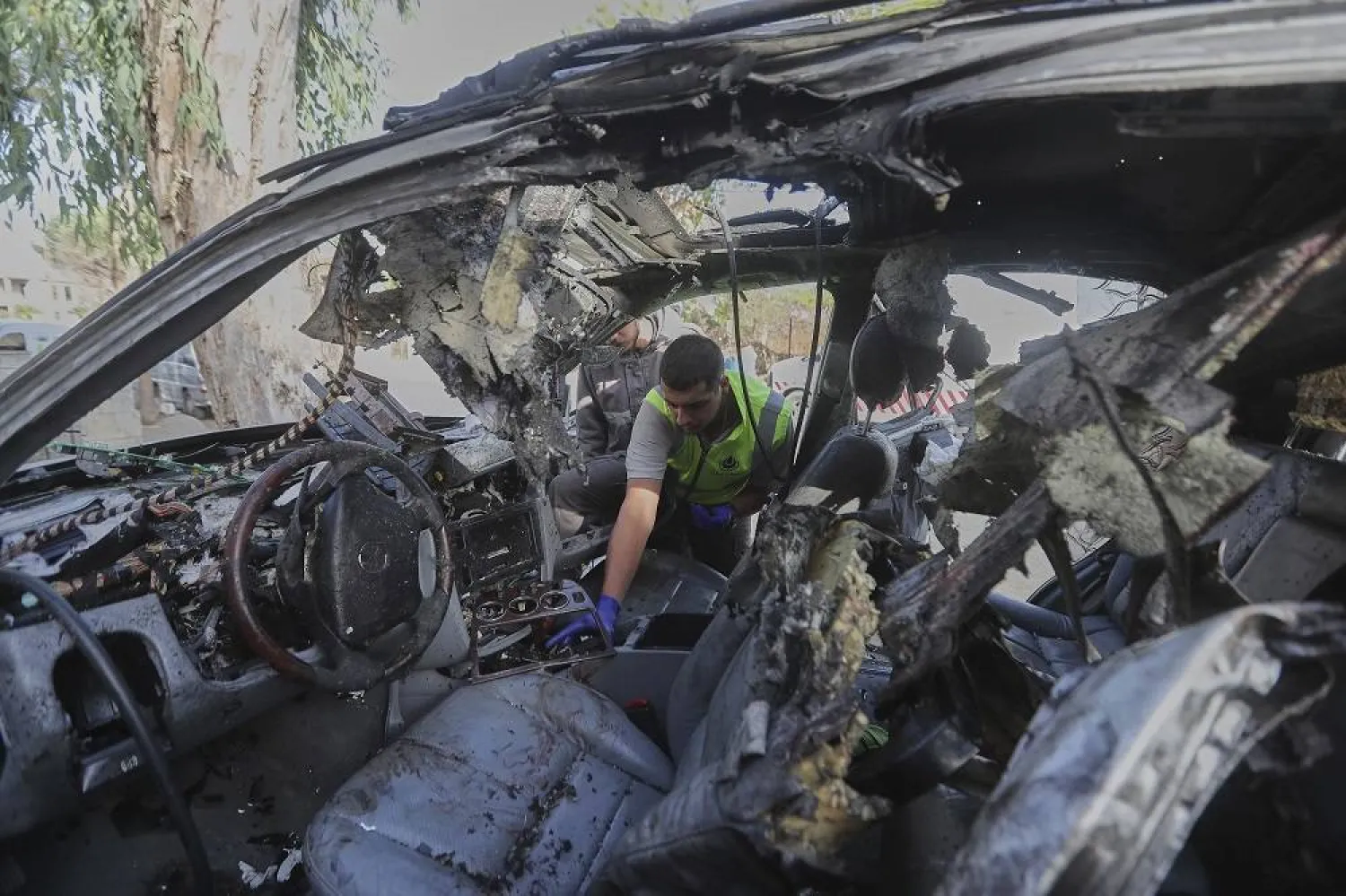
A civil defense worker inspects a damaged car hit the previous day in an Israeli drone strike that killed four members of the same family in Bint Jbeil, southern Lebanon, Monday, Sept. 22, 2025. (AP)
TT

Lebanon Confronted with Political and Israeli Escalation

A civil defense worker inspects a damaged car hit the previous day in an Israeli drone strike that killed four members of the same family in Bint Jbeil, southern Lebanon, Monday, Sept. 22, 2025. (AP)

US envoy Tom Barrack escalated his rhetoric on Sunday, saying Lebanon was in a “difficult” situation and accusing the government of “inaction” in disarming the Hezbollah group.

In an interview with Sky News Arabia, he said there were good people in government, but they haven’t really done anything to disarm the Iran-backed party, raising questions about what the future holds for Lebanon.

He made his remarks on the eve of the one-year anniversary of the eruption of the war between Israel and Hezbollah. A ceasefire was reached in November and called among other things for the disarmament of the party.

Barrack warned that Israel will not withdraw from the Lebanese territories it occupied during the war and that Hezbollah was rebuilding its strength.

The government will have to assume the responsibility for this, he added in blunt remarks.

As much as $60 million a month is flowing to Hezbollah “from somewhere” during this period, he went on to say. The Lebanese people believe that Hezbollah is not rebuilding its strength, but it is.

Barrack stressed that the US will not intervene to confront Hezbollah, whether through its forces or the Central Command.

Moreover, he said the Lebanese army is a “good organization”, but it is not “well-equipped” to handle the threat.

“Hezbollah is our enemy, and Iran is our enemy. We need to cut off the heads of these snakes and stop their funding,” Barrack urged.

Israel refuses to negotiate

It remains to be seen how Barrack’s comments will be reflected on the ground. Retired Major General Abdul Rahman Chehaitli said the situation is obvious and that Israel sees no room for negotiations.

“It will respond through escalation and strikes, the latest of which was the Bint Jbeil massacre on Sunday,” he told Asharq Al-Awsat.

Five people were killed in the strike, including four children.

The Israeli military said it was targeting a Hezbollah member, and that he “operated from within a civilian population.” It acknowledged that civilians were killed and that it was reviewing the incident.

Chehaitli added: “The negotiations we used to see when [US envoy] Amos Hochstein was here are over. Now, we have dictates made to Lebanon and it has to choose whether to implement them or face war.”

“The government chose negotiations and implementing the dictates within Lebanon’s means. It seems Israel is not pleased with this and its answer was clear: the Lebanese state must carry out the Israeli dictates or Tel Aviv will continue its attacks, demonstrated in the Bint Jbeil massacre that took place hours after Barrack’s comments and the ceasefire follow up committee met,” he remarked.

Pressure

Dr. Sami Nader, Director of the Levant Institute for Strategic Affairs, said Israel was pressuring Lebanon to implement the government’s pledge to impose state monopoly over weapons and disarm Hezbollah because the army plan it has adopted to that end does not set a deadline for disarmament.

On the one hand, the army is being encouraged to follow through with the plan, but on the other, there is dissatisfaction because it has not set a deadline, he told Asharq Al-Awsat.

The situation and balance in power allows Israel to carry out this escalation. Lebanon needs to read and understand the situation, he stressed.

Criticism of govt

The Shiite duo of Hezbollah and its ally Amal used the Bint Jbeil attack to slam the government.

Amal’s Development and Liberation bloc MP Ashraf Beydoun said the “massacre is a flagrant violation of international law.

He called on the state to assume its responsibility in protecting civilians, especially those in the South, against these repeated attacks.

Hezbollah MP Ibrahim Moussawi slammed the state, saying: “A state that cannot protect its people, especially its children, cannot be relied upon. A state that claims to be capable of defending and protecting the nation by tearfully pleading with the Americans, cannot be relied upon.”

“The Bint Jbeil massacre is evidence of its complete incompetence,” he declared in a post on the X platform.



Lebanon-Israel Ceasefire Deal: Complete Cessation of Hezbollah Attacks, Creation of Pilot Zones

(L/R) Israel's Ambassador to the US Yechiel Leiter, State Department Chief of Staff Daniel Holler, US Ambassador to Lebanon Michel Issa and Lebanese Ambassador to the US Nada Hamadeh attend a meeting between Israeli and Lebanese delegations hosted by the United States at the State Department in Washington, DC, on June 3, 2026. (Photo by Oliver Contreras / AFP)
TT

Lebanon-Israel Ceasefire Deal: Complete Cessation of Hezbollah Attacks, Creation of Pilot Zones

(L/R) Israel's Ambassador to the US Yechiel Leiter, State Department Chief of Staff Daniel Holler, US Ambassador to Lebanon Michel Issa and Lebanese Ambassador to the US Nada Hamadeh attend a meeting between Israeli and Lebanese delegations hosted by the United States at the State Department in Washington, DC, on June 3, 2026. (Photo by Oliver Contreras / AFP)

Israel and Lebanon on Wednesday agreed to a new ceasefire following talks mediated by the United States. Under the agreement, Hezbollah is to stop all attacks on Israel and withdraw its fighters from the area south of the Litani River in southern Lebanon.

In a joint statement, the US, Israel and Lebanon said “the ceasefire is contingent on a complete cessation of Hezbollah fire and the evacuation of all Hezbollah operatives from the South Litani Sector.”

Israel and Lebanon agreed with US guidance “to swiftly advance the creation of pilot zones” in which the Lebanese army “will take exclusive control of the territory to the exclusion of all non-state actors.”

“These steps will enable progress towards a comprehensive peace and security agreement,” the statement said, adding that both sides “rejected any attempt, by any state or non-state actor, to hold Lebanon’s future hostage.”

Hezbollah has yet to comment on the ceasefire. Before it was announced, the group said it had conducted two drone and rocket attacks on Israeli troops inside Lebanon that it said took place just after midnight local time on Wednesday.

In their statement, “Israel and Lebanon reaffirmed that they have no hostile intent toward one another and committed to continuing direct negotiations to build confidence, resolve all outstanding issues, and work toward a comprehensive agreement between the two countries.”

The US reaffirmed that any agreement to cease hostilities must be reached directly between the two governments, brokered by Washington, and not through any separate track.

As for Israel, it said that its security and respect for its territorial integrity can only be achieved through Hezbollah’s disarmament and the dismantlement of its infrastructure across Lebanon.

In the statement, “Lebanon reaffirmed the necessity for mutual respect of internationally recognized borders, the urgent need for full implementation of the cessation of hostilities, underscoring the principles of territorial integrity and full state sovereignty.”

It stressed commitment to enhancing the capacity of the Lebanese army, with US support, to assert effective control across the country. 


Netanyahu Faces Plunging Support in North Israel as Voters Demand Tougher Lebanon Stance

Israeli Prime Minister Benjamin Netanyahu speaks during a press conference, amid the US-Israel conflict with Iran, in Jerusalem, March 19, 2026. (Reuters)
TT

Netanyahu Faces Plunging Support in North Israel as Voters Demand Tougher Lebanon Stance

Israeli Prime Minister Benjamin Netanyahu speaks during a press conference, amid the US-Israel conflict with Iran, in Jerusalem, March 19, 2026. (Reuters)

Israeli Prime Minister Benjamin Netanyahu faces plunging support in the electorally vital north where Hezbollah rocket fire has been heaviest, a new poll has shown, putting pressure on him to take a more hawkish stance as elections loom. Wednesday night's ceasefire agreement between Israel and Lebanon - whether it holds or not - may not be what northern voters have in mind.

The May poll by Agam Labs at Israel's Hebrew University, shared exclusively with Reuters, showed residents in the north abandoning Netanyahu's Likud more quickly than voters elsewhere and faulting him more harshly over the war in Lebanon. With Iran demanding an end to Israel's military campaign as part of any peace deal it agrees with the United States, the poll shows how Netanyahu is increasingly caught between domestic electoral considerations and the diplomatic efforts of his allies in Washington.

NORTHERN VOTERS WANT END TO HEZBOLLAH THREAT

The general election due by October could tip Netanyahu's governing coalition from power, risking his long record as Israel's arch political survivor.

While his government is widely seen as the most right-wing in Israeli history, many northern voters want a tougher military stance, unfettered by US pressure to end the conflicts in the Middle East.

For residents of ‌the northern city ‌of Kiryat Shmona, where some half of voters backed Likud in the last election, ending the threat from ‌Hezbollah and ⁠its near-daily rocket ⁠and drone attacks is the biggest issue.

When sirens start to wail, they have only seconds to seek shelter and voters there told Reuters they want the war against Hezbollah pursued until the group is dismantled.

"All night there are loud explosions," said Kiryat Shmona resident Moshe Yifrah, 45, adding that he does not believe a ceasefire with Hezbollah would protect his family. "Who would we make it with? Murderers who want to kill us?" he said.

Hezbollah began firing into Israel after the Hamas attack of October 7, 2023, and Israel waged an intense armed campaign in Lebanon, killing most of the group's leaders and forcing it to accept a ceasefire.

However, Hezbollah fired again after Israel and the United States launched a war on Iran on February 28, prompting Israel to renew its assault and seize swathes of ⁠south Lebanon.

More than 50 civilians have been killed by Hezbollah fire in north Israel since October 2023, according ‌to Tel Aviv University's Institute for National Security Studies.

In Lebanon, more than 7,500 people have been ‌killed by Israeli military action since October 2023, statements by Lebanese officials that do not distinguish between civilians and combatants show.

Many northern voters, like Yifrah, want Israel to ‌intensify its campaign, which continued despite an April truce, but believe Netanyahu is buckling to pressure from US President Donald Trump to agree a ceasefire.

"I'm ‌not ashamed to say that I voted for this government, but it turns out that the one managing it is President Trump," said Yifrah.

Trump, who wants a deal with Iran, said on Monday that Israel and Hezbollah had agreed to de-escalate hours after Netanyahu ordered new strikes on Beirut's southern suburbs. Netanyahu's electoral rivals almost immediately accused him of compromising on national security - adding to his political difficulties months before the election is due.

"Everywhere Hezbollah is deployed it must be struck and the hands of the Israeli army should not be tied," said former military chief of staff Gadi Eizenkot, a prime ministerial hopeful, in a speech on Monday. Then on Wednesday evening, a new truce agreement was struck requiring Hezbollah to leave south ⁠Lebanon. Netanyahu said soon afterwards that despite ⁠the ceasefire military operations would continue for now.

ELECTION RIVALS TARGET NORTH

The Agam Labs poll showed only 23% of voters in the north saying they would back Likud in the next election, down from the 35% it gained in the last election in 2022. Support for the wider right-wing bloc that makes up Netanyahu's coalition has fallen yet further in the north, the poll showed.

The drop in support for Likud is around three times greater in the north, home to around a fifth of the electorate, than elsewhere in Israel and around 70% of the voters surveyed there said they disapproved of the handling of the war in Lebanon - more than elsewhere in Israel.

"We see a dramatic shift," said Nimrod Nir of Agam Labs.

"It's almost a mirror image of what we saw regarding the past elections, with two thirds intending to vote for the anti-Netanyahu bloc," he added.

The chairperson of Kiryat Shmona's Likud branch did not respond to a request for comment on the party's reduced support in polls or agree to an interview.

Nestled amid lush green mountains, Kiryat Shmona had been a prosperous center of tourism and farming, but residents now describe it as a ghost town with many residents having left.

Shops were shuttered, and a playground was empty during a Reuters visit this week.

Netanyahu's main rivals are trying a hawkish message in the north, with Eizenkot visiting more than 15 times in recent weeks. Netanyahu has stayed away.

"He should come visit," said Yisrael Cohen, 40, who previously backed Likud but will not in the next election. "The government needs to see us."


Katz: Israel to Continue Operations in Lebanon for Now Despite Ceasefire

(2L/R) Israel's Ambassador to the US Yechiel Leiter, State Department Chief of Staff Daniel Holler, US Ambassador to Lebanon Michel Issa and Lebanese Ambassador to the US Nada Hamadeh attend a meeting between Israeli and Lebanese delegations hosted by the United States at the State Department in Washington, DC, on June 3, 2026. (Photo by Oliver Contreras / AFP)
TT

Katz: Israel to Continue Operations in Lebanon for Now Despite Ceasefire

(2L/R) Israel's Ambassador to the US Yechiel Leiter, State Department Chief of Staff Daniel Holler, US Ambassador to Lebanon Michel Issa and Lebanese Ambassador to the US Nada Hamadeh attend a meeting between Israeli and Lebanese delegations hosted by the United States at the State Department in Washington, DC, on June 3, 2026. (Photo by Oliver Contreras / AFP)

Israel will continue its operations on the ground in southern Lebanon for the time being and Lebanese residents forced from their homes by Israel would not be able to return, Defense Minister Israel Katz said on Thursday.

His comments came a day after Lebanon and Israel said they had ⁠agreed to implement ⁠a ceasefire during talks in Washington. The deal is contingent on a cessation of fire from Hezbollah.

In a statement, Katz said troops ⁠would remain in its so-called security zone in southern Lebanon, including in the area of Beaufort Castle, a 900-year-old fortress captured by Israel on Saturday.

According to Reuters, he said Israel would continue to "dismantle terrorist infrastructure in the area" while Israel had "freedom of action, backed by the United States, ⁠to ⁠strike in Beirut in response to attacks on Israeli communities and territory."

Lebanon and Israel agreed on Wednesday to a new US-backed ceasefire in Lebanon. They had previously agreed to a cessation of hostilities in April that was then extended in May, but violence has continued.