


Kabul’s Wells Run Dry, Driving Children Out of Class and into Water Queues 

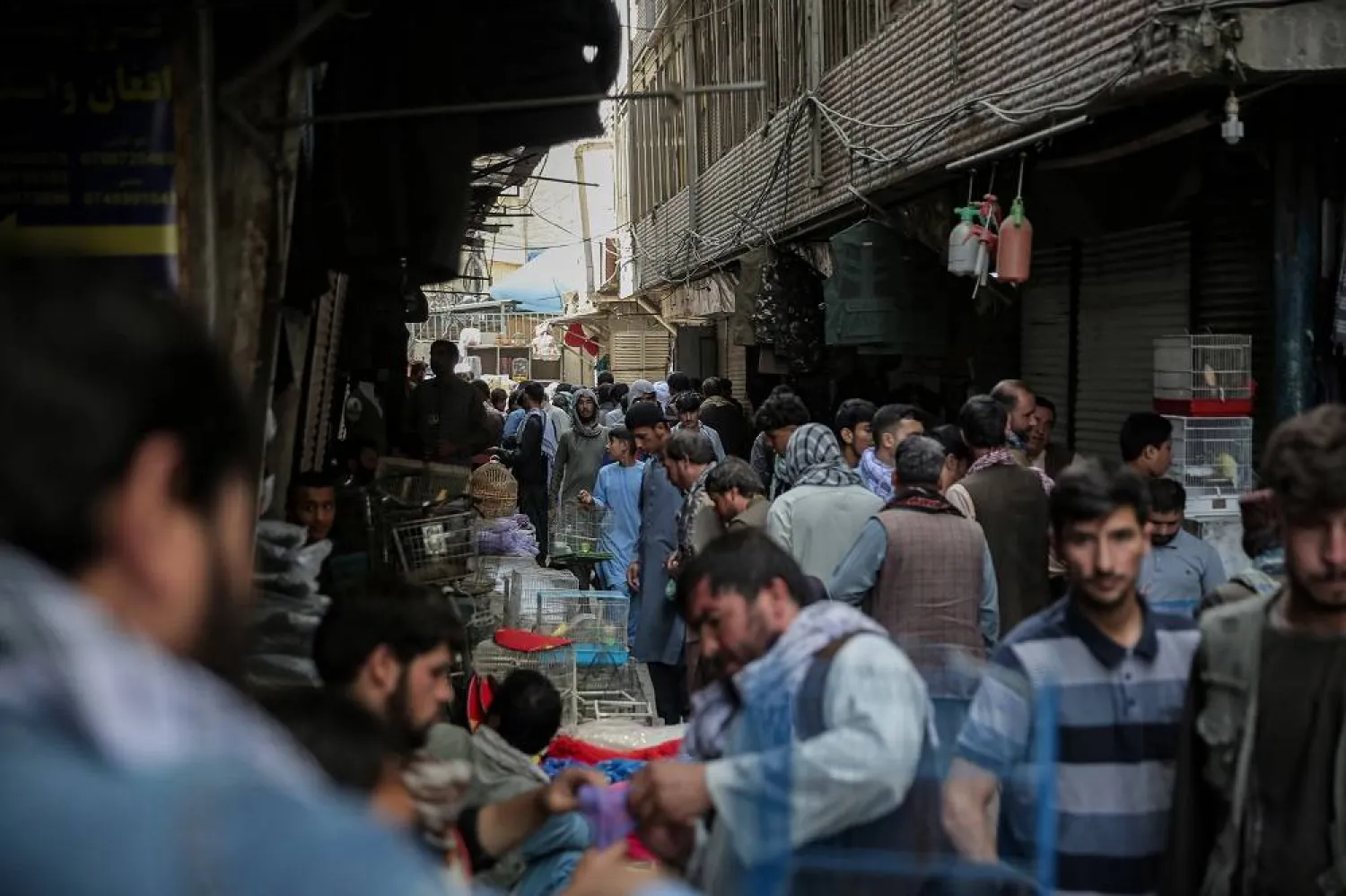
People walk along vendors offering birds at Kucheh Kah Farooshi Bazar in old Kabul, Afghanistan, 26 September 2025. (EPA)
TT

Kabul’s Wells Run Dry, Driving Children Out of Class and into Water Queues 

People walk along vendors offering birds at Kucheh Kah Farooshi Bazar in old Kabul, Afghanistan, 26 September 2025. (EPA)

Eight-year-old Noorullah and his twin, Sanaullah, spend their days hauling yellow jerrycans on a wheelbarrow through Kabul's dusty alleys instead of going to school - an ordeal for one family that reflects Afghanistan's deepening water crisis.

Once supplied with water from their own well, the family of 13 has had to queue at communal taps or pool money for costly water tankers since their supply dried up four years ago.

With climate change increasing the frequency of droughts and erratic rainfall in Afghanistan, aid agencies say Kabul is among the most water-stressed cities in Asia, with shortages fueling disease, malnutrition and school dropouts.

The Afghanistan Analysts Network, an independent Kabul-based research group, in a report this month warned the city's groundwater could run out by 2030, with other Afghan cities also running dry. The crisis is deepening inequality, as poor families spend up to 30% of their income on tanker water while the wealthy dig ever-deeper private wells.

The twin boys queue with dozens of children at a communal tap, where shoving and shouting often flare into fights as the heat builds.

STANDING IN LINE FOR HOURS

Noorullah, who has epilepsy, said he once collapsed with a seizure while fetching water. His brother added, "Sometimes we stand in line for three hours. When the heat is too much, we feel dizzy."

Their father, 42-year-old shopkeeper Assadullah, feels there is no choice. Sitting outside his small shop with empty water barrels stacked nearby, he said, "From morning until evening, my children go for water six or seven times a day."

"Sometimes they cry and say they cannot fetch more, but what else can we do?"

The shortages have gutted his income too. On a good day, he earns $2–$3, however, he often closes the shop to help his sons push their loads.

"Before, we used to receive water through a company. It lasted us three or four days. Now even that option is gone," he said.

In the family's yard, his wife, Speray, washes dishes in a plastic basin, measuring out each jug. She said her husband has developed a stomach ulcer and she contracted H. pylori, a bacterial infection linked to unsafe water. "I boil water twice before giving it to our children, but it is still a struggle," she said.

SNOWMELT ONCE REPLENISHED KABUL'S WATER BASIN

Kabul's population has surged past six million in two decades, but investment in water infrastructure has lagged. War wrecked much of the supply network, leaving residents dependent on wells or costly tankers, and those are failing.

Just a few streets from Assadullah, 52-year-old community representative Mohammad Asif Ayubi said more than 380 households in the neighborhood faced the same plight. "Even wells 120 meters (nearly 400 feet) deep have dried up," he said, a depth once considered certain to reach water.

Droughts and erratic rainfall patterns have limited the snowmelt that once replenished Kabul's water basin and left the riverbed dry for much of the year. "Kabul is among the most water-stressed areas," said Najibullah Sadid, a water researcher based in Germany.

UN envoy Roza Otunbayeva warned the UN Security Council earlier this month that droughts, climate shocks and migration risk turning Kabul into the first modern capital to run out of water "within years, not decades".

For Assadullah, the wish is simple. "If we had enough water, my children wouldn't have to run around all day," he said. "They could go to school. Our whole life would change."



Australian Bushfires Raze Homes in Two States; Firefighter Dies 

Ruins of buildings and a car smolder after a wildfire destroyed houses in Koolewong, Australia, Saturday, Dec. 6, 2025. (Dan Himbrechts/AAP Image via AP)
TT

Australian Bushfires Raze Homes in Two States; Firefighter Dies 

Ruins of buildings and a car smolder after a wildfire destroyed houses in Koolewong, Australia, Saturday, Dec. 6, 2025. (Dan Himbrechts/AAP Image via AP)

An Australian firefighter was killed overnight after he was struck by a tree while trying to control a bushfire that had destroyed homes and burnt large swathes of bushland north of Sydney, authorities said on Monday.

Emergency crews rushed to bushland near the rural town of Bulahdelah, 200 km (124 miles) north of Sydney, after reports that a tree had fallen on a man. The 59-year-old suffered a cardiac arrest and died at the scene, officials said.

Prime Minister Anthony Albanese said the "terrible news is a somber reminder" of the dangers faced by emergency services personnel as they work to protect homes and families.

"We honor that bravery, every day," Albanese said in a statement.

A fast-moving fire over the weekend destroyed 16 homes in New South Wales state's Central Coast region, home to about 350,000 people and a commuter region just north of Sydney.

Resident Rouchelle Doust, from the hard-hit town of Koolewong, said she and her husband tried to save their home as flames advanced.

"He's up there in his bare feet trying to put it out, and he's trying and trying, and I'm screaming at him to come down," Doust told the Australian Broadcasting Corp.

"Everything's in it: his grandmother's stuff, his mother's stuff, all my stuff - everything, it's all gone, the whole lot."

Conditions eased overnight, allowing officials to downgrade fire danger alerts, though the weather bureau warned some inland towns in the state could hit more than 40 degrees Celsius (104 Fahrenheit) on Tuesday, raising fire dangers.

More than 50 bushfires were burning across New South Wales as of Monday.

On the island state of Tasmania, a 700-hectare (1,729 acres) blaze at Dolphin Sands, about 150 km (93 miles) northeast of the state capital of Hobart, destroyed 19 homes and damaged 40. The fire has been contained, but residents have been warned not to return as conditions remain dangerous, officials said.

Authorities have warned of a high-risk bushfire season during Australia's summer months from December to February, with increased chances of extreme heat across large parts of the country following several relatively quiet years.

In neighboring New Zealand, five helicopters and multiple crews were working to put out a fire near the country's oldest national park, a month after a wildfire burnt through 2,589 hectares (6,400 acres) of alpine bush there.

Police said they had closed a road near the state highway and advised motorists to avoid the area and expect delays after the blaze near Tongariro National Park, a popular hiking spot, spread to 110 hectares (272 acres) by Monday afternoon.


Queen Elizabeth II to Appear on New Commemorative Coin

Queen Elizabeth II gold coins (Shutterstock) 
TT

Queen Elizabeth II to Appear on New Commemorative Coin

Queen Elizabeth II gold coins (Shutterstock) 

Many British know Queen Elizabeth II’s profile better than the back of their own hands. After all, her image has stared back at us from the hundreds of coins jangling around our pockets for decades.

But in the year marking what would have been her 100th birthday, a royal revelation is emerging. Or rather, an old one that never got its moment in the spotlight, according to London’s Metro newspaper.

A portrait of the late Queen, sculpted almost forty years ago and then quietly tucked away, is finally being released to the public for the very first time from The London Mint Office, which has secured the rights to unveil this long-hidden likeness in an exclusive collector’s coin.

Even better, the coin featuring this never before seen effigy is being offered as a free gift to the nation, with only £2.50 postage to pay.

For collectors and royal watchers, it is undoubtedly the most unexpected royal resurfacing in the recent past – a kind of numismatic archaeology.

When sculptor Raphael Maklouf created his now famous 1985 effigy of Queen Elizabeth II, he didn’t just produce the one design that graced coins from 1985 – 1997.

Several versions of the effigy were prepared, studied and refined in the long, meticulous process of creating a monarch’s official image. Some of these effigies were presented to officials, and some sketches have been referenced in numismatic circles over the years.

But one fully realized effigy – sculpted to the same level as the final chosen design – was never revealed to the public.

Instead, it remained sealed away in Maklouf’s archive. Not rejected. Not forgotten. Just quietly concealed for all this time. Until now.

2026 would have been the year that Queen Elizabeth II turned 100, making it a perfect moment for reflection, particularly on aspects of her legacy that remained unseen.

The London Mint Office’s release of this never-seen-before effigy taps directly into that sense of discovery.

For anyone who followed the Queen’s reign or simply loves an unexpected historical twist, this is one to watch. After years in the dark, Maklouf’s forgotten portrait is finally stepping into the light. And this time, it won’t be hidden away again.


Nobel Laureates Arrive for a Week of Events and Awards in Stockholm and Oslo

The Nobel medal in physiology or medicine presented to Charles M. Rice is displayed, Tuesday, Dec. 8, 2020, during a ceremony in New York. (AP)
TT

Nobel Laureates Arrive for a Week of Events and Awards in Stockholm and Oslo

The Nobel medal in physiology or medicine presented to Charles M. Rice is displayed, Tuesday, Dec. 8, 2020, during a ceremony in New York. (AP)

Nobel week was underway in Stockholm and Oslo with laureates holding news conferences and lectures before they will be awarded the prestigious prizes.

Hungarian László Krasznahorkai, who won the Prize in literature for his surreal and anarchic novels that combine a bleak world view with mordant humor, was expected to give a lecture in Stockholm on Sunday in one of his rare public appearances.

When the Nobel judges announced the award in October, they described the 71-year-old as “a great epic writer” whose work “is characterized by absurdism and grotesque excess.”

“Krasznahorkai’s work can be seen as part of a Central European tradition," the Nobel Prize organization said. “Important features are pessimism and apocalypse, but also humor and unpredictability."

Last year’s winner was South Korean author Han Kang. The 2023 winner was Norwegian writer Jon Fosse, whose work includes a seven-book epic made up of a single sentence.

Meanwhile, the director of the Norwegian Nobel Institute, Kristian Harpviken, said Saturday that Venezuelan Peace Prize laureate and opposition leader María Corina Machado will come to Oslo this week to receive her award in person.

The 58-year-old, who won for her struggle to achieve a democratic transition in the South American nation, has been hiding and has not been seen in public since January.

Harpviken told Norwegian public broadcaster NRK that Machado was expected to personally pick up the prize on Wednesday.

“I spoke with the Peace Prize winner last night, and she will come to Oslo,” Harpviken said, according to NRK.

Nobel Prize award ceremonies are held on Dec. 10, the anniversary of Alfred Nobel’s death in 1896. The award ceremony for peace is in Oslo and the other ceremonies are in Stockholm.