


Cultural Investment Conference Concludes in Riyadh with Seminars, New Agreements 

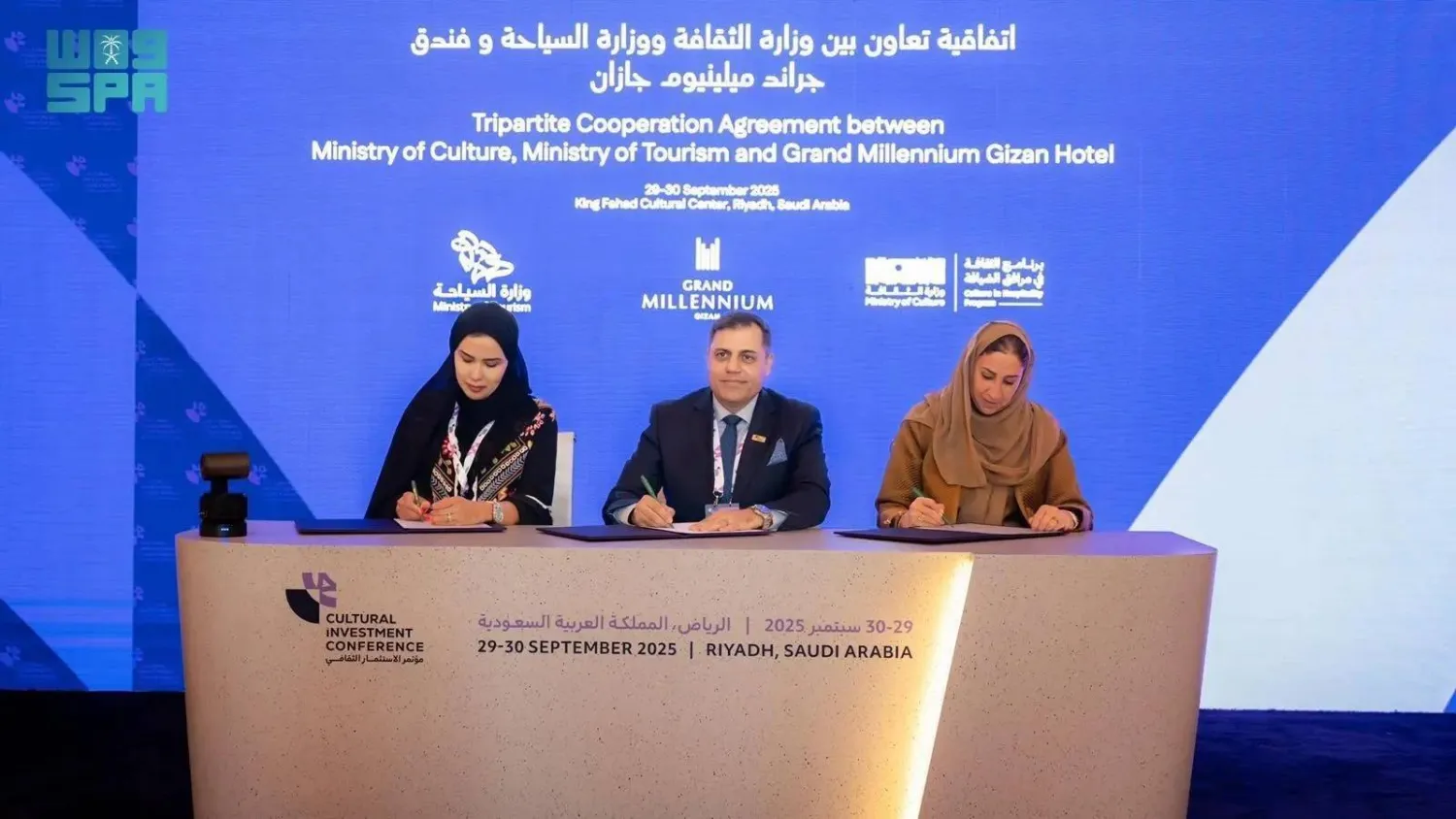
The Saudi Ministries of Culture and Tourism sign a cooperation agreement with several hotels across the Kingdom within the framework of the Culture in Hospitality Facilities program. (SPA)
TT

Cultural Investment Conference Concludes in Riyadh with Seminars, New Agreements 

The Saudi Ministries of Culture and Tourism sign a cooperation agreement with several hotels across the Kingdom within the framework of the Culture in Hospitality Facilities program. (SPA)

The inaugural Cultural Investment Conference 2025, organized by the Saudi Ministry of Culture, concluded in Riyadh on Tuesday. The two-day event witnessed the participation of more than 150 speakers and 1,500 attendees, including leading decision-makers and cultural and investment leaders from Saudi Arabia and around the world, and witnessed the signing of numerous agreements.

During the conference, Minister of Culture Prince Bader bin Abdullah bin Farhan announced the launch of the Riyadh University of Arts, which will serve as a cornerstone for creative education and innovation, nurturing talents and creators in the cultural sector.

The Ministry of Culture revealed that it has allocated more than SAR81 billion in cultural infrastructure investments since the launch of Saudi Vision 2030, through contributions from the public, private, and non-profit sectors.

Over two days, the conference featured more than 38 sessions addressing key issues related to cultural investment and its role as a driver of economic and social development, as well as in strengthening national identity.

A panel discussion on Tuesday, titled “Immersive Hospitality – Where Culture Creates Value,” featured Saudi Artisanal Company chief executive Ibrahim Alnasir, Shada Hotels chief executive Reem Garrash, and Deputy Minister of Culture for National Partnerships and Talent Development Noha Kattan.

Alnasir said the cultural and tourism sectors are among the fastest growing worldwide, noting that Saudi Arabia welcomed nearly 6.5 million visitors last year.

He stressed that expanding handicraft products relies on integrating them into the hospitality sector, whether through hotel design, guest experiences, or retail outlets, underscoring that financial performance reviews in this field focus on three key elements: increasing guest spending, extending stays, and boosting retail revenues.

Another plenary, titled “Saudi Giga Projects: Showcasing Culture to the World,” featured the CEO of New Murabba, Michael Dyke, and NEOM Deputy CEO Rayan Fayez.

Fayez stressed that NEOM is not merely a real-estate development, but a comprehensive project built on an integrated ecosystem. He noted that 15 key economic sectors have been defined, with culture and heritage identified as central to the project’s economic model.

Culture, he said, plays a vital role in attracting talent, drawing investment, and enhancing quality of life. He highlighted NEOM’s cultural initiatives, including an Artists in Residence (AIR) Program, a cultural leadership program, and the hosting of major international film productions.

Dyke noted that the New Murabba project in the heart of Riyadh draws inspiration from the historic Murabba Palace while reimagining it with a modern architectural identity. The project connects past, present, and future through new urban spaces, green areas, and innovative cultural and educational facilities.

He said the “Mukaab” (cube), set to be the world’s largest building, will serve as the project’s centerpiece, offering an immersive experience using advanced technologies such as artificial intelligence and holograms to establish itself as a global destination.

The discussion also addressed the importance of using cultural and heritage assets to boost national identity and attract investors. Fayez cited key archaeological discoveries in NEOM, such as the ancient civilization of Masyoon and the Nabataean trade routes, as rich sources for linking history with the future vision.

Agreements

On the sidelines of the conference, the Saudi Ministries of Culture and Tourism signed a cooperation agreement with several hotels across the Kingdom within the framework of the Culture in Hospitality Facilities program.

The agreement seeks to incorporate cultural elements into hotels to enrich the tourism and cultural experience of local and international visitors.

The cooperation reflects the efforts of both ministries, in partnership with the private sector, to maximize the role of hospitality facilities in promoting cultural awareness and providing diverse experiences that highlight the Kingdom’s identity and heritage.

The Cultural Development Fund signed three cooperation agreements with leading local banks, the Saudi National Bank, Saudi Awwal Bank and Bank Albilad, to expand cultural funding and provide greater access to the fund’s financing solutions.

The agreements aim to deliver innovative financing solutions under the umbrella of cultural funding, facilitating access for micro, small, and medium-sized enterprises across all cultural sectors, thereby supporting their expansion and sustainable growth. By doing so, the fund seeks to diversify funding sources and channels within the cultural industry.

The agreements reflect the shared commitment of both parties to empower the cultural sector and maximize its contribution to local content, recognizing it as one of the most promising and influential sectors in the national economy.

The Royal Institute of Traditional Arts (Wrth) signed 13 memoranda of understanding (MoUs) with national partners across the culture, tourism, hospitality, media, retail, real estate, and finance sectors.

The agreements strengthen integration between the cultural ecosystem and the private sector and pave the way for sustainable cultural economy pathways by developing human capital and empowering artisan entrepreneurs.

The initiatives link training with labor market needs and expand marketing channels locally and internationally. They also promote the incorporation of traditional arts into hospitality and real estate projects while driving innovation and technology in crafts. All these efforts align with the objectives of the Year of Handicrafts 2025.



Saudi Arabia, Syria Underline Depth of their Cultural Ties

Syrian President al-Sharaa receives the Saudi minister of culture and the accompanying delegation at the Conference Palace in Damascus on Thursday. (SPA)
TT

Saudi Arabia, Syria Underline Depth of their Cultural Ties

Syrian President al-Sharaa receives the Saudi minister of culture and the accompanying delegation at the Conference Palace in Damascus on Thursday. (SPA)

Saudi Arabia and Syria underlined the strength of their cultural relationship during high-level meetings held in Damascus on Thursday, on the sidelines of the opening of the Damascus International Book Fair 2026, where the Kingdom is participating as guest of honor.

Syrian President Ahmad al-Sharaa received Saudi Minister of Culture Prince Badr bin Abdullah bin Farhan at the Conference Palace in the capital.

Earlier the same day, Prince Badr met with his Syrian counterpart, Minister of Culture Mohammad Yassin Saleh, during an official visit to attend the fair. T

he Saudi minister congratulated Syria on hosting the exhibition and expressed his wishes for continued prosperity, progress, and stability for the Syrian government and people.

Both meetings highlighted the depth of cultural relations between the two countries, the importance of expanding joint cultural cooperation across various fields, and the alignment of positions on issues of mutual interest in a way that serves both nations.

The Saudi delegation included senior officials and advisers, among them representatives from the Royal Court, the Ministry of Culture, and the King Abdulaziz Public Library, reflecting broad institutional engagement in the visit.

In the evening, Prince Badr attended the opening ceremony of the fair’s special session, held under the patronage and in the presence of al-Sharaa. The event drew wide official and cultural participation, including Arab ministers, political and intellectual figures, and a distinguished group of writers and cultural figures.

In a post on the X platform, Prince Badr thanked “our brothers in Syria for their generous hospitality and their efforts in organizing the Damascus International Book Fair.”

The minister also inaugurated the Kingdom’s pavilion at the fair in the presence of the Syrian minister of culture and the Qatari minister of culture.

Saudi Arabia’s guest-of-honor participation continues until Feb. 16 and reflects its growing prominence and leadership in the Arab and global cultural landscape.

This participation aligns with Saudi Vision 2030, which places culture at the heart of national development, viewing it as a space for dialogue, a bridge for civilizational communication, and a tool for strengthening ties among Arab peoples.

The Saudi Literature, Publishing and Translation Commission is leading the Kingdom’s participation, highlighting the development of the cultural sector and reaffirming the central role of books as carriers of knowledge and awareness.

The Saudi pavilion boasts a comprehensive cultural program featuring intellectual seminars, poetry evenings, a manuscript exhibition, traditional Saudi fashion displays, hospitality corners, archaeological replicas, and performing arts that express the depth of the Kingdom’s cultural heritage.

On the sidelines of the visit, Prince Badr, accompanied by Minister Saleh, toured the National Museum of Damascus, which houses rare artifacts spanning prehistoric eras, ancient Syrian civilizations, classical and Islamic periods, as well as traditional and modern art.


UNESCO Honors Al-Bisht Al-Hasawi as Thousands Flock to Al-Ahsa Festival

Visitors can explore interactive displays, participate in live workshops, and witness the meticulous process of tailoring this iconic symbol of prestige - SPA
TT

UNESCO Honors Al-Bisht Al-Hasawi as Thousands Flock to Al-Ahsa Festival

Visitors can explore interactive displays, participate in live workshops, and witness the meticulous process of tailoring this iconic symbol of prestige - SPA

The third edition of Al-Bisht Al-Hasawi Festival is drawing thousands of regional and international visitors to Ibrahim Palace in historic Al-Hofuf.

Organized by the Heritage Commission, this year’s festival celebrates the inscription of the Bisht on UNESCO’s Representative List of the Intangible Cultural Heritage of Humanity.

The event showcases Al-Ahsa’s centuries-old tradition of hand-weaving and gold embroidery, a craft passed down through generations of local families, SPA reported.

Visitors can explore interactive displays, participate in live workshops, and witness the meticulous process of tailoring this iconic symbol of prestige.

With UNESCO's participation and representatives from six countries, the festival has evolved into a global platform for cultural dialogue, cementing the Bisht’s status as a world-class cultural treasure.


Saudi, Syrian Culture Ministers Tour National Museum of Damascus

The ministers observed the museum’s extensive collections spanning prehistoric eras to modern art. SPA
TT

Saudi, Syrian Culture Ministers Tour National Museum of Damascus

The ministers observed the museum’s extensive collections spanning prehistoric eras to modern art. SPA

Saudi Minister of Culture Prince Badr bin Abdullah bin Farhan and his Syrian counterpart, Mohammed Yassin Saleh, have toured the National Museum of Damascus during the Kingdom’s participation as guest of honor at the 2026 Damascus International Book Fair.

The ministers observed on Thursday the museum’s extensive collections spanning prehistoric eras to modern art.

A particular focus was placed on the Arab-Islamic wing, featuring significant artifacts from the Umayyad period.

The Kingdom's participation as guest of honor at the 2026 Damascus International Book Fair, which runs until February 16, stems from the role culture plays within Saudi Vision 2030.