

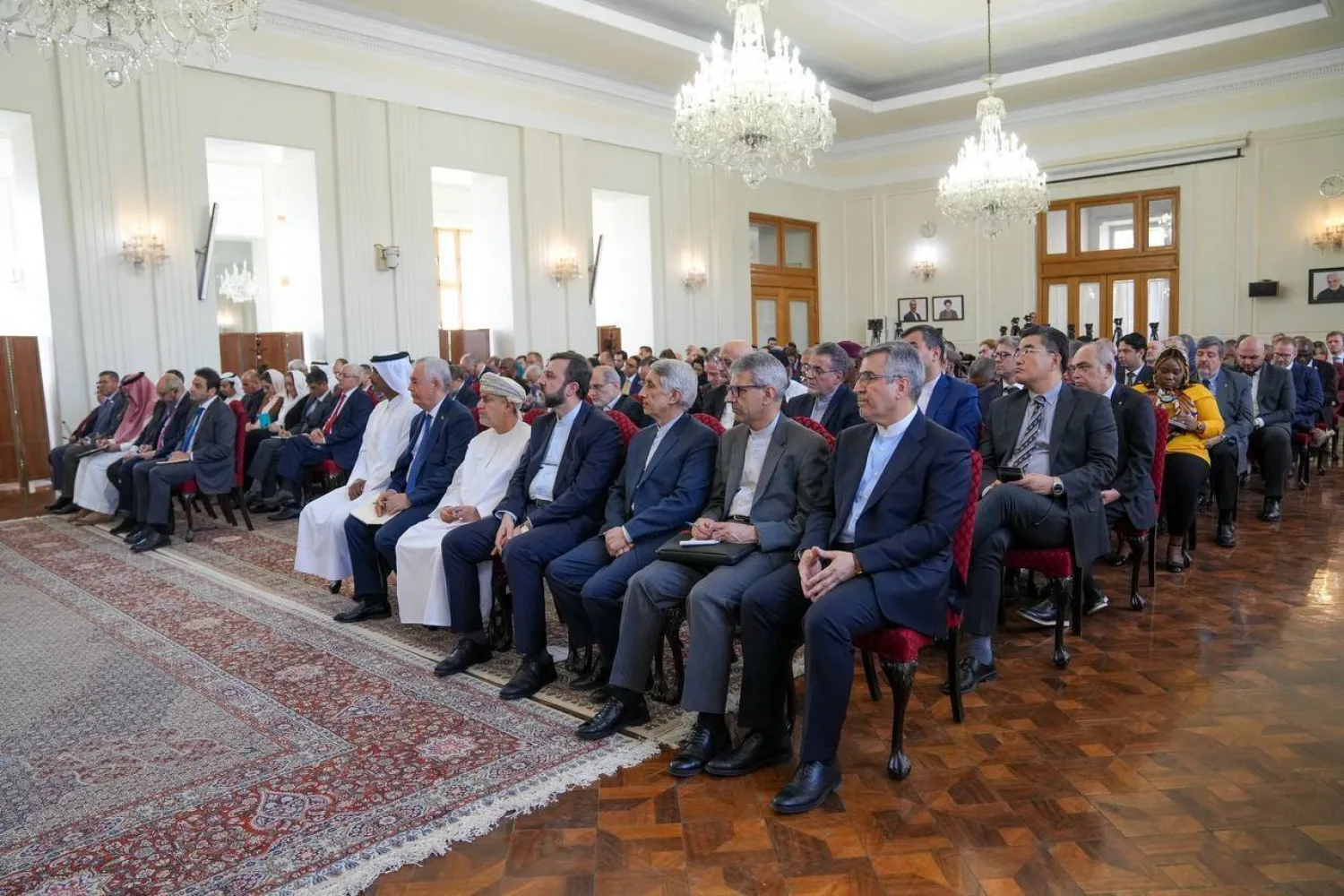

Tehran: Military Threats Complicate Diplomatic Path

Ambassadors, chargés d'affaires, and heads of foreign and international missions based in Tehran, during their meeting on Sunday with Foreign Minister Abbas Araghchi (Iranian Foreign Ministry) 
TT

Tehran: Military Threats Complicate Diplomatic Path

Ambassadors, chargés d'affaires, and heads of foreign and international missions based in Tehran, during their meeting on Sunday with Foreign Minister Abbas Araghchi (Iranian Foreign Ministry) 

Iranian Foreign Minister Abbas Araghchi stressed on Sunday that no solution exists for Iran’s nuclear program other than a diplomatic and negotiated one, also warning that military threats could not resolve crises.

The FM was speaking at a meeting with ambassadors, chargés d'affaires, and heads of foreign and international missions based in Tehran, to discuss the impacts of the UN sanctions re-imposed on Iran in September.

Araghchi said the activation of the Snapback Mechanism has changed the rules of the diplomatic game and made future negotiations with the West more difficult and complex.

The Iranian top diplomat said his meeting with the foreign diplomats aims to present the risks that could result from the move.

The UN sanctions on Iran were reinstated on September 28 after the UK, France, and Germany (the E3) triggered the snapback mechanism under the 2015 nuclear deal known as the Joint Comprehensive Plan of Action (JCPoA).

Tehran has made efforts to reach a fair and balanced negotiated solution, said Araghchi. However, he added, it was the Western countries that responded negatively to the efforts due to their excessive and unreasonable demands.

The FM also noted that it has been proven that there is no solution for Iran’s nuclear program other than a diplomatic and negotiated one.

In recent years, Araghchi said, Iran has been threatened with military action on several occasions, and even at times those threats were attempted, but it became clear that the Iranian issue could not be resolved through military means.

“The three European countries believed they had achieved a new pressure tool and assumed that by threatening to implement it, they could exert influence over Iran,” the top diplomat said. “However, after activating the sanctions, those countries saw that no change occurred. The only result was the weakening of the diplomatic process.”

Commenting on his expectations for the upcoming phase, the foreign minister said diplomacy never ceases and always remains present. However, he affirmed, the current conditions are entirely different from the past and the three European countries have clearly weakened their role in the diplomatic process.

US Conditions

Last Thursday, The Washington Post quoted a US official briefed on the Trump administration policy as saying that Washington’s pressure is intended to encourage Iran to accept four stringent conditions as a baseline for new negotiations.

The official said the talks must be “meaningful” and direct, Tehran must agree to zero enrichment of nuclear material and curbs to its missile program, and it must cease funding its proxy forces.

In response to the Washington Post article, Araghchi said that none of the mentioned conditions had been officially communicated to Tehran.

He said that in recent months, Iran’s talks with the US had been limited to the nuclear issue, conducted indirectly through messages and intermediaries.

In these exchanges, the top diplomat said no other topic had been discussed.

Araghchi noted that his Ministry would continue its efforts to advance diplomacy, adding that, from Iran’s perspective, the role of diplomacy can never be eliminated or ignored.

The End of Cairo Agreement

Commenting on Iran’s agreement with the International Atomic Energy Agency (IAEA) in Cairo last month, Araghchi said Iran had established a new framework for cooperation with the agency.

He explained that this change was necessary due to recent developments, particularly the attack on Iran’s nuclear facilities, which made continued cooperation under the previous framework unfeasible.

Araghchi also said the security threats and safety concerns arising from the attack necessitated a redefinition of the cooperation framework.

He said the IAEA had agreed to this new approach, leading to several rounds of negotiations and ultimately resulting in the Cairo agreement.

One of the three conditions set in the Cairo agreement was to allow inspectors to access Iranian nuclear sites.

Araghchi said under the current circumstances, the Cairo agreement could no longer serve as a viable basis for cooperation with the agency.

He said Iran would soon announce its new decision regarding its relation with the IAEA.


Iran President Tells Government Listen to Protesters 'Legitimate Demands'

Iranian shopkeepers and traders protest against the economic conditions, as tear gas is fired by anti-riot police in Tehran, Iran, 29 December 2025. EPA/STRINGER
TT

Iran President Tells Government Listen to Protesters 'Legitimate Demands'

Iranian shopkeepers and traders protest against the economic conditions, as tear gas is fired by anti-riot police in Tehran, Iran, 29 December 2025. EPA/STRINGER

Iran's president urged his government to listen to the "legitimate demands" of protesters, state media reported Tuesday, after several days of demonstrations by shopkeepers in Tehran over economic hardships.

Shopkeepers in the capital had shut their stores for the second day in a row on Monday, after Iran's embattled currency hit new lows on the unofficial market, reported AFP.

The US dollar was trading at around 1.42 million rials on Sunday -- compared to 820,000 rials a year ago -- and the euro nearing 1.7 million rials, according to price monitoring websites.

"I have asked the Interior Minister to listen to the legitimate demands of the protesters by engaging in dialogue with their representatives so that the government can do everything in its power to resolve the problems and act responsibly," President Masoud Pezeshkian said, according to the state-run IRNA news agency.

Protesters "are demanding immediate government intervention to rein in exchange-rate fluctuations and set out a clear economic strategy", the pro-labor news agency ILNA reported Monday.

Price fluctuations are paralyzing the sales of some imported goods, with both sellers and buyers preferring to postpone transactions until the outlook becomes clearer, AFP correspondents noted.

"Continuing to do business under these conditions has become impossible," ILNA quoted protesters as saying.

The conservative-aligned Fars news agency released images showing a crowd of demonstrators occupying a major thoroughfare in central Tehran, known for its many shops.

Another photograph appeared to show tear gas being used to disperse protesters.

"Minor physical clashes were reported... between some protesters and the security forces," Fars said, warning that such gatherings could lead to instability.

-- Battered economy --

Iranian Chief Justice Gholamhossein Mohseni Ejei called for "the swift punishment of those responsible for currency fluctuations", the justice ministry's Mizan agency reported Monday.

The government has also announced the replacement of the central bank governor.

"By decision of the president, Abdolnasser Hemmati will be appointed governor of the Central Bank," presidency communications official Mehdi Tabatabaei posted on X.

Hemmati is a former economy and finance minister who was dismissed by parliament in March because of the sharp depreciation of the rial.

Pezeshkian delivered on Sunday the budget for the next Persian year to parliament, vowing to fight inflation and the high cost of living.

In December, inflation stood at 52 percent year-on-year, according to official statistics. But this figure still falls far short of many price increases, especially for basic necessities.

The country's economy, already battered by decades of Western sanctions, was further strained after the United Nations in late September reinstated international sanctions linked to the country's nuclear program that were lifted 10 years ago.

Western powers and Israel accuse Iran of seeking to acquire nuclear weapons, a charge Tehran denies.


Trump Hints at Land Strike as Venezuela Pressure Mounts

A US Air Force C-130J Super Hercules aircraft approaches for landing at Rafael Hernandez Airport, amid tensions between US President Donald Trump's administration and the government of Venezuelan President Nicolas Maduro, in Aguadilla, Puerto Rico, December 28, 2025. (Reuters)
TT

Trump Hints at Land Strike as Venezuela Pressure Mounts

A US Air Force C-130J Super Hercules aircraft approaches for landing at Rafael Hernandez Airport, amid tensions between US President Donald Trump's administration and the government of Venezuelan President Nicolas Maduro, in Aguadilla, Puerto Rico, December 28, 2025. (Reuters)

A throwaway remark last week by President Donald Trump has raised questions about whether US forces may have carried their first land strike against drug cartels in Venezuela.

Trump said the US knocked out a "big facility" for producing trafficking boats, as he was discussing his pressure campaign against Venezuelan President Nicolas Maduro in an interview broadcast Friday.

"They have a big plant or a big facility where they send, you know, where the ships come from," Trump said in an interview with billionaire supporter John Catsimatidis on the WABC radio station in New York.

"Two nights ago we knocked that out. So we hit them very hard."

Trump did not say where the facility was located or give any other details. US forces have carried out numerous strikes in both the Caribbean Sea and eastern Pacific Ocean since September, killing more than 100 people.

The Pentagon referred questions about Trump's remarks to the White House. The White House did not respond to requests for comment from AFP.

There has been no official comment from the Venezuelan government.

Trump has been saying for weeks that the United States will "soon" start carrying out land strikes targeting drug cartels in Latin America, but there have been no confirmed attacks to date.

The Trump administration has been ramping up pressure on Maduro, accusing the Venezuelan leader of running a drug cartel himself and imposing an oil tanker blockade.

Maduro has accused Washington of attempting regime change.


UN Chief Says ‘Get Serious’ in Grim New Year Message

 UN Secretary-General Antonio Guterres. (AFP)
UN Secretary-General Antonio Guterres. (AFP)
TT

UN Chief Says ‘Get Serious’ in Grim New Year Message

 UN Secretary-General Antonio Guterres. (AFP)
UN Secretary-General Antonio Guterres. (AFP)

The United Nations urged global leaders Monday to focus on people and the planet in a New Year's message depicting the world in chaos.

"As we enter the new year, the world stands at a crossroads. Chaos and uncertainty surround us. Division. Violence. Climate breakdown. And systemic violations of international law," UN Secretary-General Antonio Guterres said in a video message.

In 2026, as war rages in Ukraine and elsewhere, world leaders must work to ease human suffering and fight climate change, he added.

"I call on leaders everywhere: Get serious. Choose people and planet over pain," said Guterres, criticizing the global imbalance between military spending and financing for the poorest countries.

Military spending is up nearly 10 percent this year to $2.7 trillion, which is 13 times total world spending on development aid and equivalent to the entire gross domestic product of Africa, he said.

Wars are raging at levels unseen since World War II, he added.

"In this New Year, let's resolve to get our priorities straight. A safer world begins by investing more in fighting poverty and less in fighting wars. Peace must prevail," said Guterres, who will be serving his last year as secretary general.
