

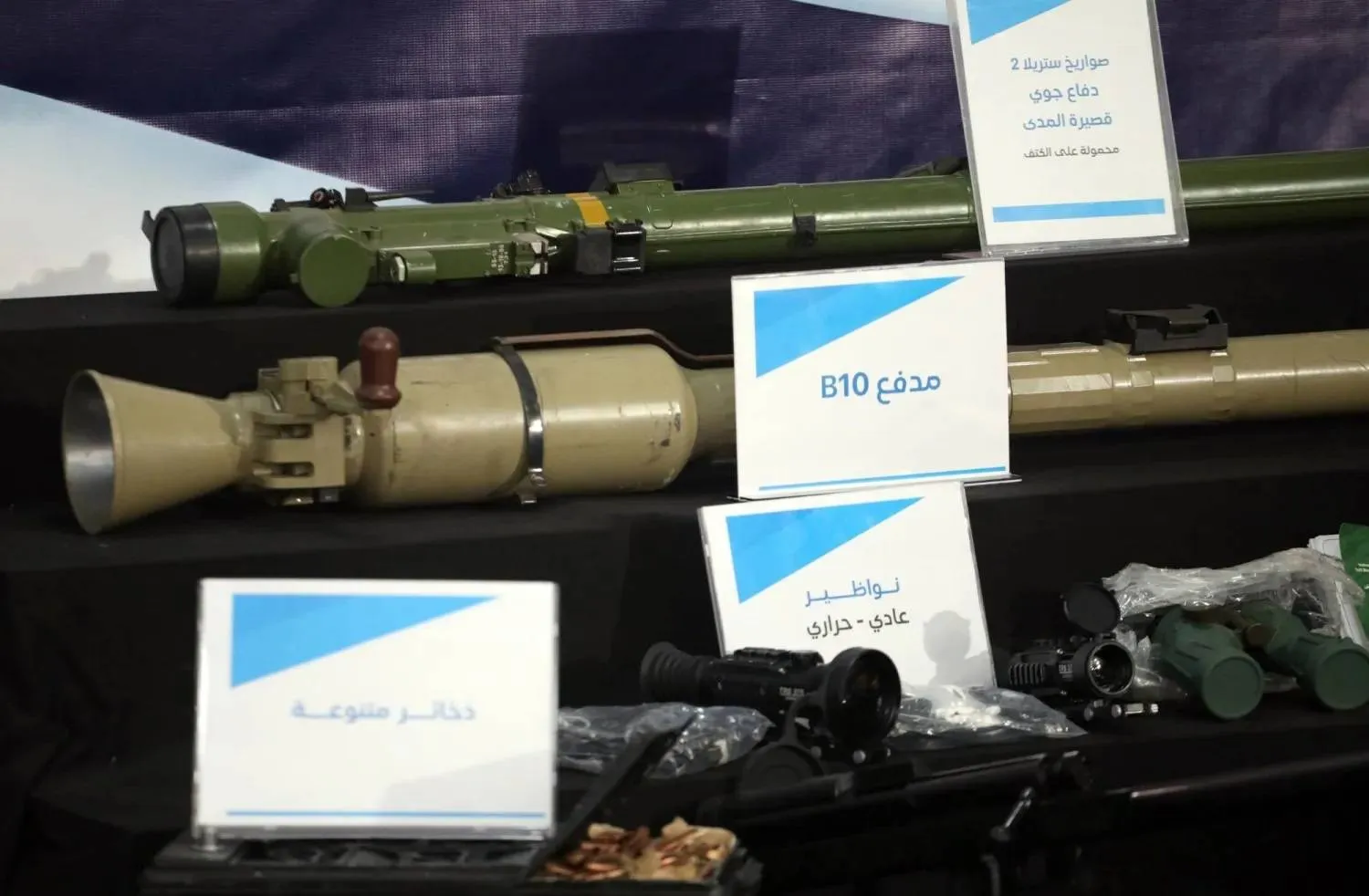

Yemeni Forces Intercept Military Shipment Headed to Houthis

Some of the confiscated gear that was being smuggled to the Houthis. (EPA)
TT

Yemeni Forces Intercept Military Shipment Headed to Houthis

Some of the confiscated gear that was being smuggled to the Houthis. (EPA)

Yemeni forces seized a vessel off the Lahj coast west of Aden that was loaded with military gear and drone components headed to the Iran-backed Houthi militias.

The bust demonstrates Iran’s continued support to the group that has escalated its attacks in the Red Sea and Gulf of Aden.

The Giants Brigades said a joint security operation, led by Brigadier General Hamdi Shukri, commander of the Brigades’ Second Unit, intercepted the shipment. Three smugglers were on board the vessel.

The confiscated shipment included advanced military gear, drone parts, surveillance equipment, advanced electronic chips, high accuracy cameras that are fitted on drones for night and day surveillance, communication devices, remote controls, high-capacity batteries and carbon fibers used in drone manufacturing.

This was the third busted smuggling attempt in recent weeks.

Yemeni authorities had seized a similar shipment in Aden in August that contained espionage devices and drones. A United Nations report at the time had found that the Houthis were involved in a weapons smuggling network that includes the Al-Qaeda in Arabian Peninsula and the extremist Al-Shabaab group in Somalia.

Weeks ago, Yemen’s coast guard seized off the western coast a vessel loaded with over 700 tons of advanced weapons that was headed to areas held by the Houthis.

In a recent report, the London-based Conflict Armament Research said the Houthis had obtained advanced weapons from Iran through sophisticated smuggling networks. Among the weapons were air defense systems, anti-ship missiles and components used in drones.

The weapons shipments seized near the Bab al-Mandeb Strait showed that the majority of the weapons were connected to Iranian networks that had been documented in Iraq, Syria and Lebanon. The report confirmed that such support has allowed the Houthis to expand the scope of their military and air operations, including attacks on commercial vessels in the Red Sea.

The Houthis have carried out over 220 attacks on marine shipping in the past two years. They had started these attacks in solidarity with Palestinians in Gaza since the eruption of the war between Israel and Hamas in October 2023.

Government sources said the frequent busts of smuggling operations demonstrate that the Houthis continue to build an arsenal of advanced naval and air weapons through Iranian support in defiance of UN Security Council resolution and in service of goals that go beyond Yemen.

Information Minister in Yemen’s legitimate government Moammar al-Eryani said the Houthi attacks against commercial ships and oil tankers in international shipping lanes were not acts of solidarity with Gaza as they claim, but rather implementation of an Iranian agenda.

The escalation of these attacks since Hamas’ October 7, 2023, attack reflects Iran’s attempts to consolidate its presence and influence in strategic waterways and it is using the Houthis as a pressure card in its conflict with the international community, he said in official statements.

Moreover, he added that the Houthi attack against a Dutch ship in the Gulf of Aden on September 29 took place just days after European powers reactivated the snapback mechanism, demonstrating that Tehran spurs the Houthis to action to serve its interests.

The Iranian regime is using the militias to extort and threaten the international community whenever it finds itself cornered or when its room to maneuver becomes limited, explained the minister.

As the war on Gaza draws to an end in wake of US President Donald Trump’s peace plane, the world will discover that the Houthis are an arm of Iran’s Wilayet al-Faqih agenda that has nothing to do with the interests of the Yemeni or Palestinian people, he stressed.

He called on the international community, starting with the European Union and UK, to assume their legal and moral responsibilities and designate the Houthis as terrorists who threaten international peace and security.

Eryani also urged support for the legitimate government in its battle to protect marine passages and Yemen’s sovereignty.



Ongoing Strikes in Iraq Expose Political, Security Divisions

Mourners attend the funeral of members of Iraq's PMF, who were killed in an airstrike in the town of al‑Qaim near the Syrian border, amid heightened regional tensions due to the US-Israel conflict with Iran, in Baghdad, Iraq, March 12, 2026. REUTERS/Stringer
TT

Ongoing Strikes in Iraq Expose Political, Security Divisions

Mourners attend the funeral of members of Iraq's PMF, who were killed in an airstrike in the town of al‑Qaim near the Syrian border, amid heightened regional tensions due to the US-Israel conflict with Iran, in Baghdad, Iraq, March 12, 2026. REUTERS/Stringer

Strikes targeting armed groups in Iraq are continuing amid the US-Israel war on Iran, piling pressure on decision-makers in Baghdad to maintain a unified stance even as factions declare their participation in the fighting alongside Tehran.

Over the past two weeks, the Iraqi government has repeatedly called for “distinguishing targets” and avoiding “mixing up the cards,” a reference to the need not to target Iraqi state institutions or official forces. The stance clashes with announcements by prominent armed factions declaring their involvement in military operations supporting Iran.

Those factions include Kataib Hezbollah, Harakat al-Nujaba and Ansar Allah al-Awfiya. In statements, they said “collaborators” were providing coordinates to what they described as the “enemy.”

Akram al-Kaabi, leader of Harakat al-Nujaba, said in a statement that recent strikes resulted from information provided by “informants,” without identifying them.

A leader in one of the factions fighting alongside Iran, however, claimed the person in question could be linked to a security agency.

Popular Mobilization sites

According to faction statements, some recent strikes targeted sites linked to the Popular Mobilization Forces (PMF), a security institution that includes several brigades affiliated with armed factions.

Observers say strikes on PMF-linked sites, alongside locations belonging to other factions, have created confusion in the political discourse over the nature of the targets and whether the strikes are aimed at specific factions or at an official security structure.

The Iraqi presidency and the prime minister’s office issued statements in recent days stressing the need to avoid dragging Iraq into the regional conflict, while reaffirming their rejection of using Iraqi territory as an arena for settling scores.

Political divisions

At the same time, divisions are widening among the armed factions themselves and between some factions and the government. Analysts say the rifts appear on two levels: military, over the extent of involvement in the war, and political, over the future of power in Baghdad.

Some factions have announced direct participation in military operations. Others have limited themselves to statements of support for Iran, while a third group has remained silent, awaiting developments in the confrontation.

The divisions are also visible within the Coordination Framework alliance, which includes the main Shiite political forces, particularly over the selection of the next prime minister.

Government formation

Iraqi politicians say the regional military escalation is further complicating an already deadlocked political scene, with parties still unable to agree on a new prime minister.

Former Prime Minister Nouri al-Maliki is the declared candidate of the Coordination Framework alliance. But sources say international objections, including from the United States, are hindering his nomination to form a government.

According to those sources, Maliki has stipulated that if he withdraws from the race, neither the current Prime Minister, Mohammed Shia al-Sudani, nor the former Prime Minister, Haider al-Abadi, should be tasked with forming the government.

Analysts say rising regional tensions could push some political forces to exploit the war to strengthen their negotiating positions inside Iraq, particularly as pressure on Tehran grows, and prospects for regional understandings that previously influenced power arrangements in Baghdad diminish.

Additional complications

The picture is further complicated by ongoing disagreements among Kurdish parties over who should be named the presidential candidate. Under the constitution, the president appoints the nominee of the largest parliamentary bloc to form the government.

Observers say delays by Kurdish parties in agreeing on a presidential candidate are effectively obstructing the formation of a new government, while some political forces are using the delay to justify postponing a decision on the premiership.

Tensions have also risen after reports that areas in the Kurdistan region were struck in connection with the escalation between armed factions and their opponents, potentially adding a new dimension to political disputes between Baghdad and Erbil.


Hezbollah-linked Financial Institution Faces Systematic Israeli Military Campaign

Part of the building struck by an Israeli air strike in the Bashoura area, where the Israeli military said Hezbollah stores money beneath it (Asharq Al-Awsat)
TT

Hezbollah-linked Financial Institution Faces Systematic Israeli Military Campaign

Part of the building struck by an Israeli air strike in the Bashoura area, where the Israeli military said Hezbollah stores money beneath it (Asharq Al-Awsat)

The Al-Qard Al-Hasan Association, a financial institution linked to Hezbollah, is facing a systematic military campaign as part of what appears to be a renewed Israeli strategy aimed at undermining the group’s economic infrastructure and cutting off its funding sources.

After the association’s branches were targeted during the 2024 war between Israel and Hezbollah, the institution has once again become a primary target in the current conflict.

The renewed campaign appears aimed at eliminating its role entirely, after it resumed operations following the previous war.

Ongoing campaign

In addition to years of political pressure and sanctions, the Israeli army targeted several of the association’s branches in Beirut, the Bekaa Valley and southern Lebanon during the 2024 war, making the institution part of a broader multi-level confrontation involving military strikes, financial sanctions and political pressure.

During the 66-day war, most of the association’s branches were hit by Israeli air strikes. Despite this, the institution was able to resume operations after the ceasefire and continued to provide financial services.

Hezbollah also used the association to distribute aid and compensation to people affected by the war through checks issued in the group’s name. The group attempted to circumvent sanctions through an entity it called the Joud Foundation, intended to serve similar financial purposes.

But in February, the United States imposed sanctions on it, saying it was being used to ensure the flow of funds from Iran to Hezbollah.

Attempt to eliminate it completely

In the current war, Israel has intensified its strikes against the association in a systematic manner. The Israeli military has clearly stated that all Al-Qard Al-Hasan branches are considered targets, a pledge it has carried out through strikes on most buildings housing its offices.

This has become a source of concern for residents, particularly because many of the association’s offices are located in residential buildings. Residents have therefore demanded that the offices be closed.

Lebanese security authorities have attempted to limit losses resulting from attacks on the association’s branches.

In this context, a decision was taken to close its branch in Sidon, southern Lebanon, and remove its sign on Thursday, following demands from business owners and institutions on the street and in neighboring buildings.

Authorities also evacuated the association’s branch building in Beirut’s Noueiri district on Friday following a decision by the interior minister.

It is also clear that the Israeli army is no longer only pursuing the association’s branches but also money storage facilities. Israeli military spokesman Avichay Adraee said on Thursday, after a strike on a building in the Bashoura area near central Beirut, that Hezbollah had hidden millions of dollars beneath the civilian building to fund its “terrorist activities.”

He added that the site was guarded by armed men and that access to the storage facility was through the building’s parking lot.

While Israeli strikes in 2024 failed to destroy what is often described as “Hezbollah’s central bank,” Israel, which views the association as a central element in financing Hezbollah’s activities and harmful to the Lebanese economy in the service of Iranian interests, now appears intent on weakening it fundamentally.

The goal appears to be depriving the group of one of its most important sources of economic and social influence in Lebanon.

Drying up resources a long and complex process

However, financial and economic affairs researcher Professor Maroun Khater said it is unlikely that Al-Qard Al-Hasan could be completely eliminated.

“Experience shows that such networks are often capable of adapting and finding alternative channels, which makes the process of cutting off resources long and complex,” Khater told Asharq Al-Awsat.

“For this reason, it is difficult to conclude that the blows suffered by Al-Qard Al-Hasan have led to the complete collapse of Hezbollah’s financial system, due both to the nature of the association itself and the diversity of funding sources that international reports say the group relies on.”

Khater added that despite the pressure, the association relies on a broad social network of depositors and borrowers who have used its services as an alternative to the traditional banking system, even before Lebanon’s banking sector effectively collapsed in 2019.

“This social base, along with political and security protection, has given it a certain capacity to endure, albeit within a limited scope, and has so far allowed it room to reorganize its activities whenever it is hit,” he said.

Fate of funds unclear

Khater also stressed that it would be simplistic to view the association as Hezbollah’s only source of funding.

Research centers and international institutions estimate that the group’s financing relies on a mix of sources, including foreign support, local economic networks, and donations, as well as various financial and commercial activities.

Some resources are also believed to move through individuals or private institutions that may remain outside full regulatory oversight, whether inside Lebanon or abroad.

For this reason, Khater said, it remains difficult to determine the true scale of the wealth accumulated by Hezbollah over past decades or to know what has happened to portions of its funds, gold reserves or other assets.

A parallel banking system under pressure

The Al-Qard Al-Hasan Association was founded in 1983 and operates more than 30 branches across Lebanon, including in Beirut, southern Lebanon and the Bekaa Valley. A broad segment of the public relies on it to obtain small loans or cash liquidity in exchange for gold or other assets pledged as collateral.

As Lebanon’s financial crisis worsened after 2019, the association’s role expanded, functioning in many ways as Hezbollah’s “parallel banking system.”

While banks suspended lending, Al-Qard Al-Hasan said it had issued 212,000 loans totaling $553 million in 2020 and 2021.

The US Treasury froze the association’s assets in 2007 and imposed additional sanctions in 2021 on several individuals linked to it, accusing the organization of collecting foreign currency to help Hezbollah build a support base.

The Treasury says that although the association claims to serve the Lebanese public, it actually transfers funds illegally through fictitious accounts and intermediaries, exposing Lebanese financial institutions to potential sanctions.

Lebanese authorities have also tightened restrictions. In 2025, Lebanon’s central bank instructed banks and financial institutions not to deal with unlicensed entities subject to sanctions, including Al-Qard Al-Hasan.


Iraq PM Vows to Prevent Attacks After French Soldier Killed

Iraqi Prime Minister Mohammed Shia al-Sudani attends an event in Baghdad, Iraq, Jan. 9, 2024. (Reuters)
TT

Iraq PM Vows to Prevent Attacks After French Soldier Killed

Iraqi Prime Minister Mohammed Shia al-Sudani attends an event in Baghdad, Iraq, Jan. 9, 2024. (Reuters)

Iraq's Prime Minister Mohammed Shia al-Sudani vowed on Friday to prevent attacks after the killing of a French soldier in an attack in the autonomous Kurdistan region.

Sudani expressed his "solidarity" with France in a phone call with French President Emmanuel Macron.

He said that "the necessary measures will be taken to prevent the recurrence of such incidents", and an investigation will be conducted into the attack.

The president of Iraq's Kurdistan region Nechirvan Barzani, in a call with Macron, also expressed his condolences and called for the Iraqi government to "set limits on outlaw groups".