


Damascus, Kurdish SDF Caught Between US Pressure and Stalled Roadmap

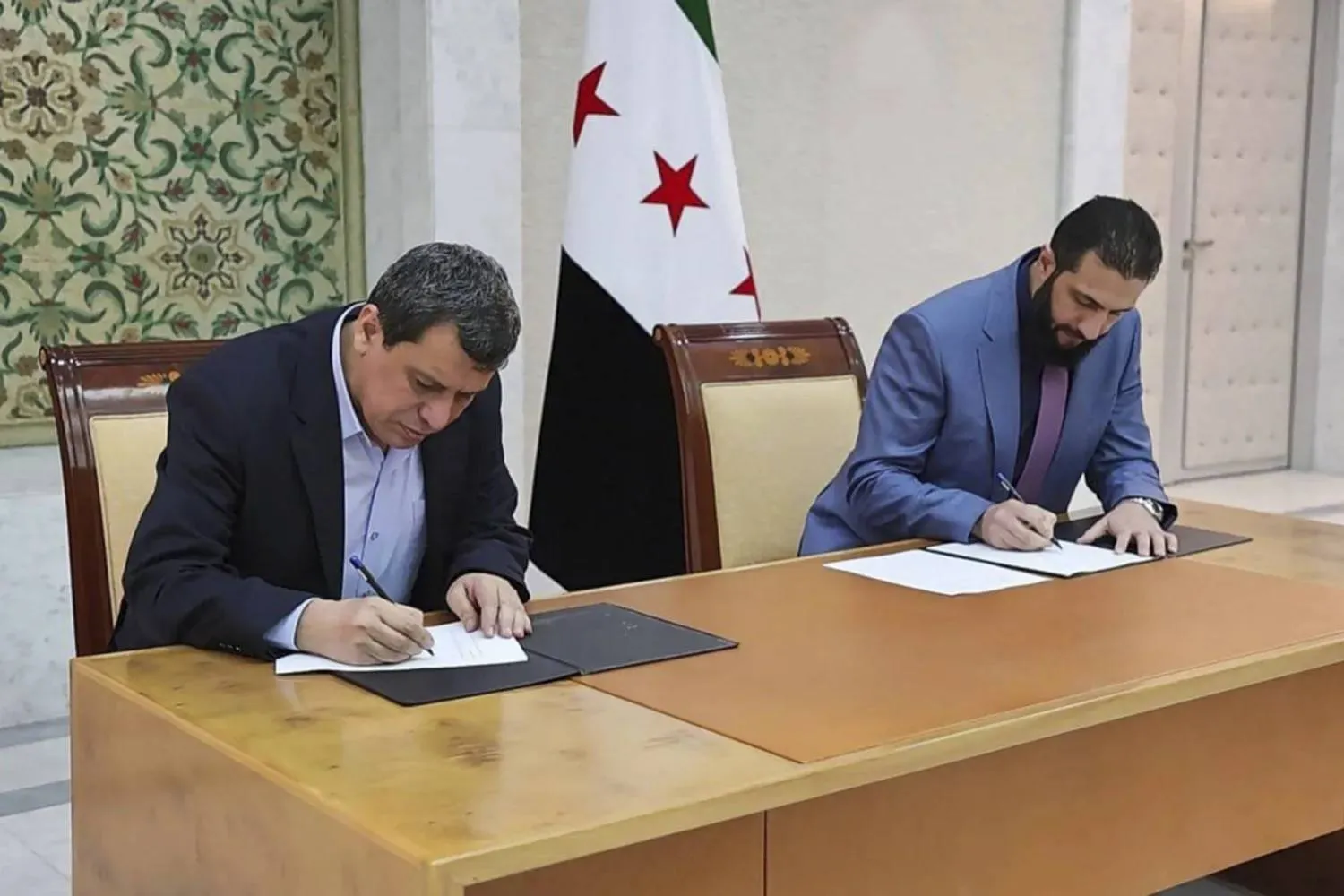
Syrian President Ahmed al-Sharaa signed a deal in Damascus last March with SDF commander Mazloum Abdi on integrating the force into state institutions (AP)
TT

Damascus, Kurdish SDF Caught Between US Pressure and Stalled Roadmap

Syrian President Ahmed al-Sharaa signed a deal in Damascus last March with SDF commander Mazloum Abdi on integrating the force into state institutions (AP)

Diplomatic activity intensified in the Syrian capital in recent hours, centering on a high-level meeting between President Ahmed al-Sharaa and delegations from the Kurdish-led Autonomous Administration of North and East Syria (AANES) and the United States, represented by Special Envoy to Syria Tom Barrack and US Central Command (CENTCOM) Commander Admiral Brad Cooper.

According to multiple sources, the talks focused on implementing the March 10 Agreement signed between the Syrian government and the Syrian Democratic Forces (SDF), amid US pressure to accelerate the process before the end of the year.

The meetings — attended by Syria’s ministers of foreign affairs and defense and the head of the General Intelligence Directorate — covered several issues, including the ceasefire in the north announced after talks between Maj. Gen. Murhaf Abu Qasra, Syria’s defense minister, and Mazloum Abdi, the SDF’s top commander.

Discussions also addressed security and administrative arrangements, the sharing of oil revenues, and the future of decentralization in SDF-held areas.

The March 10 Agreement is viewed as the main political framework regulating ties between Damascus and the SDF, but implementation has been partial.

Sinam Mohamad, the Syrian Democratic Council’s representative in Washington, told Asharq Al-Awsat that joint committees “have made little progress,” noting that issues such as the return and protection of displaced residents “remain unresolved due to a lack of guarantees and continued coercive practices by Syrian security-affiliated groups.”

By contrast, Ayman Abdel Nour, a Syrian-American political analyst and media figure, said the slow implementation reflects “confusion in the US vision” more than local field obstacles.

He told Asharq Al-Awsat that envoy Barrack “failed to strike a balance between supporting the Autonomous Administration and safeguarding Damascus’s interests,” and that his latest visit “was an attempt to rescue the agreement before US support ceases entirely.”

US Frustration Growing

James Jeffrey, the former US Secretary’s Special Representative for Syria Engagement under President Donald Trump, wrote that the roadmap negotiated between Damascus and the SDF “has yet to be implemented,” adding that Washington is increasingly frustrated by both sides’ delays.

In a commentary published by the Washington Institute for Near East Policy, Jeffrey said the temporary halt to the US troop withdrawal was driven by concerns over a potential collapse of Syria’s fragile stability.

He added that the visits by Barrack and Cooper were part of an effort “to help break this impasse,” reflecting at the same time genuine American concern over losing diplomatic momentum in a file vital to regional peace.

Integration... the Toughest Hurdle

Leaks from the Damascus meeting indicated that the most sensitive issue discussed was the integration of military and security institutions between the Syrian army and SDF formations.

Sinam Mohamad said this “cannot be resolved through quick decisions,” stressing that the SDF “includes women’s units and diverse local components that are part of the region’s identity.”

She added: “We want to be part of a national Syrian army, but based on clear guarantees and respect for the distinct character of our areas.”

Abdel Nour noted that Damascus sees integration as “the easiest step,” with President al-Sharaa viewing it as a confidence-building measure. But the SDF insists on addressing civil and economic files first.

“The disagreement reflects the deep mistrust between both sides,” he said, as Damascus views any delay as a threat to sovereignty, while the Kurdish administration fears losing its organizational and security autonomy.

Commenting on the integration of the northeast into Syria, Jeffery wrote: “Ultimately, the future welfare (and wealth) of the Syrian nation and its people greatly depend on peacefully integrating the northeast.”

“To jumpstart this process, the Kurds should go first, taking the right combination of confidence-building steps so that Damascus can feel assured about responding with similar moves.”

Jeffery also wrote that “for now, the Kurds mainly need to acknowledge the central government’s sovereignty over all of Syria,” and that “Damascus has to show restraint toward minorities and at least meet minimum international standards in considering legitimate requests, including from the Kurds.”

Decentralization and the Return of the Displaced

Decentralization and the return of displaced people formed another key focus of the talks. Mohamad stressed that a solution “must be political, based on a decentralized system that allows all Syrian components to participate in national decision-making.”

She added that the lack of security guarantees in areas such as Sheikh Maqsoud and Sweida “makes it impossible to discuss disarmament or the reintegration of local administrations,” rejecting any calls for partition.

Abdel Nour said the debate over decentralization “remains suspended between US ambitions for a gradual settlement and Damascus’s fear of losing central control.” Washington, he added, “wants to preserve Syria’s unified state structure but knows the current system cannot survive without genuine structural reforms.”

Jeffrey argued that Syria’s unity is a prerequisite “for Syria to become a full member of the international community,” warning that ongoing delays in political and administrative reforms will keep the country divided and vulnerable to regional interference.

“The main preoccupation for Syrian officials seeking to promote unity and stability is the Kurdish-controlled northeast, home to most of the country’s hydrocarbons, much of its arable land, and more than 10 percent of its population, including a mix of Kurds, Arabs, and other groups,” wrote Jeffery.

He also highlighted Türkiye’s stance as the most sensitive external factor, saying Ankara is watching the agreement’s implementation with growing concern and sees continued SDF armament as a direct threat to its national security.

“This patience could wear thin at any point,” wrote Jeffery.

US Role and Waning Influence

The diplomatic push in Damascus coincided with signs of a shrinking US footprint in the Syrian file. Sources close to the talks said Washington informed both parties that its political and military mission “will conclude by year-end.”

Abdel Nour said this message “reflects President Trump’s desire to close the Syrian file as part of a broader regional peace plan rooted in expanding the Abraham Accords.” But, he added, “Envoy Barrack has failed to translate that vision on the ground or make breakthroughs in sensitive issues such as relations with Israel and oil revenue sharing.”

For her part, Mohamad said Washington “remains more interested in preventing escalation than imposing political solutions,” arguing that “the US priority is to keep frontlines quiet ahead of any future settlements.”

The withdrawal decision risks ceding American influence in Syria to Russia and Iran, stressing that pulling out before securing a settlement between Damascus and the SDF would plunge the country back into fragile chaos.

Jeffery wrote that “Washington should press the Kurds to take the following confidence-building steps as soon as possible:

Remove non-Syrian forces from the northeast, mainly PKK members serving as administrative or military personnel.

Formalize in writing the current informal arrangements with Damascus on oil deliveries from the northeast.

Turn over international border crossings to the central government, with arrangements to allow the unimpeded flow of US military supplies.

Accelerate negotiations on handing the largely Arab province of Deir al-Zour to Damascus.”

He then pointed to Washington, in return, having to “encourage Damascus to take immediate steps to alleviate Kurdish and international concerns, focusing on measures related to education, security, and inclusive governance (though future negotiations will address many of these issues more thoroughly).”

Despite announcements that consultations will continue in the coming weeks, Abdel Nour said envoy Barrack “faces a web of conflicting interests that could derail his mission,” citing his contradictory statements alternating between calls for Syrian unity and a confederal model.

He believes Barrack’s mission “may end soon,” coinciding with the expected departure of UN Special Envoy Geir Pedersen in mid-November, with no successor likely to be appointed “given the disappearance of the conditions that justified his post following the fall of Bashar al-Assad’s regime.”



Lebanon PM Pledges State Authority, Vows to End Israeli Attacks

An Israeli officer displays weapons seized by the army in Gaza, Lebanon and Syria during a media tour (AFP). 
TT

Lebanon PM Pledges State Authority, Vows to End Israeli Attacks

An Israeli officer displays weapons seized by the army in Gaza, Lebanon and Syria during a media tour (AFP). 

Lebanon’s Prime Minister Nawaf Salam has pledged to press ahead with reforms, extend the authority of the state, and work to end Israeli attacks and remove the occupation, even as Israel signals preparations for a “measured” military action against Hezbollah.

In a New Year message posted on X, Salam wished Lebanese a year marked by hope, continued state recovery, and restored public trust.

“We promise to continue together the path of reform and the extension of state authority,” he wrote. He added a renewed pledge “to keep working to end Israeli attacks, remove the occupation, and secure the return of our detainees,” saluting the Lebanese army and security forces deployed nationwide to safeguard public safety.

Lebanon has maintained diplomatic contacts with the sponsors of the ceasefire with Israel, which took effect in November 2024 and ended 66 days of fighting between Hezbollah and the Israeli army.

Beirut says diplomacy and steps by the Lebanese army have prevented a renewed war. Israel, however, still occupies five border points inside Lebanese territory, holds around 20 detainees, including civilians, and continues to violate the agreement through intermittent strikes and targeted killings inside Lebanon.

In parallel, Israeli media report heightened security readiness for possible action against Hezbollah, citing Israeli assessments that recent Lebanese measures fall short of ceasefire terms.

The daily Maariv said security chiefs are preparing to brief Prime Minister Benjamin Netanyahu on readiness levels, pointing to what Israel describes as Lebanon’s failure to dismantle Hezbollah’s military infrastructure south and north of the Litani River.

According to the report, Lebanon may soon declare the end of army operations to disarm Hezbollah south of the Litani without extending them northward, an outcome Israel deems a breach. Israeli assessments suggest this could prompt unilateral action if Lebanon is seen as unable or unwilling to comply.

Israel accuses Hezbollah of rebuilding capabilities, including precision missiles, and says recent airstrikes targeted training sites linked to the Radwan Forces. Israeli officials argue Hezbollah is currently in a weakened operational state, enabling “calibrated” options aimed at pressuring the group while preserving the ceasefire framework.


Türkiye Plans First Overseas Deepwater Drilling in Somalia Next Month

Türkiye Minister of Energy and Natural Resources Alparslan Bayraktar speaks during the conference 'Energy Security in the World and Türkiye: Risks and Solutions in Critical Minerals' at the Sabanci University Istanbul International Center for Energy and Climate (IICEC), in Istanbul, Türkiye, December 26, 2025. REUTERS/Umit Bektas
TT

Türkiye Plans First Overseas Deepwater Drilling in Somalia Next Month

Türkiye Minister of Energy and Natural Resources Alparslan Bayraktar speaks during the conference 'Energy Security in the World and Türkiye: Risks and Solutions in Critical Minerals' at the Sabanci University Istanbul International Center for Energy and Climate (IICEC), in Istanbul, Türkiye, December 26, 2025. REUTERS/Umit Bektas

Türkiye will send a drilling vessel to Somalia in February to carry out the country's first deepwater exploration project abroad, ‌Energy Minister ‌Alparslan Bayraktar ‌said.

He ‌said the operation with the Cagri Bey vessel will focus on offshore areas ⁠in Somali waters but did not ‍provide ‍details on targeted ‍reserves or investment size.

In 2024, Türkiye signed an energy exploration deal with Somalia. It has been ⁠seeking to diversify its energy sources and reduce reliance on imports, investing in exploration at home and overseas.


Libya Says UK to Analyze Black Box from Crash That Killed General

Military personnel carry portraits of the Libyan chief of staff, General Mohamed al-Haddad (2-R), and his four advisers, who were killed in a plane crash in Türkiye, during an official repatriation ceremony at the Ministry of Defense headquarters in Tripoli, Libya, 27 December 2025. (EPA)
TT

Libya Says UK to Analyze Black Box from Crash That Killed General

Military personnel carry portraits of the Libyan chief of staff, General Mohamed al-Haddad (2-R), and his four advisers, who were killed in a plane crash in Türkiye, during an official repatriation ceremony at the Ministry of Defense headquarters in Tripoli, Libya, 27 December 2025. (EPA)

Libya said on Thursday that Britain had agreed to analyze the black box from a plane crash in Türkiye on December 23 that killed a Libyan military delegation, including the head of its army.

General Mohammed al-Haddad and four aides died after a visit to Ankara, with Turkish officials saying an electrical failure caused their Falcon 50 jet to crash shortly after takeoff.

Three crew members, two of them French, were also killed.

The aircraft's black box flight recorder was found on farmland near the crash site.

"We coordinated directly with Britain for the analysis" of the black box, Mohamed al-Chahoubi, transport minister in the Government of National Unity (GNU), said at a press conference in Tripoli.

Haddad was very popular in Libya despite deep divisions between west and east.

Haddad was chief of staff for the Tripoli-based GNU.

Chahoubi told AFP a request for the analysis was "made to Germany, which demanded France's assistance" to examine the aircraft's flight recorders.

"However, the Chicago Convention stipulates that the country analyzing the black box must be neutral," he said.

"Since France is a manufacturer of the aircraft and the crew was French, it is not qualified to participate. The United Kingdom, on the other hand, was accepted by Libya and Turkey."

After meeting the British ambassador to Tripoli on Tuesday, Foreign Minister Taher al-Baour said a joint request had been submitted by Libya and Türkiye to Britain "to obtain technical and legal support for the analysis of the black box".

Chahoubi told Thursday's press briefing that Britain "announced its agreement, in coordination with the Libyan Ministry of Transport and the Turkish authorities".

He said it was not yet possible to say how long it would take to retrieve the flight data, as this depended on the state of the black box.

"The findings will be made public once they are known," Chahoubi said, warning against "false information" and urging the public not to pay attention to rumors.