UN Faces Roadblocks in Delivering Aid to Famine-Hit Areas of North Gaza

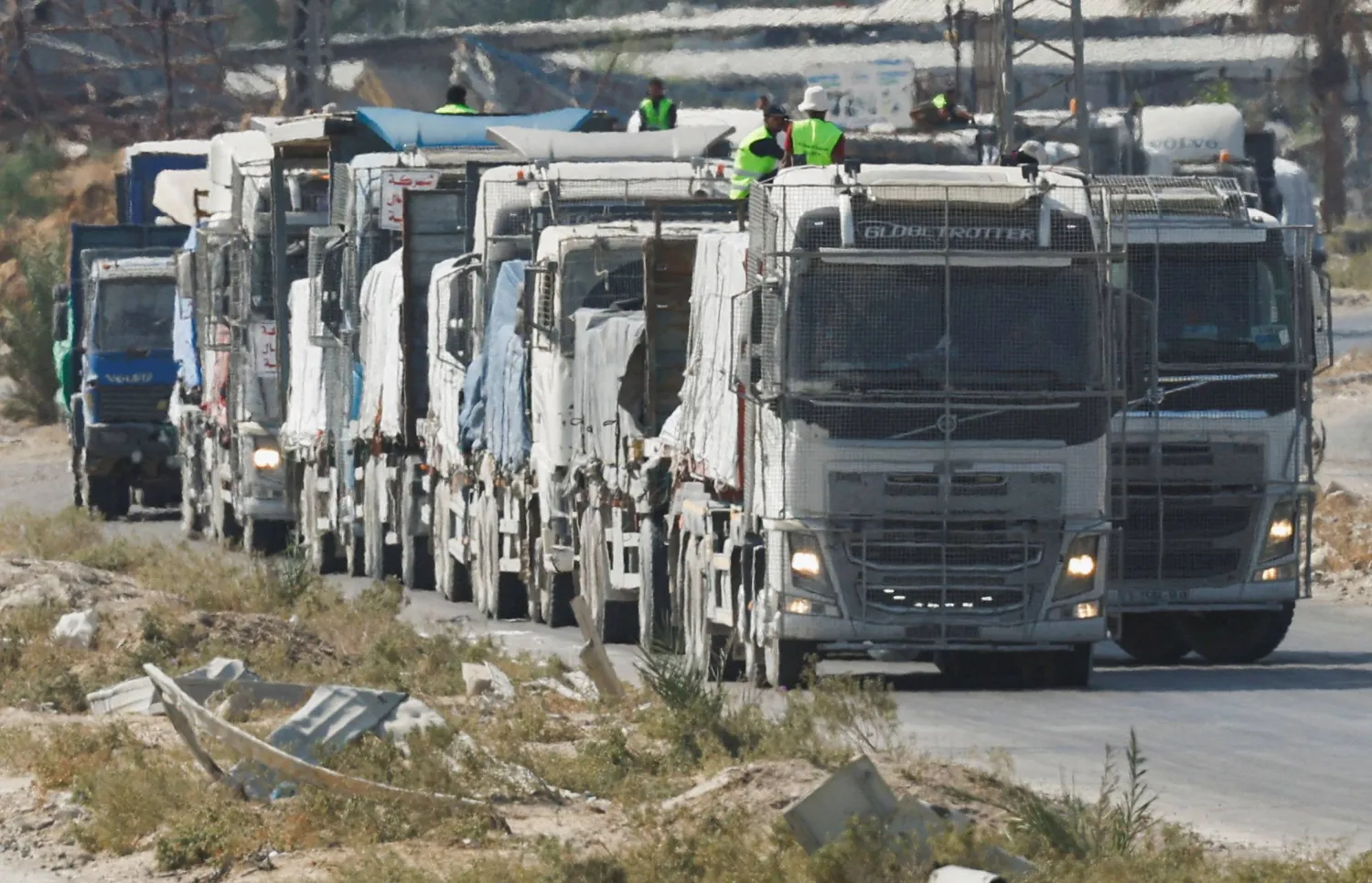
Trucks carry aid for Palestinians, amid a ceasefire between Israel and Hamas in Gaza, in Khan Younis, in the southern Gaza Strip, October 17, 2025. (Reuters)
TT

UN Faces Roadblocks in Delivering Aid to Famine-Hit Areas of North Gaza

Trucks carry aid for Palestinians, amid a ceasefire between Israel and Hamas in Gaza, in Khan Younis, in the southern Gaza Strip, October 17, 2025. (Reuters)

The UN said on Friday aid convoys were struggling to reach famine-hit areas of north Gaza due to war-damaged roads and the continued closure of key routes into the enclave's north despite a ceasefire between Israel and Hamas. 

Around 560 metric tons of food had entered the Gaza Strip per day on average since the US-brokered halt to two years of devastating war, but this was still well below the scale of need, according to the UN World Food Program. 

With famine conditions in the Gaza City region, UN humanitarian affairs chief Tom Fletcher said this week thousands of aid vehicles would have to enter weekly to tackle widespread malnutrition, homelessness and a collapse of infrastructure. 

"We're still below what we need, but we're getting there... The ceasefire has opened a narrow window of opportunity, and WFP is moving very quickly and swiftly to scale up food assistance," WFP spokesperson Abeer Etefa told a news briefing in Geneva. 

But the WFP said it had not begun distributions in Gaza City, pointing to the continued closure of two border crossings, Zikim and Erez, with Israel in the north of the enclave where the humanitarian debacle is most acute. 

"Access to Gaza City and northern Gaza is extremely challenging," Etefa said, saying the movement of convoys of wheat flour and ready-to-eat food parcels from the south of the territory was being hampered by broken or blocked roads. 

"It is very important to have these openings in the north, this is where the famine took hold. To turn the tide on this famine..., it is very important to get these openings." 

Global medical charity Medecins Sans Frontieres (Doctors Without Borders) said many relief agencies had not fully returned to the north, where hospitals are barely functioning, leaving many Gaza civilians still unable to access regular care. 

Jacob Granger, MSF emergency coordinator in Gaza, described the case of a Gaza City woman with a shrapnel wound suffered during the war who was unable to get to a medical facility to change her dressings for five days earlier this month. When she managed to see an MSF nurse and her dressing was unfolded, the wound was infected with worms and maggots, Granger said. 

Though small amounts of nutrition products have reached the north - the area of heaviest and most devastating fighting between Israel and Hamas - relief convoys were still unable to move significant quantities of food there. 

Around 950 trucks entered south and central Gaza on Thursday via the Kerem Shalom and Kissufim crossings with Israel, the UN's humanitarian coordination agency said, citing figures from Israel's military aid agency COGAT presented to mediators. 

That followed around 715 trucks that rolled into Gaza on Wednesday, including 16 bearing fuel and gas, OCHA said. 


Egypt’s Sisi, Türkiye’s Erdogan Ink Partnership Deals

A handout photo made available by the Turkish Presidential press office shows Egyptian President Abdel Fattah al-Sisi (R) and Turkish President Recep Tayyip Erdogan (L) posing before their meeting in Cairo, Egypt, 04 February 2026. (EPA/ Turkish Presidential Press Office Handout)
TT

Egypt’s Sisi, Türkiye’s Erdogan Ink Partnership Deals

A handout photo made available by the Turkish Presidential press office shows Egyptian President Abdel Fattah al-Sisi (R) and Turkish President Recep Tayyip Erdogan (L) posing before their meeting in Cairo, Egypt, 04 February 2026. (EPA/ Turkish Presidential Press Office Handout)

Turkish President Recep Tayyip Erdogan met Egyptian President Abdel Fattah al-Sisi in Cairo on Wednesday, sealing a raft of new partnership deals and signaling a united front on regional crises in Iran, Sudan and Gaza.

Relations between Cairo and Ankara have thawed sharply after nearly a decade of estrangement over the Muslim Brotherhood.

But since 2023 the two leaders have met a handful of times, exchanged visits, normalized ties and signed more than a dozen cooperation agreements, including on defense.

On Wednesday, ministers from both countries signed 18 additional agreements spanning defense, tourism, health and agriculture.

At a joint news conference, Sisi said they agreed on the need to implement all phases of the Gaza truce agreement, speed up humanitarian aid deliveries and maintain a focus on "a two-state solution, establishing a Palestinian state".

Egypt and Türkiye now form half of the mediating bloc for the current Gaza truce, back the Sudanese army in its war with paramilitary forces and share increasingly convergent positions across the region.

On Sudan, Sisi said Wednesday both sides want to see a "humanitarian truce that leads to a ceasefire and a comprehensive political path".

Sisi also called for efforts to avoid escalation in the region, advance diplomatic solutions and "avert the specter of war, whether regarding the Iranian nuclear file or concerning the region in general".

Erdogan echoed the need for diplomacy, saying foreign interference poses "significant risks to the entire region" and that dialogue remained "the most appropriate method" for addressing disputes with Iran.

Both leaders also underscored support for Somalia's territorial integrity amid heightened regional friction.

Both countries have backed the government of Somalia and condemned Israel's recognition of the breakaway region of Somaliland.

Türkiye supplied Egypt with advanced drones in 2024 and the two countries plan to manufacture them jointly.

Erdogan arrived in Cairo after a stop in Riyadh, with his tour coinciding with US-Iran contacts initially planned for Türkiye before Tehran requested a shift to Oman.


Red Cross ‘Outraged’ as On-Duty Paramedic Killed in Gaza

 Rubble from destroyed buildings lies in the north of Gaza, as seen from the Israeli side of the Israel-Gaza border in Israel, February 4, 2026. (Reuters)
Rubble from destroyed buildings lies in the north of Gaza, as seen from the Israeli side of the Israel-Gaza border in Israel, February 4, 2026. (Reuters)
TT

Red Cross ‘Outraged’ as On-Duty Paramedic Killed in Gaza

 Rubble from destroyed buildings lies in the north of Gaza, as seen from the Israeli side of the Israel-Gaza border in Israel, February 4, 2026. (Reuters)
Rubble from destroyed buildings lies in the north of Gaza, as seen from the Israeli side of the Israel-Gaza border in Israel, February 4, 2026. (Reuters)

The International Federation of Red Cross and Red Crescent Societies said it was "outraged" by the killing of an on-duty colleague on Wednesday in Gaza, where Israel is battling Hamas. 

The IFRC said Hussein Hassan Hussein Al-Samiri, "a dedicated paramedic" with the Palestine Red Crescent Society, "was killed while performing life-saving humanitarian duties in Khan Younis during an attack in the Al-Mawasi area" of the southern Gaza Strip. 

"The IFRC sends its deepest condolences to his family, friends and colleagues and expresses its full solidarity with PRCS." 

Despite a US-brokered truce entering its second phase last month, violence in the Palestinian territory has continued, with Israel and Hamas accusing each other of violating the agreement. 

The IFRC said the death brings the number of PRCS staff and volunteers killed in Gaza in the line of duty to 30 since the conflict began in October 2023. 

The federation said humanitarian workers and medical staff needed to be respected and protected at all times. 

"The Red Cross and Red Crescent emblems are symbols of protection, humanity, neutrality, and hope. Yet too often, our volunteers and staff are killed while performing life-saving work," it said. 

"The loss of Hussein is a tragic reminder of the dangers faced by those who dedicate their lives to helping others." 

The Geneva-based IFRC is the world's largest humanitarian network, with more than 17 million volunteers in more than 191 countries. 

Gazan health officials said Israeli air strikes on Wednesday killed 23 people, with Israel's military saying it struck after one of its officers was wounded by enemy gunfire. 


UN Experts Slam Israeli 'Terrorist' Death Penalty Bill

Israeli National Security Minister and head of Jewish Power party Itamar Ben-Gvir gives a statement to members of the press, ahead of a possible ceasefire between Israel and Hamas, in Jerusalem, January 16, 2025. REUTERS/Oren Ben Hakoon/File Photo
TT

UN Experts Slam Israeli 'Terrorist' Death Penalty Bill

Israeli National Security Minister and head of Jewish Power party Itamar Ben-Gvir gives a statement to members of the press, ahead of a possible ceasefire between Israel and Hamas, in Jerusalem, January 16, 2025. REUTERS/Oren Ben Hakoon/File Photo

United Nations experts on Wednesday called on Israel to withdraw a bill proposing the mandatory death penalty for terrorist acts, warning it would violate the right to life and discriminate against Palestinians.

Israel's parliament last November passed a first reading of a draft amendment to the country's penal code, demanded by far-right National Security Minister Itamar Ben Gvir, AFP reported.

"Mandatory death sentences are contrary to the right to life," a dozen independent UN rights experts warned in a statement.

"By removing judicial and prosecutorial discretion, they prevent a court from considering the individual circumstances, including mitigating factors, and from imposing a proportionate sentence that fits the crime," they said.

While the death penalty exists for a small number of crimes in Israel, it has become a de facto abolitionist country: the last person to be executed was the Nazi Holocaust perpetrator Adolf Eichmann in 1962.

But the amendment, which must pass a second and third reading before becoming law, would change that and would introduce two tracks for the death penalty in Israel, a dozen independent UN rights experts warned in a statement.

In the occupied West Bank, the statement said "the death penalty would be imposed by military courts under military law for terrorist acts causing the death of a person, even if not intended".

In Israel and occupied East Jerusalem, meanwhile, capital punishment would continue to be applied only under Israeli criminal law and only for the "intentional killing of Israeli citizens or residents".

- 'Vague and overbroad' -

The experts' statement warned that under both tracks, "vague and overbroad definitions of terrorist offences under Israeli law would apply, which can include conduct that is not genuinely terrorist, and the death penalty would be mandatory".

The experts, including Francesca Albanese, the special rapporteur for the rights situation in the occupied Palestinian territories, stressed that unintentional killings were not considered among the "most serious" crimes to which the death penalty can be applied under international law.

"Since Israeli military trials of civilians typically do not meet fair trial standards under international human rights law and humanitarian law, any resulting death sentence would further violate the right to life," said the experts, who also included the special rapporteurs for protecting rights while countering terrorism and for extrajudicial, summary or arbitrary executions.

"Denial of a fair trial is also a war crime," they stressed.

The independent experts, who are mandated by the UN Human Rights Council but who do not speak on behalf of the United Nations, also warned that "the bill makes matters worse by allowing death sentences to be imposed by a simple majority vote of military judges".

Hamas said in November that the proposed law "embodies the ugly fascist face of the rogue Zionist occupation and represents a blatant violation of international law".

The Ramallah-based Palestinian foreign ministry called it a "new form of escalating Israeli extremism and criminality against the Palestinian people".