


Fears in Lebanon of Israeli Plan to Empty and Strangle the South Economically

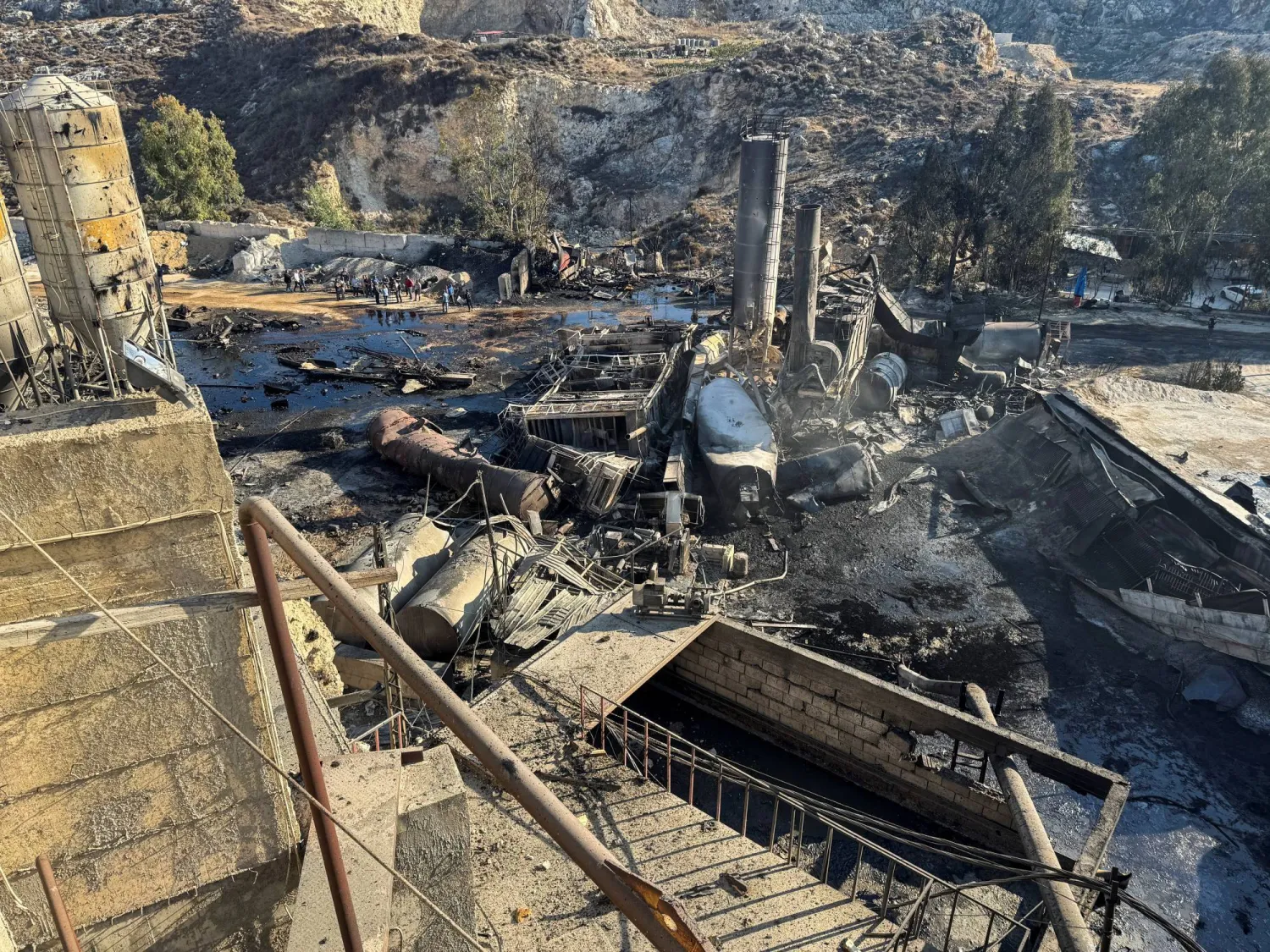
Reuters photo: Lebanese residents inspect a cement factory hit by Israeli airstrikes on Thursday night.
TT

Fears in Lebanon of Israeli Plan to Empty and Strangle the South Economically

Reuters photo: Lebanese residents inspect a cement factory hit by Israeli airstrikes on Thursday night.

Intensified Israeli airstrikes on southern Lebanon late Thursday have heightened fears that Tel Aviv is enforcing a “systematic policy to economically strangle the south and prevent life from returning,” after expanding its bombardment to include civilian and industrial facilities used in reconstruction efforts.

A week after targeting heavy machinery and excavators engaged in rebuilding damaged areas, Israeli warplanes carried out some of their most violent raids in weeks on Thursday evening, striking the Wadi Bsafour area between the towns of Ansar and Sinnay, north of the Litani River.

The bombardment caused extensive destruction in cement factories and industrial workshops, with explosions heard across Nabatieh and Zahrani.

Lebanon’s National News Agency described the raids as “among the most intense in weeks,” noting that the missiles produced an unprecedented flash and powerful tremors felt in nearby villages.

The losses extended beyond industrial and construction sites. The South Lebanon Water Establishment said in a statement that the strikes “hit and destroyed the institution’s strategic fuel depot, resulting in the total loss of its contents.”

The facility reportedly contained about half a million liters of diesel used to power electricity generators for water pumping stations and wells that supply southern towns and villages.

The raids came amid continued Israeli operations that the army said were aimed at pursuing Hezbollah fighters, alongside what it described as repeated violations of the ceasefire agreement.

On Friday afternoon, an Israeli drone struck a car in the southern town of Khirbet Selm, killing one person. Another drone dropped a stun grenade near the Qita al-Zaytouna area in the town of Blida, in the Marjayoun district.

Economic Targeting

The escalation has stirred debate over the nature and intent of Israel’s recent strikes — whether they are part of its ongoing military campaign or represent a deliberate shift toward targeting southern Lebanon’s economic and productive infrastructure.

Residents of the region say the strikes “no longer target potential military sites but have hit the arteries of civilian life.” They added that “the current confrontation is not measured by the number of rockets but by the number of destroyed workshops and workers who lost their livelihoods,” warning that the economic toll could drive residents to flee under the weight of poverty and mounting losses.

MP Mohammad Khawaja, a member of the Development and Liberation Bloc, said the targeting of cement plants and quarries “is no coincidence nor a limited field response, but a systematic policy aimed at economically suffocating the south and blocking any return to normal life.”

He told Asharq Al-Awsat that Israel “is frustrated by the return of hundreds of families to their homes in Aitaroun, Maroun al-Ras, Blida, and Khiam, after betting these towns would remain empty.” He added that residents’ determination to rebuild their homes, “even if starting with one room,” had “upset the occupation, which sought to turn the south into a desolate zone.”

Khawaja estimated the material cost of the latest strikes at over $15 million, citing the destruction of more than 300 engineering machines and trucks, some belonging to contractors working with the Ministry of Public Works. “The real goal,” he said, “is to keep the south paralyzed and prevent any genuine economic recovery or reconstruction.”

Responding to Israeli army spokesperson Avichay Adraee’s claims that Hezbollah uses such facilities to rebuild its military infrastructure, Khawaja said: “These are baseless allegations meant to justify unjustified aggression. The targeted plants are part of licensed development projects overseen by Lebanese ministries and have no link to any military activity.”

He added that Israel is now “using the economy as a weapon to subdue Lebanon politically after failing to achieve its goals militarily,” urging a “unified national stance, because the Israeli threat targets not only the south, but all of Lebanon.”

‘The Decision Lies on the Ground’

From a strategic perspective, retired Brigadier General Naji Malaeb said Israel’s targeting pattern “is no longer purely military; it now focuses on economic and civilian infrastructure such as quarries, concrete plants, and bulldozers, with the aim of crippling reconstruction and preventing the return of normal life to southern villages.”

He told Asharq Al-Awsat that “Israel understands that whoever rebuilds the land controls its political and social fate. It therefore seeks to destroy the material foundations that allow people to remain steadfast.”

“When Hezbollah deployed about 1,200 engineers and technicians after the ceasefire to assess damage and assist residents,” Malaeb added, “Israel realized the group was filling the state’s vacuum — and chose to respond by striking the very infrastructure people rely on to rebuild.”

He described the raids as “economic punishment targeting the social fabric of the south,” explaining that “every workshop bombed and every cement mixer destroyed delays people’s return home and fuels slow displacement.”

“The south today faces a dual threat — fire from the sky and economic strangulation on the ground,” Malaeb said.

On the ground, the devastation speaks for itself: idle factories, burned bulldozers, and workers left without jobs. According to Malaeb, “Israel is using the economy as a long-term weapon — one that erodes people’s resilience and turns reconstruction into a daily war of attrition. Every strike on an industrial plant is a blow to Lebanon’s social structure, not its military one.”

Post-Strikes Scenarios

Malaeb warned that Israel’s current approach “could pave the way for a scenario similar to southern Syria, where demilitarized zones were created and managed by local structures under international oversight.”

“Israel may justify such a project under the pretext of securing its borders against terrorism,” he said, “but the real goal is to depopulate the south.” He stressed that “a national solution can only be achieved through clear demarcation of land borders and full Lebanese sovereignty over its territory.”



In a First, Armed Gang in Gaza Forces Displacement of Residents

 A Palestinian woman receives donated food at a community kitchen in Deir al-Balah, central Gaza Strip, Thursday, Dec. 25, 2025. (AP)
A Palestinian woman receives donated food at a community kitchen in Deir al-Balah, central Gaza Strip, Thursday, Dec. 25, 2025. (AP)
TT

In a First, Armed Gang in Gaza Forces Displacement of Residents

 A Palestinian woman receives donated food at a community kitchen in Deir al-Balah, central Gaza Strip, Thursday, Dec. 25, 2025. (AP)
A Palestinian woman receives donated food at a community kitchen in Deir al-Balah, central Gaza Strip, Thursday, Dec. 25, 2025. (AP)

In an unprecedented development, an armed gang active in Gaza City forced inhabitants of residential bloc to evacuate their homes under threat of arms.

Field sources told Asharq Al-Awsat that identified the gang as the “Rami Halas Group”. At dawn on Thursday, its members opened fire in the air in the Hayy al-Tuffah neighborhood in eastern Gaza City. The area is located near Israel’s so-called yellow line that separates Hamas- and Israel-held parts of Gaza.

The gang members came back hours later at noon and demanded that the residents evacuate, giving them until sunset to comply and threatening to shoot anyone who doesn’t.

The sources said the gunmen did not directly approach any of the residents for fear of being attacked. They used loudspeakers to demand that they evacuate to areas a few hundred meters away, claiming these were Israeli orders.

Israeli forces are deployed some 150 meters from the area where the residents were located.

The residents, who had only just returned to their homes after the ceasefire, indeed started to evacuate towards western parts of Gaza City.

The sources said over 240 residents were forced to quit what remains of their damaged homes.

They revealed that Israeli forces had on Tuesday and Wednesday night dropped yellow barrels, devoid of explosives, in those regions. They did not ask residents to evacuate.

The sources said the gang made the evacuation order ahead of Israel’s plan to occupy the area, which had been previously declared as safe.

They accused Israeli forces of resorting to such tactics in recent weeks to further expand the yellow line border and occupy more areas in Gaza.


Syria Says Kills Senior ISIS Leader, Arrests Operative Near Damascus

A photo of a Public Security operation in Aleppo against an ISIS cell (File – Facebook)
TT

Syria Says Kills Senior ISIS Leader, Arrests Operative Near Damascus

A photo of a Public Security operation in Aleppo against an ISIS cell (File – Facebook)

Syrian authorities on Thursday said forces killed a senior leader in the ISIS group and arrested another operative in fresh operations near capital Damascus in coordination with the US-led coalition.

Syrian security and intelligence forces, working in coordination with the international coalition, conducted what the interior ministry described as a "precise security operation" in the Damascus countryside, AFP reported.

"The operation resulted in neutralising the terrorist Mohammad Shahada, known as 'Abu Omar Shaddad', who is considered one of the prominent ISIS leaders in Syria," it added.

"This operation comes as confirmation of the effectiveness of joint coordination between the national security agencies and international partners."

Later Thursday, the interior ministry said security forces "in joint coordination with international coalition forces" arrested "the leader of a terrorist cell affiliated with the ISIS organization" elsewhere near Damascus, seizing weapons and ammunition.

Late Wednesday, authorities said they captured Taha al-Zoubi, also known as Abu Omar Tabiya, an ISIS leader in the Damascus region, along with several of his men, also in a joint operation with the US-led coalition.

The interior ministry also said on Thursday that security forces had arrested three members of an ISIS-affiliated cell in Aleppo province.

A December 13 attack killed two US soldiers and an American civilian. Washington blamed the attack on a lone ISIS gunman in Syria's Palmyra.

In retaliation, US forces conducted strikes targeting scores of ISIS targets in Syria.

The strikes killed five members of the militant group, according to the Syrian Observatory for Human Rights.

In November, during a visit by interim President Ahmed al-Sharaa to Washington, Syria officially joined the US-led coalition against ISIS.


Israeli Settler Attack Injures Palestinian Baby, Five Arrested

Israeli settlers attacked farmers and volunteers harvesting olives on a Palestinian farm in Burin, near Nablus, on November 8, 2025. © Observers
TT

Israeli Settler Attack Injures Palestinian Baby, Five Arrested

Israeli settlers attacked farmers and volunteers harvesting olives on a Palestinian farm in Burin, near Nablus, on November 8, 2025. © Observers

Israeli security forces announced on Thursday the arrest of five Israeli settlers over their alleged involvement in an attack on a Palestinian home that injured a baby girl in the occupied West Bank.

The eight-month-old infant suffered "moderate injuries to the face and head" in the late Wednesday attack, according to the official Palestinian news agency Wafa.

It blamed the attack on "a group of armed settlers", accusing them of "throwing stones at homes and property" in the town of Sair, north of Hebron, AFP reported.

A statement from the Israeli police said that five suspects had been arrested for their "alleged involvement in serious, violent incidents in the village of Sair".

Israeli security forces had received reports of "stones being thrown by Israeli civilians toward a Palestinian home", adding a Palestinian girl was injured.

"The preliminary investigation determined the involvement of several suspects who came from a nearby outpost," the statement said, referring to Israeli settlements not officially recognized by Israeli authorities.

All Israeli settlements in the West Bank are considered illegal by the international community.

Some are also illegal under Israeli law, though many of those are later given official recognition.

Almost none of the perpetrators of previous attacks by settlers have been held to account by the Israeli authorities.

A Telegram group linked to the "Hilltop Youth", a movement of hardline settlers who advocate direct action against Palestinians, posted a video showing property damage in Sair.

More than 500,000 Israelis currently live in settlements in the West Bank, occupied since 1967, as do around three million Palestinians.

Violence involving settlers has risen in recent years, according to the United Nations, and October was the worst month since it began recording such incidents in 2006, with 264 attacks that caused casualties or property damage.

The violence in the West Bank, a territory occupied by Israel since 1967, has surged since Hamas' October 7, 2023 attack, which triggered the Gaza war.

Since the start of the war, Israeli troops and settlers have killed more than 1,000 Palestinians in the West Bank, including many militants as well as dozens of civilians, according to an AFP tally based on figures from the Palestinian health ministry.

According to official Israeli figures, at least 44 Israelis, both soldiers and civilians, have been killed in Palestinian attacks or Israeli military operations in the same period.