

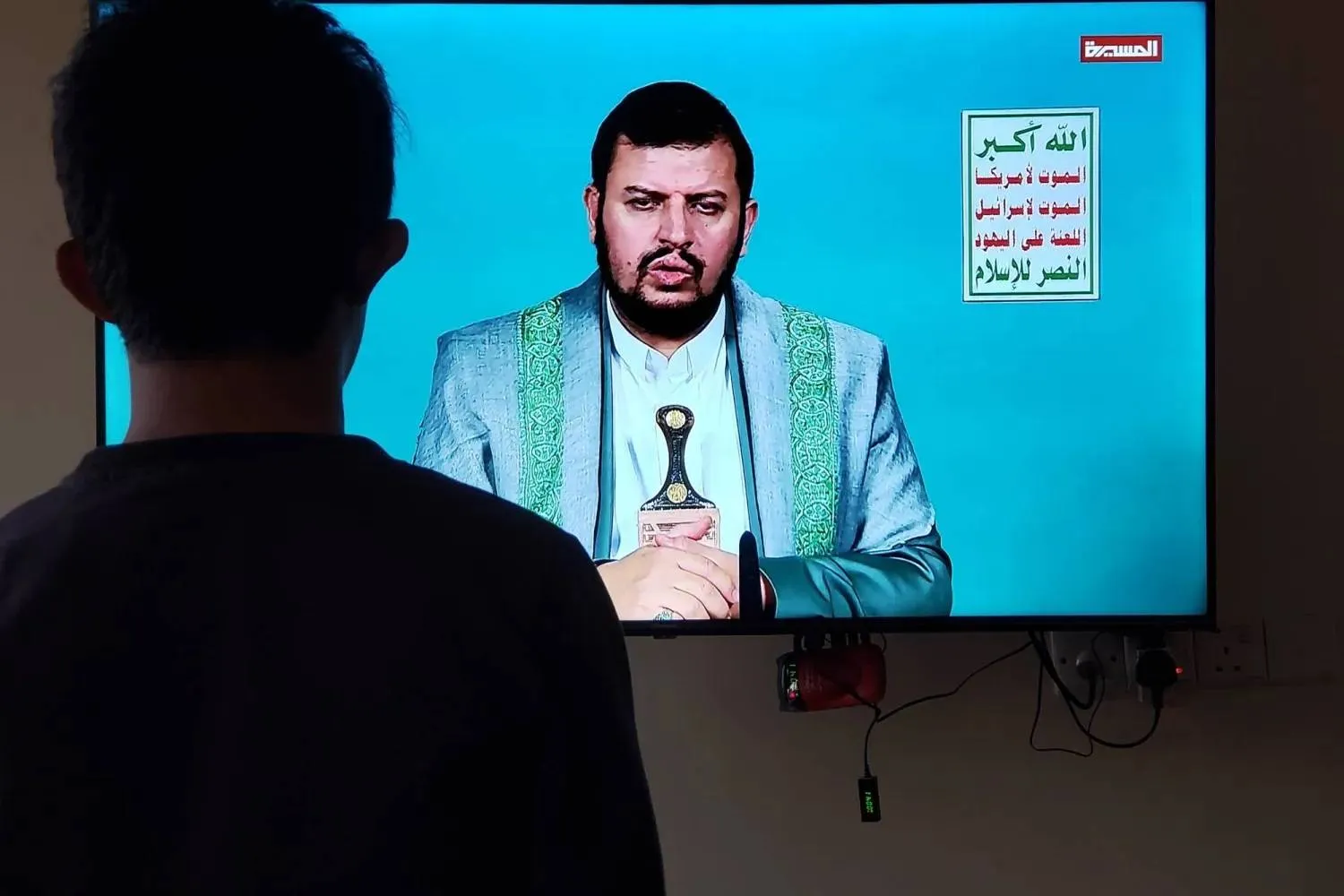

Houthi Leader Targets UN Staff, Accuses Aid Workers of Spying

Houthi leader Abdul-Malik al-Houthi has unleashed his group against UN staff (EPA)
TT

Houthi Leader Targets UN Staff, Accuses Aid Workers of Spying

Houthi leader Abdul-Malik al-Houthi has unleashed his group against UN staff (EPA)

Houthi leader Abdul-Malik al-Houthi has placed United Nations staff at the top of his list of “enemies,” accusing employees of the World Food Program (WFP) and UNICEF of carrying out “espionage” for the United States and Israel, and holding some responsible for the killing of his government’s prime minister, Ahmed Ghaleb al-Rahawi, and nine ministers in an Israeli airstrike on Sanaa in late August.

The accusations came in al-Houthi’s weekly sermon on Thursday evening, at a time when 53 UN staff members remain detained, some for up to four years. Humanitarian and rights observers fear his remarks could signal a new wave of prosecutions, possibly including death sentences, amid charges of “espionage” and “collaboration.”

In his address, al-Houthi framed the security apparatus as “a twin of the military field in confronting enemies,” claiming that his group’s security forces “arrested espionage cells working for Americans and Israelis under the cover of humanitarian work.”

He alleged that some of these cells included personnel from the WFP and UNICEF, claiming they “provided information and coordinates to Israeli intelligence,” which led to the targeting of a government meeting in Sanaa and the killing of Prime Minister al-Rahawi and several ministers.

Al-Houthi further asserted that these “espionage cells” used their affiliation with UN organizations “as a cover for hostile activities,” and that “safety and security officials in one UN agency played a central role in the crime targeting the government.”

He claimed that his group possesses “conclusive evidence” of their involvement in surveillance and communication breaches, adding that “instead of holding the perpetrators accountable, the United Nations blames our security forces,” a charge the UN has repeatedly and firmly denied.

Concerns Over Wider Abuses

Analysts say the Houthi attacks on the UN aim to divert attention from mounting losses among field commanders and justify widespread arrests of UN personnel in Sanaa and other areas under Houthi control.

Observers also note that the escalation against aid workers comes as the group faces increasing isolation. Its naval attacks in the Red Sea and Bab el-Mandeb have led to its international designation as a “terrorist group threatening maritime navigation.”

Relief sources warn that the coming days could see further Houthi crackdowns on international staff, particularly as the group insists on linking humanitarian activity to what it calls “US-Israeli aggression.”

Yemeni human rights circles fear the group could carry out executions of some detainees to intimidate aid workers and tighten control over their operations in a country grappling with the world’s worst humanitarian crisis.

In recent comments, the UN envoy to Yemen, Hans Grundberg, said he discussed with ambassadors from the five permanent members of the Security Council, as well as others, the continued detention of UN personnel, diplomats, and NGO workers by the Houthis.

Grundberg stressed that such actions obstruct humanitarian operations and undermine peace efforts. He underscored that the safety of all aid workers is a top UN priority and called for the immediate and unconditional release of all detained staff.

Acknowledging Losses

Al-Houthi’s escalation against UN staff follows the group’s admission of the killing of its chief of staff, Muhammad Abdel Karim al-Ghamari, in an Israeli airstrike believed to have targeted Sanaa in mid-June, and the appointment of leader Youssef al-Madani as his replacement.

Al-Ghamari was among the group’s top military commanders, closely aligned with al-Houthi ideologically and operationally, responsible for mine deployment, oversight of missile and naval attacks, and maintaining ties with Iran’s Revolutionary Guard.

Commenting on the development, Yemeni Information Minister Moammer al-Eryani said the Houthi acknowledgment of al-Ghamari’s death “reveals the group’s security failures and internal confusion.”

He added that “the delayed admission reflects leadership chaos within the group and confirms its declining capacity to manage frontlines or maintain internal cohesion.”

Al-Eryani noted that “the past months have seen precise strikes targeting first- and second-tier Houthi leadership,” causing “a clear fracture in the group’s military, political, and media hierarchy.” He emphasized that “the late acknowledgments and recent hostile statements expose the group’s fragility and the erosion of its terrorist project.”



Two Warnings — Arab and Western — ‘Tip the Balance’ in Iraq

Members of the Popular Mobilization Forces during the funeral of comrades killed in a US strike (AFP). 
TT

Two Warnings — Arab and Western — ‘Tip the Balance’ in Iraq

Members of the Popular Mobilization Forces during the funeral of comrades killed in a US strike (AFP). 

In an unusual development, informed sources told Asharq Al-Awsat that the Iraqi government and influential political actors received two extraordinary warning messages over the past two weeks — one from an Arab country and another from a Western intelligence service — containing what were described as “serious” indications of impending, wide-ranging military strikes inside Iraq.

An Iraqi official confirmed that a “friendly state” had briefed Baghdad on the substance of the threat, prompting Shiite factions to move swiftly toward concessions.

According to the sources, potential targets could have included government institutions linked to Shiite factions and the Popular Mobilization Forces (PMF), powerful financial and military figures, sites and depots for drones and missiles, and training camps.

The two warnings are widely believed to have accelerated a recent wave of political statements by factions calling to “confine weapons to the state,” while simultaneously requesting time and freedom of action, within what they termed a “national framework”, to dismantle their military capabilities. This position remains a point of contention among leaders of the Coordination Framework.

A Message from a “Friendly State”

The threat level first rose with a message from an Arab country that maintains good relations with both Washington and Tehran. The message warned that Baghdad was perilously close to a swift military strike, likened to the targeting of Hamas’ political office in Doha in September 2025.

The message, delivered to Iraqi officials and politicians, stressed that the threat was “extremely serious” and that Israelis were now speaking openly of having received a green light from the United States to act unilaterally in the Iraqi theater.

Iraq has been among the arenas Israel has contemplated striking since the Oct. 7, 2023 attacks. Iraqi politicians told Asharq Al-Awsat in recent months that Washington had restrained Israel from operating in Iraq, while pressing Baghdad to remove the risks posed by weapons outside state control.

A Western diplomat said US officials felt Iraqi leaders did not fully grasp the gravity of the situation and had grown frustrated with what they saw as a weak response.

An Iraqi government official acknowledged receiving multiple warnings about armed groups from friendly states and Western embassies in Baghdad.

“A Massive File”

Days after the Arab message, Iraqi officials received what sources described as a “massive file” from a Western intelligence service. The file included Israeli-prepared lists packed with detailed information on Iraqi armed factions.

The breadth, precision, and depth of the intelligence stunned Iraqi officials. One told Asharq Al-Awsat that the timing of revealing the extent of Israel’s knowledge was critical. The lists reportedly detailed faction leaders, covert operatives within their inner circles, financiers and business figures tied to the groups, and government institutions serving as fronts for factional influence.

The Western service warned that Israel was on the verge of a broad operation now that the factions’ operational and financial capabilities and the deep networks underpinning their military structures had been exposed. After reviewing parts of the file, Shiite politicians reportedly recalled the pager explosions in Lebanon as a cautionary precedent.

“What Now?”

A senior Shiite leader within the Coordination Framework revealed that the two messages “changed the equation,” pushing party leaders to accelerate steps related to factional arms. Many are now grappling with a single question: what to do next? Disagreements persist over the method and the trusted authority to oversee a transitional phase of weapons consolidation.

The leader noted the first phase would involve handing over ballistic missiles and drones and dismantling and surrendering strategic camps north and south of Baghdad. A second phase, he claimed, would include removing faction-affiliated officials from the PMF, pending the US response.

An official in the State of Law Coalition said an agreement to remove heavy weapons had already existed within the Coordination Framework, even before US pressure intensified. Current disputes center on which state body would take custody of the weapons, amid US distrust of security institutions seen as influenced by factions.

Complicating matters, factions fear implementing disarmament amid fraught negotiations to form a new government. Caretaker Prime Minister Mohammad Shia al-Sudani is seeking a second term after winning the largest bloc within the Coordination Framework, a bid opposed by his rival Nouri al-Maliki, who favors a compromise candidate.

US Pressure

The Western intelligence message coincided with the arrival in Iraq of Senior Defense Official Colonel Stephanie Bagley. US defense funding will hinge on three conditions set out in the 2025 National Defense Authorization Act, passed on Dec. 11, 2025.

The law conditions assistance on Iraq’s ability to publicly and verifiably reduce the operational capacity of Iran-aligned armed groups not integrated into the security forces through disarmament, demobilization, and reintegration. It also requires strengthening the Iraqi prime minister’s authority as commander-in-chief and investigating and prosecuting militia members or security personnel operating outside the official chain of command if involved in attacks or destabilizing acts.

Western diplomatic sources said Bagley is expected to seek a clear, enforceable timeline from Iraqi officials. She met twice in one week with Army Chief of Staff Lt. Gen. Abdul Amir Yarallah in October 2025.

A former Iraqi official noted that Washington has repeatedly pressed Baghdad for a timeline to dismantle militia influence, especially ahead of 2026, when the US-led coalition is set to complete its mission. A US State Department spokesperson reaffirmed that Washington will continue to press for the disarmament of Iran-backed militias that undermine Iraq’s sovereignty and threaten Iraqis and Americans alike.


US, Qatar, Egypt, Türkiye, Urge Restraint in Gaza

Members of the Palestinian Civil Defense remove the rubble of a destroyed home as they search for the bodies of Palestinians killed during the conflict in Khan Younis, southern Gaza Strip, 20 December 2025. (EPA)
TT

US, Qatar, Egypt, Türkiye, Urge Restraint in Gaza

Members of the Palestinian Civil Defense remove the rubble of a destroyed home as they search for the bodies of Palestinians killed during the conflict in Khan Younis, southern Gaza Strip, 20 December 2025. (EPA)

The United States was joined Saturday by Qatar, Egypt and Türkiye in urging parties in the Gaza ceasefire to uphold their obligations and exercise restraint, the chief US envoy said after talks in Miami.

Top officials from each nation met with Steve Witkoff, President Donald Trump's special envoy, to review the first stage of the ceasefire that came into effect on October 10.

"We reaffirm our full commitment to the entirety of the President’s 20-point peace plan and call on all parties to uphold their obligations, exercise restraint, and cooperate with monitoring arrangements," said a statement posted by Witkoff on X.

Their meeting came amid continuing strains on the agreement.

Gaza's civil defense said six people were killed Friday in Israeli shelling of a shelter. That brought to 400 the number of Palestinians killed by Israeli fire since the deal took effect.

Israel has also repeatedly accused Hamas of violating the truce, with the military reporting of its three soldiers killed in the territory since October.

Saturday's statement cited progress yielded in the first stage of the peace agreement, including expanded humanitarian assistance, return of hostage bodies, partial force withdrawals and a reduction in hostilities.

It called for "the near-term establishment and operationalization" of a transitional administration which is due to happen in the second phase of the agreement, and said consultations would continue in the coming weeks over its implementation.

Under the deal's terms, Israel is supposed to withdraw from its positions in Gaza, an interim authority is to govern the Palestinian territory instead of Hamas, and an international stabilization force is to be deployed.

On Friday, US Secretary of State Marco Rubio expressed hope that countries would contribute troops for the stabilization force, but also urged the disarmament of Hamas, warning the process would unravel unless that happened.


Lebanese Deputy PM to Asharq Al-Awsat: No Political Negotiations with Israel

Smoke rises from the site of a series of Israeli airstrikes that targeted the outskirts of the southern Lebanese village of al-Katrani on December 18, 2025. (AFP)
TT

Lebanese Deputy PM to Asharq Al-Awsat: No Political Negotiations with Israel

Smoke rises from the site of a series of Israeli airstrikes that targeted the outskirts of the southern Lebanese village of al-Katrani on December 18, 2025. (AFP)

Lebanon’s Deputy Prime Minister Tarek Mitri denied on Saturday that the appointment of civilian negotiators between Lebanon and Israel means that political negotiations have been launched between the two neighbors.

He told Asharq Al-Awsat that the negotiating team is primarily tasked with ensuring that the Lebanese army carries out Lebanon’s part of the ceasefire with Israel.

The army is close to completing the first phase of the agreement to impose state monopoly over arms in southern Lebanon, he added.

Other phases of the deal will follow to cover the whole of Lebanon.

Mitri added that attention must be focused on not giving Israel excuses to attack Lebanon, meaning Lebanon must meet its ceasefire obligations.

He warned, however, that Israel "could expand its military operations in Lebanon with or without excuses."

He noted that the United States appears to be pressuring Israel against launching a new war against Lebanon.

Lebanon is close to completing the disarmament of Hezbollah south of the Litani River, Prime Minister Nawaf Salam said on Saturday, as the country races to fulfil a key demand of its ceasefire with Israel before a year-end deadline.

The US-backed ceasefire, agreed in November 2024, ended more than a year of fighting between Israel and Hezbollah and required the disarmament of the Iran-aligned group, starting in areas south of the river adjacent to Israel.

Lebanese authorities, ‌led by President ‌Joseph Aoun and Salam, tasked the Lebanese ‌army ⁠on August ‌5 with devising a plan to establish a state monopoly on arms by the end of the year.

"Prime Minister Salam affirmed that the first phase of the weapons consolidation plan related to the area south of the Litani River is only days away from completion," a statement from his ⁠office said.

"The state is ready to move on to the second ‌phase - namely (confiscating weapons) north of the ‍Litani River - based on the ‍plan prepared by the Lebanese army pursuant to ‍a mandate from the government," Salam added.

The statement came after Salam held talks with Simon Karam, Lebanon's top civilian negotiator on a committee overseeing the Hezbollah-Israel truce.

Since the ceasefire, the sides have regularly accused each other of violations, with Israel questioning the Lebanese army's efforts to disarm Hezbollah. ⁠Israeli warplanes have increasingly targeted Hezbollah in southern Lebanon and even in the capital.

Israel has publicly urged Lebanese authorities to fulfil the conditions of the truce, saying it will act "as ‌necessary" if Lebanon fails to take steps against Hezbollah, which has refused to disarm.