


Two Wounded in Attack on Office of Iraqi Parliamentary Candidate

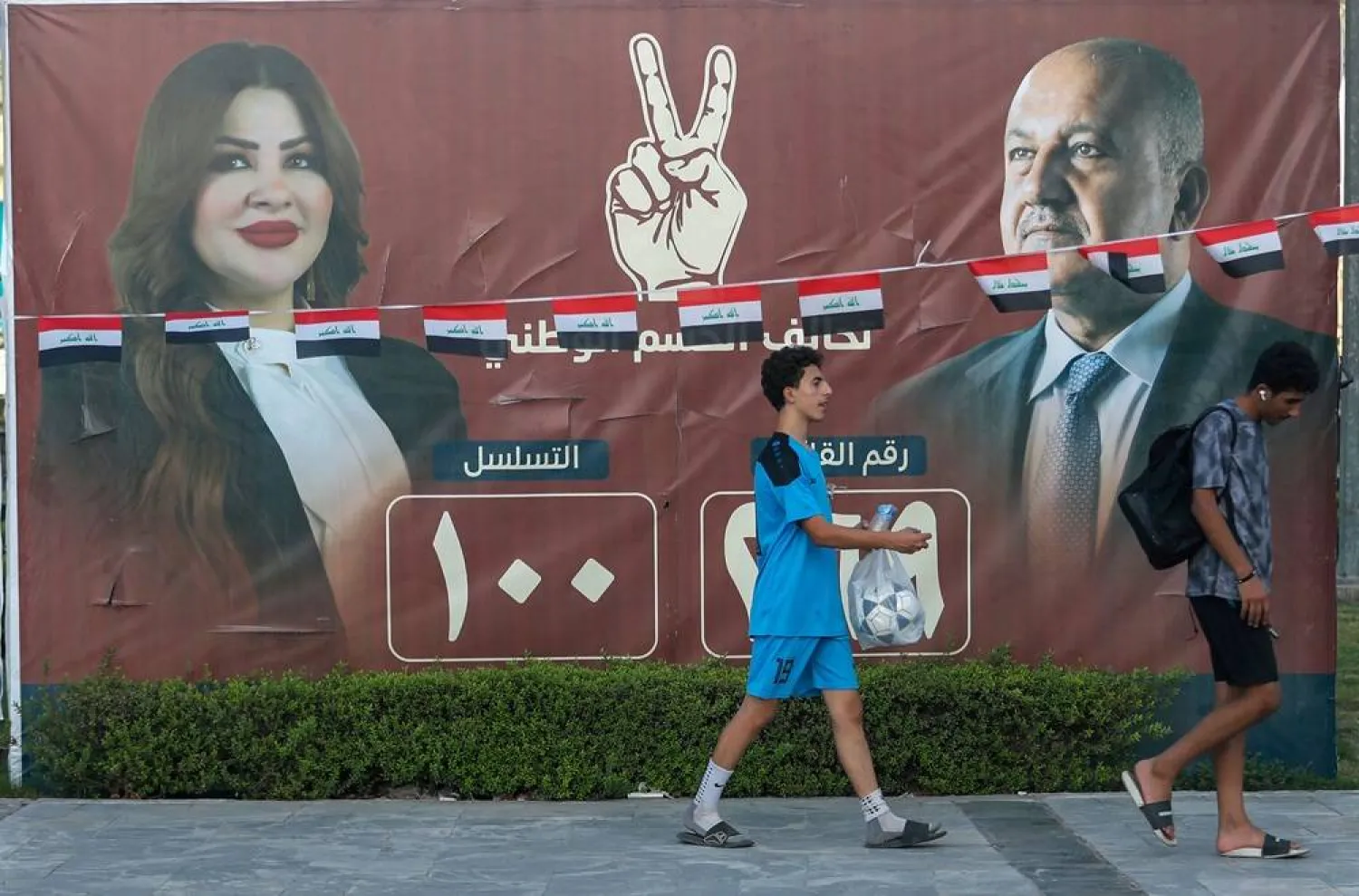
People walk past electoral billboards on a street in Baghdad on October 14, 2025, ahead of parliamentary elections on November 11. (AFP)
TT

Two Wounded in Attack on Office of Iraqi Parliamentary Candidate

People walk past electoral billboards on a street in Baghdad on October 14, 2025, ahead of parliamentary elections on November 11. (AFP)

Armed gunmen opened fire early Saturday on the office of an Iraqi parliamentary candidate south of Baghdad, wounding two bodyguards, a security source said.

The attack on Sunni politician Muthanna al-Azzawi's office comes days after a bomb killed another candidate in the November 11 elections.

The gunmen fled after the attack in Yusufiyah, 25 kilometers (16 miles) south of the capital, the source told AFP.

Azzawi is a member of the Baghdad provincial council and belongs to the "Azm Alliance", a centrist Sunni coalition led by Muthanna al-Samarrai.

The candidate "firmly condemned the cowardly attack", saying: "These acts will not stop us from continuing to serve our people."

"The attackers will be punished for their actions sooner or later," Azzawi added on his Facebook page.

A bomb killed fellow Baghdad provincial council member and election candidate Safaa al-Mashhadani on Wednesday when it exploded under his car north of the city.

It also wounded three of his bodyguards.

Mashhadani was running with the Sovereignty Alliance, one of Iraq's largest Sunni coalitions, led by businessman Khamis al-Khanjar and parliament speaker Mahmoud al-Mashhadani.

The coalition condemned the "cowardly crime", calling it "an extension of the approach of exclusion, targeting and treachery pursued by the forces of uncontrolled weapons and terrorism, all of which seek to silence free national voices".

Prime Minister Mohammed Shia al-Sudani ordered an investigation into the attack on Mashhadani and called for the perpetrators' arrests.

The majority of Iraq's 329 lawmakers represent Shiite parties aligned with neighboring Iran.

The upcoming elections are the sixth since the 2003 US-led invasion of Iraq, which toppled longtime ruler Saddam Hussein.

In Iraq, the role of prime minister traditionally goes to a Shiite and the presidency to a Kurd, while the speaker of parliament is usually Sunni.



With 19 Ports and 70 Upgraded Silos, Egypt Aims to Become Global Grain Hub

Egyptian President Abdel Fattah al-Sisi during the inauguration of the New Delta project days ago. (Egyptian Presidency)
TT

With 19 Ports and 70 Upgraded Silos, Egypt Aims to Become Global Grain Hub

Egyptian President Abdel Fattah al-Sisi during the inauguration of the New Delta project days ago. (Egyptian Presidency)

Egypt is intensifying efforts to position itself as a global hub for grain storage and trade as regional conflicts continue to disrupt international food supply chains.

Cairo’s push is anchored in its strategic geographic location, a network of 19 commercial ports and recently upgraded grain silos with expanded storage capacity. Economists interviewed by Asharq Al-Awsat described the initiative as part of Egypt’s broader ambition to play a larger role in regional food security and global supply stability.

In televised remarks Monday, Amr Abdo, a member of the Federation of Egyptian Chambers of Commerce, said that plans to establish a global strategic grain storage center were “an urgent necessity” amid escalating regional conflicts and supply-chain disruptions.

Abdo noted that Egypt’s strategic partnership with Russia — the world’s largest grain exporter — gives Cairo access to advanced storage technologies and technical expertise that help reduce spoilage and moisture loss while securing wheat imports at competitive prices.

The initiative gained momentum during the Fifth International Grain Forum, held in the Russian city of Sochi from May 20 to 23. On the sidelines of the event, Egypt’s Supply and Internal Trade Minister Sherif Farouk met Russian Agriculture Minister Oksana Lut and outlined Egypt’s goal of establishing “an integrated global logistics center for grains and edible oils.”

Farouk characterized the project as one of Egypt’s most important strategic initiatives, designed to transform the country into a regional and international hub for the storage, trading and processing of grains and food commodities.

He added that Egypt’s strategic location, combined with major upgrades to ports, economic zones and transportation networks, creates significant opportunities for Russian companies and institutions to participate through direct investment and technology transfer in storage, transport, silo management and logistics services.

Major storage expansion

According to Egyptian government figures, Egypt now operates 70 grain silos nationwide built to modern technological standards as part of a national program aimed at increasing wheat and grain storage capacity and safeguarding strategic reserves.

Economic expert Medhat Nafea, a member of the cabinet’s economic advisory committee, said that Egypt boasts substantial advantages that could help make the project viable.

He pointed to the country’s location, its 19 commercial ports, expanded silo capacity, modern storage infrastructure and Egypt’s potential role as a transit hub for exports.

Nafea stressed that transforming Egypt into a regional grain center would require major investments in storage capacity, digitalization and transportation networks, though he added that the goal “appears realistic” through cooperation with Russia.

Khaled El-Shafei, head of the Capital Center for Economic Studies, described the initiative as a potentially transformative step that could significantly strengthen Egypt’s role in securing global supply chains.

“Egypt’s move toward establishing a global grain hub could represent an unprecedented economic and developmental leap,” El-Shafei remarked, noting that Egypt’s geographic position linking East and West, along with its status as a gateway to Africa, gives it major strategic advantages.

International coordination

On April 20, Egyptian Prime Minister Mostafa Madbouly chaired a meeting to review developments related to plans for a global center for the storage, supply and trade of grains and edible oils.

Officials indicated that technical studies are being prepared for discussions between President Abdel Fattah al-Sisi and leaders of several countries as part of broader efforts to strengthen cooperation on food security.

Days later, on April 26, Russia’s Maritime Board announced that Russian presidential aide and board chairman Nikolai Patrushev discussed prospects for establishing a grain and energy hub in Egypt during talks in Cairo with Egyptian Transport Minister Kamel al-Wazir, according to Russian media.

The Russian official added that Moscow plans to direct a significant share of its exports to South Asia and Africa through Egyptian territory.

Nafea underscored the importance of attracting large-scale foreign investment from countries expected to benefit from the project, predicting substantial financial returns that could help reduce Egypt’s import bill and ease global food-security pressures.

El-Shafei acknowledged that the initiative still faces challenges but maintained that Egypt’s diplomatic relationships and ongoing infrastructure development could help secure international backing.

“The project is highly promising if there is genuine commitment and sustained cooperation to implement it,” he stressed, adding that global grain supplies increasingly require secure hubs for storage and trade.

He added that Egypt’s broader vision extends beyond becoming merely a grain-trading center to positioning itself as a global commercial and logistics hub.


Al-Burhan Announces Plans for Broad Political Dialogue Inside Sudan

Muslim worshippers pray during Eid al-Adha prayers, at Al-Sayyid Abdul Rahman al-Mahdi mosque, in Khartoum, Sudan, Wednesday, May 27, 2026. (AP)
TT

Al-Burhan Announces Plans for Broad Political Dialogue Inside Sudan

Muslim worshippers pray during Eid al-Adha prayers, at Al-Sayyid Abdul Rahman al-Mahdi mosque, in Khartoum, Sudan, Wednesday, May 27, 2026. (AP)

Sudanese army chief and Transitional Sovereignty Council Chairman Lt. Gen. Abdel Fattah al-Burhan announced plans for a comprehensive political dialogue inside Sudan aimed at completing the country’s transition to civilian democratic rule.

In an address delivered on the eve of Eid al-Adha, al-Burhan declared that the government would provide full support for the initiative, which he said would include involvement by those directly affected by the war.

He also reaffirmed the military’s commitment to continue fighting “until every inch of the country is cleared” of the Rapid Support Forces (RSF).

According to a statement released by the Sovereignty Council on Facebook, al-Burhan said: “This holiday comes as the capital of my country regains its strength, and as our people prove every day that they are stronger and braver than any conspiracy.”

Arrangements were underway for “a comprehensive political dialogue through which Sudanese will agree on the foundations of national reconstruction and governing principles that unite Sudan and end its recurring crises,” he revealed.

The dialogue, he said, would determine the path toward completing Sudan’s civilian democratic transition.

Al-Burhan stressed that the talks would take place inside Sudan and would include “those who bear the pain,” referring to people affected by the conflict between the army and RSF that erupted in April 2023.

He rejected externally imposed political initiatives, saying Sudanese citizens “will not accept the outcomes of conferences and dialogues held in foreign capitals, where positions are bought and sold.”

“The Sudanese government will invite national forces, excluding those whose hands are stained with the blood of the Sudanese people,” he stated, pledging government support for implementing the dialogue’s outcomes.

Previous statements by al-Burhan indicated that the door remained open to national reconciliation, welcoming anyone willing to align with the state against the RSF.

No immediate reaction was made by political and civilian groups aligned with the military or by the civilian pro-democracy coalition, known as “Somoud,” which opposes the continuation of the war.

Al-Burhan’s remarks came as fierce fighting continued in Blue Nile State in southeastern Sudan, where the RSF has reportedly deployed thousands of fighters in an effort to seize full control of the region.

Despite recent battlefield gains by the army and its recapture of several towns in Blue Nile State, the RSF continues to control the strategic border town of Kurmuk near Ethiopia.

On Wednesday, Sudanese army personnel released video footage from the town of Al-Baraka, saying they had regained full control of the area after defeating RSF fighters and allied forces, inflicting heavy casualties, and capturing several combat vehicles.


Israeli Strikes Kill at Least 8 in Lebanon’s Tyre Ahead of Washington Talks

A fireball and smoke erupt from a building following an Israeli strike in Tyre, southern Lebanon, on May 28, 2026. (AFP)
TT

Israeli Strikes Kill at Least 8 in Lebanon’s Tyre Ahead of Washington Talks

A fireball and smoke erupt from a building following an Israeli strike in Tyre, southern Lebanon, on May 28, 2026. (AFP)

The Israeli military early Thursday pounded Lebanon's fourth largest city, killing at least eight people in its ongoing military escalation against the Hezbollah group ahead of crucial talks in Washington. 

Several others were injured in the strikes, according to Lebanon's state-run National News Agency. 

An Israeli soldier meanwhile in northern Israel was killed in a Hezbollah drone attack, the military said. 

The intensification comes after Israeli Prime Minister Benjamin Netanyahu announced an expansion in the Israeli military's attacks in Lebanon, apparently sparked by Hezbollah's use of fiber-optic exploding drones that have struck Israeli troops in Lebanon and reached some of Israel's northern border towns. 

Lebanese and Israeli military officials are set to hold their first security talks on Friday in the US capital. The talks have extended a nominal ceasefire that went into effect April 17, although the attacks have since intensified while sparing the Lebanese capital Beirut. 

Hezbollah has dismissed the talks and instead endorsed its key ally Iran, which has made ending the war in Lebanon a condition for its own talks with Washington brokered by Pakistan. 

Prior to the attacks on Thursday, Israeli military Arabic spokesperson Avichay Adraee issued warnings to eight buildings in the coastal city of Tyre along the Mediterranean and surrounding neighborhoods. Many people have fled the area. 

Further north in the city of Sidon, an Israeli drone struck an apartment building where some displaced families lived. 

Mohammad Al-Gharbi, who lived across the street from the building in Sidon. woke to the sound of the explosion. 

"I was in my room when part of the wall and shattered glass fell on me, and everything was thrown into chaos," he said. "This building that was hit had six apartments occupied by poor families who had fled from the south to escape the attacks there, only to be hit here." 

In the nearby coastal town of Adloun, an Israeli drone struck a car with a family that was fleeing, killing six people including children. Another drone strike that came without warning killed two people on a motorcycle near Tyre. The target of the attack was not immediately clear, NNA reported. 

The Israeli military said Thursday that a soldier in northern Israel was killed in a Hezbollah drone attack and two reservists were wounded. 

Hezbollah has claimed dozens of drone and rocket attacks that it says targeted Israeli troops in southern Lebanon and northern Israel. 

Over 1 million people in Lebanon have been displaced by the war between Israel and Hezbollah, which was sparked when Hezbollah fired rockets into northern Israel on March 2 in solidarity with Iran, two days after the Iran war began. 

At least 3,269 people have been killed in Israeli strikes since the start of the war, according to the Lebanese Health Ministry, with over 9,800 wounded. 

According to Netanyahu’s office, at least 23 Israeli soldiers and a defense contractor have been killed in or near southern Lebanon and two civilians have been killed in northern Israel, the vast majority by drones.