


Fall in China’s Exports of Rare Earth Magnets Stokes Supply Chain Fears 

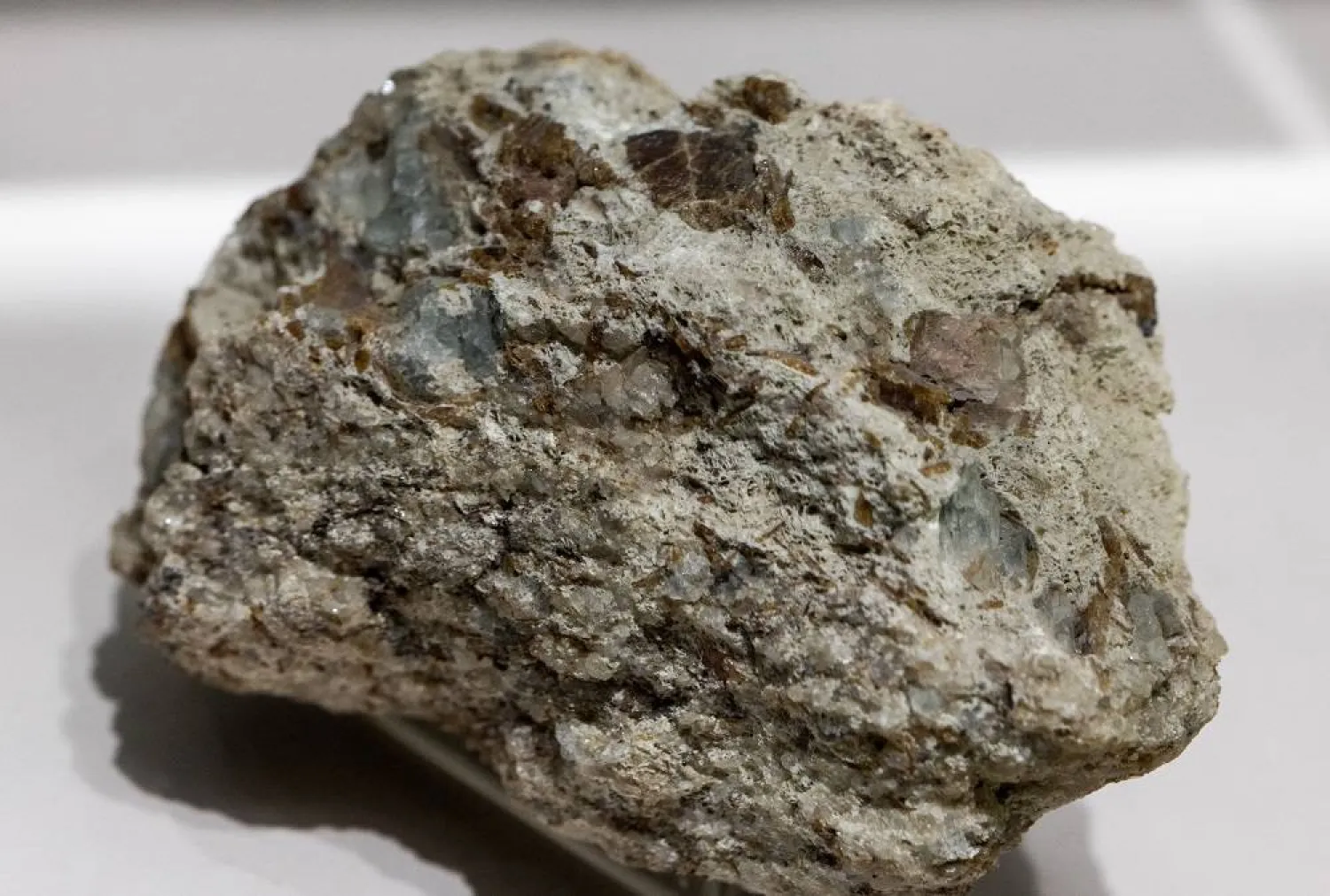
A sample of bastnaesite ore, a mineral used in the rare earth industry to extract elements such as cerium, lanthanum, and neodymium, is displayed at the Geological Museum of China in Beijing, China, October 14, 2025. (Reuters)
TT

Fall in China’s Exports of Rare Earth Magnets Stokes Supply Chain Fears 

A sample of bastnaesite ore, a mineral used in the rare earth industry to extract elements such as cerium, lanthanum, and neodymium, is displayed at the Geological Museum of China in Beijing, China, October 14, 2025. (Reuters)

China's exports of rare earth magnets fell in September, reigniting fears that the world's top supplier could wield its dominance over a component key for US defense firms and makers of items from cars to smartphones as leverage in trade talks.

In April and May, Beijing squeezed global automakers with export curbs on a range of rare earths items and related magnets, while negotiators faced off over triple-digit US tariffs on goods from the world's second-largest economy.

Four months on, after Washington and Beijing unexpectedly reprised threats of fresh tariffs and rare earth export curbs, worry is growing that China could return to the same playbook.

That would mean it reneges on a June deal with the United States to ease the flow of critical minerals.

China's shipments of rare earth magnets fell 6.1% in September from August, customs data showed on Monday, ending three months of gains, and dropping even before Beijing unveiled a dramatic expansion of its export licensing regime this month.

"The sharp swings in rare earth magnet exports show that China knows it holds a key card in international trade talks," said Chim Lee, senior analyst at the Economist Intelligence Unit.

EXPORTS FALL FROM AUGUST'S SEVEN-MONTH HIGH

The September fall to 5,774 tons from a seven-month high of 6,146 tons in August aligns with reports that China is already making it harder for firms to secure licenses for exports of rare earth magnets.

Its commerce ministry is applying scrutiny similar to that seen in April, at the height of the trade war.

On an annual basis, September shipments rose 17.5%.

Last week, China's commerce ministry accused the United States of stoking global panic over its rare earth controls by deliberately misunderstanding the curbs, and said it would approve export licenses intended for civilian use.

Still, analysts worry China could once again entangle civilian commercial users in curbs aimed at choking US defense firms' access to critical materials.

"China's ability to throttle rare earth exports is an exceptionally powerful tool," said Dan Wang, China director at Eurasia Group.

Apart from disrupting production, such measures would fuel insecurity over access to critical industrial inputs and growing reliance on China, she added.

"The world has to adjust to its management style," she said, adding that Western countries are not used to complying with a monopolistic control of critical resources from countries on "the other side".

By country, Germany, South Korea, Vietnam, the United States and Mexico were the top five export destinations for Chinese rare earth magnets by volume last month.

Over the nine months of the year, exports of such magnets totaled 39,817 tons, a fall of 7.5% from the corresponding 2024 period.

NO SIGN OF BEIJING BACKING DOWN

Shipments to the United States fell 28.7% in September on the month, the data showed, while exports to Vietnam rose 57.5% over the same period.

The Netherlands processed 109% more rare earth magnets than in August, though the figure is skewed by the huge Rotterdam port, a major transit hub for Europe-bound trade.

Just before the release of the data, President Donald Trump told reporters aboard Air Force One that he did not want China to "play the rare earth game with us".

He suggested he might hold off on raising tariffs back to levels in excess of 100% if the world's top agricultural buyer committed to purchasing US soybeans.

But Beijing shows no sign of backing down, adamant that its new wider curbs, set to take effect just days before the November 10 expiry of the latest 90-day tariff truce with the United States, are consistent with measures in other major economies.

President Xi Jinping is set to meet Trump in South Korea later this month, but economists warn that trade friction between the two biggest economies may be the new normal.

"The surge in exports during the third quarter came after it (China) eased export controls earlier in the year, but that's likely to drop again following the tighter restrictions introduced recently," added EIU analyst Chim Lee.



Morocco to Open Two Deepwater Ports in 2026 and 2028, Minister Says

A general view of Tanger Med Port, on the Strait of Gibraltar, east of Tangier, Morocco June 6, 2024. (Reuters)
TT

Morocco to Open Two Deepwater Ports in 2026 and 2028, Minister Says

A general view of Tanger Med Port, on the Strait of Gibraltar, east of Tangier, Morocco June 6, 2024. (Reuters)

Morocco will open a new deepwater Mediterranean port next year and another on the Atlantic in 2028, Equipment and Water minister Nizar Baraka said, as the North African country aims to replicate the success of Africa's largest port, Tanger Med.

Nador West Med, under construction on the Mediterranean, is scheduled to be operational in the second half of 2026, Baraka told Reuters in an interview.

It will offer 800 hectares for industrial activity, with plans to expand to 5,000 hectares, surpassing Tanger Med's industrial zones, he said.

The port will also host Morocco's first liquefied natural gas (LNG) terminal - a floating storage and regasification unit (FSRU) - linked by a pipeline to industrial hubs in the northwest, as Morocco pushes investments in natural gas and renewable energy to reduce dependence on coal.

Further south on the Atlantic coast, Morocco is building a $1 billion port in Dakhla, in the disputed Western Sahara region.

The facility will be surrounded by 1,600 hectares for industrial activities and 5,200 hectares for farmland irrigated by desalinated water, Baraka said.

"The port will be ready in 2028 and will be Morocco's deepest at 23 meters," Baraka said. Such depth would support heavy industries focused on processing raw materials from Sahel countries, he said.

Officials have marketed Dakhla as a gateway for landlocked Sahel nations to global trade.

Both Nador and Dakhla ports will include quays dedicated to exporting green hydrogen once production begins, Baraka said.

Nador and Dakhla would be Morocco's third and fourth deepwater ports after Tanger Med and Jorf Lasfar, an energy, bulk cargo and phosphates exports port on the Atlantic.

By 2024, industrial zones near Tanger Med hosted 1,400 firms employing 130,000 people across sectors including automotive, aeronautics, textiles, agri-food and renewable energy, official figures show.

Morocco is also considering building a port in Tan-Tan on the Atlantic in partnership with green hydrogen investors, Baraka said. "We are conducting studies to decide the appropriate size of the port," Baraka said.


Saudi Arabia, Qatar Sign High-Speed Railway Project Implementation Agreement

The project is slated for completion in six years, utilizing the latest railway technologies and smart engineering to ensure safe and seamless operation and to adhere to the highest international standards of quality and safety - SPA
TT

Saudi Arabia, Qatar Sign High-Speed Railway Project Implementation Agreement

The project is slated for completion in six years, utilizing the latest railway technologies and smart engineering to ensure safe and seamless operation and to adhere to the highest international standards of quality and safety - SPA

Prince Mohammed bin Salman bin Abdulaziz Al Saud, Crown Prince and Prime Minister, and Emir of the State of Qatar Sheikh Tamim bin Hamad Al Thani witnessed the signing of an agreement to implement a high-speed electric passenger railway project connecting the Kingdom of Saudi Arabia and the State of Qatar, a step reflecting the deep-rooted fraternal and historical relations between the two countries.

The agreement was signed by Minister of Transport and Logistic Services Saleh Al-Jasser and Minister of Transport of Qatar Sheikh Mohammed bin Abdulla bin Mohammed Al Thani within the framework of the Saudi-Qatari Coordination Council, representing a strategic step aimed at enhancing cooperation, developmental integration, and sustainable development, and demonstrating a shared commitment to regional prosperity, SPA reported.

The high-speed railway line spans 785 kilometers, strategically connecting the capital cities of Riyadh and Doha, and will pass through key stations including Hofuf and Dammam, while also linking King Salman International Airport and Hamad International Airport.

The train will form a new artery for rapid and sustainable transportation, improving the regional travel experience with speeds exceeding 300 kilometers per hour, reducing travel time between the two capitals to approximately two hours, significantly enhancing mobility, boosting trade and tourism, and improving quality of life.

The project is slated for completion in six years, utilizing the latest railway technologies and smart engineering to ensure safe and seamless operation and to adhere to the highest international standards of quality and safety.

It is expected to have an economic impact of nearly SAR115 billion on the GDP of both countries, serve over 10 million passengers annually, and create more than 30,000 direct and indirect jobs.

The high-speed railway will also contribute to environmental sustainability by reducing carbon emissions and supporting the transition to more efficient and innovative transportation patterns for smart and sustainable mobility in the region.

This makes the rail line one of the most important strategic projects supporting regional development and strengthening connectivity and integration among the Gulf Cooperation Council countries.


Türkiye's Pegasus Airlines Acquires Biggest Czech Airline, Smartwings, in a Deal Worth $180 million

A passenger plane of the ‘Pegasus’ airline lands at the ‘Stuttgart Airport’ in Stuttgart, Germany, Wednesday, May 3, 2023. (Bernd Weissbrod/dpa via AP, File)
TT

Türkiye's Pegasus Airlines Acquires Biggest Czech Airline, Smartwings, in a Deal Worth $180 million

A passenger plane of the ‘Pegasus’ airline lands at the ‘Stuttgart Airport’ in Stuttgart, Germany, Wednesday, May 3, 2023. (Bernd Weissbrod/dpa via AP, File)

Türkiye's Pegasus Airlines said on Monday it has signed an agreement to acquire the biggest Czech airline, Smartwings, along with its owner, Czech Airlines, from Prague City Air.

Pegasus said the deal, which is worth 154 million euros (almost $180 million) was a “step forward in our continued global growth journey,” Reuters reported.

The process of transferring the ownership of Czech Airlines should be completed in 12 months, Smartwings spokeswoman Vladimíra Dufková said.

Smartwings currently operates regular, charter and private flights to some 80 destinations with almost 50 planes. The airline previously negotiated a takeover by Polish national carrier LOT but that fell through over the weekend after Pegasus filed a rival bid.

Pegasus, a low cost carrier, that was established in 1990. It says it operates flights to 153 destinations in 54 countries.