


Trump, Australia’s Albanese Sign Critical Minerals Agreement to Counter China 

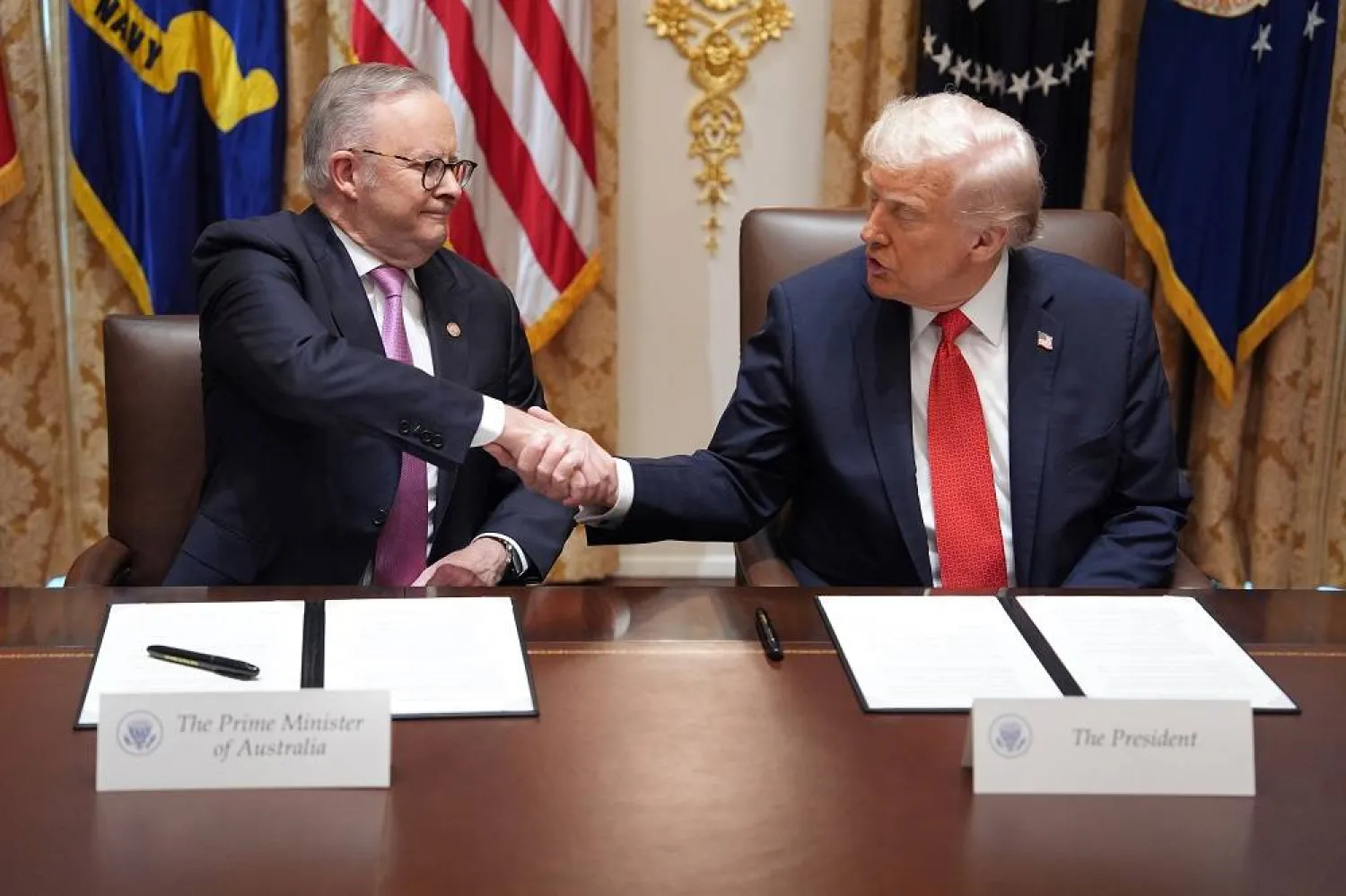
President Donald Trump, right, shakes the hand of Australian Prime Minister Anthony Albanese during a meeting in the Cabinet Room of the White House, Monday, October 20, 2025, in Washington. (AP)
TT

Trump, Australia’s Albanese Sign Critical Minerals Agreement to Counter China 

President Donald Trump, right, shakes the hand of Australian Prime Minister Anthony Albanese during a meeting in the Cabinet Room of the White House, Monday, October 20, 2025, in Washington. (AP)

US President Donald Trump and Australian Prime Minister Anthony Albanese signed a critical minerals agreement aimed at countering China on Monday at a meeting marked by Trump's jab at Australia's envoy to the United States over past criticism.

China loomed large at the first White House summit between Trump and Albanese, with the US president also backing a strategic nuclear-powered submarine deal with Australia to bolster security in the Indo-Pacific.

While Trump and Albanese greeted each other warmly, the US president expressed ire about past criticism of him by Australia's US ambassador Kevin Rudd, a former prime minister. Rudd in 2020 called Trump "the most destructive president in history," later deleting the comment from social media.

Trump said he was not aware of the critical comments and asked where the envoy was now. Upon seeing him across the table, Trump said, "I don't like you either, and I probably never will."

The visit otherwise appeared to go smoothly, with Albanese and Trump signing a minerals deal that Trump said had been negotiated in recent months. Albanese described it as an $8.5 billion pipeline "that we have ready to go."

A copy of the agreement released by both governments said the two countries will each invest $1 billion over the next six months into mining and processing projects as well as set a minimum price floor for critical minerals, a move that Western miners have long sought.

A White House statement on the agreement added that the investments would target deposits of critical minerals worth $53 billion, although it did not provide details on which types or locations.

"In about a year from now, we'll have so much critical mineral and rare earths that you won't know what to do with them," Trump told reporters.

EXIM ANNOUNCES OVER $2.2 BILLION IN INVESTMENTS

The US Export-Import Bank, which acts as the US government's export credit agency, later announced seven letters of interest totaling more than $2.2 billion to advance critical minerals projects in Australia. It said the letters went to Arafura Rare Earths, Northern Minerals, Graphinex, Latrobe Magnesium, VHM, RZ Resources, and Sunrise Energy Metals.

EXIM said the projects span a range of critical minerals essential to advanced defense systems, aerospace components, communications equipment, and next-generation industrial technologies.

The investments would help support the re-industrialization of America’s high-tech manufacturing base, while helping to "counter China's export dominance and ensure Western supply-chain resilience," it said.

Additionally, the Pentagon plans to build a gallium refinery in Western Australia. China blocked gallium exports to the United States last December.

The United States has been looking to boost its access to critical minerals around the world as China takes steps to strengthen control over global supply. Trade tensions between the United States and China have escalated ahead of Trump's meeting with Chinese President Xi Jinping in South Korea next week.

The term critical minerals applies to a range of minerals, including rare earths, lithium and nickel.

China has the world's largest rare earths reserves, according to US Geological Survey data, but Australia also has significant reserves. The minerals are used for products ranging from electric vehicles to aircraft engines and military radars.

TRUMP SIGNALS SUPPORT FOR SUBMARINE DEAL

Albanese got welcome support from Trump for the A$368 billion ($239.46 billion) AUKUS agreement, reached in 2023 under then-President Joe Biden. Under the deal, Australia is to buy US nuclear-powered submarines in 2032 before building a new submarine class with Britain.

While Trump has been eager to roll back Biden-era policies, he signaled his intent to back the AUKUS submarine agreement, months after his team launched a review of the deal over concerns about the ability of the United States to meet its own submarine needs.

Navy Secretary John Phelan told the meeting the United States and Australia were working closely to improve the original AUKUS framework for all three parties "and clarify some of the ambiguity that was in the prior agreement."

Trump said these were "just minor details," adding that "there shouldn't be any more clarifications, because we're just - we're just going now full steam ahead, building."

Ahead of Monday's meeting, Australian officials emphasized that their country is paying its way under AUKUS, contributing $2 billion this year to boost production rates at US submarine shipyards, and preparing to maintain US Virginia-class submarines at its Indian Ocean naval base from 2027.

The delay of 10 months in an official meeting since Trump took office had caused some anxiety in Australia as the Pentagon urged the Australian government to increase defense spending. The two leaders met briefly on the sidelines of the United Nations General Assembly in New York last month.

The rare earths agreement came a week after US officials condemned China's expansion of rare earth export controls as a threat to global supply chains.

Resource-rich Australia, wanting to extract and process rare earths, put preferential access to its strategic reserve on the table in US trade negotiations in April.

As part of the rare earths agreement, Trump and Albanese agreed to cut permitting for mines, processing facilities and related operations in order to boost production.

The deal called for cooperation on the mapping of geological resources, minerals recycling and efforts to stop the sale of critical minerals assets "on national security grounds."

This was an oblique reference to China, which has bought major mining assets across the planet in the past decade, including the world's largest cobalt mine in Congo, from US-based Freeport-McMoRan in 2016.



Gold Bounces Back on Softer Dollar, US-Iran Concerns; Silver Rebounds

Gold and silver bars are stacked in the safe deposit boxes room of the Pro Aurum gold house in Munich, Germany, January 10, 2025. REUTERS/Angelika Warmuth
TT

Gold Bounces Back on Softer Dollar, US-Iran Concerns; Silver Rebounds

Gold and silver bars are stacked in the safe deposit boxes room of the Pro Aurum gold house in Munich, Germany, January 10, 2025. REUTERS/Angelika Warmuth

Gold rebounded on Friday and was set for a weekly gain, helped by bargain hunting, a slightly weaker dollar and lingering concerns over US-Iran talks in Oman, while silver recovered from a 1-1/2-month low.

Spot gold rose 3.1% to $4,916.98 per ounce by 09:31 a.m. ET (1431 GMT), recouping losses posted during a volatile Asia session that followed a fall of 3.9% on Thursday. Bullion was headed for a weekly gain of about 1.3%.

US gold futures for April delivery gained 1% to $4,939.70 per ounce.

The US dollar index fell 0.3%, making greenback-priced bullion cheaper for the overseas buyers.

"The gold market is seeing perceived bargain hunting from bullish traders," said Jim Wyckoff, senior analyst at Kitco Metals.

Iran and the US started high-stakes negotiations via Omani mediation on Friday to try to overcome sharp differences over Tehran's nuclear program.

Wyckoff said gold's rebound lacks momentum and the metal is unlikely to break records without a major geopolitical trigger.

Gold, a traditional safe haven, does well in times of geopolitical and economic uncertainty.

Spot silver rose 5.3% to $74.98 an ounce after dipping below $65 earlier, but was still headed for its biggest weekly drop since 2011, down over 10.6%, following steep losses last week as well.

"What we're seeing in silver is huge speculation on the long side," said Wyckoff, adding that after years in a boom cycle, gold and silver now appear to be entering a typical commodity bust phase.

CME Group raised margin requirements for gold and silver futures for a third time in two weeks on Thursday to curb risks from heightened market volatility.

Spot platinum added 3.2% to $2,052 per ounce, while palladium gained 4.9% to $1,695.18. Both were down for the week.


Europe, Türkiye Agree to Work Toward Updating Customs Union

European Union (R) and Turkish flags fly at the business and financial district of Levent in Istanbul, Türkiye September 4, 2017. REUTERS/Osman Orsal
TT

Europe, Türkiye Agree to Work Toward Updating Customs Union

European Union (R) and Turkish flags fly at the business and financial district of Levent in Istanbul, Türkiye September 4, 2017. REUTERS/Osman Orsal

The European enlargement chief and the Turkish foreign minister said on Friday they had agreed to continue work toward modernizing the EU-Türkiye customs union and to improve its implementation, Reuters reported.

European Commissioner for Enlargement Marta Kos met Turkish Foreign Minister Hakan Fidan in the capital Ankara on Friday.

"They shared a willingness to work for paving the way for the modernization of the Customs Union and to achieve its full potential in order to support competitiveness, and economic security and resilience for both sides," they said in a joint statement afterward.

The sides also welcomed the gradual resumption of European Investment Bank (EIB) operations in Türkiye and said they intended to support projects across the country and neighbouring regions in cooperation with the bank.


Bitcoin Falls 8% and Asian Shares Mostly Slip after Wall Street is Hit by Tech Stock Losses

FILE PHOTO: Representation of Bitcoin cryptocurrency in this illustration taken September 10, 2025. REUTERS/Dado Ruvic/Illustration/File Photo
TT

Bitcoin Falls 8% and Asian Shares Mostly Slip after Wall Street is Hit by Tech Stock Losses

FILE PHOTO: Representation of Bitcoin cryptocurrency in this illustration taken September 10, 2025. REUTERS/Dado Ruvic/Illustration/File Photo

US futures and Asian shares traded mostly lower on Friday, tracking Wall Street’s losses as technology stocks again dragged on markets.

Bitcoin sank to roughly half its record price, giving back all it gained since US President Donald Trump won the White House for his second term.

Tokyo’s Nikkei 225 was up 0.8% to 54,253.68, recovering from losses earlier this week, with technology-related stocks leading gains. SoftBank Group rose 2.2% and chipmaker Tokyo Electron rose 2.6%. Japan will also be holding its general election on Sunday, in which Prime Minister Sanae Takaichi expects to win a stronger public mandate for her policies.

Shares of Toyota Motor were up 2%. The carmaker said Friday its CEO Koji Sato will be stepping down in April, and is to be replaced by Chief Financial Officer Kenta Kon, The Associated Press said.

South Korea’s Kospi lost 1.4% to 5,089.14, weighed down by tech shares. Samsung Electronics, the country’s biggest listed company, fell 0.4%. Chipmaker SK Hynix was also down 0.4%.

Hong Kong’s Hang Seng fell 1.4% to 26,519.60. The Shanghai Composite index was down 0.3% to 4,065.58.

In Australia, the S&P/ASX 200 shed 2% to 8,708.80.

Taiwan’s Taiex was mostly flat. India's Sensex traded 0.1% lower.

Against the backdrop of the technology sell-off this week, bitcoin, the world’s largest cryptocurrency, saw dimming enthusiasm and was trading about 8% lower at just under $65,000 early Friday, after it briefly sank over 12% to below $64,000 on Thursday. That’s down from a record of above $124,000 in October.

The future for the S&P 500 was 0.2% lower, while that for the Dow Jones Industrial Average fell 0.1%.

On Thursday, the S&P 500 fell 1.2% to 6,798.40, its sixth loss in the seven days. The Dow Jones Industrial Average fell 1.2% to 48,908.72. The Nasdaq composite dropped 1.6% to 22,540.59.

Technology stocks were among the worst hit as concerns persist over whether massive AI investments by many of the Big Tech firms will pay off.

Chipmaker Qualcomm sank 8.5% despite better-than-expected quarterly revenues. Alphabet lost 0.5% as investors were focused on its huge spendings on AI.

Amazon fell 11% in after hours trading Thursday after it announced plans to boost capital spending by more than 50% to $200 billion in AI and other areas.

American artificial intelligence startup Anthropic ’s new AI tools also fueled the sell-off of software stocks on Wall Street this week, as its sophistication means many traditional software development services and products could be disrupted or replaced.

Gold and silver prices have been volatile this week following a monthslong rally as investors moved into safe haven assets prompted by factors including elevated geopolitical tensions. Gold prices fell 0.6% on Friday to $4,858.60 per ounce, after nearing $5,600 last week.

Silver prices dropped 5.5% to $72.52 per ounce after rising earlier this week. It lost more than 31% last Friday.

In other dealings early Friday, US benchmark crude oil gained 35 cents to $63.64 a barrel. Brent crude, the international standard, rose 36 cents to $67.91 a barrel.

The US dollar fell to 156.74 Japanese yen from 157.03 yen. The euro was trading at $1.1789, up from $1.1777.