
The administration of US President Donald Trump has stepped up the dispatch of its envoys to Israel in what Israeli media described as “direct oversight” of Prime Minister Benjamin Netanyahu, aimed at preventing any violations that could jeopardize the ceasefire agreement with Hamas.
As US Vice President JD Vance continues his visit to Israel, Secretary of State Marco Rubio is expected to arrive on Thursday, while presidential envoys Steve Witkoff and Jared Kushner have already departed.
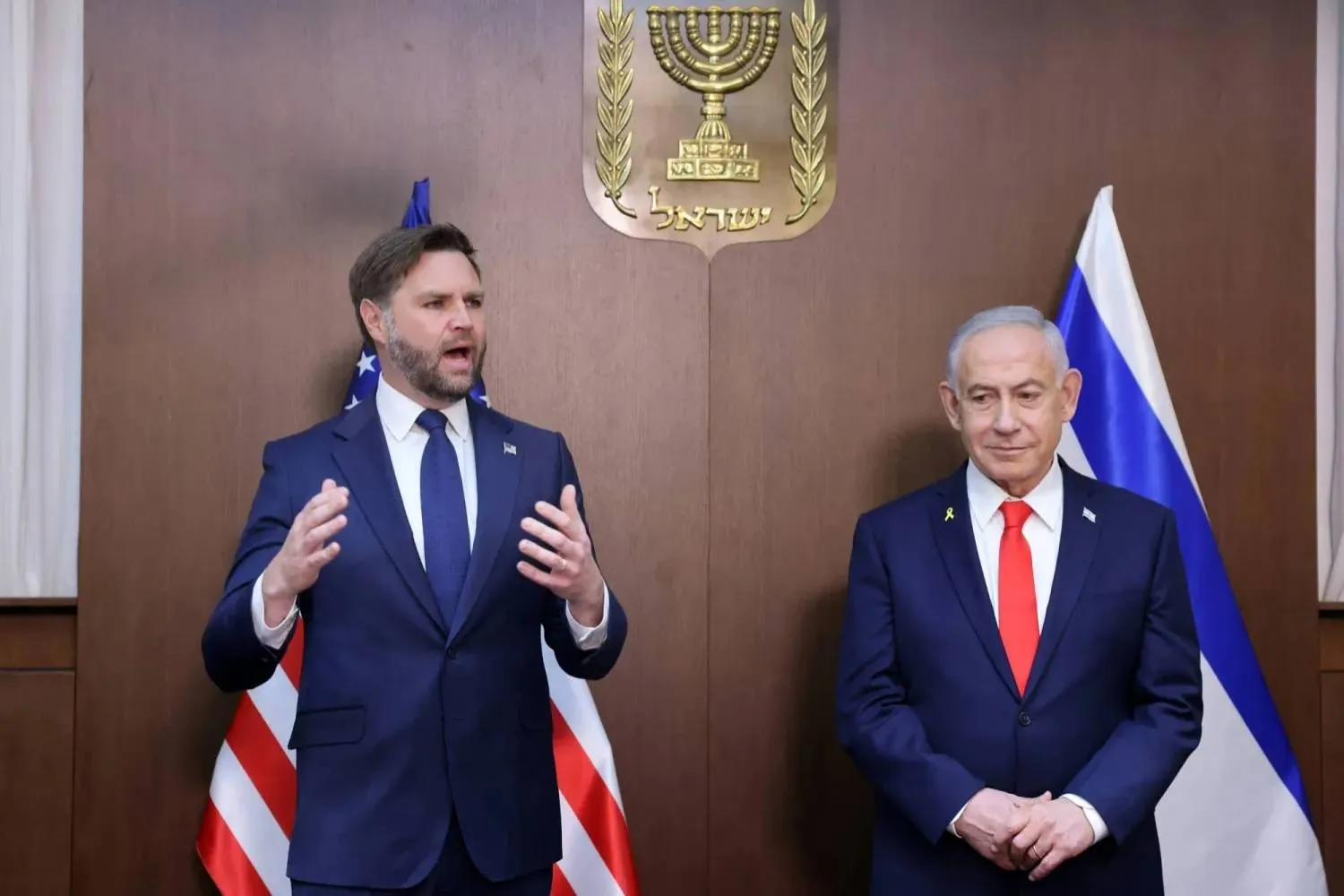
Speaking at a joint press conference with Netanyahu in Jerusalem on Wednesday, Vance said his visit was to talk about peace, about how to ensure the continuity of the agreement that began almost a week ago, and how it can successfully move into phases two and three.
While the US task force in Israel works to push the deal forward, Hussein al-Sheikh, vice president to Palestinian Authority President Mahmoud Abbas, arrived in Cairo with General Intelligence Chief Majed Faraj for the same purpose.
“We have a very, very tough task ahead of us, which is to disarm Hamas but rebuild Gaza, to make life better for the people of Gaza, but also to ensure that Hamas is no longer a threat to our friends in Israel,” Vance told reporters.
“I think this Gaza deal is a critical piece of unlocking the Abraham Accords,” Vance said, referring to the series of normalization agreements between Israel and several Arab countries in 2020.
“But what it could allow is an alliance structure in the Middle East that perseveres, that endures, and that allows the good people in this region, the world, to step up and take ownership of their own backyard,” he added.
A “Political Air Bridge”
Israel’s Kan public broadcaster said that “the arrival of US officials of unprecedented seniority, one after another, and the establishment of an international military headquarters in Kiryat Gat — housing about 200 American soldiers alongside troops from other countries — amounts to an attempt by Washington to influence Israel’s security and political affairs.”
The report described this heavy US presence as a form of “direct supervision” — or, as some put it, “monitoring Benjamin Netanyahu to prevent the Gaza ceasefire from collapsing.”
Analysts from Israel’s Channel 12 said Rubio’s upcoming visit was “part of a series of intensive trips by senior American officials to Israel,” calling it a “political air bridge” designed to consolidate understandings and ensure their implementation on the ground.
According to Israeli sources, “the aim is to guarantee the agreement’s execution with Hamas and establish a new system for Gaza’s security and governance.”
The Americans, they said, have already begun outlining “phase two” of the deal, which includes forming a technocratic government and deploying an international force in Gaza to oversee Hamas’s disarmament and prevent Israel from resuming attacks as long as foreign troops are present.
“Baby-Sitter for Bibi”
The US involvement has stirred debate in Israel over whether the country has effectively come under Washington’s “tight grip.”
Columnist Itamar Eichner wrote in Yedioth Ahronoth an article titled: “US officials arrive for ‘Bibi-sitting’ as Washington tightens ceasefire oversight of Israel.”
In the article, Eichner writes about how US intervention has become stifling, reaching a new level through high-level attendance and the establishment of an international headquarters, facing down a far-right government and setting clear rules for Gaza.
“It is hard not to wonder whether Israel has in recent days become a protectorate of the United States — or perhaps America’s de facto 51st state.”
During the presser with Vance, Netanyahu dismissed suggestions that the US was placing Israel under its protection.
“We are not a US protectorate,” Netanyahu said. “Sometimes they say Israel is our protectorate, sometimes that we are theirs. Israel will decide its security.”
Vance replied that the United States seeks partnership, not control.
Close aides to Netanyahu defended him, saying what was happening was not a breach of sovereignty but rather “a doubled-strength strategic partnership.”
Eichner noted that, despite the denials, Washington’s role appears increasingly hands-on.
“The US intends to prevent any collapse of the ceasefire, prioritizing the return of hostages’ bodies to Israel,” he wrote.
Palestinian Authority Steps In
The Palestinian Authority has also joined efforts to support the Gaza agreement.
Palestinian sources told Asharq Al-Awsat that al-Sheikh and Faraj’s visit to Cairo aimed to “discuss security details alongside political issues.”
Their trip followed a visit to Israel a day earlier by Egyptian Intelligence Chief Hassan Rashad.
According to the same sources, “Cairo and Washington are pushing to advance the agreement, but Israel still refuses to allow Palestinian Authority participation.”
Israel’s Kan 11 broadcaster reported that Washington wants “immediate implementation of phase two of the US plan,” while Cairo seeks to deploy Arab and foreign forces into Gaza “within days,” under a United Nations Security Council resolution.