

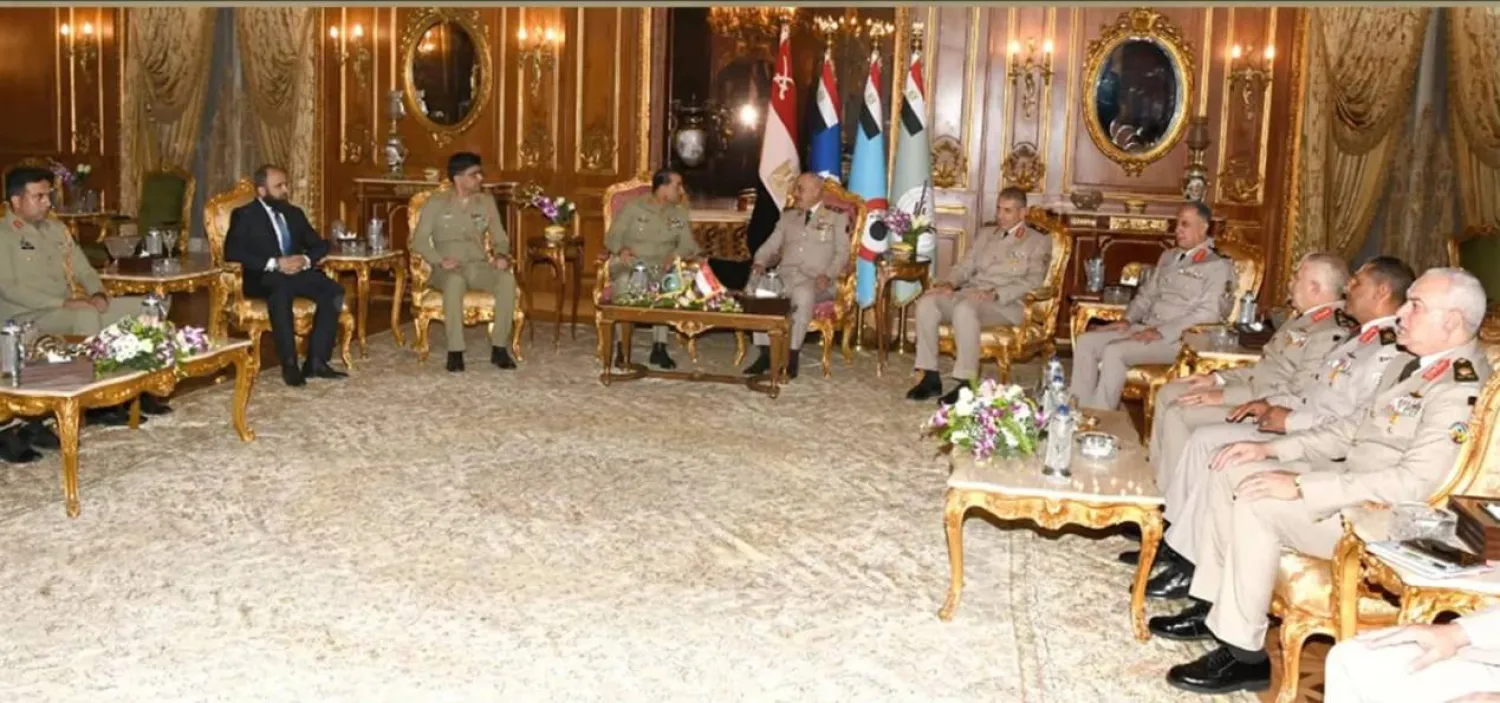

Egypt, Pakistan Move to Strengthen Military Cooperation

Pakistan army chief of staff and delegation during visit to Egypt (Egyptian Military Spokesperson)
TT

Egypt, Pakistan Move to Strengthen Military Cooperation

Pakistan army chief of staff and delegation during visit to Egypt (Egyptian Military Spokesperson)

Egypt and Pakistan are strengthening their military cooperation as Egypt’s Commander-in-Chief of the Armed Forces, Minister of Defense and Military Production, Gen. Abdel Mageed Saqr, met with Pakistan’s Chief of Army Staff Gen. Asim Munir and his accompanying delegation, who are currently visiting Cairo.

According to a statement by the Egyptian Armed Forces’ spokesman on Friday, the meeting discussed several issues of mutual interest in light of efforts to enhance military relations between the Egyptian and Pakistani armed forces, as well as shared views on frameworks supporting international peace and security.

Gen. Saqr expressed his “appreciation for the close ties between the armed forces of both countries,” emphasizing “the importance of bolstering efforts to achieve security and stability amid the rapid changes on the regional and international scenes.”

Gen. Munir, for his part, affirmed Pakistan’s “commitment to further strengthening military cooperation with Egypt in the coming period,” praising Cairo’s “pivotal role in laying the foundations for just peace in the Middle East.”

Separately, Egypt’s Chief of Staff of the Armed Forces, Lt. Gen. Ahmed Khalifa, also met with Gen. Munir. An official reception was held for the Pakistani delegation at the Defense Ministry headquarters, where the national anthems of both countries were played. The talks focused on ways to enhance cooperation and exchange expertise across various military fields.

Lt. Gen. Khalifa underlined “the importance of coordinating efforts to support military cooperation and the exchange of experience between the two armed forces,” while Gen. Munir voiced his “keenness to deepen military ties with Egypt,” expressing appreciation for the “distinguished relations between the two countries’ militaries.” The meeting was attended by several senior Egyptian and Pakistani officers.

On Thursday, Gen. Munir also met with Grand Imam of Al-Azhar Sheikh Ahmed el-Tayeb at Al-Azhar headquarters in Cairo, where he commended Al-Azhar’s “role in promoting the values of brotherhood and positive coexistence among societies.”

He noted that “the Islamic world is facing several crises and challenges, foremost among them the spread of extremist groups that distort religious texts to justify their extremism and tarnish the true image of Islam,” stressing that “Islam is a religion of tolerance and peace.”

El-Tayeb said Al-Azhar currently hosts 254 Pakistani students enrolled in various educational stages, including 162 on full scholarships offered by the institution.

He affirmed Al-Azhar’s readiness to expand these scholarships “to meet the needs of the Pakistani people and contribute to promoting social peace, coexistence, and acceptance of others.”

Last month, Egyptian and Pakistani officials also discussed strengthening cooperation in military manufacturing.

Minister of State for Military Production Mohamed Salah El-Din Mostafa met with Pakistan’s Ambassador to Cairo, Aamir Shaukat, and highlighted the “strong and long-standing ties between Egypt and Pakistan, which are witnessing remarkable development under the leadership of both countries.”

He also praised the “Joint Strategic Defense Agreement” signed between Saudi Arabia and Pakistan, aimed at enhancing defense cooperation between the two nations.

In July, Egyptian President Abdel Fattah el-Sisi held talks in Cairo with Pakistan’s Chairman of the Joint Chiefs of Staff Committee, Gen. Sahir Shamshad Mirza.

The discussions focused on “ways to strengthen cooperation, particularly in military and security fields, and on sharing expertise in combating terrorism and extremism,” reflecting the “mutual strategic interests” of Egypt and Pakistan.



Lebanon War Toll Rises to 2,055 Dead as Israel Pounds Country's South

Smoke rises from the site of an Israeli airstrike that targeted the southern Lebanese village of Deik Qanoun al-Nahr on April 12, 2026. (Photo by Kawnat HAJU / AFP)
TT

Lebanon War Toll Rises to 2,055 Dead as Israel Pounds Country's South

Smoke rises from the site of an Israeli airstrike that targeted the southern Lebanese village of Deik Qanoun al-Nahr on April 12, 2026. (Photo by Kawnat HAJU / AFP)

Lebanese official media reported extensive Israeli strikes across the country's south on Sunday as the health ministry said at least five people were killed and the war's overall toll rose to 2,055 dead.

The state-run National News Agency (NNA) reported Israeli attacks on around 30 locations in the country's south on Sunday, with additional strikes on the adjacent West Bekaa area.

The health ministry said an Israeli strike on Qana killed five people, including three women, and wounded 25 others, while the NNA said the raid targeted "homes and infrastructure.”

A photograph taken from the southern Lebanese area of Tyre shows rocket trails fired from Lebanon toward neighbouring Israel on April 12, 2026. (Photo by Kawnat HAJU / AFP)

An AFP photographer in the southern town saw huge destruction as an excavator worked to clear debris and first responders carried a body out from under the rubble.

The ministry raised the overall toll in Lebanon to 2,055 dead, including 165 children and 87 health workers, since war erupted on March 2.

In south Lebanon's Bazuriyeh, Hassan Berro, a rescue worker from the Risala Scout association -- which is affiliated with the Hezbollah-allied Amal movement -- said: "Our emergency center was hit and completely destroyed, along with all its contents, including beds and medical equipment."

The AFP photographer saw windows shattered and debris covering several hospital beds in the building, where walls and ceilings were also damaged.

Hezbollah said it launched attacks on Israeli targets across the border and inside Lebanon, including against troops in the southern town of Bint Jbeil, where the NNA reported heavy fighting.

Israel's army on Sunday accused Hezbollah of using the town's hospital compound "for military purposes.”

Officials from Lebanon, Israel and the United States are due to hold direct talks in Washington on Tuesday, a move Hezbollah has rejected.

Commenting on the planned talks, Israeli Prime Minister Benjamin Netanyahu said on Saturday that "we want the dismantling of Hezbollah's weapons, and we want a real peace agreement that will last for generations.”


Israeli Strike Kills Infant Girl in South Lebanon during Father's Funeral

A member of civil defense personnel holds the body of Taleen Saeed, 1.5 years old, killed in an Israeli strike in the village of Srifa, at the Al Kharab mosque in Tyre, Lebanon, April 12, 2026. REUTERS
TT

Israeli Strike Kills Infant Girl in South Lebanon during Father's Funeral

A member of civil defense personnel holds the body of Taleen Saeed, 1.5 years old, killed in an Israeli strike in the village of Srifa, at the Al Kharab mosque in Tyre, Lebanon, April 12, 2026. REUTERS

Wrapped in bloodied bandages, Aline Saeed, seven, barely survived the Israeli strike on her home in south Lebanon last week. She was there to bury her father as hopes of a truce spread across the region, but a new strike killed her infant sister and other relatives.

The strike on the Saeed family home in the village of Srifa took place on Wednesday, the first day of a US-Iran ceasefire that many in Lebanon hoped would apply to their country, too. Instead, Israeli strikes killed more than 350 across Lebanon and left the Saeed family with four more relatives to bury.

"They said it was a ceasefire. Like all these people, we went up to the village. We went to the casket to read the prayers and walk home... suddenly we felt like a storm was landing right on us," said Nasser Saeed, Aline's 64-year-old grandfather, who also survived, Reuters reported.

On Sunday, he joined other relatives in the southern port city of Tyre to pick up the bodies wrapped in green cloth. One of them, a fraction the size of the rest, contained his granddaughter Taleen, Aline's sister.

She had not yet turned two.

With bandages to his head and right hand and scratches on his face, Saeed mourned in silence as the women around him turned their faces up to the sky and screamed in agony.

The Israeli military said that it did not have enough details to look into the incident, adding that it takes measures to reduce harm to civilians in its strikes against Hezbollah militants.

TALEEN 'BORN IN WAR AND DIED IN WAR'

"This isn't humanity. This is a war crime," Saeed told Reuters at the hospital where Aline's mother, Ghinwa, was still being treated.

"Where are the human rights? If a child - a child! - is wounded in Israel, the whole world jumps up. Are we not people? Are we not humans? We're like them!" he said.

Taleen was born in 2024, in the last round of fierce clashes between Hezbollah and Israel.

"She was born in the war and died in the war," said Mohammed Nazzal, Ghinwa's father.

FIERCE BOMBARDMENT CONTINUES

Iran wants a ceasefire for Lebanon as part of talks with the United States, which concluded on Sunday without a breakthrough. But Israel wants to pursue talks with Lebanese officials through a separate track.

Heavy bombardment on Lebanon has continued, with nearly 100 people killed on Saturday.

Dr. Abbas Attiyeh, head of emergency operations at Tyre's Jabal Amel hospital, said last week's bombardment was one of the heaviest in recent years and many of the patients arriving at his hospital were children.

"The challenges we're facing now are the numbers of wounded that come at the same time, within the same 30 minutes or hour," Attiyeh told Reuters.


Ben Gvir, Settlers Storm Al-Aqsa Mosque

Israeli National Security Minister Itamar Ben-Gvir - REUTERS/Amir Cohen/File Photo
TT

Ben Gvir, Settlers Storm Al-Aqsa Mosque

Israeli National Security Minister Itamar Ben-Gvir - REUTERS/Amir Cohen/File Photo

Israeli National Security Minister Itamar Ben Gvir stormed the Al-Aqsa Mosque compound on Sunday morning with a group of settlers, under the protection of Israeli police.

The Palestinian News Agency (WAFA) reported that “during the incursion, settlers performed Talmudic prayers in the courtyards of Al-Aqsa Mosque, in a new provocative step aimed at imposing a new religious reality at the site and entrenching temporal and spatial division.”

The Jerusalem Governorate said the move comes amid escalating violations against Islamic and Christian holy sites in occupied Jerusalem, and continued restrictions on worshippers’ access.

In a video filmed at the site and published by his office, Ben Gvir said: “Today, I feel that I am the owner of this place,” according to Reuters.

He added: “There is still more to be done, and more that needs to be improved. I continue to press Prime Minister Benjamin Netanyahu to do more. We must continue to move forward step by step.”

Jordan’s Ministry of Foreign Affairs condemned the visit in a statement, describing it as “a flagrant violation of the historical and legal status quo at the Noble Sanctuary, a desecration of its sanctity, an escalation that is condemned, and an unacceptable provocation.”

A spokesperson for Ben Gvir said the minister is seeking to secure more entry permits for Jewish visitors and to allow prayers at the site.

The spokesperson added that Ben Gvir prayed at the site. Netanyahu’s office has not yet commented. Previous visits and statements by Ben Gvir had prompted Netanyahu to issue statements affirming that there is no change in Israel’s policy of maintaining the status quo.