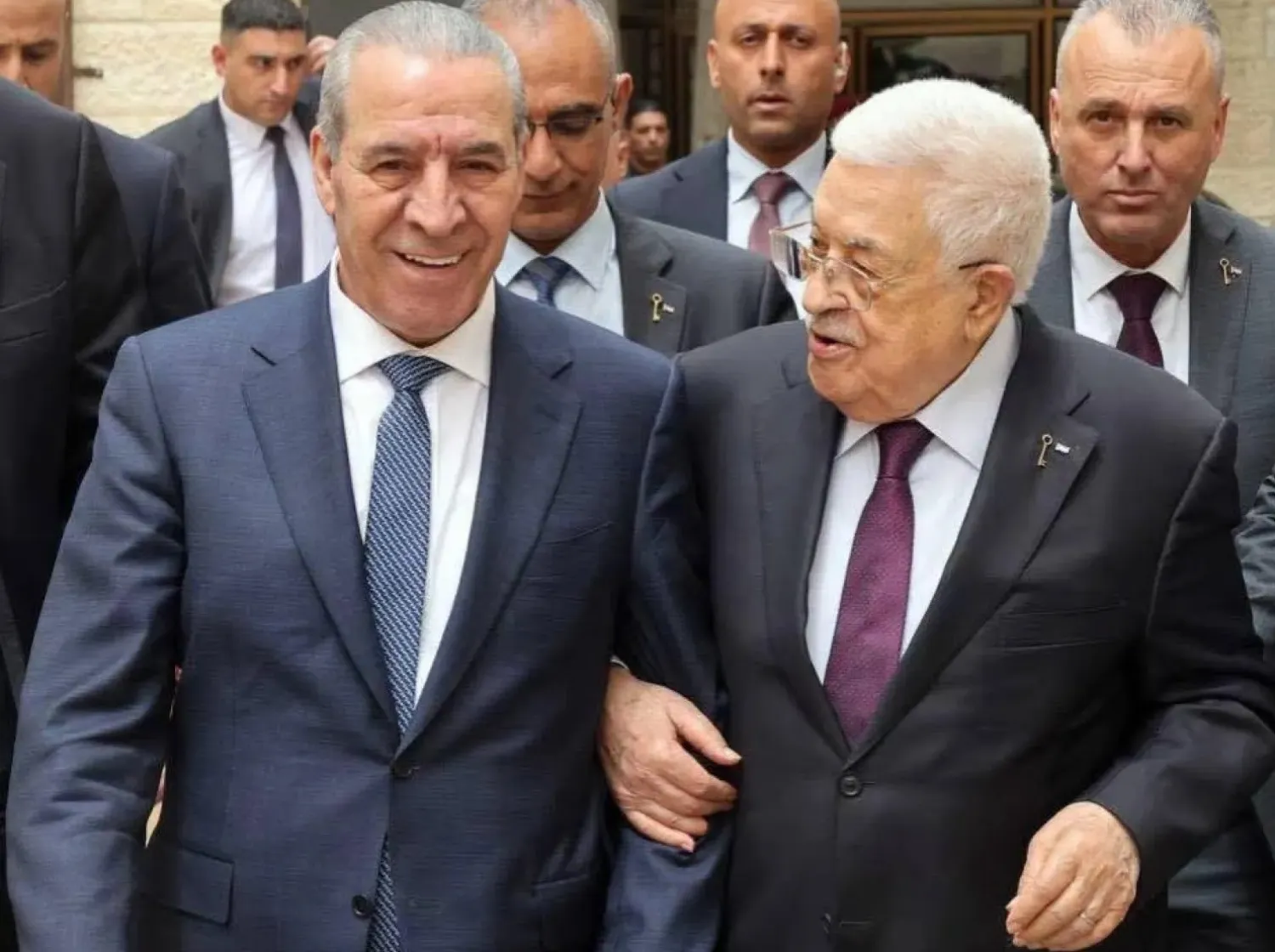

Palestinian President Mahmoud Abbas has cleared the way for his deputy, Hussein al-Sheikh, to temporarily assume the presidency in the event of a vacancy.
The move, described by political observers as deliberate and carefully timed, aims to ensure a smooth transfer of power and prevent the emergence of rival leadership structures.
In a constitutional declaration issued on Sunday, Abbas stated that if the office of the president becomes vacant in the absence of the Palestinian Legislative Council, the deputy chairman of the Palestine Liberation Organization’s Executive Committee - also the deputy president of the State of Palestine - will temporarily assume the presidency of the Palestinian Authority for up to 90 days, during which elections must be held. If circumstances prevent elections within that timeframe, the Palestinian Central Council may grant a one-time extension.
Abbas said the decision was made “out of faith and awareness of the sensitivity of this critical moment in the history of the homeland and the Palestinian cause, and in fulfillment of our constitutional and historic responsibility to protect the Palestinian political system, safeguard the homeland, preserve its security, and ensure the continuity of its constitutional institutions.”
While Abbas did not publicly explain why the decision was made at this time, Israeli media reported that it followed American pressure. However, sources in Ramallah told Asharq Al-Awsat the decision was “necessary” given the complexity of the current political environment.
“This was done for several reasons,” one source explained. “First, the situation is extremely sensitive and requires a figure of Sheikh’s stature at the helm if anything unexpected occurs. Second, it preempts internal or external attempts to bypass the PLO or establish alternative leadership structures. And third, it is part of the reform and restructuring commitments the Authority has made.”
The constitutional announcement comes amid heightened international activity by the United States, Europe, and Arab states to shape Gaza’s postwar arrangements.
The Palestinian leadership has made clear it will not accept any administrative body or international force operating in the territory without its mandate, insisting that governance and security in Gaza must remain under Palestinian Authority control.
After recent Palestinian faction meetings in Cairo, which Fatah did not attend, the movement issued a statement reaffirming that the State of Palestine and the PLO remain “the sole legitimate framework capable of protecting the national project.”
The statement rejected “attempts to bypass national legitimacy,” stressed that sovereignty over Palestinian land belongs exclusively to the Palestinian people and their institutions, and warned against any form of foreign trusteeship or mandate.
Fatah also reiterated that disarmament and security must be addressed through “a unified national vision that guarantees one authority, one weapon, and one law,” ensuring stability and denying Israel any pretext to prolong occupation or deepen division.
Hussein al-Sheikh has become one of Abbas’s closest confidants in recent years, frequently leading negotiations with Israel, the United States, and Arab states on critical political and security issues.
On Sunday, Egyptian Foreign Minister Badr Abdelatty held a phone call with Sheikh to discuss reconciliation efforts among Palestinian factions.
Cairo reaffirmed its “full support for the Palestinian Authority and its efforts to achieve unity and rebuild Gaza.”