
Future Investment Initiative: From ‘Davos in the Desert’ to a Platform for Untangling Global Crises

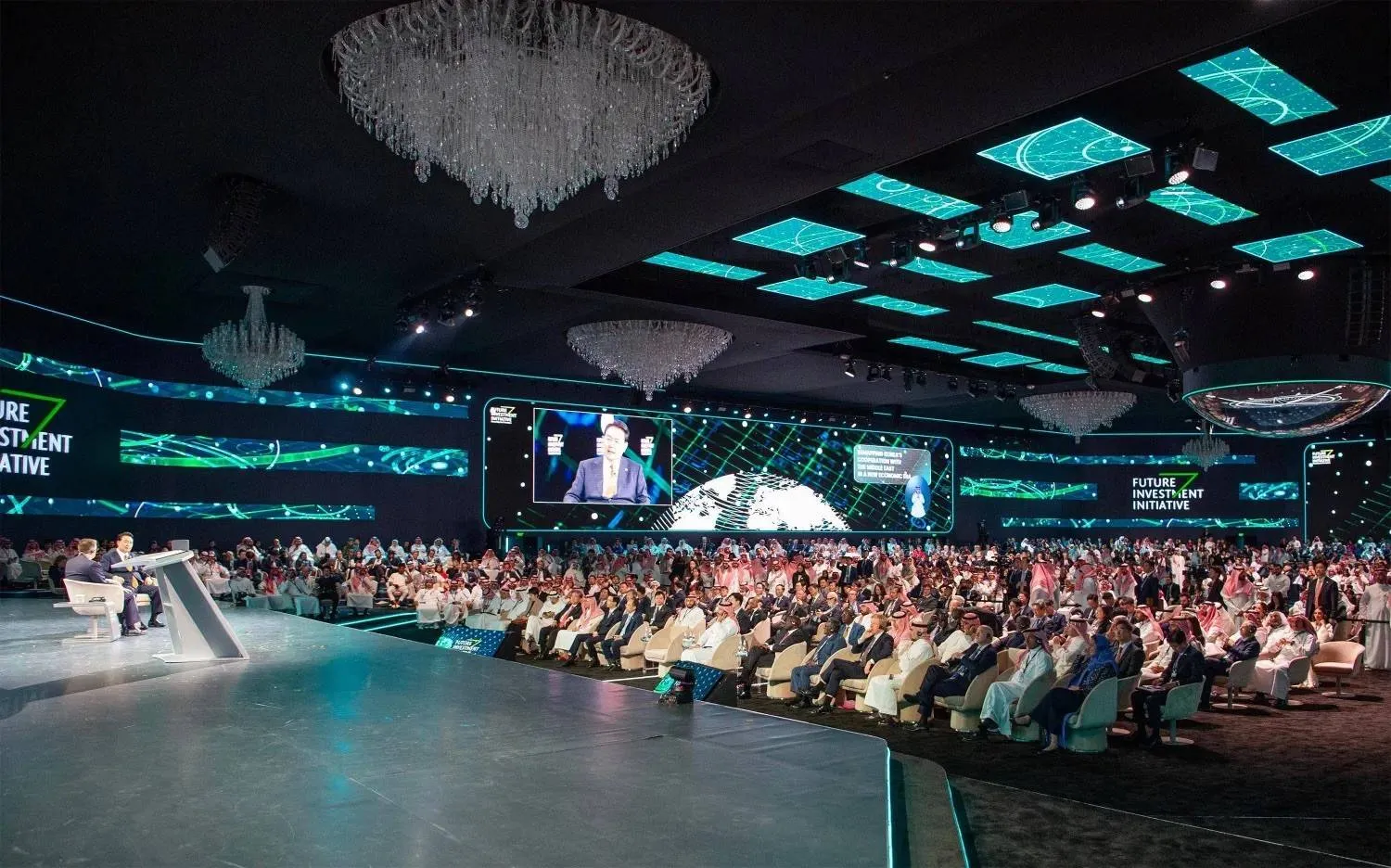
A view of the audience during one of the sessions at the eighth edition of the Future Investment Initiative conference (Asharq Al-Awsat). 
TT

Future Investment Initiative: From ‘Davos in the Desert’ to a Platform for Untangling Global Crises

A view of the audience during one of the sessions at the eighth edition of the Future Investment Initiative conference (Asharq Al-Awsat). 

The annual Future Investment Initiative (FII) is evolving from an investment forum into a powerful geoeconomic and diplomatic platform. In the midst of unprecedented geopolitical and economic transformations, Riyadh is consolidating its status as an indispensable global hub, a place where future-shaping decisions are made and urgent diplomatic solutions take form.

As the Saudi capital hosts the ninth edition of the FII - bringing together some of the world’s most influential figures in finance and technology to chart a roadmap for sustainable growth and artificial intelligence - it is simultaneously witnessing an intense wave of diplomatic activity, including high-level coordination meetings on the two-state solution.

Riyadh is positioning itself as a bridge between global capital, development imperatives, and the requirements of regional stability and peace.

The ninth edition of the forum opened with closed sessions on Monday, with the official launch scheduled for Tuesday under the theme “The New Compass: Unlocking New Frontiers for Growth.” More than 8,000 participants and 650 prominent speakers are taking part in 250 discussions.

What began years ago as an investment gathering with a local lens - dubbed “Davos in the Desert” - has now matured into a global geoeconomic platform designed to navigate and address complex crises.

This transformation comes at a critical time for the world economy. Trade tensions, including US tariffs, and geopolitical instability in Europe and the Middle East have created high levels of uncertainty. Global growth faces mounting risks.

By contrast, Saudi Arabia has charted a different course, demonstrating strong resilience against external shocks and an ability to adapt quickly to changing conditions. This strength is supported by the steady expansion of its non-oil sectors, a cornerstone of its economic diversification strategy, making the Kingdom a reliable anchor for global capital in an increasingly fragmented world.

The initiative also functions as a bridge for global capital and a key platform for investors interested in the Middle East. Globally, discussions on artificial intelligence, sustainable energy, and innovation are already shaping capital flows and influencing the valuations of major companies.

For Saudi Exchange (Tadawul), the event acts as a significant catalyst. Direct engagement between the Public Investment Fund (PIF) and global investment banks enhances awareness of the Saudi market’s depth and liquidity, aligning with the Kingdom’s goal of increasing its weight in global indices and paving the way for large upcoming IPOs.

This year, the forum carries unprecedented geopolitical weight. It takes place at a moment when regional focus is shifting from conflict to reconstruction and development. High-level diplomatic attendance, coordination meetings on the two-state solution, and discussions addressing global conflicts all underscore Riyadh’s emerging role as a mediator capable of linking political stability with economic investment.

One of the forum’s headline sessions explores three key themes: progress, innovation, and fragmentation. It addresses questions of market efficiency, the environmental cost of economic expansion, the responsible use of AI, technological entrepreneurship, climate resilience, and how to secure global supply chains in a world defined by economic competition and digital transformation.

Yasir Al-Rumayyan, Governor of the PIF and Chairman of the Future Investment Initiative Institute, will officially open the forum, presenting the fourth edition of the “Priority Compass.” This extensive survey draws on the views of tens of thousands of participants from 32 countries, representing 66 percent of the world’s population. Its aim is to guide decision-makers toward citizen-centered solutions.

The final day of the event, known as Investment Day, will be devoted to signing deals, presenting high-growth projects and emerging technologies, and fostering connections between founders and global investors. Asset managers overseeing more than $100 trillion in assets are expected to participate.

Among the prominent speakers are Laurence D. Fink of BlackRock, Jamie Dimon of JPMorgan Chase, David Solomon of Goldman Sachs, Bruce Flatt of Brookfield Asset Management, Bill Winters of Standard Chartered, Jane Fraser of Citigroup, Jenny Johnson of Franklin Templeton Investments, Ray Dalio of Bridgewater Associates, Stephen A. Schwarzman of Blackstone, Cathie Wood of ARK Invest, and Alex Clavel of SoftBank Vision Fund. Also attending are CEOs from Barclays, Nasdaq, Temasek Holdings, and China Investment Corporation.

Behind closed doors, Monday’s sessions delved into cutting-edge technological and economic shifts, from quantum computing breakthroughs to digital currencies and carbon accounting. One session, “Can We Win the Quantum Computing Race and Turn It into Profit?”, examined rapid developments in quantum hardware and software and noted that governments worldwide have committed more than $40 billion to research and development in this field.

Another session, supported by Saudi Aramco, reviewed new methods to measure product-level carbon emissions, aiming to bring greater transparency to corporate climate performance. A third session explored how digital currency infrastructure could redefine global finance, with discussions on stablecoins, central bank digital currencies, and the role of major institutions such as Bank of America, PayPal, and Stripe in driving cross-border payment solutions.


UN's FAO: World Food Prices Fall for 3rd Month in November

FILE PHOTO: Prices of food are displayed at the Borough Market in London, Britain May 22, 2024. REUTERS/Maja Smiejkowska/File Photo
TT

UN's FAO: World Food Prices Fall for 3rd Month in November

FILE PHOTO: Prices of food are displayed at the Borough Market in London, Britain May 22, 2024. REUTERS/Maja Smiejkowska/File Photo

World food commodity prices fell for a third consecutive month in November, with all major staple foods except cereals showing a decline, the United Nations' Food and Agriculture Organization said on Friday.

The FAO Food Price Index, which tracks a basket of globally traded food commodities, averaged 125.1 points in November, down from a revised 126.6 in October and the lowest since January, Reuters reported.

The November average was also 2.1% below the year-earlier level and 21.9% down from a peak in March 2022 following Russia's full-scale invasion of Ukraine, the FAO said.

The agency's sugar price reference fell 5.9% from October to its lowest since December 2020, pressured by ample global supply expectations, while the dairy price index dropped 3.1% in a fifth consecutive monthly decline, reflecting increased milk production and export supplies.

Vegetable oil prices fell 2.6% to a five-month low, as declines for most products including palm oil outweighed strength in soy oil.

Meat prices declined 0.8%, with pork and poultry leading the decrease, while beef quotations stabilized as the removal of US tariffs on beef imports tempered recent strength, the FAO said.

In contrast, the FAO's cereal price benchmark rose 1.8% month-on-month. Wheat prices increased due to potential demand from China and geopolitical tensions in the Black Sea region, while maize prices were supported by demand for Brazilian exports and reports of weather disruption to field work in South America.

In a separate cereal supply and demand report, the FAO raised its global cereal production forecast for 2025 to a record 3.003 billion metric tons, compared with 2.990 billion tons projected last month, mainly due to increased wheat output estimates.

Forecast world cereal stocks at the end of the 2025/26 season were also revised up to a record 925.5 million tons, reflecting expectations of expanded wheat stocks in China and India as well as higher coarse grain stocks in exporting countries, the FAO said.


World Bank Forecasts 4.3% Growth for Saudi Economy, Supported by Non-Oil Activities

The Saudi flag. Asharq Al-Awsat
TT

World Bank Forecasts 4.3% Growth for Saudi Economy, Supported by Non-Oil Activities

The Saudi flag. Asharq Al-Awsat

The World Bank affirmed on Thursday that Saudi Arabia's economy has gained significant momentum for 2026-2027, driven by robust non-oil sector expansion under Vision 2030.

In a report titled “The Gulf’s Digital Transformation: A Powerful Engine for Economic Diversification,” the World Bank said growth is expected to persist in the Kingdom with non-oil activities expanding by 4% on average.

The report lifted its forecast for Saudi Arabia’s real GDP growth to 3.8% in 2025 compared to a 3.2% last October.

The forecast represents a major upward revision affirming the resilience of the Saudi economy and its ability to absorb external volatility. It also indicates growing confidence in the effectiveness of ongoing structural reforms within Vision 2030.

On Tuesday, Saudi Arabia approved its state budget for 2026, projecting real GDP growth of 4.6% in 2026.

The report showed that in the Kingdom, economic momentum is strengthening across oil and non-oil sectors with non-oil activities expanding by 4% on average and oil activities expanding by 5.4%, bringing overall real growth to an average of 4.3%.

It said oil activities grew by 1.7% y/y in the first half of 2025, benefiting from the phase-out of OPEC+ voluntary production cuts starting in April 2025.

At the financial level, the fiscal deficit between 2025 and 2027 is projected to remain at an average of 3.8% of GDP.

Meanwhile, the current account balance slightly recovered, settling at 0.5% of GDP in the first quarter of 2025 against -2.6% in the second half of 2024.

The report said real GDP growth remained stable at 3.6% y/y in the first half of 2025, thanks to the stabilization of the oil sector and sustained non-oil growth.

Non-oil activities expanded by 4.8% over the period, in line with the performance of 2024 while non-oil growth was driven by the wholesale, retail trade, restaurants, and hotels sector (+7.5% y/y in the first half of 2025), consolidating the role of hospitality and tourism as engines of economic diversification.

The report also indicated that oil activities grew by 1.7% y/y in the first half of 2025, benefiting from the phase-out of OPEC+ voluntary production cuts starting in April 2025.

These trends are expected to persist in 2026-2027, with non-oil activities expanding by 4% on average and oil activities expanding by 5.4%, bringing overall real growth to an average of 4.3%.

Job Market and Inflation
The report said the labor market mirrors the stabilization of the real economy and is rapidly becoming more inclusive to women.

Overall unemployment decreased by 0.7 point between the first quarter of 2024 and the first quarter of 2025, with the female unemployment rate dropping from 11.8% to 8.1% over the same period.

Also, inflation remained low and stable in Saudi Arabia, settling at an average of 2.2% in the first half of 2025.

However, price increases have been concentrated in the housing and utilities sector as rental prices have become a key issue, largely because rental supply has failed to match demographic growth, especially in Riyadh.

While this reflects the government’s efforts to dynamize the Kingdom’s urban centers, the price increases prompted the government to freeze rental prices in Riyadh for the next five years, as anticipated increases in housing supply should help control rental prices.

Finally, the report said Saudi Arabia’s external position stabilized in the second half of 2024 and the first quarter of 2025.

Although net foreign direct investment has remained relatively stable, the World Bank has emphasized that recent changes in foreign ownership regulations in Saudi Arabia, coupled with continued structural reforms, are positive steps to attract greater flows of foreign direct investment (FDI).


Visa Relocates European Headquarters to London's Canary Wharf

FILE PHOTO: A drone view of London's Canary Wharf financial district, two days before the government presents its critical pre-election budget, in London, Britain March 3, 2024. REUTERS/Yann Tessier/File Photo
TT

Visa Relocates European Headquarters to London's Canary Wharf

FILE PHOTO: A drone view of London's Canary Wharf financial district, two days before the government presents its critical pre-election budget, in London, Britain March 3, 2024. REUTERS/Yann Tessier/File Photo

Visa is relocating its European headquarters to London's Canary Wharf financial district, the Canary Wharf Group said on Friday.

The firm is leasing 300,000 square feet on a 15-year term at One Canada Square, and is set to relocate from Paddington in the summer of 2028, the group added.

Canary Wharf Group, which runs the wider financial district and is co-owned by QIA and Canada's Brookfield, was hit hard by the pandemic-induced fall in office demand.

The area is now enjoying a rebound as more firms push staff to return to office, Reuters reported.

"Canary Wharf continues to attract a diverse range of global businesses. We are delighted to welcome Visa who have chosen the Wharf for their European headquarters as the best location to support their business growth," Shobi Khan, Canary Wharf Group CEO, said.

JPMorgan Chase last week unveiled a plan to build a tower in the Canary Wharf financial district that will contribute 9.9 billion pounds ($13.2 billion) over six years to the local economy - including the cost of construction - and create 7,800 jobs.

Qatar's sovereign wealth fund is revising plans for a revamp of its HSBC skyscraper in the east London district to retain more office space, Reuters reported in November.