


Climate Change Endangers Orange Flower that Cloaks Mexico during Day of Dead

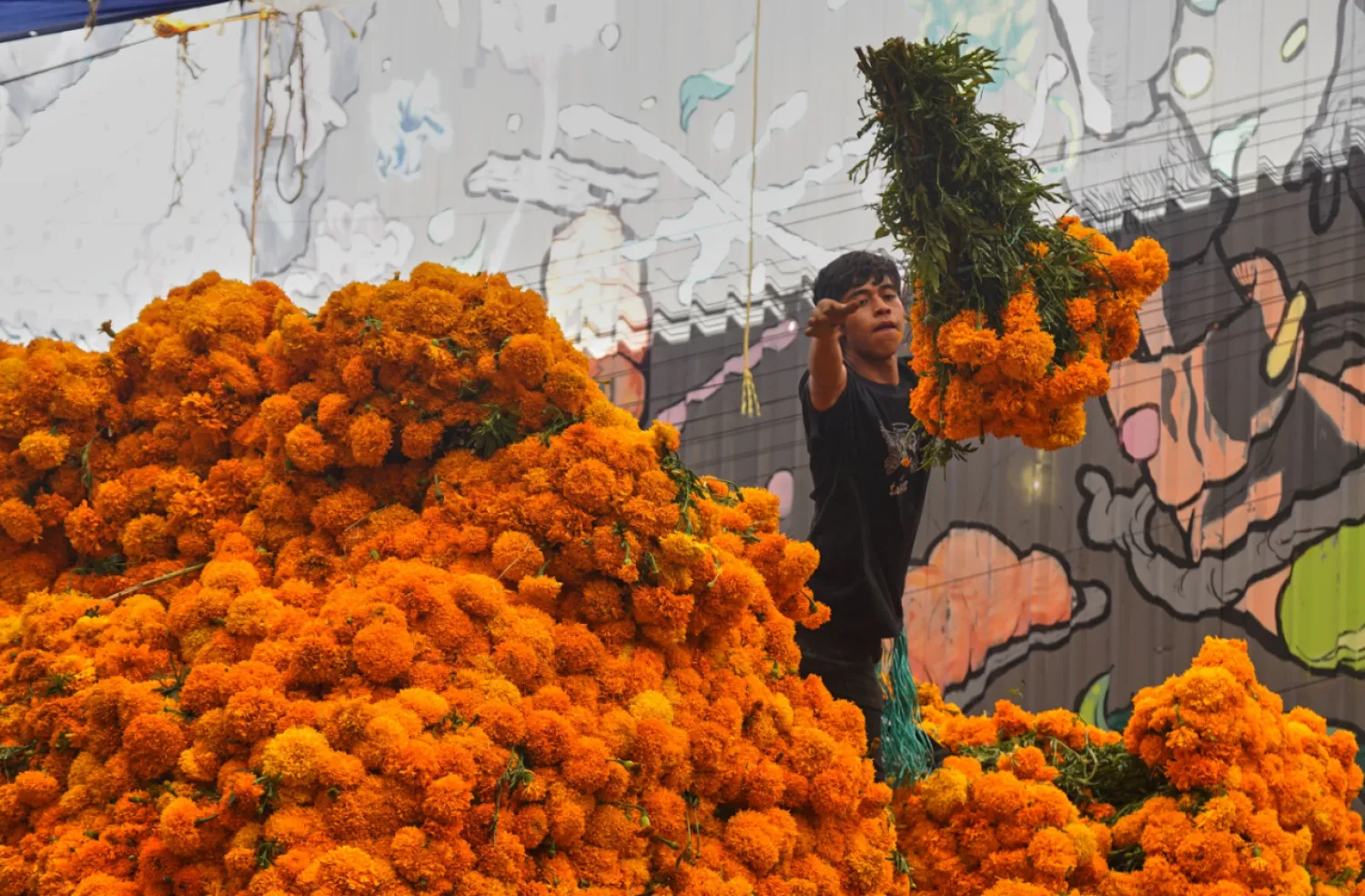
A worker unloads marigold flowers, known as cempasuchil, used during Day of the Dead celebrations, at the Jamaica flower market in Mexico City, Monday, Oct. 27, 2025. (AP Photo/Jon Orbach)
TT

Climate Change Endangers Orange Flower that Cloaks Mexico during Day of Dead

A worker unloads marigold flowers, known as cempasuchil, used during Day of the Dead celebrations, at the Jamaica flower market in Mexico City, Monday, Oct. 27, 2025. (AP Photo/Jon Orbach)

Lucia Ortíz trudges through endless fields of cempasuchil flowers, the luminescent orange petals of which will soon cloak everything from city streets to cemeteries across Mexico.

Here, in the winding canals and farms on the fringes of Mexico City, the flower also known as the Mexican marigold has been farmed for generations, and takes the spotlight every year in the country's Day of the Dead celebrations.

But as 50-year-old Ortíz and other farmers busily bundle clusters of the plant to sell in markets around the capital, they quietly wonder what will be left of their livelihood down the line, The AP news reported.

That’s because cempasuchil growers say they’ve been left reeling by torrential rains, stretching drought and other impacts from climate change — caused by the burning of fuels like gas, oil and coal — that have grown increasingly common.

Farmers, who depend on the ebbs and flows of the weather to cultivate their crops, are on the front line on the climate crisis. This year alone, cempasuchil producers said they lost up to half their flower crop from heavy rains and flooding.

“This year, we lost a lot. We struggled to even grow the cempasuchil. There were moments in which we didn’t have the money to buy fertilizer we needed,” Ortíz said. “With the cempasuchil plants, we’ve sometimes been left with nothing.”

‘Flower of the dead’ The orange flower has become a symbol of the country’s celebrations that take place every Nov. 1 and 2. Also known as the “flower of the dead”, the cempasuchil is believed to be a point of connection between the worlds of the dead and the living, with bright petals that light the path of dead souls to the altars set out by their family.

The flowers are also a crucial economic engine across Mexico, which commerce groups predict will rake in nearly 2.7 million dollars for farmers in 2025.

Ortíz and her family began growing the flower 30 years ago in their small plot of land in Xochimilco, a rural borough in the south of Mexico City where residents have continued to carry on ancient farming techniques using canals that wind through farmlands like a maze.

Every year, locals begin to plant the marigold seeds in July, and grow the plants as the rainy season winds down. But they say that they’ve been dealt a heavy blow for consecutive years as heavy rains, drought, floods and other climate shifts have made it increasingly difficult to keep their crops alive.

This year, torrential rains stretching on for months wiped out more than 37,000 acres of crops across the country, according to government figures. In a visit to cempasuchil fields earlier this month in Xochimilco, Mexico City Mayor Clara Brugada said that as many of 2 million marigold plants were put at risk. Despite that, she said that production this year simultaneously broke a record of 6 million plants as farmers ramp up to meet increasing demand even as growing the flower has become more precarious.

Ortíz said the excess of rain has brought on pests, diseases and rotted the roots of her plants. She estimates she lost at least 30% of her crop, while others say they’ve lost closer to 50%.

The family has been forced to drop money on insecticides, fertilizer and more to save their crops. As they have, razor thin profit margins have turned into losses, and they’ve had to cut back on basics like beef and sweets to make ends meet.

“If I were to take a hard look at all our losses, I’d be incredibly disillusioned and even not want to grow them anymore,” she said. “We’re just trying to push forward and make sure this keeps going on.”

Adapting to climate change Just down the road from Ortíz’s farm, government scientists are searching for long-term solutions beyond the short-term economic relief provided by the local government. In a small seed bank known as Toxinachcal, men in white suits meticulously pick through sprouts in a lab dish.

The scientists have been at work for a year and a half saving up thousands of seed variants of native plant species, including 20 variants of cempasuchil, in jars lining giant freezers in the hopes that the storage facility will be a key tool in fighting the most adverse effects of climate change.

Biologist Clara Soto Cortés, head of the seed bank, said part of the reason that the crop has been devastated is because farmers in recent years have elected to use a hybrid marigold seed variant from the United States.

The seed produces a shorter, more uniform-looking plant that is easier to sell en-masse and in places like supermarkets.

But that means farmers have turned away from sturdier, native breeds, which have longer stocks and widely vary in color, size and texture. The genetic diversity of these Mexican breeds makes them more resilient to drastic climate shifts like the ones seen this year, Soto said.

“These native seeds have adapted to different geographies, in high altitudes and low, in places where there's a lot of rain or there's none at all, or where they need to be resistant to insects,” she said.

“The (hybrid) seeds have been bred for another purpose. It doesn't have the genetic diversity needed to take on climate change.”

If more climate events, like the floods that roiled producers wipe out an entire crop, Soto said the bank will make seeds available to local producers to recover their crops – this time with a more resilient variant that their ancestors have been farming for centuries.

Carrying on an ancient tradition Meanwhile, growers are scrambling to bounce back in the short term, saying the losses also represent a threat to the farming tradition their families have struggled to maintain on the edge of the dense city of 23 million people.

Carlos Jiménez, 61, has long worked the fields of Xochimilco, but began to grow the shorter marigold plants eight years ago when he noticed the hybrid was more marketable. As he's lost more crops and gotten lower prices for the plants because of the mildew gathering at their roots, he said he's begun considering ways to adapt, like building greenhouses.

“The plants get sick, they rot, and our business is snuffed out,” Jiménez said. “And with it goes our tradition because it's our economy."

Producers like Ortíz have considered the same. But their losses mean they have no money to build added infrastructure. Her family and other farmers have called on local authorities for help, but say they've received just pennies on the dollar of what they need to bounce back. Though the local government has said it continues to work to help offset the blow felt by farmers.

She said she's begun to look at other crops she might be able to farm that are more resilient than the crinkled orange flowers.

Others like Jiménez said that while the roots of plants may rot around him, for now he's holding strong.

“This plant has a deeper meaning to our lost loved ones,” he said. “These are traditions we carry down from our ancestors. They can't just disappear.”



Bethlehem Lights up Christmas Tree for First Time Since Gaza War

People gather during the lighting of the Christmas tree ceremony at the Manger Square, next to the Church of Nativity in the background, in the West Bank city of Bethlehem, 06 December 2025. (EPA)
TT

Bethlehem Lights up Christmas Tree for First Time Since Gaza War

People gather during the lighting of the Christmas tree ceremony at the Manger Square, next to the Church of Nativity in the background, in the West Bank city of Bethlehem, 06 December 2025. (EPA)

Christmas cheer returned to the traditional birthplace of Jesus Christ on Saturday as Bethlehem in the occupied West Bank lit up a tree for the first time since the war in Gaza began over two years ago.

Covered in red and gold baubles, the Christmas tree standing meters away from the Church of the Nativity on Manger Square has become a symbol of hope.

At the end of a two-hour ceremony, the tree was illuminated to cheers, its yellow lights twinkling and a bright red star on top shining against the clouded night sky irradiated by a luminescent, almost full moon.

It is the first time the city has held the usual celebrations since the outbreak of the war in Gaza following Hamas’s attack on Israel in October 2023.

“It’s like a symbol for resilience,” said 27-year-old Abeer Shtaya, who works at Al-Zaytoonah University of Science and Technology in Salfit in the West Bank.

She had traveled 100 kilometers (60 miles) with a group of the university’s students because “we want to celebrate and be with our brothers and sisters in Bethlehem to enjoy this day.”

“It’s a message for the world that it’s calm,” Mike Shahen, 43, said at his ceramic store on the square, after a handful of visitors came in for purchases.

Thousands of people attended, including Christians and Muslims, and many who traveled from Palestinian territories and Israel -- some from even further afield -- to enjoy the festive spirit return.

Nuns could be seen watching from one roof, while many families including small children filled balconies and roofs to catch a glimpse of the tree lit up.

Sounds of laughter filled the air as many could not help but smile despite moments of rain.

“This event didn’t happen for the last two years because of the war and it’s quite emotional after two years of nothing but war and death,” said 50-year-old Liyu Lu, who had traveled from northern Israel, close to the border with Lebanon.

Originally from China but now living in Israel for decades, she was with a group including Gary Lau, a traveling businessman and Christian staying in Jerusalem for the past couple of months.

“Being here, with the festivities, is something very nice and special,” Lau, 51, said, adding he was “taking in the atmosphere.”

For the past two years, Bethlehem has celebrated Christmas in a more somber manner, with no major public festivities.

Tentative return

Christian pilgrims, especially from Asia, South America and eastern Europe have, however, slowly returned in the past few months.

Fabien Safar, guide and director of Terra Dei which organizes pilgrimages to the Holy Land, said a few small groups would come for Christmas this year and he already saw some bookings for 2026.

Safar expected a real recovery in 2027 but “this obviously depends on how the situation evolves” in Gaza and Lebanon.

Despite a November 2024 ceasefire that was supposed to end more than a year of hostilities between Israel and militant group Hezbollah, Israel has kept up strikes on Lebanon.

Pilgrims “remain afraid because there’s no official end to the war” in Gaza, Safar said, adding they were also worried about the situation in Lebanon.

‘Worse than COVID’

But it has all taken a toll on Bethlehem, which had only just cheered the return of tourists in 2022 after the COVID-19 pandemic, before the war in Gaza broke out.

Bethlehem’s economy relies almost completely on tourism.

“Covid was bad but nothing like the last two years,” said Shahen from the ceramic store.

Many visitors from Israel and the Palestinian territories spent hours on the road to reach Bethlehem including musician Lu.

She woke up at 6 am to get a bus at 7 am with a large group. They arrived at 12:30 pm, she said, without any trouble.

War isn’t the only reason for Bethlehem’s woes.

Since the 2023 Hamas attack, it is more difficult to travel around the West Bank with long queues on the roads with Israeli military checkpoints.

Violence in the West Bank, which Israel has occupied since 1967, has also surged since the Gaza war. It has not stopped despite the fragile truce between Israel and Hamas that began this October.


Number's Up: Calculators Hold Out against AI

Calculators are more affordable than phones, and run on batteries and solar power. Lillian SUWANRUMPHA / AFP
TT

Number's Up: Calculators Hold Out against AI

Calculators are more affordable than phones, and run on batteries and solar power. Lillian SUWANRUMPHA / AFP

The humble pocket calculator may not be able to keep up with the mathematical capabilities of new technology, but it will never hallucinate.

The device's enduring reliability equates to millions of sales each year for Japan's Casio, which is even eyeing expansion in certain regions.

Despite lightning-speed advances in artificial intelligence, chatbots still sometimes stumble on basic addition.

In contrast, "calculators always give the correct answer," Casio executive Tomoaki Sato told AFP.

But he conceded that calculators could one day go the way of the abacus.

"It's undeniable that the market for personal calculators used in business is on a downward trend," Sato said in Tokyo.

Smartphones and web browsers can handle everyday sums, while AI models achieved gold-level scores for the first time this year at a prestigious global maths contest.

But calculators are more affordable than phones, and run on batteries and solar power -- a plus for schools in developing countries, a potential growth area for Casio, Sato said.

And people who do buy calculators prefer the way they feel, he argued.

Thitinan Suntisubpool, co-owner of a shop selling red bags and beckoning cats in Bangkok's Chinatown, said she loves how durable her big calculator is, having dropped it several times.

"It's more convenient in many ways," the 58-year-old told AFP.

"We can use it to press the numbers and show the customer," avoiding language-barrier misunderstandings.

But at a nearby street stall selling clocks, torches and calculators, the vendor, who gave her name as Da, said calculator sales were "quiet".

'Optimised tools'

At a Casio factory in Thailand, assembly line workers slotted green circuit boards into place and popped cuboid buttons labelled "DEL" from a plastic tub onto pastel-blue calculator frames.

"Calculators are still in demand," said Ryohei Saito, a general manager for Casio in Thailand.

"Not everywhere in the world has smartphone connectivity, and calculators are optimised tools focused on necessary functions," he said.

In the year to March 2025, Casio sold 39 million calculators, general and scientific, in around 100 countries.

That compares to 45 million in 2019-20, but is still up from the 31 million that sold the following year after the Covid-19 pandemic hit.

The company has come a long way from the 1957 invention of the desk-sized "14-A", which it says was the first compact all-electric calculator.

Calculator history even made headlines recently when Christie's suspended the Paris sale of an early calculating machine, "La Pascaline", after a court said it could not be taken abroad.

The auction house called the ebony-decorated 1642 device "the first attempt in history to substitute the human mind with a machine".

Those attempts have accelerated with AI.

Scoring gold

In July, AI models made by Google, OpenAI and DeepSeek reached gold-level scores at the annual International Mathematical Olympiad (IMO).

But neither attained full marks at the annual contest for under-20s, unlike five human participants who achieved perfect scores.

IMO president Gregor Dolinar called the progress of artificial intelligence in the field "fascinating".

"When we talk about scientific calculators, in the past you needed them, but nowadays it's easier to just ask AI," he told AFP.

"If you pose the question in the right way," artificial intelligence can crunch abstract, logical questions and show how it reached its conclusion, Dolinar said.

Dolinar, a professor in engineering at the University of Ljubljana, thinks physical calculators are likely to "slowly disappear".

Something that has already happened for his students.

"They can calculate everything on a phone," he said.


Saudi Arabia Ranks 5th Globally, 1st in Arab World for AI Sector Growth on Global AI Index

File photo of the Saudi flag/AAWSAT
TT

Saudi Arabia Ranks 5th Globally, 1st in Arab World for AI Sector Growth on Global AI Index

File photo of the Saudi flag/AAWSAT

The Kingdom of Saudi Arabia ranked fifth globally and first in the Arab world in artificial intelligence sector growth, according to the Global AI Index, the Saudi Press Agency reported on Sunday.

This marks a national achievement that builds on the Kingdom’s steady progress in artificial intelligence and reflects the effectiveness of its development plans and its ability to achieve high international competitiveness under Saudi Vision 2030.

During the period measured by the Global AI Index, Saudi Arabia launched a wide range of national initiatives led by the Saudi Data and Artificial Intelligence Authority (SDAIA). These initiatives strengthened Saudi Arabia’s position on the index.

They included several projects, notably the Rowad Package initiative, which supports entrepreneurs and startups by enabling them to verify customer data through electronic linkage with the National Information Center’s databases.

SDAIA also launched the AI Ethics Incentive Badges initiative to raise awareness of ethical practices and promote responsible use of technologies. The initiative provides a clear framework to help organizations and developers adhere to global best standards. More than 50 accreditation certificates have been granted to national AI companies for developing AI-based products serving priority sectors.

The generative Gaia AI accelerator, supported by SDAIA and the National Technology Development Program (NTDP) in collaboration with New Native, has helped numerous startups enter the market more quickly and efficiently.

These efforts also extended to the SDAIA Academy, which has focused on building national capabilities and empowering young talent through advanced training programs in data and AI, offered in partnership with international organizations.

As part of its efforts, the SDAIA Academy trained more than one million Saudi men and women in data and AI skills through the SAMAI initiative, conducted in collaboration with several government entities. The initiative is considered one of the world’s largest training programs targeting the general population.

These achievements highlight SDAIA’s success in the field of data and AI, both nationally and internationally. They reinforce its role as the Kingdom’s central authority for regulation, development, and application, and advance the nation toward leadership in data- and AI-driven economies.
