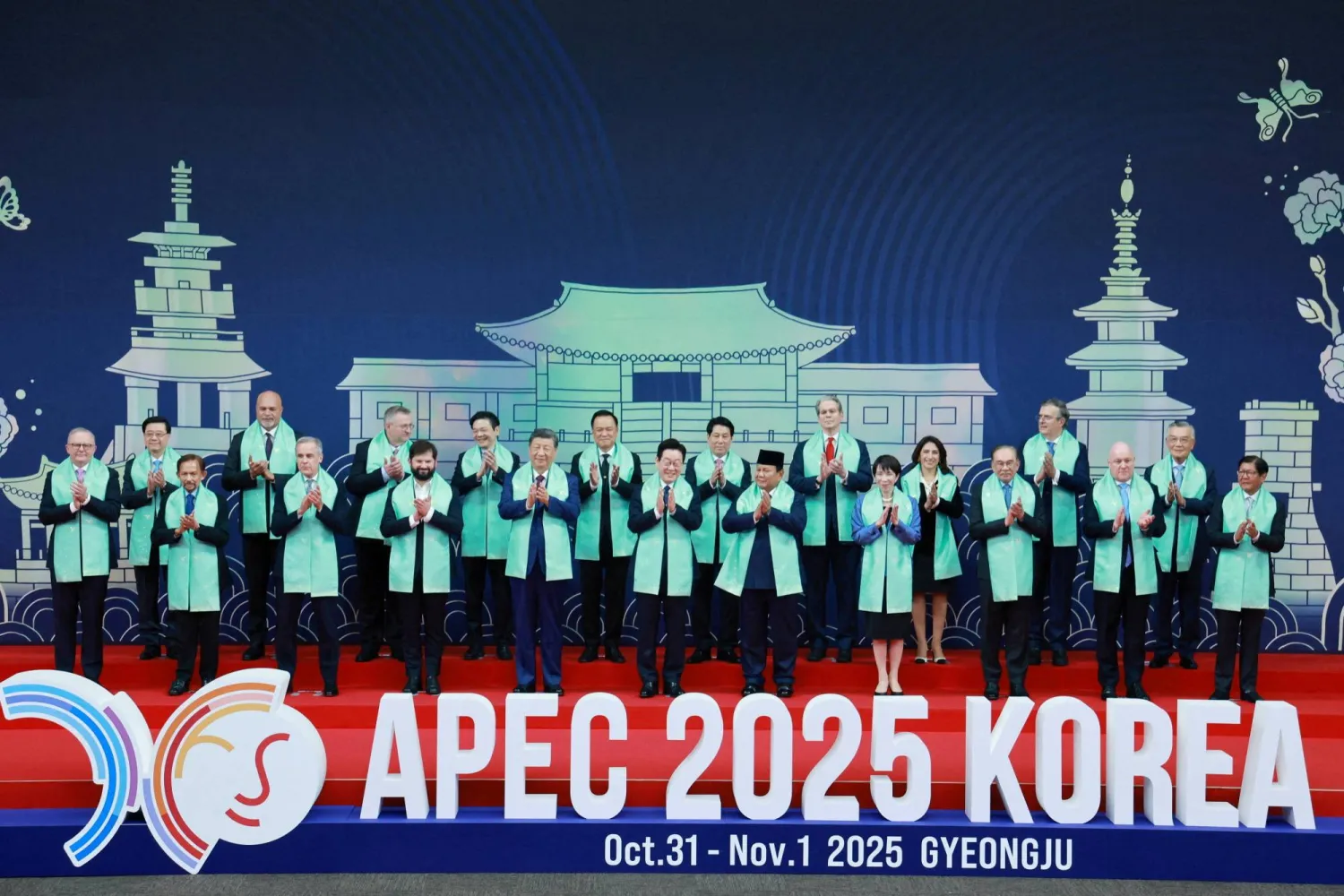

Asia-Pacific leaders on Saturday agreed that trade and investment should advance in a way that brings benefits to all, a joint declaration showed, following their regional forum meetings.
At the Asia-Pacific Economic Cooperation (APEC), the leaders adopted the joint Declaration as they concluded the two-day gathering that brought together the 21 APEC members in the city of Gyeongju, according to South Korea’s Yonhap news agency.
During the meeting held under the theme “Building a Sustainable Tomorrow,” the leaders have advanced their shared objectives through three priorities — Connect, Innovate, Prosper.
The declaration, for the first time, recognizes cultural and creative industries as a new growth driver for the Asia-Pacific region and reflects the member economies' shared understanding and commitment to cooperation on AI and demographic changes, the South Korean presidential office said.
Alongside the declaration, the leaders also adopted two separate documents on an AI initiative and responding to demographic changes.
Chinese President Xi Jinping sat down with South Korean counterpart Lee Jae Myung on Saturday, capping an Asian summit at which Beijing emerged as an economic force in the absence of US President Donald Trump.
The Chinese President held direct talks with Trump ahead of the APEC summit South Korea on Thursday, in the first meeting between the two men since 2019.
The Presidents agreed to a temporary trade war truce, in which the US agreed to lower some tariffs in return for China's commitment to lift certain rare earth export restrictions and resume purchases of US goods.
After sealing the trade war pause with Xi in South Korea, Trump promptly jetted home on Thursday.
His swift exit allowed the Chinese leader to take center stage at the Asia-Pacific Economic Cooperation summit, where Beijing sought to position itself as a steady advocate of free and open trade, a role the US had dominated for decades. Also, China will host APEC in Shenzhen in 2026, President Xi Jinping announced.
The President met Canadian Prime Minister Mark Carney on the sidelines of the event on Friday, the first formal talks between the two countries' leaders since 2017.
Xi told the Liberal leader he was determined to work together to get relations back on the “right track” and invited Carney to visit China.
For his part, Carney described the meeting as a “turning point” in ties between Ottawa and Beijing.
Xi also sat down on Friday with Japan's new premier Sanae Takaichi, long seen as a China hawk.
She told Xi she wanted a “strategic and mutually beneficial relationship.”
But Takaichi told reporters that she also raised a number of thorny issues with the Chinese leader, saying that it was “important for us to engage in direct, candid dialogue.”
The Chinese leader then turned his attention to the South Korean President and their first sit-down meeting since Lee’s election in June.
Lee to ‘reassure’ Beijing
Seoul has long trodden a fine line between top trading partner China and defense guarantor the United States.
Relations with China soured in 2016 after Seoul agreed to deploy the US-made THAAD missile defense system.
Beijing hit back with sweeping economic retaliation, restricting South Korean businesses and banning group tours.
Cultural spats, including China’s claims over the origins of the Korean staple dish Kimchi, have also soured public opinion against Beijing.
“Public opinion matters in foreign policy,” Gi-Wook Shin, a Korea expert and sociology professor at Stanford University, told AFP.
“Public perception of China in South Korea is highly negative. I suppose the Chinese view of South Korea is not favourable either,” he said.
South Korea, which this week also agreed a multibillion dollar economic deal with the United States, remains heavily dependent on trade with its vast Asian neighbor.
Lee will likely try to “reassure Beijing that South Korea’s alignment with the United States does not preclude pragmatic economic engagement with China,” Seong-Hyon Lee, a scholar at the Harvard University Asia Center.
The South Korean leader is keen to “seek a measure of economic stability and a more predictable floor in bilateral relations,” he told AFP.
Also hanging over relations are Beijing’s close ties with North Korea, which remains technically at war with the South.
Lee plans to raise the issue of “denuclearization” with the Chinese leader, as well as broader peace efforts on the peninsula, Seoul’s presidential office said.