



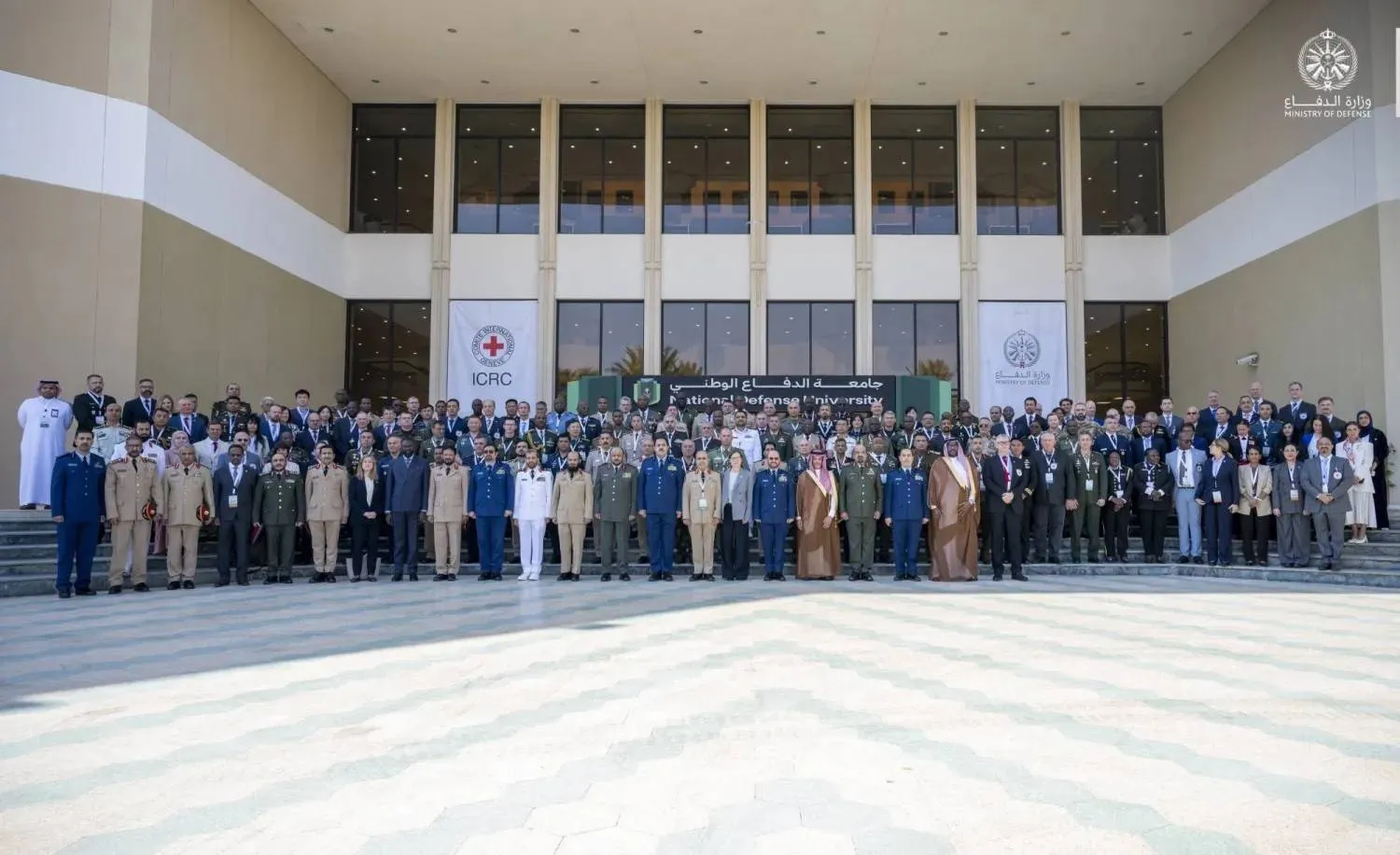

The 18th edition of the Senior Workshop on International Rules Governing Military Operations (SWIRMO) kicked off in Riyadh on Saturday, organized by Saudi Arabia’s Ministry of Defense, represented by the Saudi National Defense University (SANDU), in partnership with the International Committee of the Red Cross (ICRC).
The event, opened by Lieutenant General Fayyadh al-Ruwaili, Saudi Arabia’s Chief of the General Staff, and Mirjana Spoljaric, President of the International Committee of the Red Cross, carries special significance amid a global surge in armed conflicts and growing strain on the international legal framework designed to protect civilians during war.
Speaking before more than 125 senior military officers from 90 countries, Lt. Gen. al-Ruwaili said the workshop, held for the first time in the Kingdom, reaffirms Saudi Arabia’s firm commitment to respecting and promoting international humanitarian law and strengthening its application in military operations.
He said the Kingdom, under the leadership of Custodian of the Two Holy Mosques King Salman bin Abdulaziz and Crown Prince and Prime Minister Mohammed bin Salman, has given great attention to the principles of international humanitarian law in its national legislation, criminalizing violations of the laws of war and aligning its regulations with international legal standards governing armed operations.
The system also ensures fair accountability through a solid legal and institutional framework in which competent courts play an active role in addressing cases that may arise in wartime, in accordance with international humanitarian law and its guarantees, he said.
Al-Ruwaili stressed that the Kingdom’s commitment is rooted in the principles of Islamic Sharia, which call for mercy, justice and benevolence, even in times of war, and for humane treatment of prisoners of war.
He added that these noble values form a solid foundation for promoting human rights both in peace and conflict, as part of the Kingdom’s deeply held respect for human dignity.
The Chief of the General Staff said the Ministry of Defense has integrated the principles of international humanitarian law into its military education curricula and training programs to ensure that members of the armed forces understand and apply them in the field.
He revealed that the ministry has carried out numerous specialized training programs in international humanitarian law, either in cooperation with the ICRC or through national institutions, emphasizing that Saudi Arabia seeks to be a global model in the implementation and teaching of international law.
Al-Ruwaili described the partnership with the ICRC as “a distinguished example of effective cooperation in legal and humanitarian training and awareness,” which strengthens professional conduct and discipline across the armed forces.
He added that the Kingdom’s commitment extends beyond the legal and military spheres to the humanitarian and relief fields, citing the efforts of the King Salman Humanitarian Aid and Relief Center (KSRelief), which has implemented hundreds of projects in conflict and disaster zones worldwide, embodying the values of compassion, solidarity, neutrality, and non-discrimination enshrined in international humanitarian law.
For her part, Spoljaric said this year’s workshop comes at a pivotal moment, as the world witnesses a rise in both the number and intensity of conflicts while the laws established to protect civilians in wartime face unprecedented pressure.
She said the gathering of representatives from 90 countries, including states on opposing sides of current conflicts, in Riyadh reflects the shared responsibility of all nations to respect and uphold international humanitarian law.
Spoljaric also expressed gratitude to Saudi Arabia for hosting the global forum, aimed at turning the rules of war from words on paper into practice on the battlefield.
The six-day workshop will cover a wide range of topics, including urban warfare, emerging military technologies, multinational operations, and the protection of civilians and civilian infrastructure in conflict zones.


