


Palestinian National Team on 'Mission' for Peace in Spain Visit

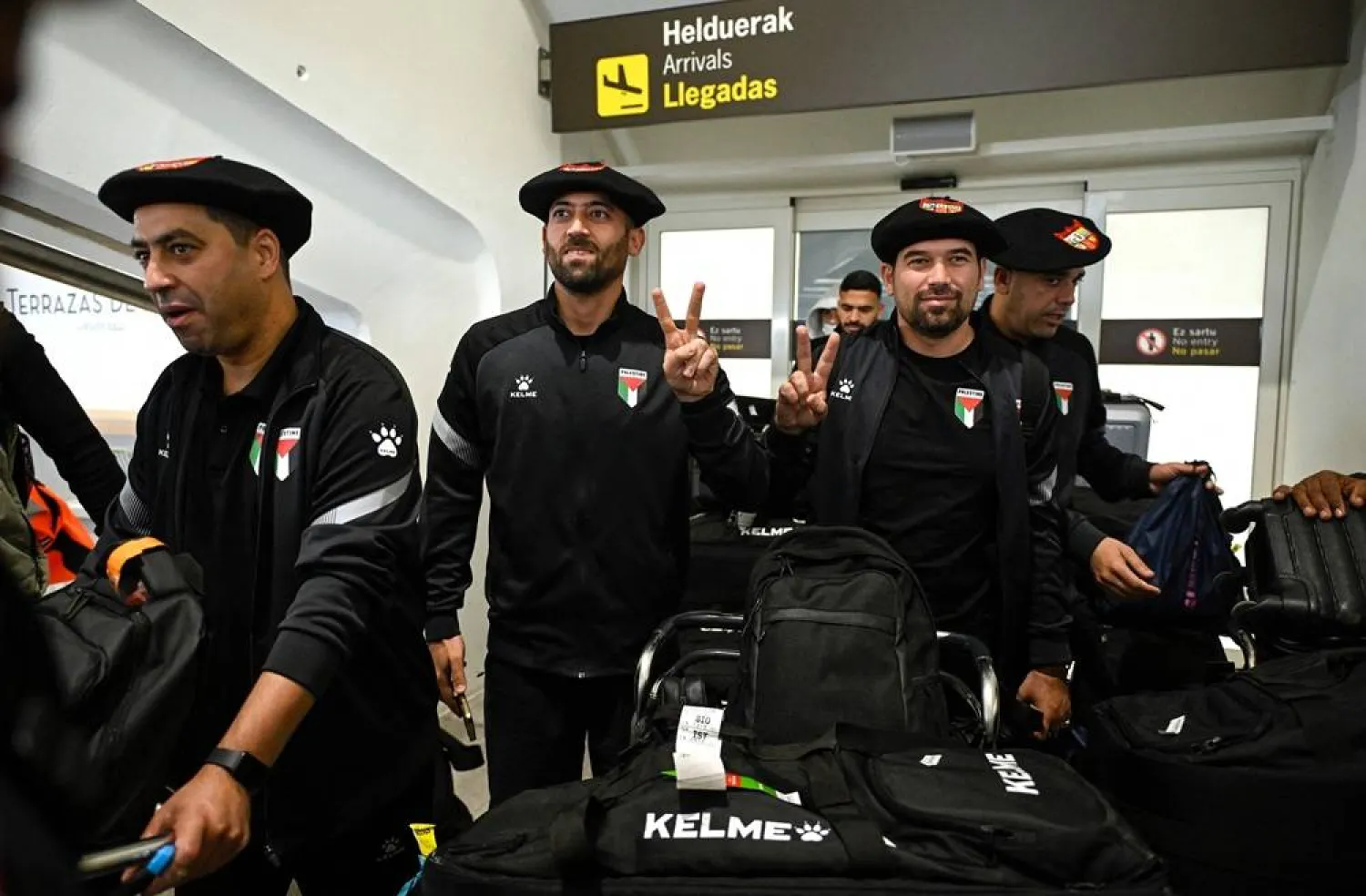
Palestinian national football team members wear the traditional Basque "txapela" (beret) as they arrive at Bilbao airport ahead of their friendly match against the Basque national team in Bilbao on November 11, 2025. (AFP)
TT

Palestinian National Team on 'Mission' for Peace in Spain Visit

Palestinian national football team members wear the traditional Basque "txapela" (beret) as they arrive at Bilbao airport ahead of their friendly match against the Basque national team in Bilbao on November 11, 2025. (AFP)

On a "mission" in Spain, Palestinian national team coach Ehab Abu Jazar and his players will play symbolic friendlies against the Basque Country and Catalan national teams in the hopes of working towards safety and freedom for their people.

Dressed in a black tracksuit, whistle in mouth, Palestinian coach Abu Jazar leads the team's training session with authority at Lezama, Athletic Bilbao's training ground on Friday.

On one of the pitches offered by the top-flight club he tries to prepare his players as best he can for what will be much more than just a match at the grand San Mames stadium, in front of 50,000 spectators supporting the Palestinian cause on Saturday.

As seen during the pro-Palestinian protests that heavily affected cycling's Vuelta a Espana Grand Tour this summer, there is heavy support for them in the region as they play their first match in Europe.

They are 98th in the FIFA rankings, and their dream of playing in their first World Cup vanished this summer in the third round of the Asian qualifiers.

Abu Jazar has lost many family members to the Israel-Hamas war and some of his relatives are still at risk, a situation always present in his thoughts.

"I am from the Gaza Strip, from a large family in the Gaza Strip. We have almost 200 martyrs from the family. My own house was destroyed in this war," he tells AFP.

"My relatives, my mother until today is still living in a tent along with my brothers, my sisters, my cousins, my neighbors, my friends, and all of Gaza. So, emotionally and psychologically, it is extremely difficult."

Most of his players have never set foot in Gaza. Some play in Qatar, one in Chile, in Iceland, or in the United States.

They are the last representatives of Palestinian football, devastated at all levels by two years of Israeli bombardment, described as genocide by the Spanish government, in response to Hamas's unprecedented cross-border attack on October 7, 2023.

Since then, there has been no league, no functioning clubs, and hundreds of athletes have been injured or killed, including the country's most famous footballer, Suleiman Al-Obeid, 41, nicknamed the "Palestinian Pele".

The Palestine Football Association said he was killed when Israel attacked civilians waiting for humanitarian aid.

"From day one, they targeted sports. They destroyed all the infrastructure in Gaza, 289 (locations) in total," Palestinian Football Federation president Jibril Rajoub tells AFP.

"1,100 athletes, employees, coaches, and referees have been killed, including our captain (Al-Obeid). Thousands have been injured, hundreds of others are missing."

"Israel should be sanctioned," continues the 72-year-old chief, also the secretary-general of Fatah, the party of Palestinian President Mahmoud Abbas.

"We are here on a mission," explains coach Abu Jazar, adjusting his keffiyeh around his neck.

"Our message to the whole world is this -- put pressure on this occupation to stop this genocide."

Despite the fragile ceasefire which came into place on October 10, the coach highlighted the continuing peril for civilians in Gaza.

"Death continues in Gaza to this day, famine continues in the Gaza Strip, and there is no shelter," continues Abu Jazar, after Israel's relentless bombing razed much of the land.

"So, we are telling the entire world -- apply as much pressure as you can on this occupation, because in Palestine there is a people who deserve a state and a dignified life.

"We want to live with dignity and independence, and this will not happen except with the end of the occupation."

The coach, like his players, hopes this charity match, with proceeds donated to Doctors Without Borders, will help increase the "pressure" on the international community to fight for lasting peace and recognition of a Palestinian state.

"This is the most important thing -- giving a voice to Palestinians who don't have one, and raising funds to help humanitarian organizations," said defender Yaser Hamed, born in Bilbao and trained at Athletic Bilbao.

"This money will help a lot, especially in rebuilding hospitals, delivering medicines, etc."

Hamed, who speaks fluent Basque and Spanish, considers himself "lucky" to be able to continue living his passion, "while some Palestinians are starving."

"It makes you savor every plate, and all the little things people don't notice in daily life," he continued.

"We have this responsibility to bring a bit of joy to our compatriots who are suffering. All of this must stop, and Palestine must finally be free."

His teammate Ahmed Al-Qaq, born in the United States to Palestinian parents, hopes these matches can "open the world's eyes" to the humanitarian situation in Gaza.

"We are not politicians, but as players, we give people something to look forward to. Especially with everything they're going through, it gives them a glimmer of hope," explains the 23-year-old winger.

And if Palestine lose, as they did against Malaysia and Algeria in recent matches?

"We'll recover. It's in our genes to always get back up when we fall."


Mexico City Suspends Classes, Shifts to Remote Work for World Cup Kickoff

 Souvenirs shaped like the FIFA World Cup trophy are displayed for sale on a street in Mexico City on June 8, 2026. (AFP)
Souvenirs shaped like the FIFA World Cup trophy are displayed for sale on a street in Mexico City on June 8, 2026. (AFP)
TT

Mexico City Suspends Classes, Shifts to Remote Work for World Cup Kickoff

 Souvenirs shaped like the FIFA World Cup trophy are displayed for sale on a street in Mexico City on June 8, 2026. (AFP)
Souvenirs shaped like the FIFA World Cup trophy are displayed for sale on a street in Mexico City on June 8, 2026. (AFP)

Mexico's President Claudia Sheinbaum on Tuesday issued a decree ordering federal workers in the capital to work from home on June 11 and suspending school classes to ease traffic ‌during FIFA World ‌Cup opening ‌events.

The decree aims ⁠to improve urban mobility and road safety as Mexico City hosts the World Cup opening match and accompanying ⁠events on June 11.

The ‌opening events are expected ‌to draw significant numbers of ‌visitors.

Federal agencies must implement remote work schemes for Mexico City-based staff, with ‌exceptions for essential services including healthcare, security, critical ⁠infrastructure ⁠and World Cup operations.

Schools from preschool through university, both public and private, will close for the day under the decree.

The government also urged private companies to adopt similar remote work arrangements.


Iran Football Body Claims Fans’ Tickets for World Cup Games in the US Have Been Revoked

 Reza Mansoori (R) and Mostafa Pourmanda, Iranian supporters living in San Diego and staying at the same hotel as Iran's national football team, cheer for their team in Tijuana, Mexico, on June 8, 2026, ahead of the FIFA 2026 World Cup football tournament. (AFP)
Reza Mansoori (R) and Mostafa Pourmanda, Iranian supporters living in San Diego and staying at the same hotel as Iran's national football team, cheer for their team in Tijuana, Mexico, on June 8, 2026, ahead of the FIFA 2026 World Cup football tournament. (AFP)
TT

Iran Football Body Claims Fans’ Tickets for World Cup Games in the US Have Been Revoked

 Reza Mansoori (R) and Mostafa Pourmanda, Iranian supporters living in San Diego and staying at the same hotel as Iran's national football team, cheer for their team in Tijuana, Mexico, on June 8, 2026, ahead of the FIFA 2026 World Cup football tournament. (AFP)
Reza Mansoori (R) and Mostafa Pourmanda, Iranian supporters living in San Diego and staying at the same hotel as Iran's national football team, cheer for their team in Tijuana, Mexico, on June 8, 2026, ahead of the FIFA 2026 World Cup football tournament. (AFP)

FIFA has revoked the ticket allocation for Iran fans at the team’s three World Cup games in the United States, the national soccer federation claimed Tuesday.

Each federation for the 48 teams taking part is entitled to receive and distribute 8% of stadium capacity at the World Cup, adding up to several thousands of tickets for each game.

Just days before Iran opens its World Cup — on June 15 at the Los Angeles Rams’ stadium in Inglewood against New Zealand — the federation claimed in a statement reported by semi-official state media that it was now unable to provide any tickets to its supporters.

FIFA was approached for comment.

The claim adds to the turmoil between Iranian soccer, FIFA and tournament co-host the US, which began military attacks on Iran on Feb. 28.

Iran’s team is now based in the Mexican border city of Tijuana instead of its pre-war plan to train in Tucson, Arizona.

Some federation officials also have been denied visas to enter the US, where Iran also plays Belgium in Inglewood on June 21 and then Egypt in Seattle on June 26.

Federations of World Cup teams typically sell their ticket allocation to the most loyal fans who attend games at home and away.

Iran residents were subject to a travel ban by the US government since last year and were unlikely to get entry visas for the World Cup. It was unclear how many tickets in Iran’s allocation were sold since the tournament draw was made in December to the country's diaspora including in the US.

Still, FIFA president Gianni Infantino stated in 2017 — when US football officials were preparing a co-hosting bid with Canada and Mexico they won the following year — that fans must have access to the tournament.

“It’s obvious when it comes to FIFA competitions as well (that) any team, including the supporters and the officials of that team, who would qualify for a World Cup need to have access to the country, otherwise there is no World Cup,” Infantino said nine years ago. “That is obvious.”

A FIFA-appointed match referee from Somalia was denied entry to the US in Miami at the weekend and on Monday he was ruled out of taking part in the 104-game tournament that starts on Thursday.


World Cup Nears Kickoff after Pre-tournament Turbulence

The World Cup will kick off in the Estadio Azteca in Mexico City. Carl DE SOUZA / AFP
TT

World Cup Nears Kickoff after Pre-tournament Turbulence

The World Cup will kick off in the Estadio Azteca in Mexico City. Carl DE SOUZA / AFP

The World Cup kicks off on Thursday with FIFA betting that the enduring appeal of the greatest footballing show on earth can rise above anger at soaring ticket prices, an uneasy political climate in Donald Trump's America and the shadow of conflict in the Middle East.

A record 48 teams and millions of fans are set to descend on the United States, Canada and Mexico for the first ever World Cup co-hosted by three nations, the largest and most logistically complex edition of the tournament ever staged.

The action gets under way at Mexico City's iconic Estadio Azteca on Thursday, with co-hosts Mexico taking on South Africa at 3:00 pm local time (1900 GMT), launching a sprawling, nearly six-week-long spectacle that will culminate in the final at New Jersey's 82,500-seat MetLife Stadium on July 19.

Can Lionel Messi, at the age of 38, settle any lingering debate about his status as the greatest player of all time by leading Argentina to a second consecutive World Cup title?

Or can Messi's great rival, the 41-year-old Cristiano Ronaldo, defy father time by inspiring a talented Portugal team to its maiden World Cup win?

Or will England, led by Harry Kane, finally end the country's 60-year wait for a second major international championship following their lone 1966 World Cup victory?

Those questions and more will be answered over the course of a tournament that Gianni Infantino, the president of world football's governing FIFA, has bullishly hyped as "the greatest show that the planet has ever seen."

- Ticket fury -

Yet Infantino's breezy optimism has run into hurricane-force headwinds of skepticism during a build-up dogged by concerns over affordability, politics and conflict.

The skyrocketing cost of tickets to the tournament has triggered a global backlash which has left FIFA and Infantino struggling to mount a convincing public relations defense.

The most expensive ticket for the 2022 World Cup final cost around $1,600 at face value; in 2026 the most expensive face value ticket being sold by FIFA is an eye-watering $32,970.

That kind of inflation has been prevalent across the tournament's 104 matches, where seats for many games remain available on secondary re-sale markets despite huge demand.

Even Infantino's staunch ally, Donald Trump, has balked at the cost, reacting with surprise when told of the $1,000 price tag for tickets to the USA's opening game with Paraguay in Los Angeles on Friday -- the first game on US soil.

"I wouldn't pay it either, to be honest with you," the US president told the New York Post.

While fans absorb the expense of travel to the tournament, other critics have questioned whether the World Cup party will be soured by the political climate in the United States.

Human Rights Watch says Trump's crackdowns on immigration, demonstrations and press freedom could lead to a World Cup defined by "exclusion and fear."

Those fears were fueled Monday when FIFA dropped a Somali referee from the World Cup after he was denied entry to the United States.

Omar Artan was set to be the first match official from Somalia to referee at a global finals, but he was turned back when he arrived at Miami International Airport on Saturday.

FIFA said it was powerless to influence the decision and announced it had omitted Artan from its 52-strong referees roster.

The US-Israel military strikes launched against Iran in February have also loomed large over the tournament, where Iran are due to play three group games in the United States, starting with their opener against New Zealand on June 15.

Trump initially suggested Iran should withdraw from the tournament for their own "life and safety" before walking back his rhetoric.

Iran meanwhile have switched their base camp from Tucson, Arizona to the Mexican city of Tijuana, where they touched down early Sunday.

While Iran's players are free to travel in and out of the United States, some 15 administrative and management staff have been denied visas by US authorities in a move Iranian authorities have condemned as "deliberate and discriminatory treatment."

- Expanded field -

On the field, the decision to expand the tournament to 48 teams -- up from 32 in 2022 -- is likely to strip the group stage of any sense of jeopardy.

A total of 72 first-round matches will be needed to eliminate just 12 teams, with 32 advancing to the knockout rounds -- the top two finishers in each of the 12 first ground groups along with the eight best third-place finishers.

The tournament will see a range of other innovations.

For the first time in World Cup history, every game will feature cooling breaks in the middle of each half, a measure designed to mitigate the effects of searing heat and humidity expected at many of the tournament's 16 venues.

Players and referees will need to adjust to several new rules being rolled out at the World Cup, including teams being required to make substitutions inside 10 seconds to prevent time-wasting.

A crackdown on racist abuse will see players risk a red card for covering their mouth with a hand, arm or shirt during a confrontation with an opponent.

Next month's final, meanwhile, could well be the longest on record due to the decision to stage a Super Bowl-style halftime show, headlined by Madonna, Shakira and BTS.

The show means the half-time interval will be stretched from the traditional 15 minutes to around 25 minutes.
