

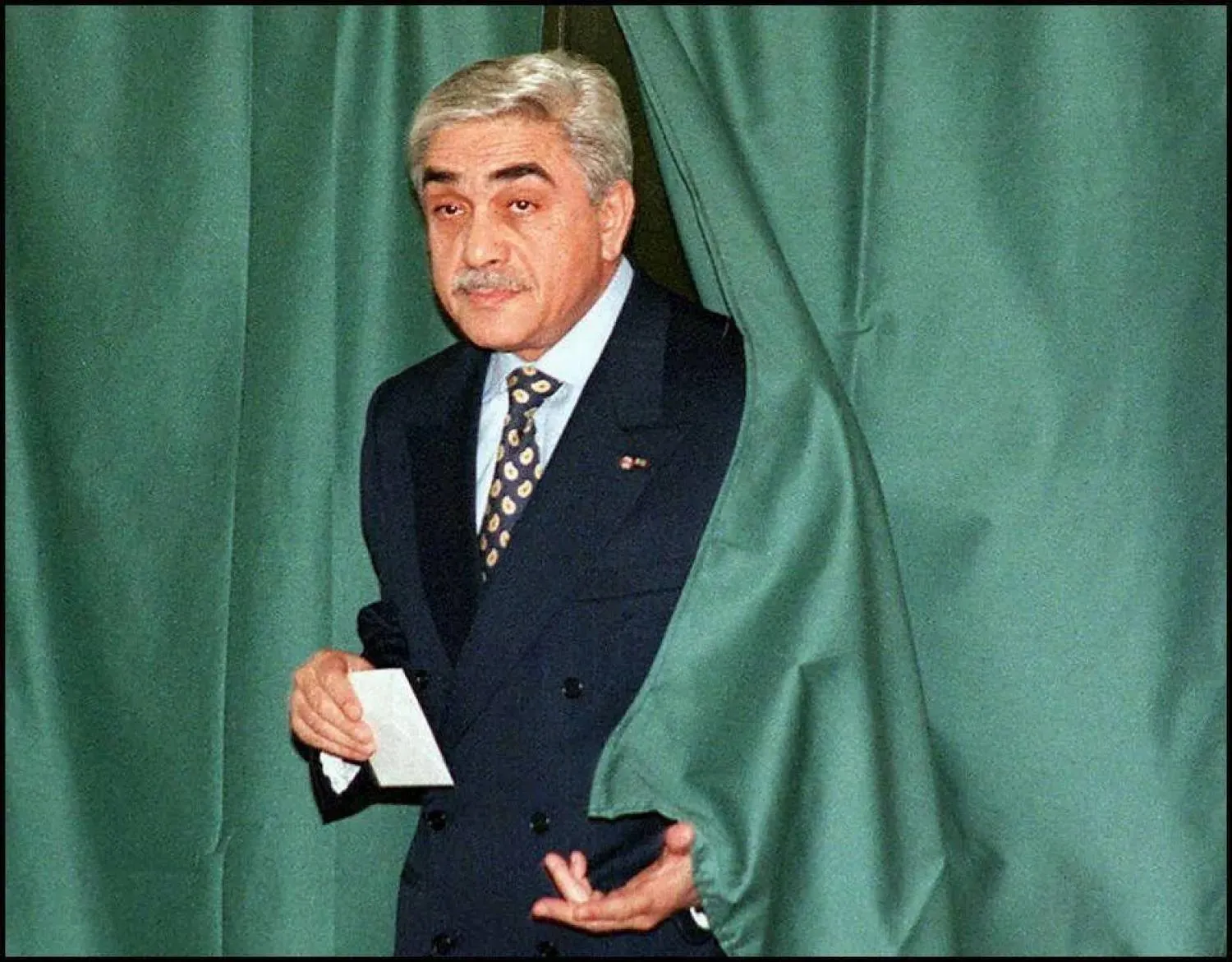

Secret Files Reveal Western Unease after Zeroual’s Election Victory in Algeria

Former Algerian president Liamine Zeroual casting his vote in the 1997 parliamentary elections (AFP). 
TT

Secret Files Reveal Western Unease after Zeroual’s Election Victory in Algeria

Former Algerian president Liamine Zeroual casting his vote in the 1997 parliamentary elections (AFP). 

Thirty years ago today, Liamine Zeroual won Algeria’s 1995 presidential election, an event that marked a turning point in a nation ravaged by violence since the cancellation of the 1991 vote won by the Islamic Salvation Front (FIS). Until then, critics of the army-backed authorities had repeatedly accused the regime of lacking “popular legitimacy.”

Zeroual’s decision to seek a mandate at the ballot box abruptly deprived the opposition of that argument. It was, in every sense, a political gamble: the country was drowning in bloodshed, armed groups were at their peak, and they openly threatened anyone who dared approach a polling station. Major opposition parties - FIS, the National Liberation Front (FLN) and the Socialist Forces Front (FFS) - all called for a boycott.

Zeroual pressed ahead. His victory was not unexpected; he was the interim president, a former defense minister and enjoyed firm military backing. The surprise lay in the manner of his win. Voters lined up at polling centers despite the danger, shattering the barrier of fear that terrorism had imposed.

For the authorities, Zeroual’s triumph restored long-contested “legitimacy” and effectively signaled the beginning of the end of Algeria’s “black decade.” The following year he held parliamentary elections that formally closed the chapter of FIS’s 1991 win. Meanwhile, the balance of the conflict shifted decisively toward the army, which dealt severe blows to armed groups and compelled many militants to surrender under an amnesty later implemented by Zeroual’s successor, Abdelaziz Bouteflika, in 1999.

Most young Algerians, with little memory of the 1990s carnage, may not grasp the significance of Zeroual’s victory. To mark the anniversary, Asharq Al-Awsat examines declassified British government files held in the UK National Archives, shedding light on Western reactions to the 1995 vote.

The documents reveal confusion and caution in Western capitals. France, for instance, refrained from issuing a formal “congratulation,” while Britain’s Foreign Office deemed it inappropriate for Queen Elizabeth II to send her own message, although the prime minister would do so.

A report dated 17 November 1995 from Britain’s ambassador to Algiers, Peter Marshall, notes that Zeroual secured a “landslide victory,” winning 61.34 percent of the vote. He wrote that the election “defied three years of terrorism and repression” as well as threats of disruption by the banned FIS and armed Islamist groups. Turnout reached a surprising 75 percent of the 16 million registered voters, well above official expectations.

According to the report, analysts viewed the result as “a strong mandate against violence rather than an endorsement of any particular candidate.” High participation, especially among women and young people, sent the authorities a clear message that “the large silent majority wants to live in peace in a secular state.”

The documents highlight voters’ rejection of Zeroual’s main rival, the moderate Islamist Mahfoud Nahnah, who won 25.38 percent of the vote, less than 20 percent of the electorate. This signaled “a firm refusal of Islamic rule,” according to the report. Meanwhile, the boycott strategy of major opposition parties “misread the public mood,” and may even have strengthened the regime’s hand. The report concluded that legitimacy conferred by the election was “more solid than expected,” prompting even boycotting groups, including FIS and the FLN, to issue conciliatory statements.

The success of the vote, the British embassy observed, was enabled by unprecedented security measures. Massive military and police deployment produced what was described as one of Algeria’s most peaceful days in years. Although some alleged fraud, British officials believed the process was conducted “with integrity and transparency,” and the figures were “reasonably accurate.”

Yet the documents also warned that Algeria remained under the same military-backed leadership. The regime had achieved its goal of acquiring “a degree of democratic legitimacy,” allowing the generals to “step back from the spotlight.” But doubts persisted over whether Zeroual would have any greater freedom of action, with his name continuing to serve as “a shorthand for the system itself.” Analysts cautioned that the danger was that the authorities might interpret the result more as “approval of their previous policies than as a demand for change.”

Looking ahead, the files expected Zeroual to pursue his dual strategy of political dialogue and counter-terrorism, “with a slight tilt toward the latter.” His promise of parliamentary elections the following year could entice opposition groups to re-engage, though reintegrating the banned FIS seemed increasingly remote. The report stressed that long-term stability remained uncertain: the deep social and economic grievances that fueled extremism were still “as intractable as ever,” and armed groups were unlikely to simply abandon their struggle.

The documents show that international reactions were “satisfied but cautious.” The European Union welcomed the peaceful vote and high participation, hoping to tie political progress to sustainable economic reforms. France issued a “muted” response; although President Jacques Chirac would send a message, it would avoid explicit congratulations. Privately, Paris was pleased, believing high turnout had weakened both FIS and the FFS, and awaited early signals of Zeroual’s commitment to legislative elections.

Other European leaders, including those of Germany, Russia, Greece and Spain, also sent messages. The British prime minister would congratulate Zeroual while noting London’s interest in political dialogue and commercial opportunities, including BP’s multibillion-dollar bid in Algeria. A royal message, however, remained “inappropriate,” given the military regime’s record of brutality.



Shells of Unknown Origin Land Near Military Airport in Damascus, Syrian State TV Says

Smoke billows following an Israeli strike on Damascus over the summer. (Reuters file)
TT

Shells of Unknown Origin Land Near Military Airport in Damascus, Syrian State TV Says

Smoke billows following an Israeli strike on Damascus over the summer. (Reuters file)

Shells of unknown origin fell in the vicinity of Syria's Mezzah military airport in the capital Damascus on Tuesday, the state-run Al Ekhbariya TV reported.

Syria's state news agency earlier reported the sound of an explosion in the vicinity of Damascus and said the matter was under investigation.

The airbase sits at the gateway to parts of southern Syria.


Israeli Army Takes Journalists into a Tunnel in a Gaza City It Seized and Largely Flattened

Mattresses and a plastic chair lie on the floor inside a tunnel in Rafah, Gaza Strip, Monday, Dec. 8, 2025. (AP)
TT

Israeli Army Takes Journalists into a Tunnel in a Gaza City It Seized and Largely Flattened

Mattresses and a plastic chair lie on the floor inside a tunnel in Rafah, Gaza Strip, Monday, Dec. 8, 2025. (AP)

One by one, the soldiers squeezed through a narrow entrance to a tunnel in southern Gaza. Inside a dark hallway, some bowed their heads to avoid hitting the low ceiling, while watching their step as they walked over or around jagged concrete, crushed plastic bottles and tattered mattresses.

On Monday, Israel's military took journalists into Rafah — the city at Gaza's southernmost point that troops seized last year and largely flattened — as the two-month-old Israel-Hamas ceasefire reaches a critical point. Israel has banned international journalists from entering Gaza since the war began more than two years ago, except for rare, brief visits supervised by the military, such as this one.

Soldiers escorted journalists inside a tunnel, which they said was one of Hamas' most significant and complex underground routes, connecting cities in the embattled territory and used by top Hamas commanders. Israel said Hamas had kept the body of a hostage in the underground passage: Hadar Goldin, a 23-year-old soldier who was killed in Gaza more than a decade ago and whose remains had been held there.

Hamas returned Goldin's body last month as part of a US-brokered ceasefire in the war triggered by the fighters' Oct. 7, 2023, attack on southern Israel in which 1,200 people were killed and hundreds taken hostage. Israel’s retaliatory offensive has killed more than 70,000 Palestinians, according to Gaza’s Health Ministry, which operates under the Hamas-run government. The ministry does not differentiate between civilians and combatants, but says roughly half the dead have been women and children.

Israel and Hamas are on the cusp of finishing the first phase of the truce, which mandated the return of all hostages, living and dead, in exchange for Palestinians held by Israel. The body of just one more hostage remains to be returned.

Mediators warn the second phase will be far more challenging since it includes thornier issues, such as disarming Hamas and Israel’s withdrawal from the strip. Israel currently controls more than half of Gaza.

Israeli Prime Minister Benjamin Netanyahu is set to travel to Washington this month to discuss those next steps with US President Donald Trump.

Buildings lie in ruins amidst the rubble in Rafah in the southern Gaza Strip, December 8, 2025. (Reuters)

Piles of rubble line Rafah's roads

Last year, Israel launched a major operation in Rafah, where many Palestinians had sought refuge from offensives elsewhere. Heavy fighting left much of the city in ruins and displaced nearly one million Palestinians. This year, when the military largely had control of the city, it systematically demolished most of the buildings that remained standing, according to satellite photos.

Troops also took control of and shut the vital Rafah crossing, Gaza’s only gateway to the outside world that was not controlled by Israel.

Israel said Rafah was Hamas’ last major stronghold and key to dismantling the group’s military capabilities, a major war aim.

On the drive around Rafah on Monday, towers of mangled concrete, wires and twisted metal lined the roads, with few buildings still standing and none unscathed. Remnants of people's lives were scattered the ground: a foam mattress, towels and a book explaining the Quran.

Last week, Israel said it was ready to reopen the Rafah crossing but only for people to leave the strip. Egypt and many Palestinians fear that once people leave, they won't be allowed to return. They say Israel is obligated to open the crossing in both directions.

Israel has said that entry into Gaza would not be permitted until Israel receives all hostages remaining in the strip.

Israeli soldiers gather next to the entrance of a tunnel where the army says the body of soldier Hadar Goldin was held in Rafah, Gaza Strip, Monday, Dec. 8, 2025. (AP)

Inside the tunnel

The tunnel that journalists were escorted through runs beneath what was once a densely populated residential neighborhood, under a United Nations compound and mosques. Today, Rafah is a ghost town. Underground, journalists picked their way around dangling cables and uneven concrete slabs covered in sand.

The army says the tunnel is more than 7 kilometers (4 miles) long and up to 25 meters (82 feet) deep and was used for storing weapons as well as long-term stays. It said top Hamas commanders were there during the war, including Mohammed Sinwar, who was believed to have run Hamas’ armed wing and was the younger brother of Yahya Sinwar, the Hamas leader who helped mastermind the Oct. 7 attack. Israel has said it has killed both of them.

“What we see right here is a perfect example of what Hamas did with all the money and the equipment that was brought into Gaza throughout the years," said Lt. Col. Nadav Shoshani. "Hamas took it and built an incredible city underground for the purposes of terror and holding bodies of hostages.”

Israel has long accused Hamas of siphoning off money for military purposes. While Hamas says the Palestinians are an occupied people and have a right to resist, the group also has a civilian arm and ran a government that provided services such as health care, a police force and education.

The army hasn’t decided what to do with the tunnel. It could seal it with concrete, explode it or hold it for intelligence purposes among other options.

Since the ceasefire began, three soldiers have been killed in clashes with about 200 Hamas fighters that Israeli and Egyptian officials say remain underground in Israeli-held territory.

Hamas has said communication with its remaining units in Rafah has been cut off for months and that it was not responsible for any incidents occurring in those areas.

Both Israel and Hamas have accused each other of repeated violations of the deal during the first phase. Israel has accused Hamas of dragging out the hostage returns, while Palestinian health officials say over 370 Palestinians have been killed in continued Israeli strikes since the ceasefire took effect.


Israel to Reopen Jordan Border Crossing for Passage of Aid and Goods

Allenby Bridge Crossing between West Bank and Jordan is closed, in the Israeli-occupied West Bank, September 24, 2025. REUTERS/Ammar Awad/File Photo
TT

Israel to Reopen Jordan Border Crossing for Passage of Aid and Goods

Allenby Bridge Crossing between West Bank and Jordan is closed, in the Israeli-occupied West Bank, September 24, 2025. REUTERS/Ammar Awad/File Photo

Israel is set to reopen the Allenby Crossing with Jordan to the passage of goods and aid on Wednesday, an Israeli security official said on Tuesday.

The border crossing has been closed to aid and goods since September, when a driver bringing humanitarian aid to Gaza opened fire and killed two Israeli military personnel before being killed by security forces, Reuters reported.

The security official said the crossing would have tightened screening for Jordanian drivers and truck cargo, and that a dedicated security force had been assigned to the crossing.

The Allenby Bridge is a key route for trade between Jordan and Israel and the only gateway for more than 3 million Palestinians in the Israeli-occupied West Bank to reach Jordan and the wider world.

The crossing reopened to passenger traffic shortly after the attack, but had remained closed to aid trucks. The UN says the crossing is a major route for bringing food, tents and other goods into Gaza.
