


Two Newly Discovered Bach Organ Works Unveiled in Germany

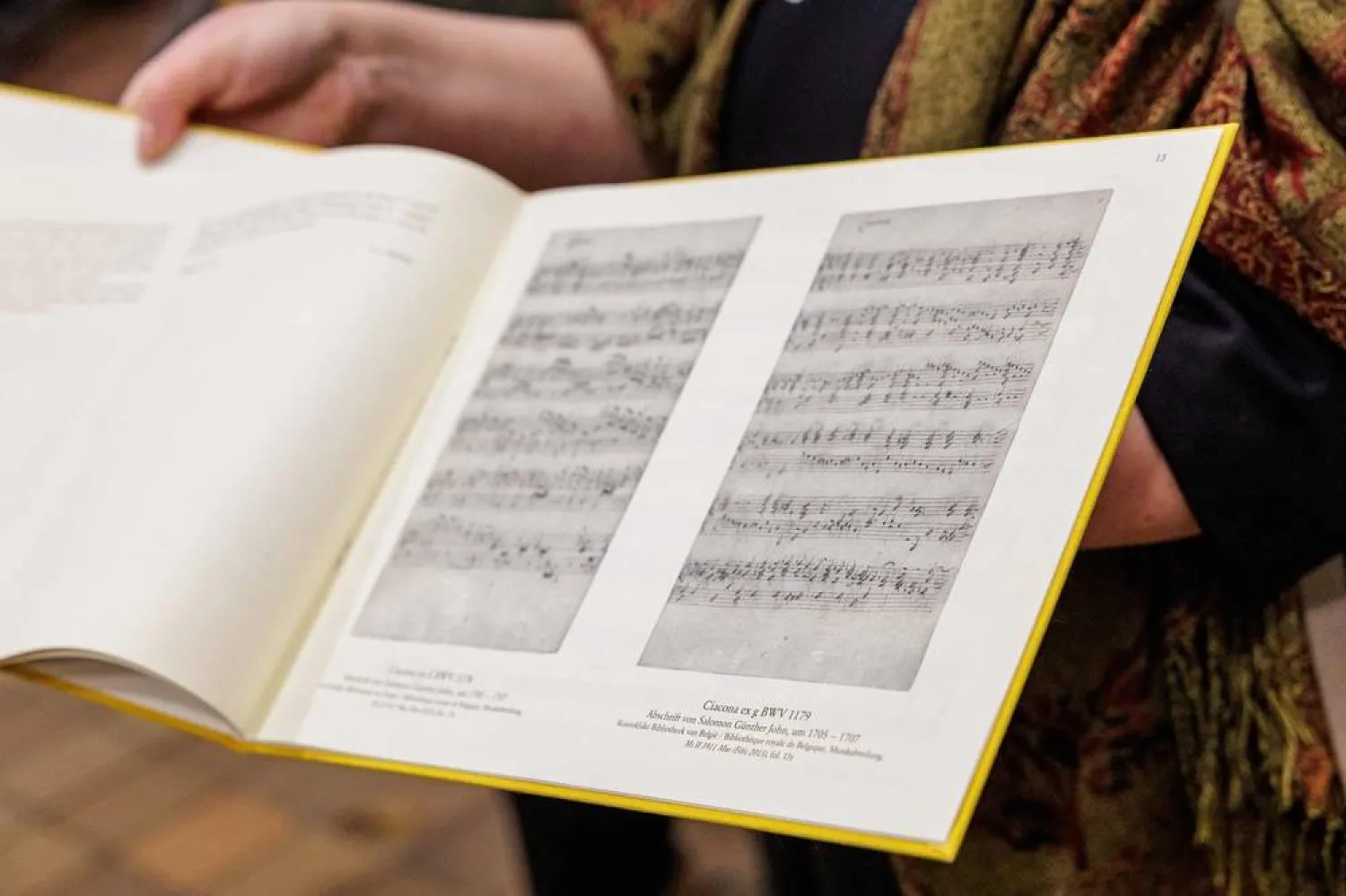
This handout picture released on November 17, 2025 by the Bach Archive Leipzig shows an employee of the archive holding a print of two long-lost organ pieces written by a teenage Johann Sebastian Bach during a presentation as part of the festival week celebrating the 75th anniversary of the Bach Archive Leipzig at the St. Thomas Church in Leipzig. (Jens Schlueter / Bach Archive / AFP)
TT

Two Newly Discovered Bach Organ Works Unveiled in Germany

This handout picture released on November 17, 2025 by the Bach Archive Leipzig shows an employee of the archive holding a print of two long-lost organ pieces written by a teenage Johann Sebastian Bach during a presentation as part of the festival week celebrating the 75th anniversary of the Bach Archive Leipzig at the St. Thomas Church in Leipzig. (Jens Schlueter / Bach Archive / AFP)

Two long-lost organ pieces written by a teenage Johann Sebastian Bach were unveiled in Germany on Monday in a discovery described as a "great moment for the world of music".

The two solo organ works, written while Bach was working as an organ teacher in the town of Arnstadt in Thuringia early in his career, first caught the attention of researchers over 30 years ago.

But it is only now that experts have been able to prove they were written by Bach after finally confirming the identity of the person who penned the manuscripts.

The Chaconne in D minor BWV 1178 and Chaconne in G minor BWV 1179 have been added to the official catalogue of Bach's works as of Monday.

They were also performed for the first time in 320 years at the St Thomas Church in Leipzig, where Bach is buried and served as a cantor for 27 years.

In a press conference before the works were performed, Culture Minister Wolfram Weimer hailed the discovery as a "global sensation" and a "great moment for the world of music".

"This is a source of great joy for many, many music lovers around the world," he said.

Bach researcher Peter Wollny first came across the works in the Royal Library of Belgium in 1992, according to the Bach Archive in Leipzig, which documents and researches the composer's life and work.

The manuscripts were undated and unsigned but are thought to have been written in around 1705, when Bach would have been 18 years old.

Wollny was fascinated by the works from the outset because they contained several characteristics that were unique to Bach during that period.

But the identity of the manuscript writer remained a mystery.

Several years ago, experts came across some very similar handwriting in a letter dating from 1729 written by a former pupil of Bach in Arnstadt, Salomon Guenther John.

But since the letter was written 20 years after the manuscripts and the handwriting was not identical, more evidence was needed.

It was only recently that earlier samples of John's writing were found, from around the same period, providing definitive proof that the handwriting was his.

"I searched for a long time for the missing piece of the puzzle to identify the compositions -- now the whole picture is clear," Wollny said.

"We can now say with certainty that the copies were made around 1705 by Bach's pupil Salomon Guenther John."

Ton Koopman, the Dutch organist and head of the Bach Archive who performed the works on Monday, said they were "of a very high quality".

"When one thinks of the young Bach or Mozart, it is often assumed that genius comes later in life -- but that is not the case," he said.

"I am convinced that organists worldwide will be very grateful for this virtuoso, lively new repertoire and will perform it regularly in future."

Bach was born in Eisenach in central Germany in 1685 and died in 1750.

Founded 75 years ago, the Bach Archive has helped to unearth several previously lost works by the composer.

In 2004, a Bach cantata that had been lost for decades was rediscovered in the papers of Japanese pianist Chieko Hara.



Syrian Culture Minister Applauds Saudi Pavilion at Damascus Book Fair

The 2026 Damascus International Book Fair is held from February 6 to 16 - SPA
TT

Syrian Culture Minister Applauds Saudi Pavilion at Damascus Book Fair

The 2026 Damascus International Book Fair is held from February 6 to 16 - SPA

Syrian Minister of Culture Mohammed Yassin Saleh visited the Kingdom’s pavilion at the 2026 Damascus International Book Fair, held from February 6 to 16, where the Kingdom is serving as the Guest of Honor.

He commended the efforts of the Literature, Publishing and Translation Commission in showcasing the rich diversity of the Saudi cultural and literary scene. The pavilion features exhibitions of manuscripts, a Saudi fashion corner, and archaeological replicas, SPA reported.

The minister reviewed the commission's Tarjim translation initiative and Saudi literature comics.

This participation at the 2026 Damascus International Book Fair showcases Saudi creativity and fosters cultural dialogue, supporting Saudi Vision 2030’s goals of knowledge exchange and cultural leadership.


Saudi Arabia, Syria Underline Depth of their Cultural Ties

Syrian President al-Sharaa receives the Saudi minister of culture and the accompanying delegation at the Conference Palace in Damascus on Thursday. (SPA)
TT

Saudi Arabia, Syria Underline Depth of their Cultural Ties

Syrian President al-Sharaa receives the Saudi minister of culture and the accompanying delegation at the Conference Palace in Damascus on Thursday. (SPA)

Saudi Arabia and Syria underlined the strength of their cultural relationship during high-level meetings held in Damascus on Thursday, on the sidelines of the opening of the Damascus International Book Fair 2026, where the Kingdom is participating as guest of honor.

Syrian President Ahmad al-Sharaa received Saudi Minister of Culture Prince Badr bin Abdullah bin Farhan at the Conference Palace in the capital.

Earlier the same day, Prince Badr met with his Syrian counterpart, Minister of Culture Mohammad Yassin Saleh, during an official visit to attend the fair. T

he Saudi minister congratulated Syria on hosting the exhibition and expressed his wishes for continued prosperity, progress, and stability for the Syrian government and people.

Both meetings highlighted the depth of cultural relations between the two countries, the importance of expanding joint cultural cooperation across various fields, and the alignment of positions on issues of mutual interest in a way that serves both nations.

The Saudi delegation included senior officials and advisers, among them representatives from the Royal Court, the Ministry of Culture, and the King Abdulaziz Public Library, reflecting broad institutional engagement in the visit.

In the evening, Prince Badr attended the opening ceremony of the fair’s special session, held under the patronage and in the presence of al-Sharaa. The event drew wide official and cultural participation, including Arab ministers, political and intellectual figures, and a distinguished group of writers and cultural figures.

In a post on the X platform, Prince Badr thanked “our brothers in Syria for their generous hospitality and their efforts in organizing the Damascus International Book Fair.”

The minister also inaugurated the Kingdom’s pavilion at the fair in the presence of the Syrian minister of culture and the Qatari minister of culture.

Saudi Arabia’s guest-of-honor participation continues until Feb. 16 and reflects its growing prominence and leadership in the Arab and global cultural landscape.

This participation aligns with Saudi Vision 2030, which places culture at the heart of national development, viewing it as a space for dialogue, a bridge for civilizational communication, and a tool for strengthening ties among Arab peoples.

The Saudi Literature, Publishing and Translation Commission is leading the Kingdom’s participation, highlighting the development of the cultural sector and reaffirming the central role of books as carriers of knowledge and awareness.

The Saudi pavilion boasts a comprehensive cultural program featuring intellectual seminars, poetry evenings, a manuscript exhibition, traditional Saudi fashion displays, hospitality corners, archaeological replicas, and performing arts that express the depth of the Kingdom’s cultural heritage.

On the sidelines of the visit, Prince Badr, accompanied by Minister Saleh, toured the National Museum of Damascus, which houses rare artifacts spanning prehistoric eras, ancient Syrian civilizations, classical and Islamic periods, as well as traditional and modern art.


UNESCO Honors Al-Bisht Al-Hasawi as Thousands Flock to Al-Ahsa Festival

Visitors can explore interactive displays, participate in live workshops, and witness the meticulous process of tailoring this iconic symbol of prestige - SPA
TT

UNESCO Honors Al-Bisht Al-Hasawi as Thousands Flock to Al-Ahsa Festival

Visitors can explore interactive displays, participate in live workshops, and witness the meticulous process of tailoring this iconic symbol of prestige - SPA

The third edition of Al-Bisht Al-Hasawi Festival is drawing thousands of regional and international visitors to Ibrahim Palace in historic Al-Hofuf.

Organized by the Heritage Commission, this year’s festival celebrates the inscription of the Bisht on UNESCO’s Representative List of the Intangible Cultural Heritage of Humanity.

The event showcases Al-Ahsa’s centuries-old tradition of hand-weaving and gold embroidery, a craft passed down through generations of local families, SPA reported.

Visitors can explore interactive displays, participate in live workshops, and witness the meticulous process of tailoring this iconic symbol of prestige.

With UNESCO's participation and representatives from six countries, the festival has evolved into a global platform for cultural dialogue, cementing the Bisht’s status as a world-class cultural treasure.