


Minerals on Agenda at Saudi-US Washington Talks

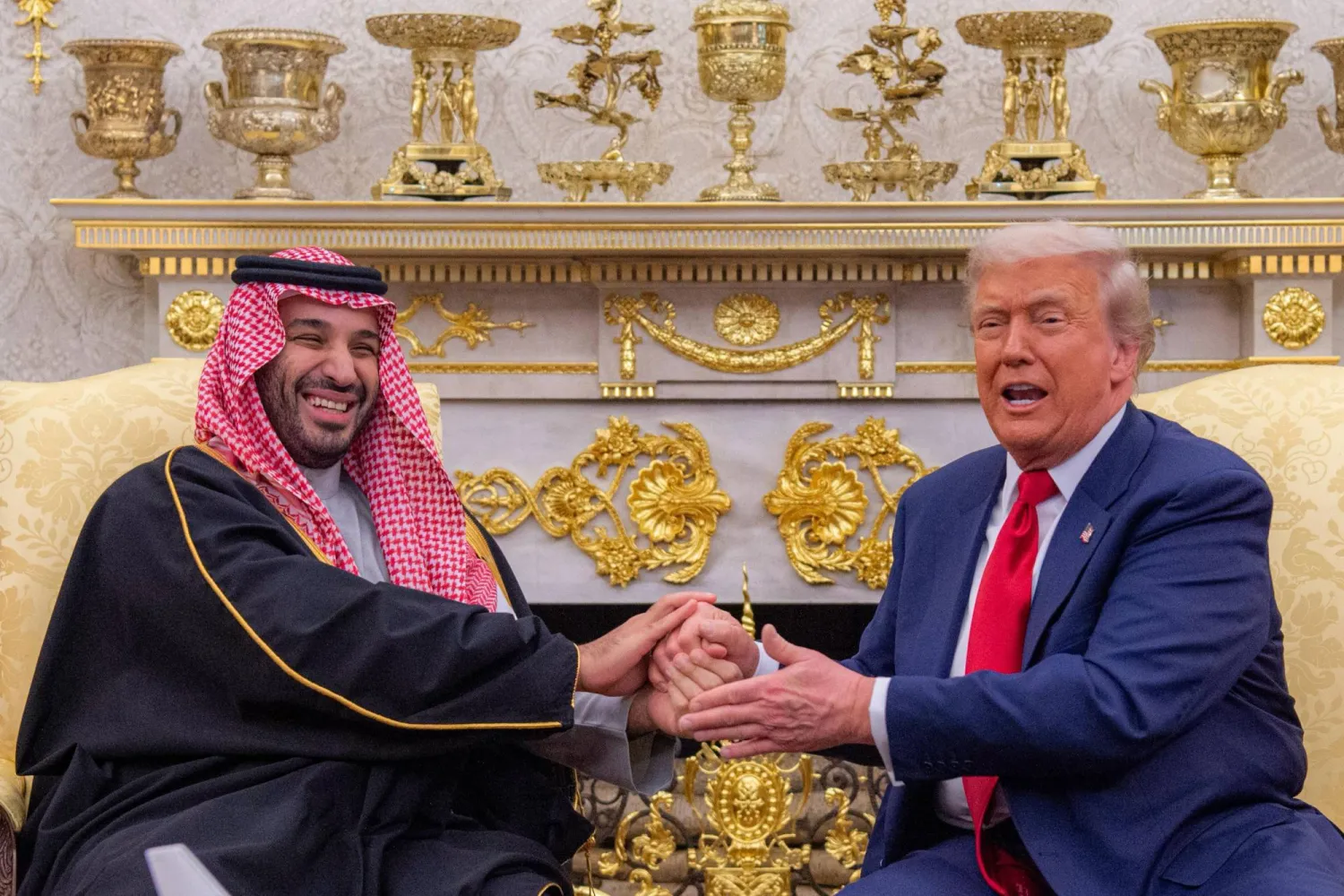
18 November 2025, US, Washington: Saudi Arabia's Crown Prince, Mohammed bin Salman, meets with US President Donald Trump at the White House in Washington. Photo: -/SPA/dpa
TT

Minerals on Agenda at Saudi-US Washington Talks

18 November 2025, US, Washington: Saudi Arabia's Crown Prince, Mohammed bin Salman, meets with US President Donald Trump at the White House in Washington. Photo: -/SPA/dpa

Saudi Arabia is cementing its position as a rising global power in the market for critical minerals, declaring the sector the “third pillar” of its national economy.

The strategy centers on converting an estimated 2.5 trillion dollars in mineral wealth into geopolitical and economic leverage, placing the Kingdom at the center of Washington’s attention and on the agenda of talks between Crown Prince Mohammed bin Salman, Prime Minister of Saudi Arabia, and US President Donald Trump.

In a sign of deepening cooperation, US Energy Secretary Chris Wright said in Riyadh earlier this year that the United States and Saudi Arabia were close to signing a preliminary agreement for cooperation in energy and civilian nuclear technology.

He said the partnership would focus on building a commercial nuclear energy industry in the Kingdom.

These issues top the agenda, with reports saying the Crown Prince and Trump are expected to sign a framework for nuclear cooperation during their White House meeting.

This comes as the discussion on traditional and future energy security intersects with the security of supply chains for critical minerals.

Saudi Energy Minister Prince Abdulaziz bin Salman has repeatedly said the Kingdom is pressing ahead with its national civilian nuclear program, including the construction of its first nuclear power plant.

He said the goal is to diversify the energy mix, support sustainable development and secure clean supplies while adhering to the highest safety standards, cooperating with the International Atomic Energy Agency and building national expertise.

The grand strategy: inside and outside the Kingdom

Saudi Arabia’s mining and minerals sector is emerging as one of the world’s most attractive, offering a unique competitive edge through low costs, abundant raw materials, a flexible incentive structure and access to competitive financing.

The sector plays a critical role in global economic development, from providing basic infrastructure to enabling green technologies such as electric vehicles and solar panels. In the Kingdom, domestic demand for metals exceeds local supply, highlighting significant opportunities for import substitution.

The economic transformation under way is also expected to sharply increase demand from resource-intensive manufacturing sectors, including industrial machinery, electrical equipment and automotive production.

Key sector targets:

• 75 billion dollars in expected contribution to GDP by 2035
• 1.3 trillion dollars in potential mineral resources, recently revised to 2.5 trillion dollars
• 48 minerals identified across the Kingdom
• Saudi Arabia is the world’s fourth-largest importer of metal products
• Imports targeted to fall to 11.5 billion dollars by 2035 from 19 billion dollars

The broad strategy

Saudi Arabia is pursuing two parallel tracks to anchor this transformation. The domestic track aims to position the Kingdom as a major regional mining hub through a new mining law, generous incentives and 75 billion dollars in new investments over the next decade.

This has attracted extensive partnerships with global firms such as the US companies Alcoa and Mosaic.

Alcoa has been a key partner of Saudi Arabian Mining Company (Maaden) in the aluminum sector, participating in the integrated aluminum project at Ras Al Khair Industrial City, one of the largest and most efficient complexes in the world. Mosaic, the world’s biggest producer of phosphate fertilizers and potash, partnered with Maaden to establish the Kingdom’s giant phosphate project through Maaden Waad Al Shamal Phosphate Company.

The external track is led by the Kingdom’s new investment arm, Manara Minerals, a joint venture launched in 2023 between the Public Investment Fund and Maaden.

Manara aims to acquire stakes in copper, nickel, lithium and rare earth assets worldwide to secure long-term supplies for domestic industries, including electric vehicles and defense.

It has already made major moves, including a 10 percent, 2.5-billion-dollar stake in Brazil’s Vale Base Metals, and has entered advanced negotiations to acquire stakes in copper assets in Zambia and Pakistan’s Reko Diq project.

Analysts say Manara’s international investments provide geographic diversification that reduces the risk of supply disruptions caused by political instability or sanctions.

Saudi Energy Minister Prince Abdulaziz bin Salman and Wright exchange documents related to their strategic cooperation memorandum.

The strategic partnership

Securing supply chains for critical minerals has become a strategic meeting point with the United States. The relationship evolved into a structured partnership in 2025 through a series of high-level meetings.

In April 2025, Secretary Wright visited Riyadh and met Prince Abdulaziz bin Salman for broad strategic talks that laid the groundwork for cooperation in energy and infrastructure.

This was followed by the signing of a strategic cooperation memorandum between the Saudi ministries of energy and industry and minerals in May 2025.

Saudi Industry and Mineral Resources Minister Bandar Alkhorayef then traveled to Washington in August for talks with Wright on strengthening mining cooperation.

In October, Alkhorayef met US Deputy Energy Secretary James Danly in Riyadh, where the two sides reaffirmed plans to deepen collaboration in supply chains, processing and advanced technologies. The US delegation was invited to the Future Minerals Forum 2026.

US Interior Secretary Doug Burgum also met Saudi energy and business leaders in Riyadh earlier this month, writing on X that the goal was to ensure America’s independence in minerals.

The summit between the Crown Prince and the US president underscores the Kingdom’s shift from a traditional oil producer to an investment and geopolitical heavyweight with the ability to secure global strategic resources.

Cooperation on critical minerals, alongside progress in civilian nuclear energy, is expected to strengthen the long-term strategic partnership between Riyadh and Washington.



Saudi Industry Minister, Syrian Counterpart Visit Made in Saudi Expo 

Saudi Minister of Industry and Mineral Resources Bandar Alkhorayef and Syrian Minister of Economy and Industry Mohammad Nidal al-Shaar at the Ministry of Interior’s pavilion at the Made in Saudi Expo 2025 in Riyadh. (SPA)
TT

Saudi Industry Minister, Syrian Counterpart Visit Made in Saudi Expo 

Saudi Minister of Industry and Mineral Resources Bandar Alkhorayef and Syrian Minister of Economy and Industry Mohammad Nidal al-Shaar at the Ministry of Interior’s pavilion at the Made in Saudi Expo 2025 in Riyadh. (SPA)

Saudi Minister of Industry and Mineral Resources Bandar Alkhorayef and Syrian Minister of Economy and Industry Mohammad Nidal al-Shaar visited the Ministry of Interior’s pavilion at the third annual Made in Saudi Expo 2025 in Riyadh, reported the Saudi Press Agency on Tuesday.

The event is being held from December 15-17.

The ministers reviewed efforts to localize spending on military and technological systems and promote national products and solutions in security and service sectors, including the Saudi armored vehicle “Al-Dahna,” the ministry’s e-platform “Absher,” and the “ASEF II” drone for environmental security and sustainability.

They also explored electronic services for citizens, residents, and visitors, as well as key developmental projects within the ministry and its security sectors.


Abu Dhabi Ports Signs MoU to Develop, Operate Shuaiba Container Terminal in Kuwait

Containers are seen at Abu Dhabi's Khalifa Port, UAE, December 11, 2019. REUTERS/Satish Kumar
TT

Abu Dhabi Ports Signs MoU to Develop, Operate Shuaiba Container Terminal in Kuwait

Containers are seen at Abu Dhabi's Khalifa Port, UAE, December 11, 2019. REUTERS/Satish Kumar

Kuwait Ports Authority (KPA) said on Monday it had signed a memorandum of understanding with Abu Dhabi Ports Group to develop and operate the container terminal at Kuwait’s Shuaiba port under a concession agreement.

Shuaiba port, established in the 1960s, is Kuwait’s oldest port. It covers a total area of 2.2 million square metres (543.63 acres) and has 20 berths, while the container terminal has a storage area of 318,000 sqare metres, according to KPA’s website.

The port, located about 60 km (37.3 miles) south of the capital, handles commercial cargo, heavy equipment, raw materials and chemicals essential to various industries.

The MoU represents “the first preliminary step” toward concluding a concession contract, subject to the completion of required studies, KPA said in a statement without disclosing the value of the deal, Reuters reported.

Under the agreement, Abu Dhabi Ports Group will prepare the technical, environmental and financial studies needed for the project, including infrastructure requirements.


Iran’s Rial Currency Plummets to New Low, Sparking Fears of Higher Food Prices

An Iranian trader counts money in Tehran's Grand Bazaar. (Reuters)
TT

Iran’s Rial Currency Plummets to New Low, Sparking Fears of Higher Food Prices

An Iranian trader counts money in Tehran's Grand Bazaar. (Reuters)

Iran’s rial slid further Monday to a new record low of more than 1.3 million to the US dollar, deepening the currency’s collapse less than two weeks after it first breached the 1.2-million mark amid sanctions pressure and regional tensions.

Currency traders in Tehran quoted the dollar above 1.3 million rials, underscoring the speed of the decline since Dec. 3, when the rial hit what was then a historic low.

The rapid depreciation is compounding inflationary pressures, pushing up prices for food and other daily necessities and further straining household budgets, a trend that could be intensified by a gasoline price change introduced in recent days.

Iran on Saturday added a third gasoline price tier, raising the cost of full bought beyond monthly quotes at 50,000 rials (4 US cents). It is the first major adjustment to fuel pricing since a price hike in 2019 that sparked nationwide protests and a crackdown that reportedly killed over 300 people.

Under the revised system, motorists continue to receive 60 liters a month at the subsidized rate of 15,000 rials per liter and another 100 liters at 30,000 rials, but any additional purchases now cost more than three times the original subsidized price. While gasoline in Iran remains among the cheapest in the world, economists warn the change could feed inflation at a time when the rapidly weakening rial is already pushing up the cost of food and other basic goods.

The fall comes as efforts to revive negotiations between Washington and Tehran over Iran’s nuclear program appear stalled, while uncertainty persists over the risk of renewed conflict following June’s 12-day war involving Iran and Israel. Many Iranians also fear the possibility of a broader confrontation that could draw in the United States, adding to market anxiety.

Iran’s economy has been battered for years by international sanctions, particularly after Donald Trump unilaterally withdrew the United States from Tehran’s nuclear deal with world powers in 2018. At the time the 2015 accord was implemented — which sharply curtailed Iran’s uranium enrichment and stockpiles in exchange for sanctions relief — the rial traded at about 32,000 to the dollar.

After Trump returned to the White House for a second term in January, his administration revived a “maximum pressure” campaign, expanding sanctions that target Iran’s financial sector and energy exports. Washington has again pursued firms involved in trading Iranian crude oil, including discounted sales to buyers in China, according to US statements.

Further pressure followed in late September, when the United Nations reimposed nuclear-related sanctions on Iran through what diplomats described as the “snapback” mechanism. Those measures once again froze Iranian assets abroad, halted arms transactions with Tehran and imposed penalties tied to Iran’s ballistic missile program.

Economists warn that the rial’s accelerating decline risks feeding a vicious cycle of higher prices and reduced purchasing power, particularly for staples such as meat and rice that are central to Iranian diets. For many Iranians, the latest record low reinforces concerns that relief remains distant as diplomacy falters and sanctions tighten.