

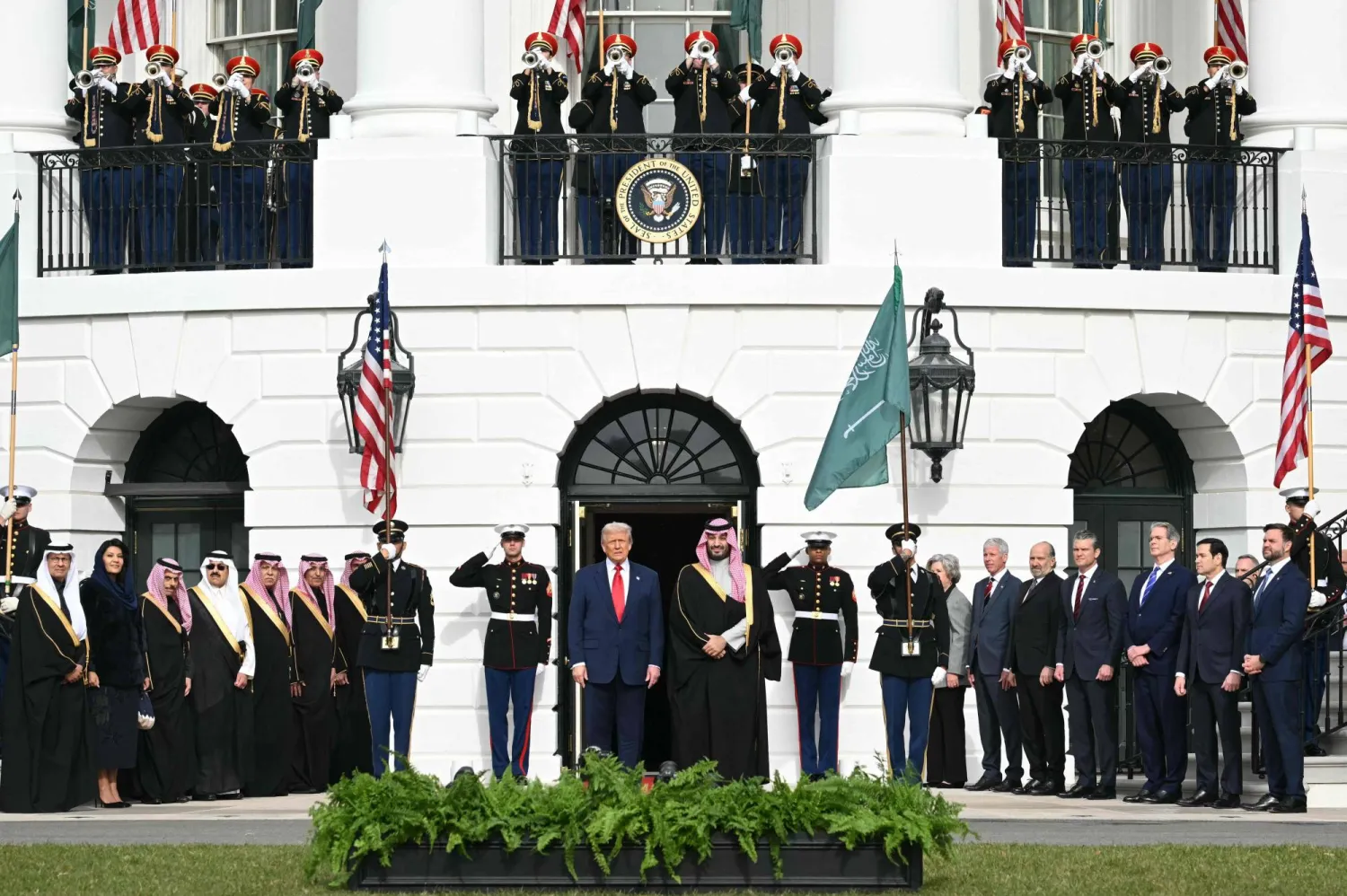

Crown Prince’s Visit Resets the Rules, Opening New Chapter in Saudi-US Alliance

US President Donald Trump greets Crown Prince and Prime Minister of the Kingdom of Saudi Arabia Mohammed bin Salman on the South Lawn at the White House in Washington, DC on November 18, 2025. (Photo by SAUL LOEB / AFP)
TT

Crown Prince’s Visit Resets the Rules, Opening New Chapter in Saudi-US Alliance

US President Donald Trump greets Crown Prince and Prime Minister of the Kingdom of Saudi Arabia Mohammed bin Salman on the South Lawn at the White House in Washington, DC on November 18, 2025. (Photo by SAUL LOEB / AFP)

After a visit marked by unusual political momentum and results described in Washington and Riyadh as exceptional, officials in both countries have returned to their offices to finalize and translate dozens of strategic agreements across multiple fields.

Analysts who spoke to Asharq Al-Awsat said the outcomes of the visit were not read as a routine upgrade in cooperation.

They see the results as signaling a deeper shift in Saudi Arabia’s place in the regional and international landscape, positioning it as an independent actor able to set its own tempo in a fast-changing environment.

Dr. Hesham Alghannam, a scholar at the Malcolm H. Kerr Carnegie Middle East Center, said what is happening in Washington is “not just protocol and not a resumption of an old track, but a moment that is reshaping the weight of actors within the regional security system.”

Alghannam told Asharq Al-Awsat that the level of reception accorded to the Crown Prince, coupled with the move to proceed with the sale of F-35 fighter jets to the Kingdom and the opening of a path toward a possible peaceful nuclear agreement, alongside a wide package of defense, economic and technological deals, shows that Riyadh’s position is now managed as an active component in shaping the equation of power and mutual dependence, not as a side actor following the tempo set by others.

The visit also saw President Donald Trump formally designate Saudi Arabia a “major non-NATO ally” and approve the sale of the F-35, the world’s most advanced fighter jet, marking a first for an Arab military.

The two sides also signed the Strategic Defense Agreement, the Strategic Artificial Intelligence Partnership, a joint declaration on completing negotiations over cooperation in civilian nuclear energy, and a strategic framework for securing supply chains of uranium, minerals, permanent magnets and critical metals.

Alghannam, who also oversees the National Security Program at Naif Arab University for Security Sciences, believes that from a Saudi security perspective, these developments reflect “a gradual shift from a role of depth to a role of shaping the scene.”

He added that the Kingdom enters this phase combining three rare elements in a turbulent region: significant financial and investment capacity, a central position in energy and critical minerals markets, and a growing base in technology and artificial intelligence.

The “US-Saudi Investment Forum” concluded with agreements and memorandums of understanding worth nearly 270 billion dollars.

Dr. Khaled M. Batarfi, an academic and political analyst, said the visit carried a level of political symbolism that went beyond deals, and could be read as an announcement of a redistribution of roles within the traditional alliance structure.

He said that if the sale of the F-35 is completed with its technical and operational conditions, it would mean Washington now views Saudi Arabia as an actor capable of shouldering broader regional security responsibilities rather than merely relying on the American security umbrella.

That, he said, positions Riyadh as an independent player able to set its own pace, whether in building regional deterrence balances or designing new security architectures in cooperation with international partners.

Bernard Haykel, professor of Near Eastern Studies and director of the Institute for the Transregional Study of the Contemporary Middle East, North Africa and Central Asia at Princeton University, said in an earlier interview with Asharq Al-Awsat that the agreements show Saudi Arabia and the United States are “strategic allies,” giving a more formal character to this type of partnership.

Saudi Arabia has maintained close ties with the United States for nearly nine decades, during which cooperation has deepened across various sectors.

Dr. Saleh Al-Khathlan, a senior adviser at the Gulf Research Center, offered a different reading.

He said the most significant outcome of the visit was the “decoupling” of the bilateral relationship from the normalization file, as he described it.

Al-Khathlan believes Saudi Arabia’s role has always been present and that the visit did not place the Kingdom in a new position.

“Saudi Arabia has always been an influential actor, making decisions based on its interests and managing its international relations with full independence,” he said.

But he noted that Riyadh is now contributing “more clearly and more substantially” to shaping the regional scene, due to its clear vision of what that landscape should look like.

Saudi political analyst Faisal Al-Shammeri said the Kingdom has consolidated its place as a central player in the balance between East and West, using its balanced relationships to secure strategic gains without aligning itself fully with any axis. He said Saudi Arabia has become an active player in political and economic balances.

The Middle East remains one of the world’s most volatile regions, with an ongoing Arab-Israeli conflict, tensions with Iran, instability in the Red Sea, and hotspots in Syria, Lebanon, Sudan and Yemen.

Alghannam said the real weight of the understandings reached will be measured by their ability to turn into binding commitments and by Riyadh’s success in leveraging this momentum to build a security-and-development model capable of managing and resolving crises rather than coexisting with them.

Batarfi also stressed that the visit is not a ceremonial event but a signal marking the start of a new chapter in which Saudi Arabia redraws the rules of the regional game from the position of an active actor rather than a recipient.



Saudi Arabia 'Disappointed in UAE for Pressuring STC' in Yemen, Says Kingdom's Security a 'Red Line'

A general view of Riyadh, Saudi Arabia. (SPA)
TT

Saudi Arabia 'Disappointed in UAE for Pressuring STC' in Yemen, Says Kingdom's Security a 'Red Line'

A general view of Riyadh, Saudi Arabia. (SPA)

Saudi Arabia expressed on Tuesday its disappointment in the United Arab Emirates for pressuring the Southern Transitional Council to carry out military operations on the Kingdom's southern borders in Yemen's Hadhramaut and Al-Mahra governorates, which it deemed a threat to its national security and the security and stability of Yemen and the region.

A Saudi Foreign Ministry statement said: "The steps taken by the UAE are considered highly dangerous, inconsistent with the principles upon which the Coalition to Restore Legitimacy in Yemen was established, and do not serve the coalition's purpose of achieving security and stability for Yemen."

"The Kingdom stresses that any threat to its national security is a red line, and the Kingdom will not hesitate to take all necessary steps and measures to confront and neutralize any such threat," it declared.

It underscored "its commitment to the security, stability, and sovereignty of Yemen, and affirms its full support to the President of the Presidential Leadership Council and the Yemeni government."

"The Kingdom reaffirms that the Southern cause is a just cause that has historical and social dimensions, and that the only path to resolve it is through dialogue within a comprehensive political solution in Yemen, and among all Yemeni parties including the Southern Transitional Council."

"The Kingdom stresses the importance that the brotherly UAE accept Yemen's request for all its forces to leave Yemen within 24 hours, and halt any military or financial support to any party within Yemen."

"With this regard, the Kingdom hopes that wisdom, the principles of brotherhood, good neighborliness, strong ties among countries of the Gulf Cooperation Council, and the interest of brotherly Yemen, will prevail," it said.

"The Kingdom also hopes that the brotherly UAE will take the necessary steps to preserve bilateral relations between the two brotherly countries, which the Kingdom is keen on strengthening, and continue joint efforts towards all that leads to the wellbeing, prosperity and stability of countries in the region."


Arab Coalition Carries out 'Limited' Airstrike on Military Shipment at Yemen's Mukalla Port

A screengrab shows of the airstrike on Al-Mukalla port. (Arab coalition)
TT

Arab Coalition Carries out 'Limited' Airstrike on Military Shipment at Yemen's Mukalla Port

A screengrab shows of the airstrike on Al-Mukalla port. (Arab coalition)

The Joint Forces Command of the Arab coalition to support legitimacy in Yemen announced that it had carried out a "limited" airstrike targeting a military shipment that had arrived in Yemen's Al-Mukalla port.

In a statement, coalition spokesman Major General Turki al-Malki said the forces detected on Saturday and Sunday the arrival of two vessels from the Port of Fujairah to Mukalla without obtaining any permits from the Joint Forces Command.

"The crew had disabled the tracking devices aboard the vessels, and unloaded a large amount of weapons and combat vehicles in support of the Southern Transitional Council’s forces in Hadhramaut and Al-Mahra governorates in eastern Yemen," it added.

It described the actions as "flagrant violations" of peace efforts and United Nations Security Council resolution 2216.

In response to a request of the president of the Presidential Leadership Council in Yemen that the coalition "take all necessary military measures to safeguard civilians in Hadhramaut and Mahra and considering that the aforementioned weapons are an imminent threat, and an escalation that threatens peace and stability," the Coalition Air Force conducted on Tuesday a limited airstrike targeting the weapons and military vehicles offloaded in Mukalla.

"The airstrike took place following close surveillance and documentation of the cargo, and was conducted in accordance with the Customary International Humanitarian Law, and in a manner that guarantees no collateral damage."

"The Joint Forces Command of the Coalition will continue its de-escalation and pacification in Hadhramaut and Mahra, and will maintain its blocking of any and all military support from whichever country that does so without coordinating with the legitimate Yemeni Government and the coalition, in order to ensure the success of Saudi Arabia and coalition’s efforts to achieve security and stability, and prevent further expansion of the conflict."


Crown Prince of Kuwait Meets with GCC Secretary-General

Secretary General of the Gulf Cooperation Council Jasem Mohamed Albudaiwi. GCC
TT

Crown Prince of Kuwait Meets with GCC Secretary-General

Secretary General of the Gulf Cooperation Council Jasem Mohamed Albudaiwi. GCC

Kuwaiti Crown Prince Sheikh Sabah Khaled Al-Hamad Al-Sabah met with Secretary-General of the Gulf Cooperation Council (GCC) Jasem Albudaiwi on Monday at the Bayan Palace in Kuwait.

Albudaiwi presented a comprehensive report to Sheikh Sabah regarding Kuwait’s presidency of the 45th session of the GCC Supreme Council, and expressed his appreciation for the generous support and steadfast commitment Kuwait provides to the GCC's journey, SPA reported.

He underscored that such support serves as a powerful catalyst for continued efforts toward achieving greater integration and cooperation, ultimately fostering prosperity and well-being for the GCC member states and their peoples.