


Death Toll Climbs in Southeast Asia as Heavy Rains Cause Floods, Landslides

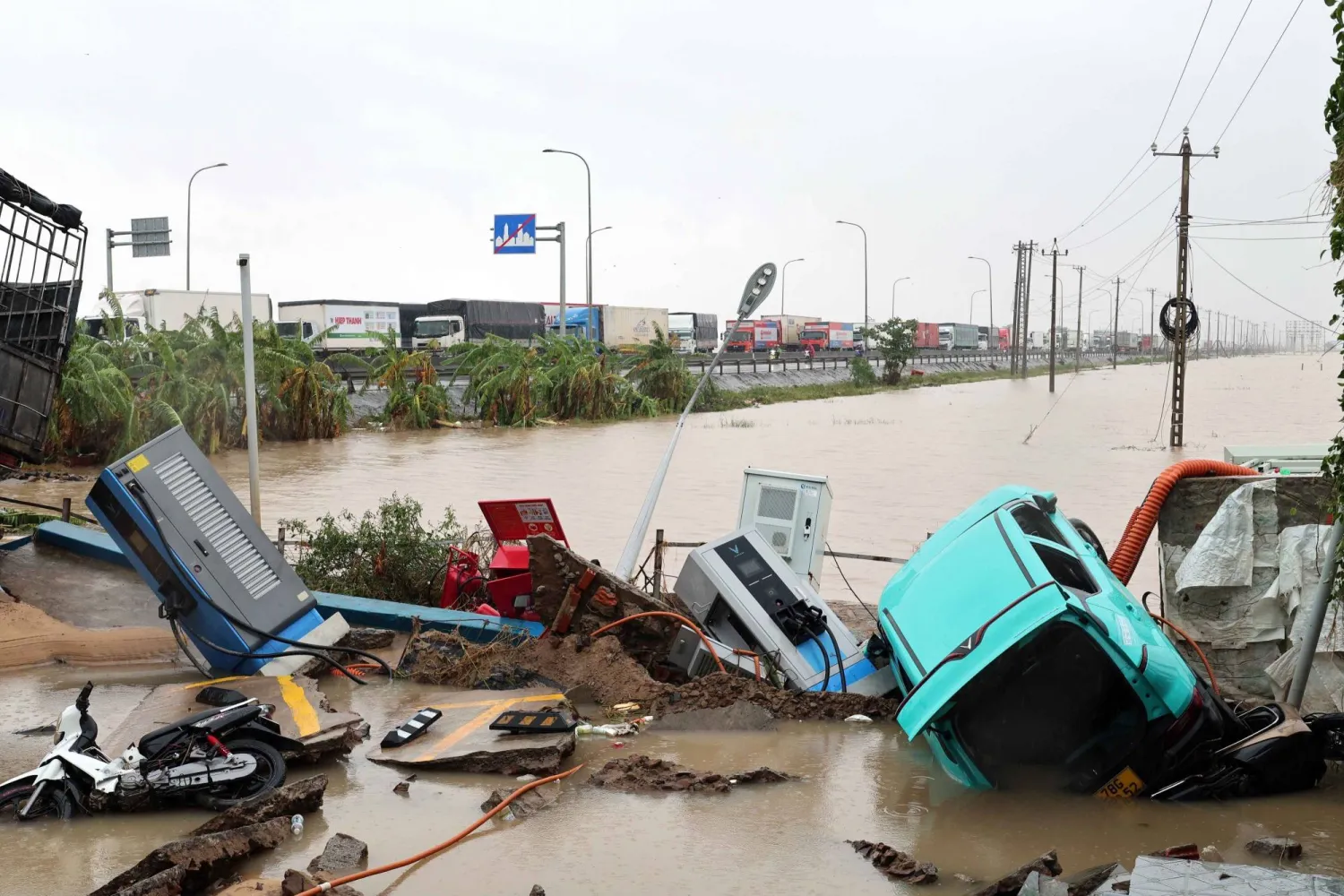
Vehicles are damaged due to floods at a charging station in Dak Lak, Vietnam Saturday, Nov. 22, 2025. (Do Van Truong/VNA via AP)
TT

Death Toll Climbs in Southeast Asia as Heavy Rains Cause Floods, Landslides

Vehicles are damaged due to floods at a charging station in Dak Lak, Vietnam Saturday, Nov. 22, 2025. (Do Van Truong/VNA via AP)

The death toll in widespread flooding and landslides caused by heavy rains in Southeast Asia mounted on Monday with another person reported killed in Vietnam, and five others in Thailand with tens of thousands of people displaced.

The total number of confirmed dead in Vietnam is now 91, with 11 others missing as the heavy rain that began a week ago has caused severe flooding and triggered landslides from Quang Tri to Lam Dong provinces, a stretch of 800 kilometers (500 miles) along the country’s central region, including the highlands.

In Dak Lak, the worst hit province, 63 people were killed, mostly due to drowning. Other fatalities were from Khanh Hoa, Lam Dong, Gia Lai, Danang, Hue and Quang Tri provinces.

With roads washed out in many areas, helicopters have been deployed to drop food and aid supplies and to assist in evacuating people.

After a break in the rain on the weekend, Pham Thu Huyen was one of many hundreds of residents and visitors who helped clean up debris washed ashore in Nha Trang, a popular tourist destination in Khanh Hoa province, known for its white sand beaches.

“We've never experienced that much rain and such bad flooding,” The Associated Press quoted the 45-year-old said.

Waters have also taken their toll on this year's crops, submerging coffee farms in Dak Lak, Vietnam’s major coffee growing region.

Overall, damage so far is estimated to be around $500 million in this round of floods.

Some of the waters have now receded but Vietnam's weather agency warned that with rains continuing in some places the risks remain, and said a new tropical depression was forming that could bring worse weather again later in the week.

Vietnam is among the world’s most flood-prone countries, with nearly half its population living in high-risk areas. Scientists warn that a warming climate is intensifying storms and rainfall across Southeast Asia, making floods and landslides increasingly destructive and frequent.

The current destruction has hit a region already battered earlier this month by floods from record rainfall and the powerful typhoon Kalmaegi.

The country was also hit by typhoons in September and October, and the International Organization for Migration announced Monday that South Korea would contribute $1 million to help Vietnam assist displaced people, communities and migrants affected by those.

The United Nations agency said that according to preliminary data, Vietnam estimates economic damage of some $1.2 billion from that period, with more than a half million homes damaged and hundreds of thousands of people evacuated and dozens killed.

In Thailand, torrential rain in the south of the country caused severe flash flooding over the weekend, affecting nearly 2 million people, officials said. Five were killed and four were injured across six southern provinces, according to regional health officials.

Ten southern provinces have been hit with heavy rainfall over the last week, and officials warned Monday that water levels are expected to rise further with the rain expected to continue through Tuesday.

The city of Hat Yai, a major economic hub in Songkhla province, was hit with 335 millimeters (more than 13 inches) of rain on Friday, the highest 24-hour figure in 300 years, officials said.

From Wednesday through Friday, the city saw 630 millimeters (nearly 25 inches) of rain, complicating evacuation efforts as hundreds of residents and tourists were trapped inside homes and hotels by rising water that forced emergency crews to use lifeboats to transport people along flooded streets.

Thailand was already hit with widespread flooding in the north earlier in the year, followed by months of flooding in the central region, which killed more than two dozen people. That flooding also caused widespread damage to farmers fields and crops, and many thousands of homes.

Malaysia is also grappling with flooding across several states that is expected to worsen as heavy, persistent rainfall continues.

The Social Welfare Department reported Monday that more than 12,500 people across nine states have been evacuated.

The worst-hit area is the northeastern state of Kelantan, which accounts for the majority of those displaced. Authorities have opened 86 temporary shelters and have warned that further rainfall is expected.

Floods are common in parts of Malaysia during the annual monsoon season, which begins in November and can last until March.



Turkish, Greek Leaders Voice Desire to Resolve Issues After Talks

In this photo released by the Turkish Presidency, Türkiye’s President Recep Tayyip Erdogan, right, and Greece's Prime Minister Kyriakos Mitsotakis, shake hands during their meeting in Ankara, Türkiye, Wednesday, Feb. 11, 2026. (Turkish Presidency via AP)
TT

Turkish, Greek Leaders Voice Desire to Resolve Issues After Talks

In this photo released by the Turkish Presidency, Türkiye’s President Recep Tayyip Erdogan, right, and Greece's Prime Minister Kyriakos Mitsotakis, shake hands during their meeting in Ankara, Türkiye, Wednesday, Feb. 11, 2026. (Turkish Presidency via AP)

The leaders of Türkiye and Greece voiced their desire to resolve longstanding maritime disputes hobbling ties during discussions in Ankara on Wednesday, as the NATO allies and historic rivals try to build on warming relations.

The neighbors have been at odds over a range of issues for decades, primarily maritime boundaries and rights in the Aegean, an area widely believed to hold energy resources and with key implications for airspace and military activity.

Following years of heightened tensions, a 2023 declaration on friendly relations prompted a thaw in rhetoric, though their maritime issues have remained unresolved and the two sides still disagree over ‌regional matters.

Speaking at ‌a press conference in Ankara with Greek Prime Minister Kyriakos Mitsotakis, ‌Turkish ⁠President Recep Tayyip Erdogan said ⁠they had discussed their issues in the Aegean and eastern Mediterranean "in an open and sincere way" during the talks.

"While the issues may be thorny, they are not unsolvable on the basis of international law. I saw that we were in agreement with my friend Kyriakos," Erdogan said.

He added that the two countries would continue working to achieve their goal of reaching $10 billion in bilateral trade.

Mitsotakis said he hoped circumstances would allow the sides to solve a dispute on ⁠the demarcation of maritime and exclusive economic zones in the Aegean ‌and eastern Mediterranean.

'IF NOT NOW, WHEN?'

"It is time to ‌remove any substantial and formal threats to our relations, if not now, when?" Mitsotakis said.

"Destiny has ‌appointed us to live in the same neighborhood. We cannot change geography, but we can ‌make it an ally, choosing convergence, dialogue and trust in international law... to build a future of peace, progress and prosperity for our people."

Despite the positive tone, Greece's foreign minister earlier said Athens planned to extend its territorial waters further, including potentially in the Aegean.

Shortly after, Ankara said it had issued ‌a maritime notice urging Greece to coordinate research activities in areas of the Aegean that Türkiye considers part of its continental shelf.

In ⁠1995, Türkiye’s parliament ⁠declared a casus belli — a cause for war — should Greece unilaterally extend its territorial waters beyond six nautical miles in the Aegean, a stance Athens says violates international maritime law. Greece says it wants only to discuss demarcation of maritime zones.

Mitsotakis also said the flows of migrants in the Aegean Sea had decreased by almost 60% last year due to cooperation between the two countries, adding this should be strengthened.

Fifteen migrants died in a shipwreck off the Greek island of Chios last week after their boat collided with a Greek coastguard vessel and sank in the Aegean Sea off the Turkish coast.

Türkiye is a transit country for migrants seeking to reach the European Union via Greece. Ankara says the EU has not fully delivered on commitments under a 2016 migration deal and Athens wants Türkiye to do more to curb irregular crossings.


US Energy Secretary in Venezuela for Oil Talks

Handout picture released by the US Embassy in Venezuela showing US Secretary of Energy Chris Wright (2-R) walking next to the new head of the United States diplomatic mission for Venezuela, Laura Dogu (2-L), upon his arrival at Maiquetia International Airport in Maiquetia, La Guaira state, Venezuela, on February 11, 2026. (Handout / US Embassy in Venezuela / AFP)
TT

US Energy Secretary in Venezuela for Oil Talks

Handout picture released by the US Embassy in Venezuela showing US Secretary of Energy Chris Wright (2-R) walking next to the new head of the United States diplomatic mission for Venezuela, Laura Dogu (2-L), upon his arrival at Maiquetia International Airport in Maiquetia, La Guaira state, Venezuela, on February 11, 2026. (Handout / US Embassy in Venezuela / AFP)

US Energy Secretary Chris Wright arrived in Venezuela on Wednesday for talks with acting president Delcy Rodriguez and oil industry executives on harnessing the country's vast crude reserves.

Wright is the highest-ranking official in the administration of US President Donald Trump to travel to Venezuela since US special forces seized and overthrew longtime socialist leader Nicolas Maduro on January 3.

Trump has backed Maduro's former deputy Rodriguez to succeed the ousted leader, on condition that she abide by US demands, including granting the United States access to Venezuelan oil and ease state repression.

Welcoming Wright to Venezuela on X, the US embassy in the country said: "Your visit is key to advancing @POTUS's (Trump's) vision of a prosperous Venezuela."

It added that "the US private sector will be essential to boost the oil sector, modernize the electric grid, and unlock Venezuela's enormous potential."

A photo posted by the embassy showed Wright on the tarmac at Maiquetia International Airport, which serves the capital Caracas, together with the new US charge d'affaires in Venezuela, Laura Dogu.

Venezuela sits on about a fifth of the world's oil reserves and was once a major crude supplier to the United States.

But it produced only around one percent of the world's total crude output in 2024, according to OPEC, due to years of under-investment, mismanagement and US sanctions.

Washington eased sanctions on Venezuelan oil last month after Rodriguez's administration passed a law throwing open the sector to private investment.

Trump wants US oil majors to rapidly rebuild the sector and boost output by millions of barrels a day.


Trump Meets Netanyahu, with US-Iran Nuclear Diplomacy Topping Agenda

 President Donald Trump shakes hands with Israel's Prime Minister Benjamin Netanyahu at the end of a news conference at Mar-a-Lago, Dec. 29, 2025, in Palm Beach, Fla. (AP)
President Donald Trump shakes hands with Israel's Prime Minister Benjamin Netanyahu at the end of a news conference at Mar-a-Lago, Dec. 29, 2025, in Palm Beach, Fla. (AP)
TT

Trump Meets Netanyahu, with US-Iran Nuclear Diplomacy Topping Agenda

 President Donald Trump shakes hands with Israel's Prime Minister Benjamin Netanyahu at the end of a news conference at Mar-a-Lago, Dec. 29, 2025, in Palm Beach, Fla. (AP)
President Donald Trump shakes hands with Israel's Prime Minister Benjamin Netanyahu at the end of a news conference at Mar-a-Lago, Dec. 29, 2025, in Palm Beach, Fla. (AP)

President Donald Trump hosted Benjamin Netanyahu at the White House on Wednesday, with the Israeli prime minister expected to press him to widen US talks with Iran to include limits on Tehran's missile arsenal and other security threats beyond its nuclear program.

In his seventh meeting with Trump since the president returned to office nearly 13 months ago, Netanyahu was looking to influence the next round of US discussions with Iran following nuclear negotiations held in Oman last Friday.

Trump has threatened strikes on Iran if no agreement is reached, while Tehran has vowed to retaliate, stoking fears of a wider war. He has repeatedly voiced support for a secure Israel, a longstanding US ally and arch-foe of Iran.

In media interviews on Tuesday, Trump reiterated his warning, saying that while he believes Iran wants a deal, he would do "something very tough" if it refused.

TRUMP SAYS NO TO IRANIAN NUCLEAR WEAPONS, MISSILES

Trump told Fox Business that a good deal with Iran would mean "no nuclear weapons, no missiles," without elaborating. He also told Axios he was considering sending a second aircraft carrier ‌strike group as part ‌of a major US buildup near Iran.

Israel fears that the US might pursue a narrow ‌nuclear deal ⁠that does not ⁠include restrictions on Iran's ballistic missile program or an end to Iranian support for armed proxies such as Hamas and Hezbollah, according to people familiar with the matter. Israeli officials have urged the US not to trust Iran's promises.

"I will present to the president our perceptions of the principles in the negotiations," Netanyahu told reporters before departing for the US. The two leaders could also discuss potential military action if diplomacy with Iran fails, one source said.

Iran has said it is prepared to discuss curbs on its nuclear program in exchange for lifting sanctions but has ruled out linking the issue to missiles.

Iran’s "missile capabilities are non-negotiable," Ali Shamkhani, an adviser to Iran's supreme leader, said on Wednesday.

Netanyahu's arrival at the White House was lower-key than usual. He entered the building away ⁠from the view of reporters and cameras, and a White House official then confirmed he was inside ‌meeting with Trump.

GAZA ON THE AGENDA

Also on the agenda was Gaza, with Trump looking to ‌push ahead with a ceasefire agreement he helped to broker. Progress on his 20-point plan to end the war and rebuild the shattered Palestinian enclave has stalled, ‌with major gaps over steps such as Hamas disarming as Israeli troops withdraw in phases.

Netanyahu's visit, originally scheduled for February 18, was brought forward ‌amid renewed US engagement with Iran. Both sides at last week's Oman meeting said the talks were positive and further talks were expected soon.

US Secretary of State Marco Rubio said ahead of the Oman meeting that negotiations would need to address Iran's missiles, its proxy groups, and its treatment of its own population. Iran said Friday’s talks focused only on nuclear issues.

Trump has been vague about broadening the negotiations. He was quoted as telling Axios on Tuesday that it was a "no-brainer" ‌for any deal to cover Iran's nuclear program, but that he also thought it possible to address its missile stockpiles.

Iran says its nuclear activities are for peaceful purposes, while the US and Israel have ⁠accused it of past efforts to develop ⁠nuclear weapons.

Last June, the US joined Israel's strikes on Iranian nuclear facilities during a 12-day war.

Israel also heavily damaged Iran's air defenses and missile arsenal. Two Israeli officials say there are signs Iran is working to restore those capabilities.

Trump threatened last month to intervene militarily during a bloody crackdown on anti-government protests in Iran, but ultimately held off.

ISRAEL WARY OF A WEAKENED IRAN REBUILDING

Tehran's regional influence has been weakened by Israel’s June attack, losses suffered by its proxies in Gaza, Lebanon, Yemen and Iraq, and the ousting of its ally, former Syrian President Bashar al-Assad.

But Israel is wary of its adversaries rebuilding after the multi-front war triggered by Hamas' October 2023 assault on southern Israel.

While Trump and Netanyahu have mostly been in sync and the US remains Israel's main arms supplier, Wednesday’s meeting could expose tensions.

Part of Trump's Gaza plan holds out the prospect for eventual Palestinian statehood - which Netanyahu and his coalition, the most far-right in Israel's history, have long resisted.

Netanyahu's security cabinet on Sunday authorized steps that would make it easier for Israeli settlers in the occupied West Bank to buy land while granting Israel broader powers in what the Palestinians see as the heartland of a future state. The decision drew international condemnation.

"I am against annexation," Trump told Axios, reiterating his stance. "We have enough things to think about now."