

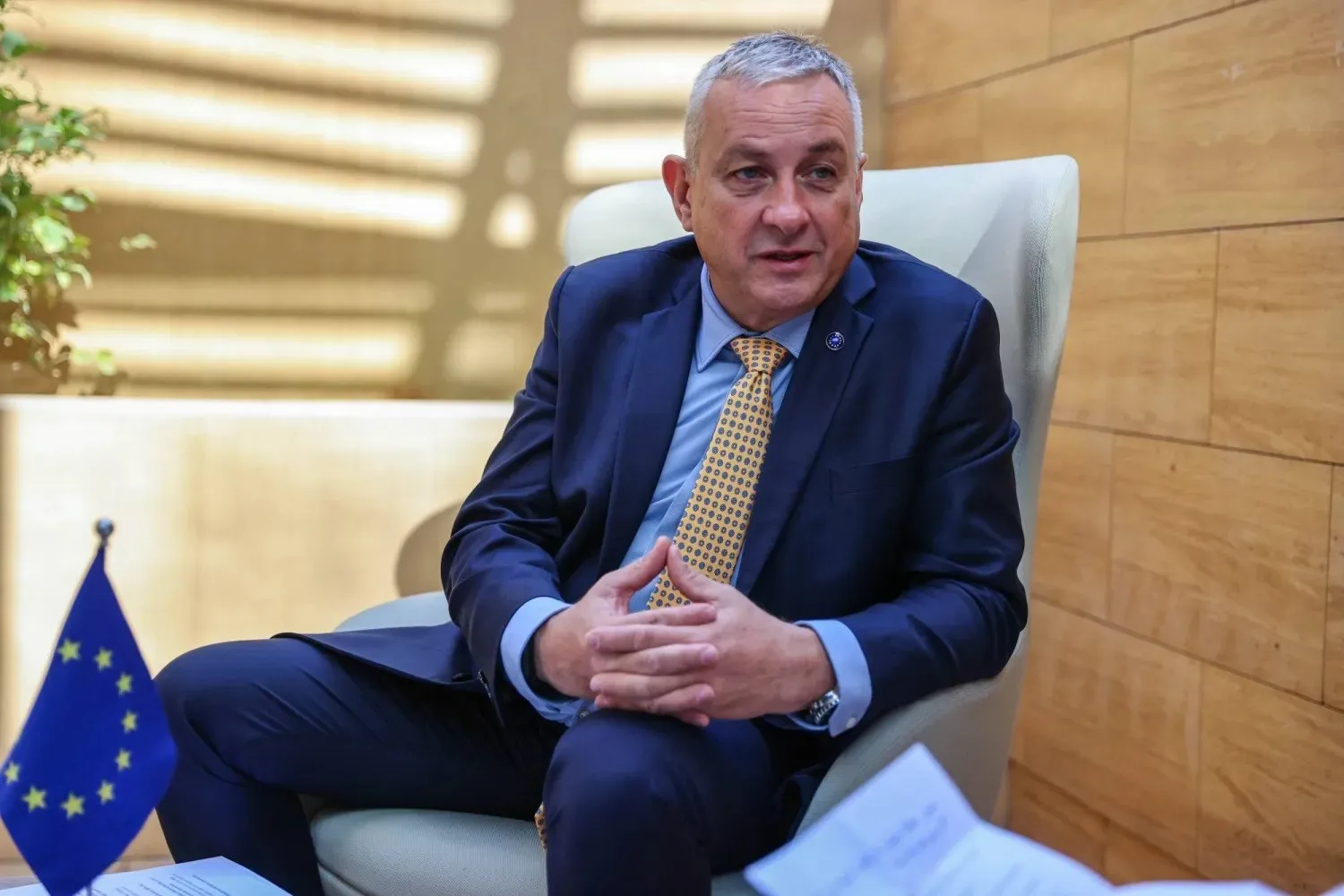

EU Official: Partnership with Saudi Arabia Has No Limits

The EU Commissioner for International Partnerships speaks to Asharq Al-Awsat (Photo: Saad Al-Enezi)
TT

EU Official: Partnership with Saudi Arabia Has No Limits

The EU Commissioner for International Partnerships speaks to Asharq Al-Awsat (Photo: Saad Al-Enezi)

A senior European Union official has described cooperation with Saudi Arabia as boundless, stressing that the Kingdom is rapidly evolving into a major economic and technological center driven by accelerated reforms, openness, and a long-term strategic vision.

Jozef Síkela, European Commissioner for International Partnerships, told Asharq al-Awsat that Brussels now views Saudi-European relations as entering a phase of significant expansion.

He said the momentum goes beyond bilateral trade and investment, with extensive opportunities emerging in Africa, Central Asia, South Asia, the Pacific, and the Caribbean.

“The ceiling for cooperation will remain open without limits,” provided both sides align their development priorities, he underlined.

Speaking in Riyadh during the UN Industrial Development Organization (UNIDO) Global Industry Summit, Síkela said the timing of the event was ideal because it emphasized sustainable industry, job creation and local value.

He noted that Saudi Arabia’s hosting of the summit demonstrated its growing role in the global industrial landscape.

According to Síkela, the EU currently partners with UNIDO on 38 active programs worth close to USD350 million, making Brussels UNIDO’s largest voluntary contributor.

He said his previous experience as Minister of Industry, Trade and Energy allows him to use this visit to deepen discussions with Saudi ministers, the Saudi Fund, and major companies on expanding collaboration.

He argued that both sides are prioritizing the same sectors, particularly renewable energy, hydrogen, mining, environmental protection, as well as education and skills development in third countries.

Síkela described relations with Riyadh as gaining unprecedented momentum. He pointed out that Saudi Arabia is the European Union’s largest trading partner in the Gulf and is implementing an ambitious diversification agenda under Vision 2030.

A clearly defined national strategy makes the Kingdom particularly attractive for European companies, he underlined, explaining that investors look for stability and predictability, conditions that Saudi Arabia increasingly offers.

He added that if Europe’s global development framework aligns with Saudi Arabia’s economic transformation, cooperation will expand without limits.

Brussels, he noted, recognizes strong potential for joint work in the Global South, especially in regions where the Saudi Development Fund is already active. These locations are consistent with the EU’s Global Gateway initiative, which seeks to promote sustainable development using European investment, technology, and standards.

Síkela described Global Gateway as an approach focused on building the future by investing in human capital before physical infrastructure. The strategy aims to enable partner countries to use their resources effectively, build value chains, and access regional and global markets through better logistics, ports and transportation corridors.

He said that the EU remains the world’s largest development donor, contributing more than 40 percent of global spending while representing only 16 percent of global economic output. The initiative’s funding target - originally 300 billion euros by 2027 - has already been nearly achieved, leading the EU to raise it to 400 billion euros, according to the commissioner.

He also stated that the initiative is designed as a partnership between equals, avoiding imposed conditions or unbalanced relationships.

Síkela confirmed that discussions with Saudi officials included opportunities for Saudi participation in Global Gateway, alongside efforts to improve the business environment between both sides. He expressed confidence that additional measures will deepen relations in the coming period.

Looking ahead, he described Saudi Arabia as a rapidly advancing economic and technological hub. He pointed out that if he were advising European banks or companies today, he would urge them to increase their presence in the Kingdom, citing fast reforms, openness, and policy clarity as powerful advantages.



Qatar PM Condemns Iran Attacks in Call with Foreign Minister

The skyline of Doha, Qatar, 04 March 2026. (EPA)
TT

Qatar PM Condemns Iran Attacks in Call with Foreign Minister

The skyline of Doha, Qatar, 04 March 2026. (EPA)

Qatar's prime minister condemned Iran's attacks on Gulf states in a call with Tehran's foreign minister Wednesday, the first high-level contact since the Islamic republic launched its missile and drone campaign. 

Qatari premier Sheikh Mohammed bin Abdulrahman Al Thani accused Iran of seeking to "harm its neighbors and drag them into a war that is not theirs", on the call with Iran's Abbas Araghchi, according to a statement by Qatar's foreign ministry. 

Gulf countries have borne much of Tehran's response since the US and Israel launched a massive air campaign against Iran over the weekend with an 11-year-old girl killed in Kuwait on Wednesday by falling shrapnel. 

Thirteen people, seven of them civilians, have been killed in countries around the Gulf since the war began. 

The Pentagon has announced the deaths of six US servicemen since Saturday, four of them in Kuwait. 

The Qatari prime minister urged "an immediate halt to these attacks" on the call and said Iran had "struck civilian and residential areas" despite Araghchi's assertion "the Iranian missile attacks were directed at US interests and did not target the State of Qatar". 

"These attacks cannot pass without a response," Sheikh Mohammed added. 

Kuwait's health ministry said "resuscitation was performed in the ambulance while the girl was being transported to the hospital," adding attempts continued for nearly half an hour at Al-Amiri Hospital but she "passed away due to her injuries". 

The United Arab Emirates and Qatar said they had intercepted Iranian drone and missile barrages, with the UAE reporting it engaged three ballistic missiles and intercepted 121 of 129 drones, while Qatar said it shot down 10 drones and two cruise missiles. 

- Stocks drop - 

Earlier, Kuwait's military said it detected incoming projectiles and was working to intercept the missiles and drones in its airspace. 

Bahrain said residents could register as volunteers to aid war efforts in sectors including health. 

In Saudi Arabia, the defense ministry said two cruise missiles were intercepted over an area south of the capital Riyadh, which is also home to the sprawling Prince Sultan air base, and several drones were destroyed after entering its airspace. 

Saudi Arabia said on Wednesday it intercepted a drone targeting its massive Ras Tanura refinery on the Gulf coast, days after a Monday strike on the complex forced some operations to halt following a fire. 

"Initial estimates indicate that the attack was carried out by a drone and did not result in any damage," the ministry said in a statement. 

The war continued to rattle the Gulf elsewhere with stocks dropping sharply in the United Arab Emirates on the Dubai and Abu Dhabi exchanges after a two-day trading suspension. 

The main Dubai index fell 4.7 percent, while Abu Dhabi's dropped nearly two percent. 

Qatar authorities also announced they had dismantled two spy cells linked to Iran's Revolutionary Guards, its official press agency reported. 

"Close surveillance made it possible to arrest 10 suspects: seven were tasked with spying and gathering information about vital and military infrastructure in the country, and three were meant to carry out sabotage operations," the agency said. 

Iranian missiles and drones have slammed Gulf states' cities and infrastructure, upending relations with Tehran and placing the neighbors on a potential course for greater military confrontation. 


Saudi FM Discusses Regional Developments with Indian, Indonesian Counterparts

Saudi Minister of Foreign Affairs Prince Faisal bin Farhan bin Abdullah
TT

Saudi FM Discusses Regional Developments with Indian, Indonesian Counterparts

Saudi Minister of Foreign Affairs Prince Faisal bin Farhan bin Abdullah

Saudi Minister of Foreign Affairs Prince Faisal bin Farhan bin Abdullah received a phone call from Indian Minister of External Affairs Dr. Subrahmanyam Jaishankar.

During the call the two sides discussed the latest developments in the region and their repercussions on regional and international security and stability.

In another call with this Indonesian Counterpart he also discussed the latest developments in the region and ongoing efforts to address them.


UAE and Qatar Say Intercepted Drone, Missile Barrages

Vehicles drive along a highway, amid the US-Israeli conflict with Iran, in Dubai, United Arab Emirates, March 4, 2026. Picture taken with a mobile phone. REUTERS/Rula Rouhana
TT

UAE and Qatar Say Intercepted Drone, Missile Barrages

Vehicles drive along a highway, amid the US-Israeli conflict with Iran, in Dubai, United Arab Emirates, March 4, 2026. Picture taken with a mobile phone. REUTERS/Rula Rouhana

The United Arab Emirates and Qatar separately said Wednesday they had intercepted drone and missile barrages.

The UAE's Ministry of Defense said its air defenses "successfully engaged today (March 4, 2025) with 3 ballistic missiles and detected 129 drones, of which 121 drones were intercepted while 8 fell on state territory.”

Qatar's military said it was targeted "at dawn today, by 10 drones and 2 cruise missiles” coming from Iran, with all of the projectiles intercepted by its forces.