
Landslides and Flash Floods on Indonesia’s Sumatra Leave at Least 17 Dead 

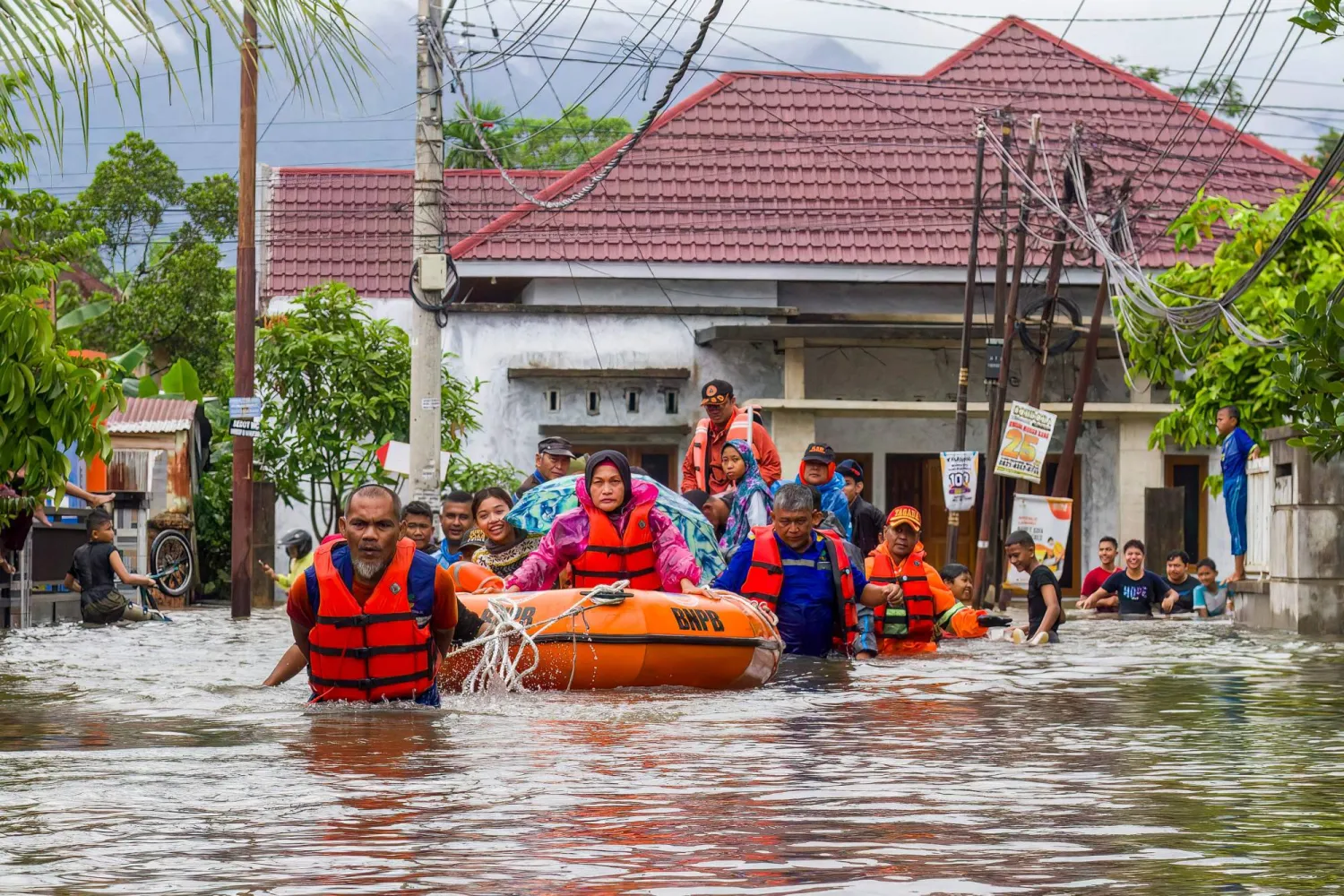
A rescue team evacuates women and children in a rubber boat as floodwaters hit a residential area in Padang, West Sumatra on November 25, 2025. (AFP)
TT

Landslides and Flash Floods on Indonesia’s Sumatra Leave at Least 17 Dead 

A rescue team evacuates women and children in a rubber boat as floodwaters hit a residential area in Padang, West Sumatra on November 25, 2025. (AFP)

Rescuers recovered more bodies in the search for dozens of people buried under landslides or swept away after torrential rains unleashed flash floods and triggered landslides on Indonesia’s Sumatra island, increasing the death toll to 17 and leaving six people missing, officials said Wednesday. 

Rescue teams were struggling to reach affected areas in six regencies of North Sumatra province after the monsoon rains over the past week caused rivers to burst their banks, tearing through hilly villages as mud, rocks and trees tumbled down, leaving destruction in their wake, the National Police said in a statement. 

Rescue workers by Wednesday had recovered at least five bodies and three injured people in the worst-hit city of Sibolga and were searching for four villagers who were reported missing, the statement said. In the neighboring district of Central Tapanuli, landslides hit several homes, killing at least a family of four, and floods submerged nearly 2,000 houses and buildings. 

Rescuers retrieved seven more bodies in South Tapanuli district, raising the death toll to eight, after floods and landslides also uprooted trees, prompting more than 2,800 residents to flee to temporary shelters and injuring 58 others, said National Disaster Mitigation Agency’s spokesperson Abdul Muhari. 

He said landslides also hit 50 houses in North Tapanuli district and destroyed at least two main bridges in the region. Floods had cut off a bridge in Mandailing Natal and submerged hundreds of houses in the hilly district and its neighboring Padang Sidempuan city, while a main road was blocked by mud and debris on Nias island. 

Videos on social media show water cascading down rooftops as panicked residents scramble for safety. In some areas, flash floods rose rapidly, transforming streets into raging torrents carrying tree trunks and debris. 

Sibolga police chief Eddy Inganta said emergency shelters have been set up and authorities urged residents in high-risk zones to evacuate immediately, warning that continued rainfall could trigger more landslides after six landslides in the hilly city flattened 17 houses and a café. 

“Bad weather and mudslides hampered the rescue operation,” Inganta said, adding that access remains limited as rescuers battle harsh conditions. 

Tuesday’s disasters occurred the same day the National Disaster Mitigation Agency declared the official end of relief efforts in two areas of Indonesia’s main island of Java after 10 days of operations. More than 1,000 rescue workers had been deployed to search for people buried under landslides triggered by torrential rains that left 38 people dead in Central Java's districts of Cilacap and Banjarnegara. 

At least two people in Cilacap and 11 in Banjarnegara were still unaccounted for when the operations ended, as unstable ground, bad weather and the depth and extent of the landfill material pose a high safety risk to rescue teams and residents, the agency said. 

Heavy seasonal rain from about October to March frequently causes flooding and landslides in Indonesia, an archipelago of 17,000 islands where millions of people live in mountainous areas or near fertile floodplains. 


US, Israel Unlikely to Achieve ‘Regime Change’ in Iran, Says Merz

 27 March 2026, Hesse, Frankfurt/Main: Germany's Chancellor Friedrich Merz speaks at the "FAZ" Congress. (dpa)
27 March 2026, Hesse, Frankfurt/Main: Germany's Chancellor Friedrich Merz speaks at the "FAZ" Congress. (dpa)
TT

US, Israel Unlikely to Achieve ‘Regime Change’ in Iran, Says Merz

 27 March 2026, Hesse, Frankfurt/Main: Germany's Chancellor Friedrich Merz speaks at the "FAZ" Congress. (dpa)
27 March 2026, Hesse, Frankfurt/Main: Germany's Chancellor Friedrich Merz speaks at the "FAZ" Congress. (dpa)

The US-Israeli war against Iran is unlikely to lead to "regime change", German Chancellor Friedrich Merz said Friday, as the month-long conflict showed no signs of abating.

"Is regime change really the goal?" he said at a forum in Frankfurt organized by the FAZ newspaper.

"If that's the goal, I don't think you'll achieve it. It's mostly gone wrong" in past conflicts, he said, pointing to the Afghanistan war.

"I have serious doubts as to whether there is a strategy and whether that strategy is being successfully implemented," he added. "In that respect, it could take even longer."

Germany has pushed back at US President Donald Trump's criticisms of NATO members for failing to join the attacks on Iran, insisting that it is not their war.

Merz however said Friday he believed that Trump had accepted this stance.

He also said Germany would be open to helping provide military protection in the Strait of Hormuz, a key route for oil and gas, which has been nearly totally blocked, in the event of a ceasefire.

"This requires an international mandate, it requires approval from the German parliament and, prior to that, a cabinet decision. And we are far from that."


More Than 300 US Troops Injured Since Start of Iran War

US Navy sailors taxi an F/A-18F Super Hornet on the flight deck aboard Nimitz-class aircraft carrier USS Abraham Lincoln in support of the Operation Epic Fury attack on Iran from an undisclosed location March 17, 2026. (US Navy/Handout via Reuters)
TT

More Than 300 US Troops Injured Since Start of Iran War

US Navy sailors taxi an F/A-18F Super Hornet on the flight deck aboard Nimitz-class aircraft carrier USS Abraham Lincoln in support of the Operation Epic Fury attack on Iran from an undisclosed location March 17, 2026. (US Navy/Handout via Reuters)

More than 300 US troops have been wounded since the start of the Iran war on February 28, US Central Command said on Friday.

"Since the start of Operation Epic Fury, approximately 303 US service members have been wounded. The vast majority of these injuries have been minor, and 273 troops have returned to duty," US Navy Captain Tim Hawkins said.

A US official who asked not to be identified told AFP that 10 troops remain seriously wounded.

A further 13 troops have been killed in the war, according to the latest figures, with seven killed in the Gulf and six in Iraq.

In a separate development Friday, Iran's military said that hotels housing US soldiers in the region would be considered targets.

"When all the Americans (forces) go into a hotel, then from our perspective that hotel becomes American," armed forces spokesman Abolfazl Shekarchi told state television on Thursday.

Iran's government has not released an updated casualty toll, but a US-based activist group said on March 23 that some 1,167 Iranian troops had been killed and 658 troops' status is unknown. AFP is not able to independently verify tolls in Iran due to reporting restrictions.

The war began on February 28 when the United States and Israel launched strikes on Iran, killing its supreme leader Ali Khamenei.

Since then, the conflict has spread across the Middle East. Iran has fired drone and missiles at Gulf states home to American military bases and other interests.

US President Donald Trump insisted on Thursday that talks to end the conflict were "ongoing" and "going very well".


UN Appeals for $80 Mn for Refugees, Hosts in Iran

 A man clears debris from a building damaged after a nearby residential building was hit in a US-Israeli strike in Tehran, Friday, March 27, 2026. (AP)
A man clears debris from a building damaged after a nearby residential building was hit in a US-Israeli strike in Tehran, Friday, March 27, 2026. (AP)
TT

UN Appeals for $80 Mn for Refugees, Hosts in Iran

 A man clears debris from a building damaged after a nearby residential building was hit in a US-Israeli strike in Tehran, Friday, March 27, 2026. (AP)
A man clears debris from a building damaged after a nearby residential building was hit in a US-Israeli strike in Tehran, Friday, March 27, 2026. (AP)

The United Nations said Friday it had launched an $80-million appeal to address the urgent humanitarian needs of nearly two million refugees in Iran and their host communities as the Middle East war rages.

Iran hosts the largest number of refugees in the world and has a significant migrant population, including 4.5 million Afghans, according to Tehran, and, according to the UN, hundreds of thousands of Iraqis.

"With the recent escalation of conflict, refugees, other Afghans and host communities in Iran are struggling with concerns for their safety, job losses, psychological distress and urgent shelter needs," said Babar Baloch, spokesman for UNHCR, the UN refugee agency.

UNHCR and its humanitarian partners have put together a flash refugee response plan, urgently seeking $80 million to respond to the immediate humanitarian needs from March to May.

"This will cover 1.8 million Afghan refugees and Afghans under other status living in Iran, plus also a million in their hosting communities who have also been affected," Baloch told a press conference.

"In Iran, most Afghan refugees, they live with the urban communities side by side, and everyone is affected," he said, adding that UNHCR was getting "thousands of desperate calls every day" from Afghans seeking support.

The Middle East war erupted on February 28 when Washington and Israel launched strikes on Iran, with Tehran in turn attacking targets in Israel and Gulf nations.

The UN's International Organization for Migration said no atypical outflows of people from Iran had been detected.

Meanwhile, the International Committee of the Red Cross said the month of war had upended the lives of millions and sent shockwaves far beyond the region at a speed "that threatens to overwhelm the humanitarian response".

"Essential infrastructure critical for the supply of energy, water and health care has been damaged or destroyed. The use of heavy explosive weapons with wide area impact in urban settings has caused suffering and fear," the ICRC said in a statement.

"Without respect for the rules of war, civilians will continue to suffer profound consequences that could outlast the current conflict."