

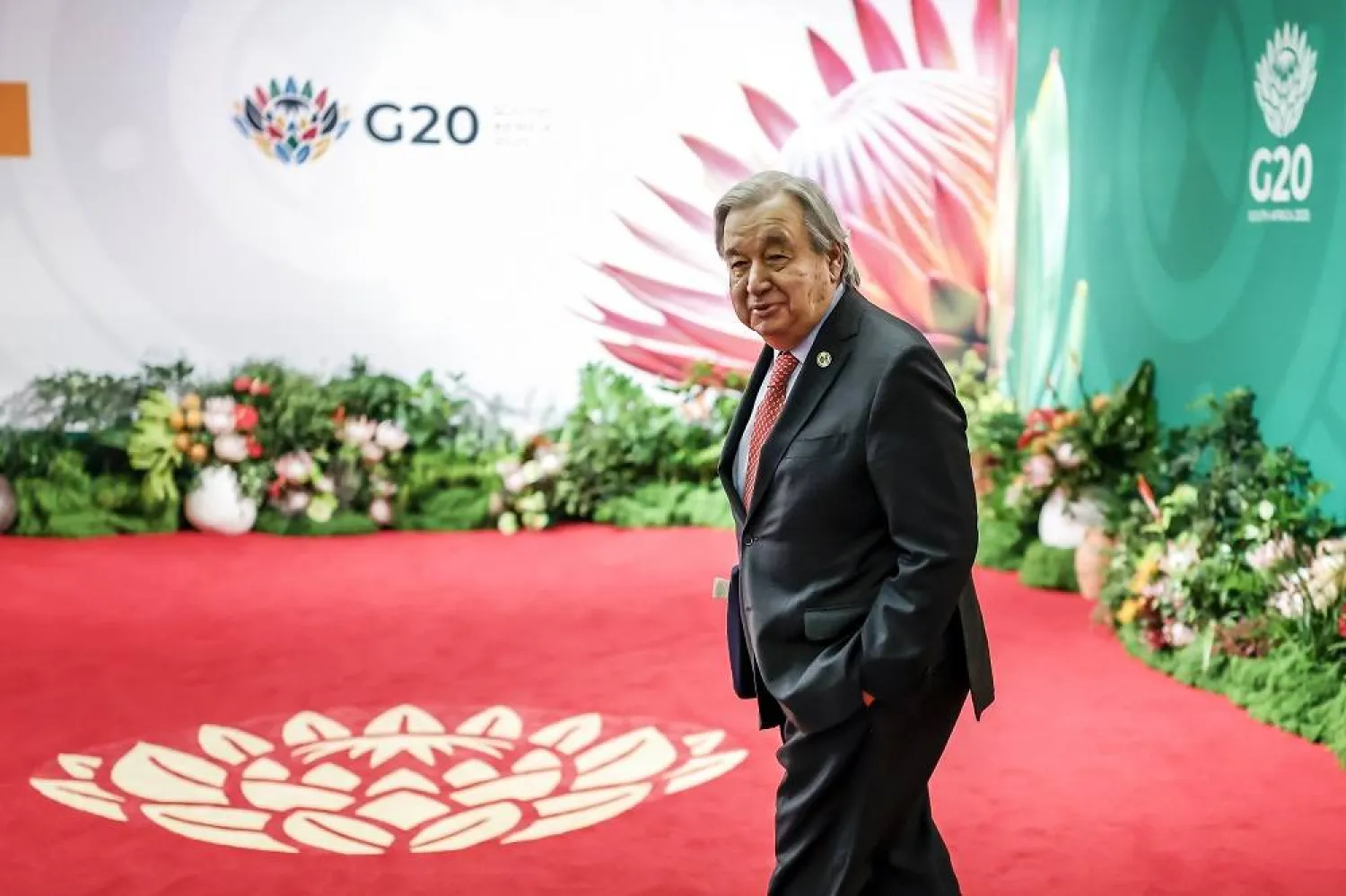

Secretary-General Selection Process Begins at UN 

Secretary-General of the United Nations Antonio Guterres arrives for the second day of the Group of Twenty (G20) Leaders' Summit at the Nasrec Expo Centre in Johannesburg, South Africa, 23 November 2025. (EPA)
TT

Secretary-General Selection Process Begins at UN 

Secretary-General of the United Nations Antonio Guterres arrives for the second day of the Group of Twenty (G20) Leaders' Summit at the Nasrec Expo Centre in Johannesburg, South Africa, 23 November 2025. (EPA)

The search for the next Secretary-General of the United Nations launched Tuesday, as member states were invited to send nominations to replace Antonio Guterres for the term starting in 2027.

In a letter from UN leaders to 193 member states, the 80-year-old global intergovernmental organization is seeking candidates with extensive experience in international relations, diplomacy and language skills.

"The position of Secretary-General is one of great importance and one that requires the highest standards of efficiency, competence and integrity and a firm commitment to the purposes and principles of the Charter of the United Nations," said the joint letter from Sierra Leone ambassador and current Security Council president Michael Imran Kanu and General Assembly President Annalena Baerbock.

Some member states are advocating for a woman to be selected, and in its letter UN leadership noted "with regret that no woman has ever held the position of Secretary-General" and called on members "to strongly consider nominating women."

Some names that are already in the mix include former Chilean President Michelle Bachelet, the Argentinian International Atomic Energy Agency head Rafael Grossi, and Costa Rica's Rebeca Grynspan, who is currently leading the UN agency for trade and development (UNCTAD).

Candidates must be presented by a state or group of states and submit a vision statement and list funding sources.

There is a tradition of geographical rotation, which would make it Latin America's turn this time around, but it's not always followed. The letter notes "the importance of regional diversity" without specifying a required area.

Candidates may undergo public interviews, a transparency procedure first used during the 2016 selection that led to Guterres' first term.

Security council members will begin the formal selection process by the end of July, and the five permanent members with veto power -- United States, China, Russia, United Kingdom and France -- hold the candidate's future in their hands.

Once the Security Council makes its recommendation, the Assembly can elect the Secretary-General to a five-year term that begins January 1, 2027, and is renewable once.



Italy Arrests Nine Over Alleged Hamas Funding through Charities

President of the Palestinian Association in Italy, Mohammad Hannoun, carries a Palestinian flag during a nationwide strike, called by the USB union, in solidarity with Gaza and against the government and its plan to increase military spending, in Rome, Italy, November 29, 2025. Italian Interior Minister Matteo Piantedosi said Mohammad Hannoun is among nine people arrested on December 27 on suspicion of financing Hamas through charities based in Italy, in an operation coordinated by anti-mafia and anti-terrorism units. in Italy. REUTERS/Remo Casilli
TT

Italy Arrests Nine Over Alleged Hamas Funding through Charities

President of the Palestinian Association in Italy, Mohammad Hannoun, carries a Palestinian flag during a nationwide strike, called by the USB union, in solidarity with Gaza and against the government and its plan to increase military spending, in Rome, Italy, November 29, 2025. Italian Interior Minister Matteo Piantedosi said Mohammad Hannoun is among nine people arrested on December 27 on suspicion of financing Hamas through charities based in Italy, in an operation coordinated by anti-mafia and anti-terrorism units. in Italy. REUTERS/Remo Casilli

Italian prosecutors said on Saturday they had arrested nine people on suspicion of ​financing Hamas through charities based in Italy, in an operation coordinated by anti-mafia and anti-terrorism units.

The suspects are accused of "belonging to and having financed" the Palestinian group, which the European Union designates as a terrorist organization, prosecutors in the northern Italian city of Genoa said in a statement, Reuters reported.

Those arrested allegedly diverted to Hamas-linked ‌entities around 7 million ‌euros ($8.2 million) raised over the ‌last ⁠two years ​for ‌ostensibly humanitarian purposes, prosecutors said. Police seized assets worth more than 8 million euros.

In another statement on Sunday, police said officers had seized 1.08 million euros in cash found in the offices of a pro-Palestinian charity and in the private homes of suspects, as well as pro-Hamas material.

The ⁠Italian investigation began after suspicious financial transactions were flagged and expanded ‌through cooperation with Dutch authorities and other ‍EU countries, coordinated through the ‍EU judicial agency Eurojust.

Prime Minister Giorgia Meloni thanked ‍the authorities for "a particularly complex and important operation" which had uncovered financing for Hamas through "so-called charity organizations."


470-kilo WWII Bomb Removed in Belgrade

This handout photograph taken on December 28, 2025 and released by Serbia's Ministry of Interior shows a 470-kg World War II aerial bomb, dropped on Nazi-occupied Belgrade in 1944, found in a construction site in the Serbian capital before being removed by Serbian bomb disposal experts. (Photo by Handout / SERBIAN MINISTRY OF INTERIOR AFFAIRS / AFP)
TT

470-kilo WWII Bomb Removed in Belgrade

This handout photograph taken on December 28, 2025 and released by Serbia's Ministry of Interior shows a 470-kg World War II aerial bomb, dropped on Nazi-occupied Belgrade in 1944, found in a construction site in the Serbian capital before being removed by Serbian bomb disposal experts. (Photo by Handout / SERBIAN MINISTRY OF INTERIOR AFFAIRS / AFP)

A 470-kilogram (1,000-pound) World War II aerial bomb was safely removed on Sunday from a construction site in a central district of Serbia’s capital, Belgrade, police said.

The US-made AN-M44 bomb was used during Allied air raids on German positions during the liberation of Belgrade from Nazi occupation in 1944.

Ahead of the bomb’s removal, the site, which is near a residential area and a shopping mall, underwent detailed reconnaissance "to ensure safe conditions," AFP quoted police as saying.

Residents were also told to remove vehicles and leave their homes if possible.
The bomb was transported to an army arms training ground 180 km (110 miles) from Belgrade, where it will be destroyed in the coming days.

Several unexploded bombs dating back to past wars have been discovered in Serbia in recent years, all of which were safely removed without detonating.

In September 2024, a century-old artillery shell weighing nearly 300 kilograms (660 pounds) was cleared from a construction site near the Serbian parliament in Belgrade.

Earlier that year, in April, a large bomb from the 1999 NATO bombing campaign was found in Nis, southern Serbia.

In 2021, a 242-kilogram (530-pound) World War II bomb was also removed from a construction site in a Belgrade suburb.


Has Iran Built an Espionage Network in Israel?

People walk in the rain during stormy weather in the port of Tel Aviv, Israel, 27 December 2025.  EPA/ABIR SULTAN
People walk in the rain during stormy weather in the port of Tel Aviv, Israel, 27 December 2025. EPA/ABIR SULTAN
TT

Has Iran Built an Espionage Network in Israel?

People walk in the rain during stormy weather in the port of Tel Aviv, Israel, 27 December 2025.  EPA/ABIR SULTAN
People walk in the rain during stormy weather in the port of Tel Aviv, Israel, 27 December 2025. EPA/ABIR SULTAN

For the past year, Israel has arrested dozens of Israeli citizens on suspicion of spying for Iran, Yedioth Ahronoth has reported on.

The Hebrew newspaper revealed on Saturday that some of the recruits were asked to photograph sensitive facilities and to collect information including documentation of Israeli army bases, strategic sites and homes linked to senior Israeli officials.

The newspaper said that since September 2024, Israeli authorities have uncovered 35 serious Iranian espionage cases. In some, individuals acted alone; in others, they were part of organized cells, with a mission to sow chaos, burn vehicles and carry out failed assassination plots.

It said the youngest of their recruits is a 13-year-old boy from Tel Aviv. Others had served in the reserves and regular forces.

They leaked sensitive information, including documentation of sensitive military bases, strategic sites and homes linked to senior Israeli officials.

The recruits included Mordechai “Moti” Maman, 72, of Ashkelon. He entered Iran twice and discussed with the agents the possibility of carrying out terror attacks in Israel.

The Iranian handlers discussed with him the option of assassinating senior figures such as Prime Minister Benjamin Netanyahu, then-Defense Minister Yoav Gallant and then-Shin Bet chief Ronen Bar.

After Maman told them the level of security surrounding senior officials made such attacks impractical, the sides discussed alternative terror and espionage activities, including possible attacks on former Prime Minister Naftali Bennett or mayors. Maman was arrested in September 2024.

In October 2024, four cells were arrested, including a couple who had been in contact with Iranian agents since 2021 and groups of five to eight people on suspicion of conducting espionage for Iran.

One of the cases involved seven Israelis who immigrated from Azerbaijan, including a father and son, suspected of maintaining ties for two years with operatives from Iran.

As part of that relationship, the suspects photographed military bases that later became targets in Iran’s ballistic missile attack last year. Some of the group were caught surveilling a senior Israeli official and his son, allegedly as part of an assassination plan.

Authorities also uncovered another case in which seven people aged 19 to 23 from the Jerusalem neighborhood of Beit Safafa were arrested on suspicion of conducting espionage for Iran for several months. Their main assignment was to assassinate an Israeli nuclear scientist and a mayor.

In early 2025, another espionage case was uncovered, and an indictment was filed against an Israeli from Petah Tikva, on charges including contact with a foreign agent and passing information to the enemy.

According to the indictment, the recruit photographed the neighborhood of National Unity party leader Benny Gantz and a power station in Tel Aviv.

His handler contacted him via Telegram and offered payment through a digital wallet in exchange for carrying out security-related tasks. These included documenting security facilities, spraying political graffiti, arson attacks on vehicles and other acts.

During 2025, more than nine indictments have been filed against cells and individuals accused of spying for Iran, most of them Jews the newspaper said.
Investigations revealed that most of the spies had carried out various missions in exchange for payment.

The majority of the recruits had not travelled to Iran to complete their recruitment, but communicated with Iranians through social networks or during their presence in other countries.