

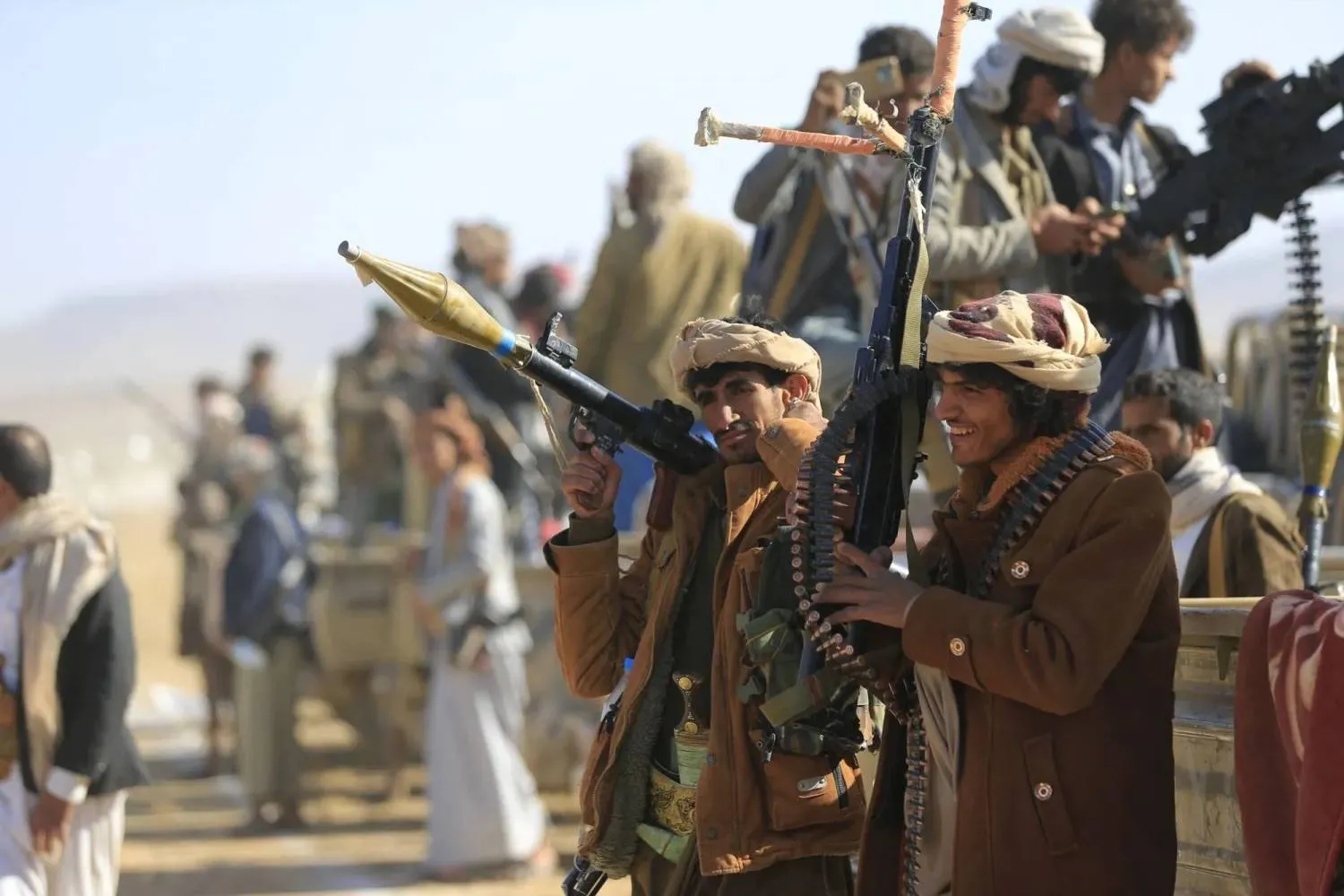

Houthi Condolences Signal Call for Hezbollah to Resume Fight

Houthi gunmen display their strength during a gathering north of Sanaa (AFP). 
TT

Houthi Condolences Signal Call for Hezbollah to Resume Fight

Houthi gunmen display their strength during a gathering north of Sanaa (AFP). 

Condolence messages sent by Yemen’s Houthi movement to Hezbollah’s deputy secretary-general, Naim Qassem, after the killing of senior commander Haytham Ali Tabtabai in an Israeli airstrike on Beirut’s southern suburb last Sunday, quickly took on a political edge.

Rather than merely expressing grief, the messages were widely read as a call for Hezbollah to resume open confrontation with Israel despite the ceasefire.

Although framed as tributes to a fallen ally, the language used by the Houthi leadership carried pointed political signals about how it views the next phase of the regional conflict.

In a strongly worded message, Houthi leader Abdul-Malik al-Houthi described Tabtabai’s death as a “necessary martyrdom,” arguing that it obliges Hezbollah to continue on the “path of jihad.”

He asserted that Israel “will not abide by a ceasefire” in Lebanon, and that developments in Gaza and southern Lebanon “prove that confrontation is a destiny that cannot be reversed.” He praised the “steadfastness of the Lebanese resistance,” adding that Hezbollah’s “distinguished role cannot stop.”

Yemeni political analysts say this rhetoric reflects the Houthis’ interest in keeping the Lebanese front active.

By ensuring that another arena remains unstable, the group can justify its own operations in the Red Sea and continue presenting attacks on shipping and maritime routes as part of a regional campaign to “support Gaza,” rather than actions driven by internal political calculations.

The message from Mohammed Ali al-Houthi, a senior figure in the movement and cousin of the group’s leader, left even less room for ambiguity.

He linked Tabtabai’s killing directly to the “necessity of continuing resistance,” describing Hezbollah’s operations as “the only way to deter Israel.” He accused the United States of responsibility for the assassination and declared that the Houthis are “ready” to stand with Hezbollah in Lebanon and alongside Palestinian factions, in a clear attempt to reaffirm their role within Iran’s broader regional alliance.

Yemeni analysts say that part of the military advances made by the Houthi movement over the past decade can be traced to training and expertise provided by Hezbollah officers, including Tabtabai.

They note that within the broader regional confrontation pitting Iran and its allied groups against Israel, the latest Houthi messages are unlikely to directly alter Hezbollah’s strategy.

However, the tone reflects growing concern within the movement that a quiet Lebanese front would allow Israel to concentrate on degrading Houthi capabilities and targeting their leadership, particularly after the series of strikes the group has absorbed in recent months.

The Houthis had earlier declared a halt to attacks on Israel and against shipping in the Red Sea and the Gulf of Aden, following the ceasefire agreement reached between Israel and Hamas in October.

The group said at the time that it would monitor developments while remaining ready to resume operations if the deal faltered, according to statements by its leader.


One Dead as Israeli Forces Open Fire on West Bank Stone-Throwers

Israeli troops during a military operation in the Palestinian village of Qabatiya, near the West Bank city of Jenin, 27 December 2025. (EPA)
TT

One Dead as Israeli Forces Open Fire on West Bank Stone-Throwers

Israeli troops during a military operation in the Palestinian village of Qabatiya, near the West Bank city of Jenin, 27 December 2025. (EPA)

The Israeli military said its forces killed a Palestinian in the occupied West Bank in the early hours on Thursday as they opened fire on people who were throwing stones at soldiers.

Two other people were hit on a main ‌road near the ‌village of Luban ‌al-Sharqiya ⁠in Nablus, ‌the military statement added. It described the people as militants and said the stone-throwing was part of an ambush.

Palestinian authorities in the West Bank said ⁠a 26-year-old man they named as ‌Khattab Al Sarhan was ‍killed and ‍another person wounded.

Israeli forces had ‍closed the main entrance to the village of Luban al-Sharqiya, in Nablus, and blocked several secondary roads on Wednesday, the Palestinian Authority's official news agency WAFA reported.

More ⁠than a thousand Palestinians were killed in the West Bank between October 2023 and October 2025, mostly in operations by security forces and some by settler violence, the UN has said.

Over the same period, 57 Israelis were killed ‌in Palestinian attacks.


UN Chief Condemns Israeli Law Blocking Electricity, Water for UNRWA Facilities

A girl stands in the courtyard of a building of the United Nations Relief and Works Agency for Palestine Refugees (UNRWA) in the Askar camp for Palestinian refugees, east of Nablus in the Israeli-occupied West Bank, on December 31, 2025. (AFP)
TT

UN Chief Condemns Israeli Law Blocking Electricity, Water for UNRWA Facilities

A girl stands in the courtyard of a building of the United Nations Relief and Works Agency for Palestine Refugees (UNRWA) in the Askar camp for Palestinian refugees, east of Nablus in the Israeli-occupied West Bank, on December 31, 2025. (AFP)

United Nations Secretary-General Antonio Guterres condemned on Wednesday a move by Israel to ban electricity or water to facilities owned by the UN Palestinian refugee agency, a UN spokesperson said.

The spokesperson said the move would "further impede" the agency's ability to operate and carry out activities.

"The Convention on the Privileges and Immunities of the United Nations remains applicable to UNRWA (United Nations Relief and Works Agency for Palestine Refugees in the Near East), its property and assets, and to its officials and other personnel. Property used ‌by UNRWA ‌is inviolable," Stephane Dujarric, spokesman for the ‌secretary-general, ⁠said while ‌adding that UNRWA is an "integral" part of the world body.

UNRWA Commissioner General Phillipe Lazzarini also condemned the move, saying that it was part of an ongoing " systematic campaign to discredit UNRWA and thereby obstruct" the role it plays in providing assistance to Palestinian refugees.

In 2024, the Israeli parliament passed a law banning the agency from operating in ⁠the country and prohibiting officials from having contact with the agency.

As a ‌result, UNRWA operates in East Jerusalem, ‍which the UN considers territory occupied ‍by Israel. Israel considers all Jerusalem to be part ‍of the country.

The agency provides education, health and aid to millions of Palestinians in Gaza, the West Bank, Jordan, Lebanon and Syria. It has long had tense relations with Israel, but ties have deteriorated sharply since the start of the war in Gaza and Israel has called repeatedly for UNRWA to ⁠be disbanded, with its responsibilities transferred to other UN agencies.

The prohibition of basic utilities to the UN agency came as Israel also suspended of dozens of international non-governmental organizations working in Gaza due to a failure to meet new rules to vet those groups.

In a joint statement, Canada, Denmark, Finland, France, Iceland, Japan, Norway, Sweden, Switzerland and the United Kingdom said on Tuesday such a move would have a severe impact on the access of essential services, including healthcare. They said one in ‌three healthcare facilities in Gaza would close if international NGO operations stopped.


Israel Says It ‘Will Enforce’ Ban on 37 NGOs in Gaza

The sun sets behind the ruins of destroyed buildings in the Nuseirat refugee camp in the central Gaza Strip on December 31, 2025. (AFP)
TT

Israel Says It ‘Will Enforce’ Ban on 37 NGOs in Gaza

The sun sets behind the ruins of destroyed buildings in the Nuseirat refugee camp in the central Gaza Strip on December 31, 2025. (AFP)

Israel said on Thursday that 37 international NGOs operating in Gaza had not complied with a deadline to meet "security and transparency standards," in particular disclosing information on their Palestinian staff, and that it "will enforce" a ban on their activities.

"Organizations that have failed to meet required security and transparency standards will have their licenses suspended," said spokesman for the Ministry of Diaspora Affairs and Combating Antisemitism, Gilad Zwick.

In March, Israel gave a ten-month deadline to NGOs to comply with the new rules, which expired on Wednesday night.

The UN has warned that the ban will exacerbate the humanitarian situation in Gaza.
