

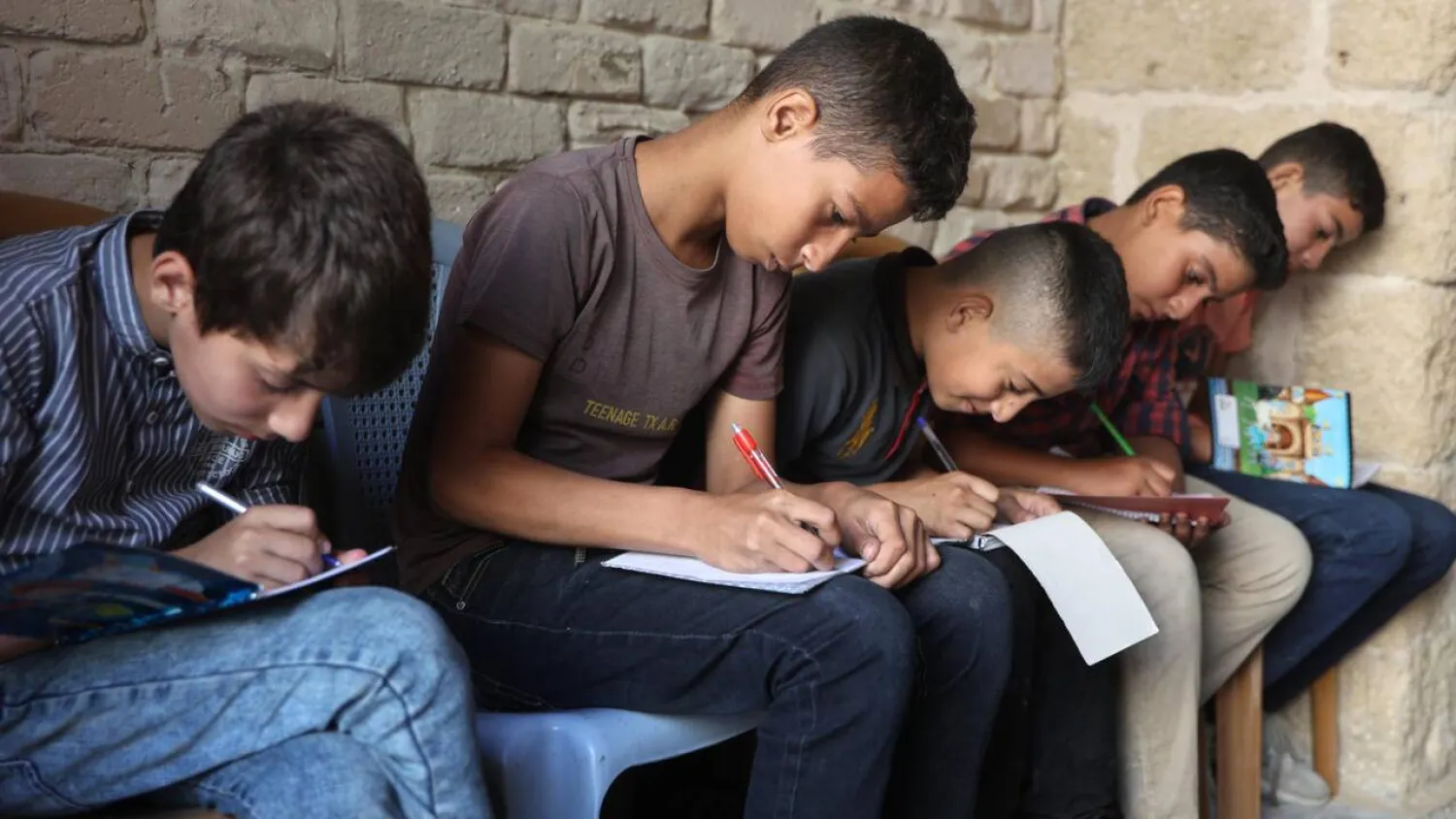

Schools But No Books: Gaza's Children Return to Makeshift Classrooms

Palestinian children take notes as they attend a class in the historic Al-Kamaliya al-Othmanya school in Gaza City's Old Town, as part of a volunteer initiative organized by displaced teachers, in Gaza City. Omar AL-QATTAA / AFP/File
TT

Schools But No Books: Gaza's Children Return to Makeshift Classrooms

Palestinian children take notes as they attend a class in the historic Al-Kamaliya al-Othmanya school in Gaza City's Old Town, as part of a volunteer initiative organized by displaced teachers, in Gaza City. Omar AL-QATTAA / AFP/File

With no backpack, books or uniform, 11-year-old Layan Haji navigates the ruins of Gaza City and heads to a makeshift classroom after two years of war halted her education.

But the school is not what she is used to. Painted walls and students' artwork no longer adorn the walls and hallways -- instead, tents set up in a battered building serve as their temporary classrooms.

"I walk for half an hour at least. The streets are devastated, full of ruins... It is difficult and sad," Haji said, wearing a torn shirt and patched trousers.

But "I am happy to return to my studies," added the young girl, who already dreams of becoming a doctor.

Haji is one of 900 students who are going to the Al-Louloua al-Qatami school, one of a number of these establishments that have opened their doors in a bid to allow children to resume their schooling for the first time since the Israel-Hamas war broke out.

"We don't have books or notebooks. The libraries are bombed and destroyed," said Haji, who lives in a displacement camp in the Tal al-Hawa area in Gaza City.

"There is nothing left," she added.

A month after a fragile ceasefire took effect, the UN agency for Palestinian refugees (UNRWA) and Gaza's education ministry announced that children had gradually begun returning to schools in areas not under Israeli military control.

'Heavy labor'

Sixteen-year-old Said Sheldan said he was full of joy at being able to attend school now that the war has stopped.

But "I don't have books, notebooks, pens or a bag. There are no chairs, electricity or water -- not even streets," he said.

But before going to the classroom, Sheldan has much more basic needs to attend to.

"Every morning, I have to collect water and wait in line for bread," said Sheldan, whose family has been displaced "10 times" and "no longer have a home".

Headmaster Iman al-Hinawi, 50, said the school hopes to provide books and other supplies soon and for free.

But she warned that the war has forced Gaza's children to perform "heavy labor" to support their families, especially in cases where the breadwinner has been killed.

"They collect firewood, fetch water and stand in line for food" across the territory where the UN previously declared famine.

AFP correspondents have witnessed scenes where countless children, clutching plastic buckets, dented pans or even just plates, cry and shout as they jostle through massive crowds to collect food for their families.

In an effort to address the psychological distress the children have endured, Hinawi said the school has adopted new learning methods through playing.

Young girls compete by dancing to solve math equations and other children act out comedic scenes to recite poems on the curriculum.

But Faisal al-Qasas, in charge of the Al-Louloua al-Qatami school, said the children are constantly preoccupied by the queues for bread and water.

The school, having launched two shifts for 900 children, now uses "extracurricular activities to address the students' mental health" and help them resume their studies.

A critical moment

According to a UN assessment, 97 percent of Gaza's schools sustained some level of damage, including from "direct hits", with most of them needing full reconstruction or major rehabilitation.

Israeli strikes have killed many Palestinians sheltering in schools, with Israel alleging that Hamas fighters hide in such establishments.

With schools also serving as displacement shelters, UNRWA has recently opened "temporary learning spaces".

Last month, UNRWA chief Philippe Lazzarini said that more than 25,000 children have joined these new spaces, and some 300,000 would follow online classes.

But that still falls short of the education ministry's estimates of more than 758,000 students in the strip.

In the Al-Mawasi area in southern Gaza, local initiatives, some of which receive international support, are hoping to bring children back to school.

Qatar's Education Above All Foundation has launched the "Rebuilding Hope for Gaza" program, aimed at supporting more than 100,000 students.

The program includes distributing school supplies, ensuring access to the internet and electricity, and providing psychological support.

But even with that support, one such school in the Al-Mawasi area can only offer four subjects: Arabic, English, maths and science.

Hazem Abu Habib, from an initiative backed by the foundation, said "we aim to help as many students as possible resume their education, even if it's just with basic courses".

Before the war, Gaza was "completely free of illiteracy", he said.

But now "education is facing its most critical period".


UNICEF: Sudan Faces World’s Largest Internal Displacement Crisis

Sudan has the world’s largest internal displacement crisis (Reuters) 
TT

UNICEF: Sudan Faces World’s Largest Internal Displacement Crisis

Sudan has the world’s largest internal displacement crisis (Reuters) 

The UN Children’s Fund (UNICEF) said Thursday that Sudan has become the world’s largest internal displacement crisis, with an estimated 9.5 million people uprooted across 18 states.

In a statement on X, the agency said, “For nearly three years, Sudanese children have endured a deepening humanitarian emergency driven by violence, displacement, disease and widespread hunger.”

UNICEF said it continues to operate on the ground with partners to deliver life-saving services to children and families affected by the crisis, including health and nutrition care, access to safe water, psychosocial support and education.

Since April 15, 2023, the Sudanese army and the paramilitary Rapid Support Forces (RSF) have been locked in a war that has killed thousands of people.

Separately, High Representative of the EU Foreign Affairs Council, Kaja Kallas, said the Union’s foreign ministers approved on Thursday the imposition of sanctions on members of the two Sudanese warrying parties due to the dramatic escalation of violence and serious violations of international humanitarian and human rights law.

“The Ministers approved new sanctions against members of RSF and the SAF. These measures alone will not end the war, but they will increase the cost for those responsible,” she said.

The RSF captured the city of El-Fasher in late October after an 18-month siege, consolidating its control over western Sudan.

Extensive documentation confirmed the RSF committed severe atrocities in the city.

Meanwhile, Doctors Without Borders/Médecins Sans Frontières (MSF) described on Thursday El-Fasher as largely destroyed and emptied, with few civilians remaining, adding that its teams were granted access to the city to assess the current situation for civilians and health facilities after the RSF seized the city last October.

“On January 15, our team spent four hours in El-Fasher while under the constant supervision of security officials. We saw destroyed areas, largely emptied of the communities that used to live there. The regional capital now looks like a ghost town, with few civilians remaining,” the organization reported.

MSF said its fears are now growing that most of the civilians who were still alive when RSF seized the city have since been killed or displaced.

The team went to health facilities and two displacement sites hosting mostly women, children, and elderly people.

In the health facilities, the teams reiterated their willingness to support referrals of patients in need of surgery to existing MSF projects with surgical capacity.

“Our visit was too limited to allow us to get more than a glimpse of El-Fasher, yet this glimpse was a grim reminder of the sheer scale of the destruction that took place in the city as many of its residents were wiped out,” MSF said.

It affirmed that the patients in the nearby town of Tawila have shared stories of mass killings, torture, kidnappings, and other violence occurring in the city and along escape routes.

UNICEF spokesperson Eva Hinds said last week more than 500,000 displaced people are in Tawila, warning that further people are expected to arrive to the city.


Lavrov: Al-Assad’s Trial Closed Long Time Ago

A Syrian member of the military operations looks on as he stands at an inspection checkpoint for incoming vehicles before a Russian flag and Russian soldiers behind manning the entrance of the Russian-leased Syrian military base of Hmeimim in Latakia province in western Syria on December 29, 2024. (AFP) 
TT

Lavrov: Al-Assad’s Trial Closed Long Time Ago

A Syrian member of the military operations looks on as he stands at an inspection checkpoint for incoming vehicles before a Russian flag and Russian soldiers behind manning the entrance of the Russian-leased Syrian military base of Hmeimim in Latakia province in western Syria on December 29, 2024. (AFP) 

Russian Foreign Minister Sergei Lavrov confirmed Thursday that the trial of former Syrian President Bashar al-Assad was closed a long time ago, and that Russia's partners are fully aware of the circumstances of his arrival in Russia, according to Sputnik.

Asked about his position on requests for the prosecution of al-Assad, Lavrov told Turkish state TV channel, TRT, and Türkiye newspaper, that, “This issue has not been raised for a long time. Our partners are fully aware of the circumstances surrounding al-Assad and his family’s arrival in the Russian Federation in December 2024.”

Back then, Lavrov said, “Al-Assad’s life was under threat. He was granted asylum in Russia for purely humanitarian reasons, and he took it. As you may observe (if you follow our domestic affairs), al-Assad does not interfere in Syrian political affairs.”

He added that “understandings are now being substantiated. Processes long envisioned with our Turkish friends are beginning to take shape in Syria today, particularly regarding the political integration of Kurdish communities into Syria’s governmental, military and security structures,” he said.

On Thursday, Kremlin spokesman Dmitry Peskov said the presence of Russian military bases in Syria was discussed during talks between Putin and Syrian leader Ahmed al-Sharaa in Moscow.

Putin told al-Sharaa that Moscow always supported Syria’s integrity and congratulated him on reclaiming control over the area, describing it as a “very important step.”

“You know that we always stood for the restoration of Syria’s territorial integrity, and we support all your efforts in this direction,” Putin said.

For his part, al-Sharaa, who first visited Russia in October, thanked Putin for helping to stabilize Syria.

Al-Sharaa led a swift opposition offensive in December 2024 that ousted former Syrian President Bashar al-Assad, who enjoyed Moscow’s support for years as his government fought a devastating civil war.

Last Tuesday, President Recep Tayyip Erdogan said the rights of Kurdish citizens in Syria are guaranteed by a special presidential decree. On January 16, al‑Sharaa issued Decree No. (13) of 2026 affirming that Syrian Kurdish citizens are an integral and authentic part of the Syrian people, and that their cultural and linguistic identity is an inseparable component of Syria’s unified and diverse national identity.

Speaking at a ceremony for the Overseas Contracting Services Success Awards in Ankara, Erdogan reiterated his call on the PKK/YPG to abandon autonomy demands. “The shelf life of terrorism has expired,” he said.


Sources to Asharq Al-Awsat: Hamas to Discuss Weapons Issue With Mediators in Coming Days

A Palestinian child picks flowers on Thursday from a field near destroyed buildings in the Nuseirat refugee camp, north of Deir al-Balah in central Gaza (AFP)
TT

Sources to Asharq Al-Awsat: Hamas to Discuss Weapons Issue With Mediators in Coming Days

A Palestinian child picks flowers on Thursday from a field near destroyed buildings in the Nuseirat refugee camp, north of Deir al-Balah in central Gaza (AFP)

As Israeli Prime Minister Benjamin Netanyahu intensifies pressure to disarm Hamas and other armed factions as part of the second phase of a ceasefire, the Palestinian movement is pushing back, saying the issue of weapons must be resolved through a broader “national consensus.”

Factional sources in Gaza told Asharq Al-Awsat that “general consultations” are underway with Hamas on the weapons issue alongside other matters.

One source said more serious talks with mediators are likely to begin in the coming days, particularly as preparations to hand over governmental responsibilities in the enclave to the Gaza Administration Committee begin.

Netanyahu said at a news conference on Tuesday that the disarmament process will happen either the easy way or the hard way, but it will happen in the end.

US President Donald Trump has also said Hamas must disarm as it had pledged to do, while his envoy to the United Nations, Mike Waltz, said the Board of Peace would put pressure on the movement to disarm.

Senior Hamas officials insist the weapons file is a purely Palestinian matter that does not concern the movement alone, and that any decision must be taken within a framework of “national consensus.”

No agreement yet

A Hamas source told Asharq Al-Awsat that the issue of the “weapons of resistance” remains at the stage of general consultations, whether among factions or with mediators.

The source said Hamas has again floated ideas and approaches, including placing the weapons under the custodianship of an agreed Palestinian body, or under guarantees from mediators, in a way that would prevent their disarmament by US or Israeli means or their transfer to either side.

The sources stressed that no agreement has been reached to date and that the issue has not yet been seriously discussed.

Israeli Channel 13 reported on Monday that the United States is expected in the coming days to present Israel and Hamas with a document setting a deadline to begin disarmament and comply with the conditions of the second phase.

The report said the document would allow the Israeli government to act independently to carry out the process if the Palestinian movement failed to comply.

Israeli military sources, cited by the public broadcaster on Sunday, expressed doubt that Hamas would accept disarmament. Channel 14 reported that a series of military plans had been approved to force Hamas to do so, including the possibility of reoccupying the Gaza Strip in full.

US envoy Steve Witkoff said days ago that a new meeting with Hamas might be needed if required, adding that he expected the movement to agree to disarm eventually.

Inclusive national framework

Hamas sources inside and outside Gaza said the movement wants any agreement on weapons to be reached within a comprehensive, inclusive national framework. They said consultations have taken place with Palestinian factions and that a proposal is being formulated to present to mediators during serious talks on the issue.

Sources said some mediators raised the issue of weapons during recent meetings, including a meeting in Istanbul days ago between Hamas leaders and Turkish Foreign Minister Hakan Fidan.

One source said mediators and some parties, which he did not specify, had shown acceptance of approaches put forward during the general consultations that affirm the right of Palestinian factions to retain what enables them to resist occupation.

On Hamas’s understanding of “national consensus,” sources, including a senior leader, told Asharq Al-Awsat that the weapons do not belong to Hamas alone, noting that other armed factions have taken part effectively in resisting the Israeli occupation.

“We cannot alone decide the fate of an important issue tied to the principles and future of the Palestinian cause,” one of the Hamas sources said.

While Hamas appears keen to avoid being seen as standing alone behind a decision to hand over or dismantle faction weapons in a way that would portray it as defeated, the sources rejected that interpretation.

They said several issues must be settled within a framework of Palestinian national consensus, as was done in the handover of governance in Gaza to a technocratic committee.

They added that a national committee of Gaza factions would work with the committee to ensure it receives all the tools needed for government work, to reach an inclusive national formulation on this “fateful issue.”

The sources said national consensus is not limited to weapons but extends to other “existential issues.”

What role for Fatah

Asked whether Fatah would take part in new factional consultations on the weapons issue, a senior Hamas source said: “Certainly, we are seeking that. But we do not know whether it will refuse, as it did in consultations on forming the technocratic committee, or agree. In any case, Hamas has no problem with decisions being taken in the same way.”

He said the goal of factional consultations due to be held soon in Cairo is to reach an explicit agreement on the fate of the weapons of resistance, without any unilateral decision by Hamas or any other faction on this and other critical issues related to the future of Gaza and the Palestinian cause.

These include moving toward a comprehensive Palestinian national dialogue to restore unity under Arab, Islamic, and international sponsorship.

Israeli and US threats

It remains unclear how Israel and the US will respond to Hamas’s steps, as Israel threatens a return to military action. Some Palestinians believe the Trump administration may be open to other options regarding the future of the weapons.

Trump said about Hamas members, roughly two weeks ago, that they were born with weapons in their hands, so giving them up is not a simple matter.

US Ambassador to the United Nations Mike Waltz said on Wednesday that all military, terrorist, and offensive infrastructure will be destroyed, including tunnels and weapons production facilities, and they will not be rebuilt.

He added that independent international monitors would oversee the disarmament process in Gaza, placing weapons permanently out of use through an agreed process to decommission them, supported by an internationally funded buyback and reintegration program.

Mousa Abu Marzook, a member of Hamas’s political bureau, said in televised remarks that any arrangements concerning Gaza must be reached in understanding with the movement, including the weapons issue. He said Hamas has never accepted handing over its weapons in any form.
