

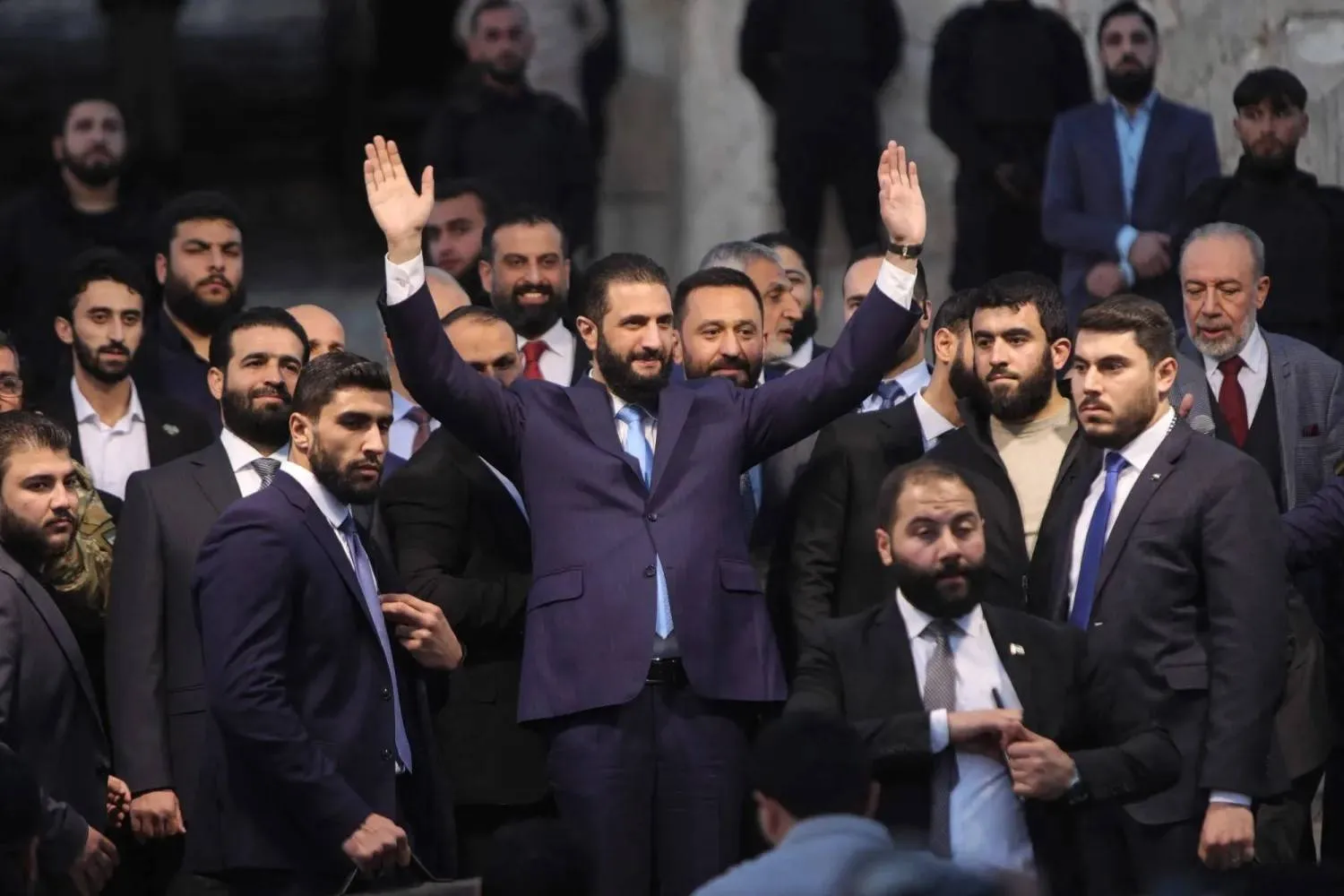

Al-Sharaa in Aleppo Vows Full Effort to Rebuild Syria

President Al-Sharaa greets crowds marking Assad’s fall at Aleppo Citadel on Saturday (AFP)
TT

Al-Sharaa in Aleppo Vows Full Effort to Rebuild Syria

President Al-Sharaa greets crowds marking Assad’s fall at Aleppo Citadel on Saturday (AFP)

Syrian President Ahmed al-Sharaa vowed on Saturday to marshal every possible effort to rebuild the country, declaring from the city of Aleppo that Syria stands at the threshold of a long and demanding recovery.

During a visit to the northern metropolis, he described Aleppo’s reconstruction as a cornerstone of the broader national effort, saying its ancient walls had witnessed both the city’s liberation and the advance toward Damascus.

What began as a celebration of Aleppo, he added, marks the opening chapter of a new era for Syria and the wider region.

Al-Sharaa told Aleppo residents that the authorities would not stop at the city’s liberation, saying the effort had begun from the first moment it was retaken.

He pledged collective work to rebuild Syria. It is widely known that the opposition assault that toppled Bashar al-Assad a year ago began in the western countryside of Aleppo before reaching Damascus.

His statements came as the authorities confront complex challenges at home and abroad ahead of the first anniversary of Assad’s overthrow. Domestically, the country faces security fragility and divisions across several layers of society. Externally, Israeli incursions and attacks continue inside Syrian territory.

The Interior Ministry on Saturday displayed its vehicles carrying a new visual identity, moving in a convoy from the Mezzeh highway to Umayyad Square and then to the Carlton roundabout in Damascus amid popular celebrations.

Interior Minister Anas Khattab said the new identity was not a cosmetic change but a reaffirmation of state authority, describing it as part of a broader national project.

As retaliatory killings continue in different parts of the country, Syrians are demanding that the authorities impose state control, enforce the law and speed up transitional justice procedures to curb security breakdowns and improve economic conditions, according to sources close to the government who spoke to Asharq Al-Awsat.

The sources said Damascus faces security challenges of high complexity and sensitivity, beginning with groups linked to remnants of the former regime and members of minority communities who fear the Islamic background of the current authorities, and extending to advocates of decentralization in Sweida in the south and in areas controlled by the Syrian Democratic Forces, SDF, in the northeast.

The sources stressed that the difficulties are not limited to demands for partition or calls for international protection, which Israel uses to justify continued attacks.

They said these pressures are affecting the government’s support base and sharpen its internal sensitivities to a degree that could threaten national stability and push the country toward chaos.

According to the sources, the support base and its loyalists are divided into several layers.

The first includes hardline supporters who say the only reason they do not go after the remnants of the former regime or opponents from minority groups is their commitment to state orders and specifically to the instructions of al-Sharaa, who insists that no component of Syrian society be targeted.

The second layer includes some of the former “comrades in jihad,” among them several foreign fighters, who question the authorities’ stance toward them and claim they have been sidelined in response to international pressure.

The third layer consists of civilian revolutionaries and the traditional opposition to the Assad regime. Segments of these groups feel that the current authorities exclude them from meaningful participation in rebuilding the state and treat them as individuals rather than as political entities that contributed to the uprising against the former government.

The sources also pointed to a paradox visible in the recent anniversary celebrations marking one year since the start of the campaign to topple Assad, which took place in response to a call from al-Sharaa.

They said the demonstration in Damascus’s Umayyad Square on Friday appeared spontaneous and lacked organization, with chants ranging from sectarian slogans to calls for national unity and rejection of sectarianism, all under the banner of support for the new authorities and condemnation of the Israeli strike on the town of Beit Jinn in southern Syria.

The Interior Ministry’s celebration of the new visual identity coincided with the first anniversary of the “Repelling the Aggression” battle that ended Assad’s rule.

It came amid mass public gatherings, some of which appeared driven by momentum to counter demonstrations in Alawite areas of Homs, Latakia, Tartus and the countryside of Hama, where protesters called for decentralization and the release of detainees from the former regime.

The authorities are attempting to contain rising tensions through countermeasures. In this context, a Christmas tree lighting ceremony was held at the Mar Mikhael Church in Latakia in the presence of the city’s governor, Mohammad Othman.

In a parallel move, Hama Governor Abdulrahman al-Sahyan issued a decision banning the posting of any religious or legal announcements inside government or service institutions or public facilities without prior approval from the Directorate of Religious Endowments in Hama.



One Dead as Israeli Forces Open Fire on West Bank Stone-Throwers

Israeli troops during a military operation in the Palestinian village of Qabatiya, near the West Bank city of Jenin, 27 December 2025. (EPA)
TT

One Dead as Israeli Forces Open Fire on West Bank Stone-Throwers

Israeli troops during a military operation in the Palestinian village of Qabatiya, near the West Bank city of Jenin, 27 December 2025. (EPA)

The Israeli military said its forces killed a Palestinian in the occupied West Bank in the early hours on Thursday as they opened fire on people who were throwing stones at soldiers.

Two other people were hit on a main ‌road near the ‌village of Luban ‌al-Sharqiya ⁠in Nablus, ‌the military statement added. It described the people as militants and said the stone-throwing was part of an ambush.

Palestinian authorities in the West Bank said ⁠a 26-year-old man they named as ‌Khattab Al Sarhan was ‍killed and ‍another person wounded.

Israeli forces had ‍closed the main entrance to the village of Luban al-Sharqiya, in Nablus, and blocked several secondary roads on Wednesday, the Palestinian Authority's official news agency WAFA reported.

More ⁠than a thousand Palestinians were killed in the West Bank between October 2023 and October 2025, mostly in operations by security forces and some by settler violence, the UN has said.

Over the same period, 57 Israelis were killed ‌in Palestinian attacks.


UN Chief Condemns Israeli Law Blocking Electricity, Water for UNRWA Facilities

A girl stands in the courtyard of a building of the United Nations Relief and Works Agency for Palestine Refugees (UNRWA) in the Askar camp for Palestinian refugees, east of Nablus in the Israeli-occupied West Bank, on December 31, 2025. (AFP)
TT

UN Chief Condemns Israeli Law Blocking Electricity, Water for UNRWA Facilities

A girl stands in the courtyard of a building of the United Nations Relief and Works Agency for Palestine Refugees (UNRWA) in the Askar camp for Palestinian refugees, east of Nablus in the Israeli-occupied West Bank, on December 31, 2025. (AFP)

United Nations Secretary-General Antonio Guterres condemned on Wednesday a move by Israel to ban electricity or water to facilities owned by the UN Palestinian refugee agency, a UN spokesperson said.

The spokesperson said the move would "further impede" the agency's ability to operate and carry out activities.

"The Convention on the Privileges and Immunities of the United Nations remains applicable to UNRWA (United Nations Relief and Works Agency for Palestine Refugees in the Near East), its property and assets, and to its officials and other personnel. Property used ‌by UNRWA ‌is inviolable," Stephane Dujarric, spokesman for the ‌secretary-general, ⁠said while ‌adding that UNRWA is an "integral" part of the world body.

UNRWA Commissioner General Phillipe Lazzarini also condemned the move, saying that it was part of an ongoing " systematic campaign to discredit UNRWA and thereby obstruct" the role it plays in providing assistance to Palestinian refugees.

In 2024, the Israeli parliament passed a law banning the agency from operating in ⁠the country and prohibiting officials from having contact with the agency.

As a ‌result, UNRWA operates in East Jerusalem, ‍which the UN considers territory occupied ‍by Israel. Israel considers all Jerusalem to be part ‍of the country.

The agency provides education, health and aid to millions of Palestinians in Gaza, the West Bank, Jordan, Lebanon and Syria. It has long had tense relations with Israel, but ties have deteriorated sharply since the start of the war in Gaza and Israel has called repeatedly for UNRWA to ⁠be disbanded, with its responsibilities transferred to other UN agencies.

The prohibition of basic utilities to the UN agency came as Israel also suspended of dozens of international non-governmental organizations working in Gaza due to a failure to meet new rules to vet those groups.

In a joint statement, Canada, Denmark, Finland, France, Iceland, Japan, Norway, Sweden, Switzerland and the United Kingdom said on Tuesday such a move would have a severe impact on the access of essential services, including healthcare. They said one in ‌three healthcare facilities in Gaza would close if international NGO operations stopped.


Israel Says It ‘Will Enforce’ Ban on 37 NGOs in Gaza

The sun sets behind the ruins of destroyed buildings in the Nuseirat refugee camp in the central Gaza Strip on December 31, 2025. (AFP)
TT

Israel Says It ‘Will Enforce’ Ban on 37 NGOs in Gaza

The sun sets behind the ruins of destroyed buildings in the Nuseirat refugee camp in the central Gaza Strip on December 31, 2025. (AFP)

Israel said on Thursday that 37 international NGOs operating in Gaza had not complied with a deadline to meet "security and transparency standards," in particular disclosing information on their Palestinian staff, and that it "will enforce" a ban on their activities. 

The groups will now be required to cease their operations by March 1, which the United Nations has warned will exacerbate the humanitarian crisis in the war-ravaged Palestinian territory. 

"Organizations that have failed to meet required security and transparency standards will have their licenses suspended," the Ministry of Diaspora Affairs and Combating Antisemitism said in a statement on Thursday. 

Several NGOS have said the requirements contravene international humanitarian law or endanger their independence, while Israel has faced international criticism in the run-up to the deadline. 

Israel says the new regulation aims to prevent bodies it accuses of supporting terrorism from operating in the Palestinian territories. 

"The primary failure identified was the refusal to provide complete and verifiable information regarding their employees, a critical requirement designed to prevent the infiltration of terrorist operatives into humanitarian structures," the ministry said. 

In March, Israel gave a ten-month deadline to NGOs to comply with the new rules, which demand the "full disclosure of personnel, funding sources, and operational structures." 

The deadline expired on Wednesday. 

The 37 NGOs "were formally notified that their licenses would be revoked as of January 1, 2026, and that they must complete the cessation of their activities by March 1, 2026," the ministry said Thursday. 

- 'Weaponization of bureaucracy' - 

Minister of Diaspora Affairs and Combating Antisemitism Amichai Chikli said: "The message is clear: humanitarian assistance is welcome - the exploitation of humanitarian frameworks for terrorism is not." 

Numerous prominent humanitarian organizations have been hit by the ban, including Doctors Without Borders (MSF), World Vision International and Oxfam, according to the list provided by the ministry. 

In the case of MSF, Israel accused it of having two employees who were members of Palestinian groups Islamic Jihad and Hamas. 

MSF said earlier this week that the request to share a list of its staff "may be in violation of Israel's obligations under international humanitarian law" and said it "would never knowingly employ people engaging in military activity". 

On Thursday, 18 Israel-based left-wing NGOs denounced the decision to ban their international peers, saying "the new registration framework violates core humanitarian principles of independence and neutrality." 

"This weaponization of bureaucracy institutionalizes barriers to aid and forces vital organizations to suspend operations," they said. 

On Wednesday, United Nations rights chief Volker Turk described Israel's decision as "outrageous", calling on states to urgently insist Israel shift course. 

"Such arbitrary suspensions make an already intolerable situation even worse for the people of Gaza," he said. 

UN Palestinian refugee agency chief Philippe Lazzarini said the move sets a "dangerous precedent". 

"Failing to push back against attempts to control the work of aid organizations will further undermine the basic humanitarian principles of neutrality, independence, impartiality and humanity underpinning aid work across the world," he said on X. 

- 'Catastrophic' - 

On Tuesday, the foreign ministers of 10 countries, including France and the United Kingdom, urged Israel to "guarantee access" to aid in the Gaza Strip, where they said the humanitarian situation remains "catastrophic". 

A fragile ceasefire has been in place in Gaza since October, following a deadly war waged by Israel in response to Hamas's unprecedented attack on Israeli territory on October 7, 2023. 

Conditions for the civilian population in the Gaza Strip remain dire, with nearly 80 percent of buildings destroyed or damaged by the war, according to UN data. 

About 1.5 million of Gaza's more than two million residents have lost their homes, said Amjad Al-Shawa, director of the Palestinian NGO Network in Gaza.