


China's Factory Activity Shrinks Again in November, Services Cool

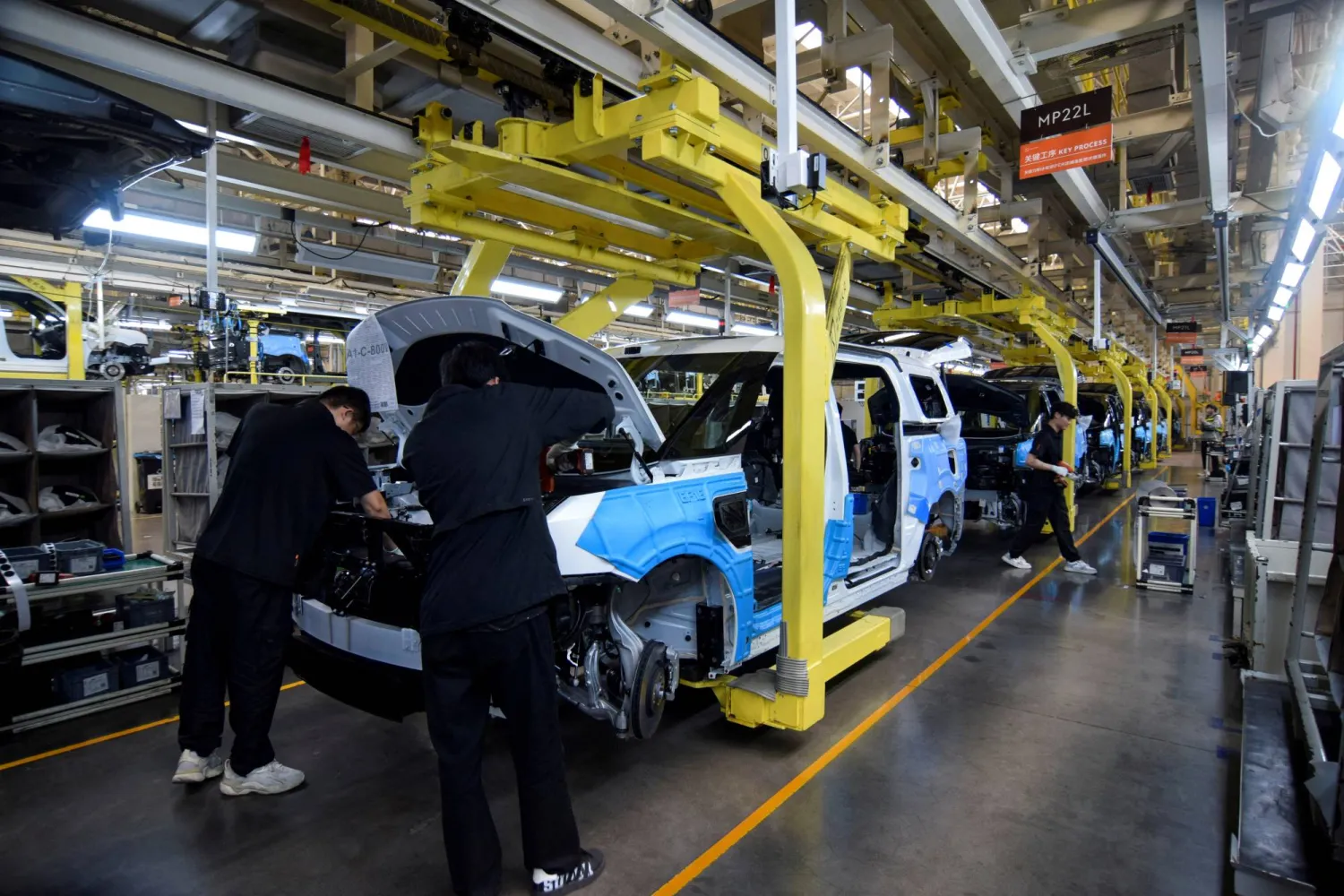
FILE PHOTO: Workers build Zeekr 009 electric minivans at Zeekr's factory in Ningbo, China, April 20, 2025. REUTERS/Nick Carey/File Photo
TT

China's Factory Activity Shrinks Again in November, Services Cool

FILE PHOTO: Workers build Zeekr 009 electric minivans at Zeekr's factory in Ningbo, China, April 20, 2025. REUTERS/Nick Carey/File Photo

China's factory activity shrank for an eighth month in November while services cooled, highlighting the dilemma facing policymakers over whether to press ahead with tough structural reforms or roll out more stimulus to lift domestic demand.

The manufacturing purchasing managers' index rose to 49.2 in November from 49.0 in October, the National Bureau of Statistics' survey showed on Sunday, remaining below the 50-point mark separating growth from contraction. It was in line with analysts' forecast of 49.2 in a Reuters poll.

The data reflects manufacturers' difficulty in sustaining a recovery after COVID-19, compounded by a trade war with the US that has ramped up pressure on businesses.

Output stalled, with the sub-index coming at 50.0. Sub-indexes of new orders and new export orders both improved from October but remained below 50.

Although manufacturing continued to slow in November, "We maintain our view that government may hold off on major policy support until the first quarter next year, since this year's growth target appears broadly achievable," Goldman Sachs economist Yuting Yang said in a research note.

The government's 2025 growth target is around 5%.

For decades, China's policymakers have had two reliable levers to juice growth: revving up the nation's huge industrial machine to boost exports when household spending softened, or unleashing state-funded infrastructure projects to drive momentum.

But with a global slowdown, a protracted property crisis and local governments straining under debt, officials are finding it hard to jump-start activity, putting renewed focus on the need for economic reforms.

Despite the overall November decline, the PMI for small manufacturing firms rose by two percentage points to a six-month high of 49.1, NBS data showed.

That improvement may have been driven by export resilience and by President Donald Trump reducing the high US tariffs he had placed on Chinese goods, said Tianchen Xu, senior economist at the Economist Intelligence Unit.

The non-manufacturing PMI, which includes services and construction, fell to 49.5 from 50.1 in October, shrinking for the first time since December 2022.

Services fell below 50 for the first time since September 2024 to the lowest since December 2023, as a boost from an October holiday waned, according to the NBS.

"The business activity index for real estate and household services sectors both fell below 50, indicating subdued market activity," said Huo Lihui, an NBS statistician.

But the services business outlook sub-index came in at 55.9, indicating service enterprises maintain an optimistic outlook on future market development, Huo said.

Policymakers acknowledge the need for reforms to correct long-standing supply–demand imbalances, lift household spending and address the heavy local government debt that prevents many provinces - some with economies the size of countries - from standing on their own.

Even so, they recognize that such structural changes will be painful and carry political risks at a time when Trump's trade war is piling additional pressure on the economy.

China unveiled a plan to boost consumption on Wednesday, homing in on upgrades of consumer goods in rural areas and sectors such as "pet, anime and trendy toys.”

"If the government can earmark a third round of its consumption subsidies to the services sector in 2026, that would provide a great lift to the industry and its employment," the EIU's Xu said.



Environment Ministry Launches Saudi Citrus Season with Production Exceeding 158,000 Tons

The citrus production season in the Kingdom begins in July and continues through March each year. (SPA)
TT

Environment Ministry Launches Saudi Citrus Season with Production Exceeding 158,000 Tons

The citrus production season in the Kingdom begins in July and continues through March each year. (SPA)

The Saudi Ministry of Environment, Water and Agriculture launched on Wednesday the Kingdom’s citrus season in local markets as part of its efforts to support and develop the agricultural sector and enhance food security in the country, in line with the Saudi Vision 2030.

The is part of the ministry’s ongoing efforts to support national agricultural products, raise awareness of citrus varieties and their nutritional benefits and production areas, and highlight their year-round diversity across production seasons.

These efforts help in improving marketing efficiency, boost competitiveness, and achieve rewarding economic returns.

Citrus fruits are among the most widely cultivated crops in the Kingdom. They are grown in several regions that produce a variety of citrus types, most notably lemons, oranges, mandarins, grapefruit, citron, and kumquats.

The ministry said lemon production leads Saudi citrus output, with total production exceeding 123,000 tons and more than 1.5 million fruit-bearing trees. Orange production follows, with total output reaching 35,700 tons and more than 397,000 fruit-bearing trees.

The citrus production season in the Kingdom begins in July and continues through March each year, it added.

The ministry said the Saudi citrus season has been launched with a number of major retail markets across the Kingdom showcasing local products through innovative packaging and display methods. This boosts the quality and reliability of local products and increases consumer demand during production seasons.


SLB Awarded 5-Year Contract to Stimulate Unconventional Gas in Saudi Arabia

SLB has been awarded a five-year contract by Saudi Aramco to provide stimulation services for its unconventional gas fields. (Asharq Al-Awsat)
TT

SLB Awarded 5-Year Contract to Stimulate Unconventional Gas in Saudi Arabia

SLB has been awarded a five-year contract by Saudi Aramco to provide stimulation services for its unconventional gas fields. (Asharq Al-Awsat)

Global technology company, SLB, has been awarded a five-year contract by Saudi Aramco to provide stimulation services for its unconventional gas fields, the company said in a statement on Tuesday.

The move is part of a broader multi-billion contract, supporting one of the largest unconventional gas development programs globally, it said.

The contract encompasses advanced stimulation, well intervention, frac automation, and digital solutions, which are important to unlocking the potential of Saudi Arabia’s unconventional gas resources - a cornerstone of the Kingdom’s strategy to diversify its energy portfolio and support the global energy transition.

“This agreement is an important step forward in Aramco’s efforts to diversify its energy portfolio in line with Vision 2030 and energy transition goals,” said Steve Gassen, SLB executive vice president.

“With world-class technology, deep local expertise, and a proven track record in safety and service quality, SLB is well positioned to deliver tailored solutions that could help redefine operational performance in the development of Saudi Arabia’s unconventional resources,” he added.

These solutions provide the tools to work toward new performance benchmarks in unconventional gas development.

SLB is a global technology company that drives energy innovation for a balanced planet.

With a global footprint in more than 100 countries and employees representing almost twice as many nationalities, it works on innovating oil and gas, delivering digital at scale, decarbonizing industries, and developing and scaling new energy systems that accelerate the energy transition.


US Says China Chip Policies Unfair but Will Delay Tariffs to 2027

 People walk past a Christmas tree at the Taikoo Li shopping center in Beijing on December 24, 2025. (AFP)
People walk past a Christmas tree at the Taikoo Li shopping center in Beijing on December 24, 2025. (AFP)
TT

US Says China Chip Policies Unfair but Will Delay Tariffs to 2027

 People walk past a Christmas tree at the Taikoo Li shopping center in Beijing on December 24, 2025. (AFP)
People walk past a Christmas tree at the Taikoo Li shopping center in Beijing on December 24, 2025. (AFP)

US trade officials determined that China should be punished for employing unfair tactics to dominate the semiconductor industry, but will wait 18 months to impose tariffs, American authorities said Tuesday.

A US Trade Representative (USTR) investigation concluded China's targeting of semiconductors "for dominance is unreasonable and burdens or restricts US commerce and thus is actionable," the agency said in a public notice.

The current tariff level of zero will be increased "in 18 months on June 23, 2027 to a rate to be announced not fewer than 30 days prior to that date," USTR said.

Beijing said Wednesday it "firmly opposes" the move and accused Washington of abusing tariffs to "unreasonably suppress Chinese industries".

This "disrupts the stability of the global supply chain, hinders the development of all countries' semiconductor industries and harms others while hurting itself", foreign ministry spokesman Lin Jian.

"We urge the United States to quickly correct its erroneous practices," Lin said at a regular press briefing.
USTR officials launched the probe in December 2024 in the final weeks of Joe Biden's presidency, extending the initiative when US President Donald Trump took office in January.

Trump has been a prolific purveyor of tariffs, unveiling sector-specific levies on steel, autos and other items as well as broader measures to achieve a variety of policy objectives.

The White House has jousted with Beijing but reached a broad truce with China after a major escalation in the spring.

The USTR's "Section 301" probe concluded that China had employed "increasingly aggressive and sweeping non-market policies" to dominate semiconductors that have included "massive and persistent" state support of private actors and "wage-suppressing labor practices."

The USTR did not respond to an AFP query on the reason for the 18-month timeframe on tariffs.