How a Jordanian’s Work Trip to Moscow Ended in Death on the Fronthttps://english.aawsat.com/features/5214632-how-jordanian%E2%80%99s-work-trip-moscow-ended-death-front
How a Jordanian’s Work Trip to Moscow Ended in Death on the Front
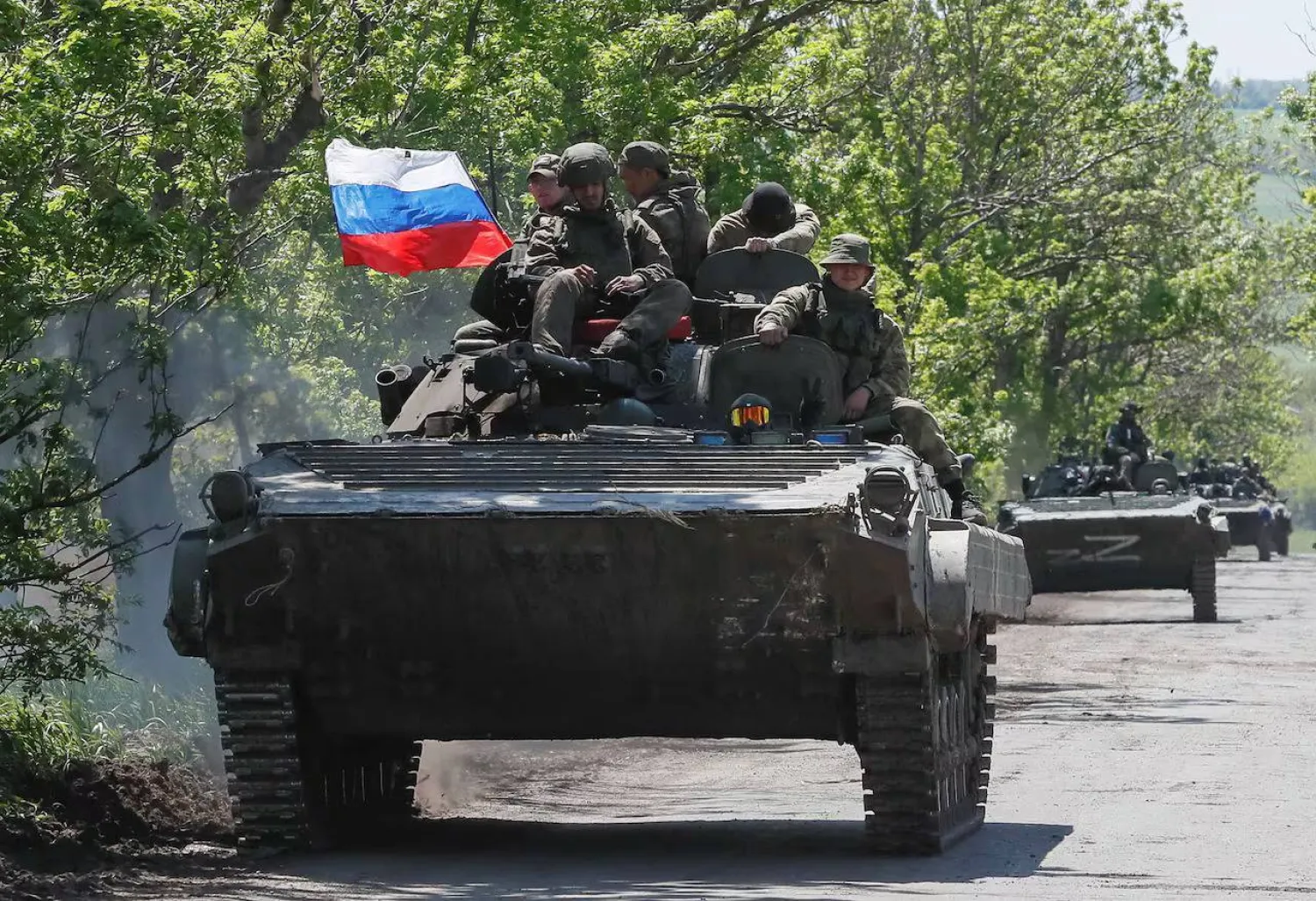
Russian soldiers are seen in southeastern Ukraine. (Reuters)
The eldest son of Raed Ramzi Sabir Hammad – one of two Jordanians killed after being recruited by the Russian army – revealed the shocking account of his father’s journey to Moscow that ended up with him dying as a soldier in the Russian military.
Asharq Al-Awsat spoke to Hammad’s son, Awwab, soon after the Jordanian Foreign Ministry called on citizens to inform it about any attempts to recruit them to the Russian army.
Awwab told Asharq Al-Awsat that his father had departed to Moscow in August after being hired for an administrative position in the Russian Defense Ministry.
Days later, he informed his family that he had been deployed to the front to fight against Ukraine. All contact with him was lost at the end of the same month.
Awwab said his father, 54, had never served in the Jordanian military and that he has a background in engineering. After recently being out of a job, he sought employment abroad in a domain that matches his experience.
He revealed that his father applied for an administrative job in Russia that was posted on the Telegram app. Soon after landing the position, he flew from Amman to Moscow before shortly being recruited as a soldier to be deployed to the Ukrainian front.
The father informed the family of the deployment but did not explain how he was transferred from a civilian post to a military one, continued Awwab. His contact with the family gradually decreased and came to a complete stop on August 25.
Awwab said the family reached out to the Jordanian Foreign Ministry to help locate his father. They were informed of his death on September 25. The search was then on to find out how his was killed and to locate his corpse so that he could be buried in Jordan.
Awwab revealed that several members of his family had also flown to Moscow after receiving job offers through Telegram. He suspected that some 400 Jordanians had fallen for these online “scams”.
The consular affairs department in the Jordanian Foreign Ministry revealed on Thursday that two citizens had been killed after being recruited to join the Russian army.
In a statement, it said it was closely probing how Jordanians were being lured to join the foreign battlefronts and illegally being recruited to foreign armies in violation of Jordanian and international law.
It urged citizens to be wary of attempts to recruit them to the Russian army, while also demanding Russian authorities to cease such behavior.
Hundreds of Jordanians live in Russia and over 20,000 had pursued an education at universities and institutes in Russia and former Soviet states, according to unofficial data, reported AFP.
At the start of the Russian-Ukrainian war, then Russian Defense Minister Sergi Shoigu revealed that some 16,000 volunteers from the Middle East were ready to fight alongside Moscow’s forces. Reports at the time said that some 2,000 Syrian regime soldiers had headed to Russia to join the front.
In November, AFP found many Iraqis are being lured to fight for Russia by seemingly irresistible offers pushed by influencers on social media.
They include a monthly salary of $2,800 -- four times what they could earn in the military at home -- and a sign-up fee of up to $20,000 to set them up in life.
A Russian passport, insurance and pension also come as part of the package, they are told, as well as compensation in case of injury.
Similar methods have been used to recruit young men from Central Asia, India, Bangladesh and Nepal, AFP reporters have found, as well as from Cuba.
Former military chief Gadi Eisenkot, leader of the Yashar party, visits a polling station, on the day of Israel’s national election, in Ofakim, southern Israel, October 27, 2026. (Reuters)
TT
TT
In Israel, Eisenkot Tries Quiet Appeal to Oust Netanyahu
Former military chief Gadi Eisenkot, leader of the Yashar party, visits a polling station, on the day of Israel’s national election, in Ofakim, southern Israel, October 27, 2026. (Reuters)
Gadi Eisenkot, the man who could unseat Israeli Prime Minister Benjamin Netanyahu, almost always dresses in black, speaks halting English and tends to respond in interviews with bullet-point lists, a reflection of the military culture that shaped him.
For some voters in Tuesday's general election, the 66-year-old's lack of charisma may be one of his greatest assets.
Serious and unassuming, Eisenkot is in many ways the opposite of Netanyahu, Israel's longest-serving prime minister, who has flawless American-accented English and is ever ready with headline-grabbing soundbites on US television or social media.
Eisenkot, the military chief of staff from 2015 to 2019, has vowed to unite Israelis after the divisive tenure of Netanyahu, who has moved the country sharply to the right.
"There is a large camp in Israel whose main goal in the coming election is just for things to be calmer," said Tal Elovits, a researcher at the Molad think tank.
"The middle class," he said, "is looking for someone who will look responsible, boring. I think Eisenkot has that appeal."
Eisenkot, who has been neck and neck with Netanyahu in polls, has promised to try to restore the international image of Israel, badly strained after three years of war in Gaza and violence in the occupied West Bank.
He has vowed to crack down on extremist West Bank settlers who have attacked Palestinians with impunity and recently beat up an American journalist and a French mayor, decrying the incidents as "Jewish terror" abetted by Netanyahu's government.
But the military man is no peacenik. He has even sought to play to the right of Netanyahu by vowing no Palestinian state, replaying clips from an earlier political era in which the long-serving prime minister begrudgingly voiced openness to the idea under US pressure.
Commanding the military during the 2006 war with Hezbollah, Eisenkot devised the so-called "Dahieh doctrine", named after Beirut’s southern suburb, in which Israel vowed massive force against civilian infrastructure in areas populated by the Lebanese group.
Israel has adopted the doctrine again in Gaza, causing destruction that critics say amounts to war crimes, an assertion disputed by Israel.
- Working-class roots -
Eisenkot has garnered broad public sympathy after his son Gal and two nephews were killed fighting in Gaza.
His working-class roots constitute another element of his appeal. He would be the first prime minister who is Sephardic, Jews who trace their recent origins to the Middle East and North Africa.
Unlike Netanyahu, who comes from an elite family and whose father was a prominent professor in the United States, Eisenkot is the son of Moroccan Jews, and grew up on Israel's geographic periphery.
His background came into the spotlight when a senior commentator on the pro-Netanyahu Channel 14 television station described Eisenkot as "a monkey" controlled by "Ashkenazi elitists". He was referring to Jews of European descent who have historically dominated Israel's political and economic institutions.
While the term is not necessarily a racial slur in Hebrew and can mean something akin to a "fall guy" taking the blame on behalf of others, the remark drew widespread condemnation from opposition politicians and from Netanyahu himself.
Eisenkot swiftly sought to turn the episode to his advantage.
His campaign erected billboards denouncing discrimination against the Sephardim, and his party accused Netanyahu of sidelining Sephardic members of Likud by limiting their media appearances during the campaign.
- Limited change on security -
In weekend appearances, Eisenkot met religious Jews to whom he defended Israeli control over the West Bank.
"Israeli settlement (of the West Bank) is a value, on condition that it serves the interests of the state of Israel, and it's done according to the law," he told representatives of the Religious Zionist movement on Sunday.
He appeared to be rejecting the establishment of unauthorized settlement outposts, which have fueled a recent rise in violence against Palestinians.
On Gaza, he has vowed to end Hamas rule within 18 months. He recently said this could be achieved either through the implementation of US President Donald Trump's ceasefire plan, which envisages Hamas's gradual disarmament and a transfer of power, or through "creative operations" aimed at destroying the movement's military wing.
Addressing a key source of resentment among Israelis following three years of war, Eisenkot has promised to curb exemptions from military service for religious students.
He promised a "universal national service law" requiring ultra-Orthodox Jews and Arab citizens to perform either military or civil service.
He has sought to appeal to centrist and liberal voters by pledging to "protect judicial independence, the rule of law, minority rights and a free press".
And in his final major rally before Tuesday's vote, he appealed directly to wavering Netanyahu supporters to change their vote.
"Deep down, you too know that Israel cannot go on like this," he said. "Israel needs change."
Benjamin Netanyahu: Israel’s Longest-Serving PM Fighting for Survivalhttps://english.aawsat.com/features/5334109-benjamin-netanyahu-israel%E2%80%99s-longest-serving-pm-fighting-survival
A man walks past a poster of Israeli Prime Minister and Likud party leader Benjamin Netanyahu and US President Donald Trump during the country's national elections in central Jerusalem, October 27, 2026. (Reuters)
TT
TT
Benjamin Netanyahu: Israel’s Longest-Serving PM Fighting for Survival
A man walks past a poster of Israeli Prime Minister and Likud party leader Benjamin Netanyahu and US President Donald Trump during the country's national elections in central Jerusalem, October 27, 2026. (Reuters)
Prime Minister Benjamin Netanyahu, Israel's consummate political survivor, faces the fight of his life in Tuesday's election as he tries to convince voters he is still the only candidate capable of keeping them safe.
The 77-year-old's security-first reputation was all but shattered by Hamas's October 7, 2023 attack, and his main rival -- ex-military chief Gadi Eisenkot -- has channeled public anger over the failure and is running neck and neck with Netanyahu in polls.
Now Israel's longest-serving premier is pulling out all the stops, touting an endorsement from Donald Trump, warning that hostile powers want him to lose, and stoking fears of a Palestinian state -- opposed by a majority of Israelis -- should his opponents triumph.
His election campaign has leaned heavily on a single slogan, visible on posters throughout the country: "Either the Right or Palestine."
Off the campaign trail, Netanyahu faces an international arrest warrant over alleged war crimes in Gaza, a long-running corruption trial, and a spiraling multi-front conflict that has dragged on for three years.
But Netanyahu is hoping to use the wars he waged after October 7 to paper over that glaring security lapse, touting the military blows dealt to Hamas in Gaza, Hezbollah in Lebanon and the groups' backer Iran, which Israel has twice launched wars against.
Last week, after two Israeli soldiers were killed by Palestinian gunmen near Hebron, Netanyahu launched a major military operation in the occupied West Bank and vowed to "pursue Hamas terrorists" everywhere.
- Long career -
Born in Tel Aviv on October 21, 1949, Netanyahu inherited his ideological background from his father Benzion, a former aide to Zeev Jabotinsky, leader of the so-called "Revisionist" strand of Zionism that advocates for a "Greater Israel".
Netanyahu opposed, and eventually helped to bury, the Israeli-Palestinian peace process of the 1990s, which held a two-state solution as its ultimate goal.
He now promotes a vision of an Israel whose borders extend as far as Jordan, voicing support for annexing parts of the occupied West Bank and undertaking measures to promote the growth of Israeli settlements which are illegal under international law.
As a younger man, Netanyahu served in an Israeli commando unit and fought in the 1973 Arab-Israeli war.
His early life's defining tragedy came when his elder brother Yonatan was killed leading the Entebbe hostage-rescue mission in Uganda.
"When the news reached me that Yoni had died, I felt as if my life had ended," Netanyahu later wrote.
Raised partly in the United States and a graduate of the Massachusetts Institute of Technology (MIT), he became one of Israel's most visible spokesmen abroad, showing an ease on US television that has never left him.
Elected to parliament in 1988, he took over leadership of the right-wing Likud party in 1993. In 1996, in the first election after the assassination of peace-negotiating Yitzhak Rabin, Netanyahu pulled off an upset victory by the tiniest of margins and at age 46 became the youngest prime minister in Israeli history.
He served as head of government from 1996 to 1999, then again from 2009 to 2021, before returning to power in late 2022 by cobbling together a coalition that includes once-shunned extremists.
For years, Netanyahu maintained that the foundations of Israel's security rested on military strength, but he also gained a reputation for caution.
Adamantly opposed to a Palestinian state, Netanyahu saw Hamas rule in Gaza as a way to divide Palestinians and weaken the West Bank-based Palestinian Authority, which enjoys strong European support.
The Hamas attack exposed the failures of this setup. As the war in Gaza widened, Netanyahu began to frame the conflict as a generational struggle intended to reshape the region and uproot the influence of Iran's clerical state.
In recent months, he has repeated the refrain that he "changed the face of the Middle East".
- 'He spreads hatred' -
His supporters credit him with responding to Israel's darkest hour with unprecedented military resolve, and confronting Tehran directly -- something none of his predecessors had done.
Critics, however, say his actions have mired the country in intractable conflicts and made it a pariah on the world stage.
His rival Eisenkot has declared that Netanyahu "is unfit to remain in office".
"He spreads hatred, fear and portrays his rivals as enemies of Israel," Eisenkot told public broadcaster Kan.
But Netanyahu still has a powerful ally in US President Trump, whom he has called "the greatest friend Israel has ever had" in the White House.
He received the US president's endorsement 10 days before the vote, with Trump assuring him that he was "the man I want by my side".
Polls show Netanyahu is unlikely to be able to form a government on his own. But for decades, he has defied predictions of his downfall.
On Channel 14, a private station that supports him unquestioningly, he recently declared that the stakes of these elections were "the continued existence of the Jewish state, and to guarantee that, you must vote for the person who will get the job done".
Netanyahu Might Be Finished but His Policies Toward the Palestinians Will Largely Endurehttps://english.aawsat.com/features/5333685-netanyahu-might-be-finished-his-policies-toward-palestinians-will-largely-endure
A view of the Israeli settlement of Itamar from the village of Awarta, south of Nablus in the West Bank, 20 October 2026. (EPA)
TT
TT
Netanyahu Might Be Finished but His Policies Toward the Palestinians Will Largely Endure
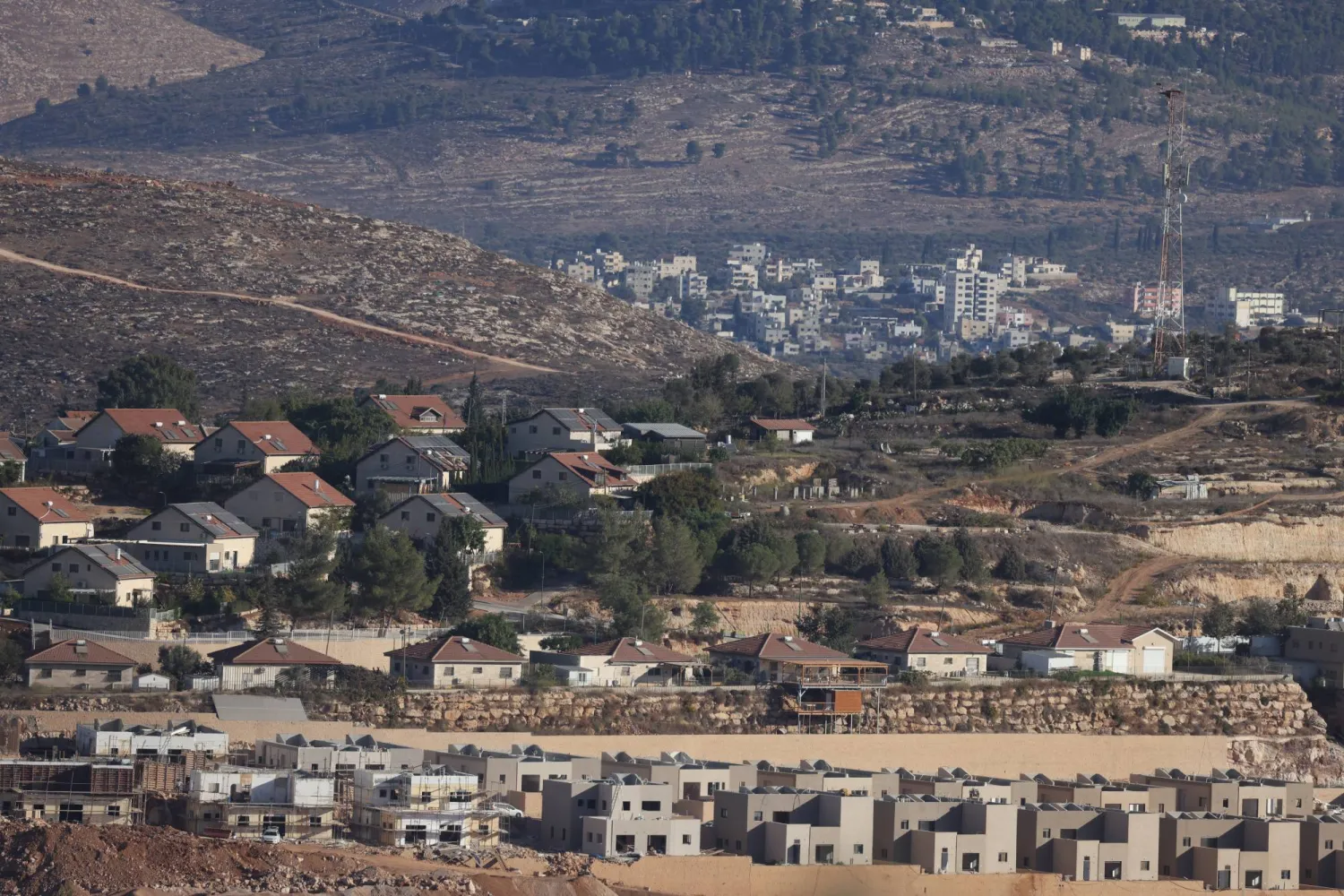
A view of the Israeli settlement of Itamar from the village of Awarta, south of Nablus in the West Bank, 20 October 2026. (EPA)
Israel's elections Tuesday could mark the end of Prime Minister Benjamin Netanyahu's decades-long political career.
But his legacy in the Israeli-occupied West Bank — of massive settlement expansion, the displacement of tens of thousands of Palestinians and the empowerment of armed settler extremists — will likely endure, even if his opponents seek to rein it in.
Israelis are deeply divided over Netanyahu's leadership and moral character, but they largely support settlement expansion and are opposed to a Palestinian state. So, while Netanyahu's opponents have vowed to crack down on settler violence and remove the most contentious outposts, they are mostly against a two-state solution, seen internationally as the only realistic way to resolve the conflict.
“There shouldn’t be any illusions,” said Mairav Zonszein, senior Israel analyst at the International Crisis Group.
“At best, (a new government) would be able to slow down the extremely crazy acceleration that we’ve seen in the last four years of every aspect of Israel’s aggression in the occupied territories and inside Israel itself.”
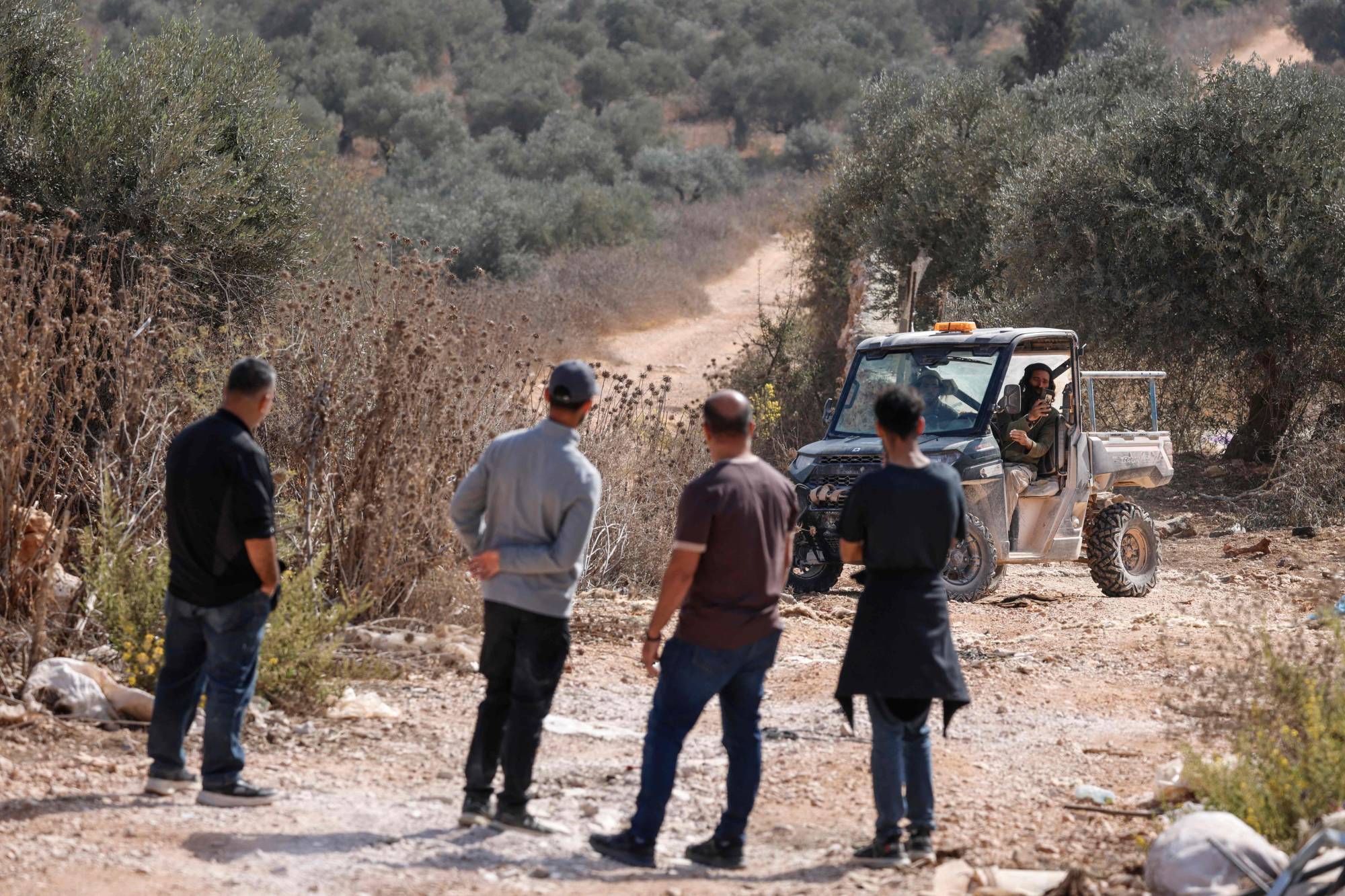
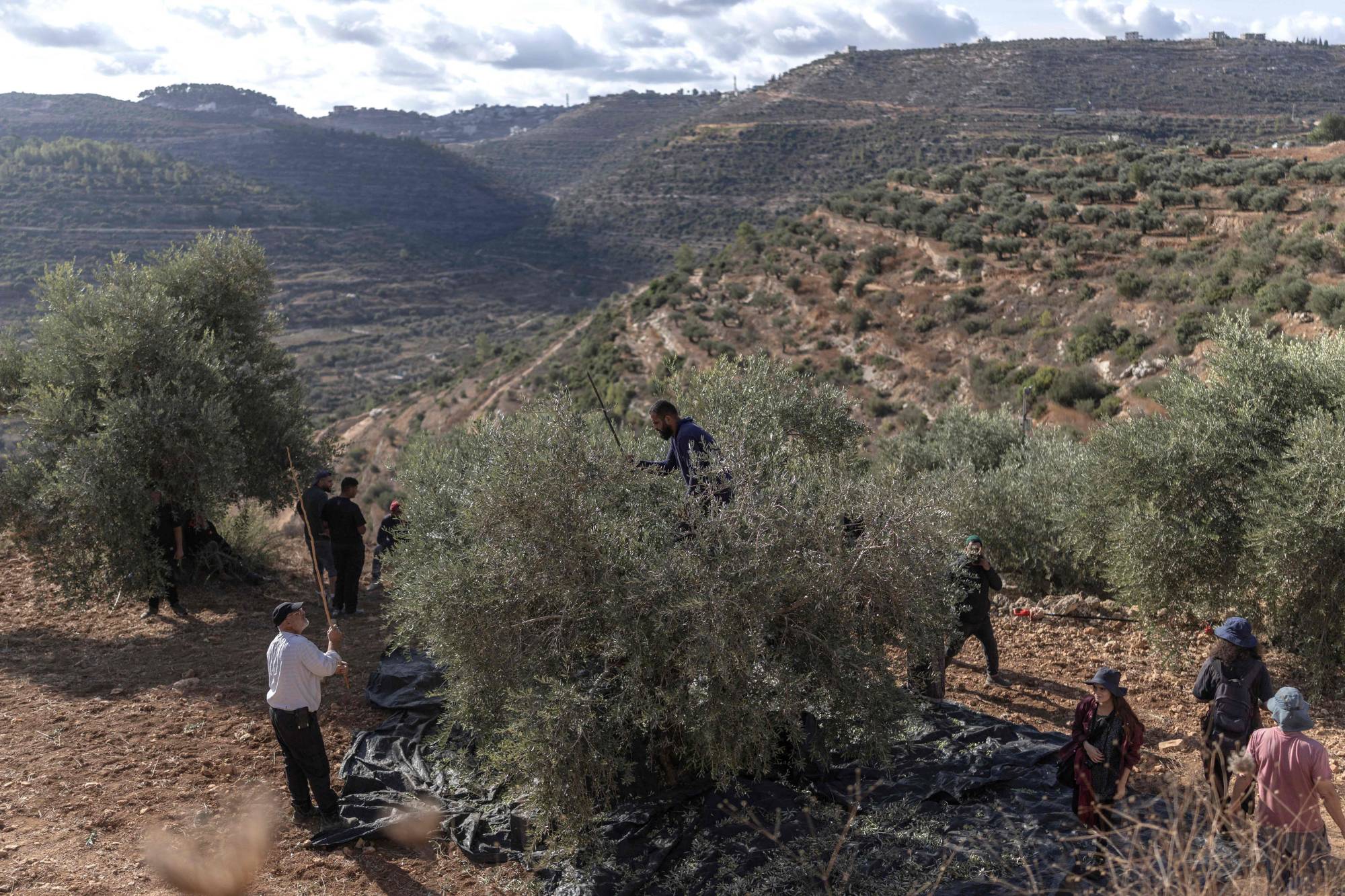
An Israeli settler takes photographs of Palestinian farmers and foreign activists gathered to pick olives in the village of Turmus Ayya, northeast of Ramallah in the Israeli-occupied West Bank, on October 21, 2026. (AFP)
The military stands down in the face of settler violence
One legacy of Netanyahu’s nearly unbroken 17-year rule — the longest of any Israeli leader — is that large groups of armed settlers now routinely defy the Israeli military as they rampage through Palestinian communities, drive people from their homes and seize ever larger swaths of their land.
Hamas' Oct. 7, 2023, attack out of Gaza turbocharged the process. Netanyahu's opponents could bring in more troops and authorize stricter measures, but the genie may already be out of the bottle.
Netanyahu's government has distributed thousands of firearms to the settlers, who have allies in the military and security forces. Some extremist settlers have become like sheriffs — making arrests, killing Palestinians they say posed a threat, summoning security forces and driving Palestinian families from their homes.
The Palestinian Tubasi family was forced out in July after settlers besieged their hilltop home in the West Bank village of Jalud for 19 days. The settlers cut off their water access and their electricity, and threatened to “barbecue” them if they didn’t leave, said Mahmoud Tubasi, 60, the patriarch.
An Israeli court ordered the military to bring the family back, but that hasn't happened. Troops aborted their latest mission soon after it began, when a mob of over 150 armed settlers quickly assembled, scaled the walls of the home and set a car on fire.
Troops threw Tubasi and his family into an armored jeep and drove them away as settlers torched the place. They now live in relatives' houses in the valley below their gutted and blackened home, around which settlers still roam.
Israel’s military did not respond to a request for comment.
“If they wanted to evacuate them, of course, 100%, they can do that,” Tubasi said. “This is an army that fights in Lebanon, Gaza and in Iran — they can’t control 150 or 200 settlers?”
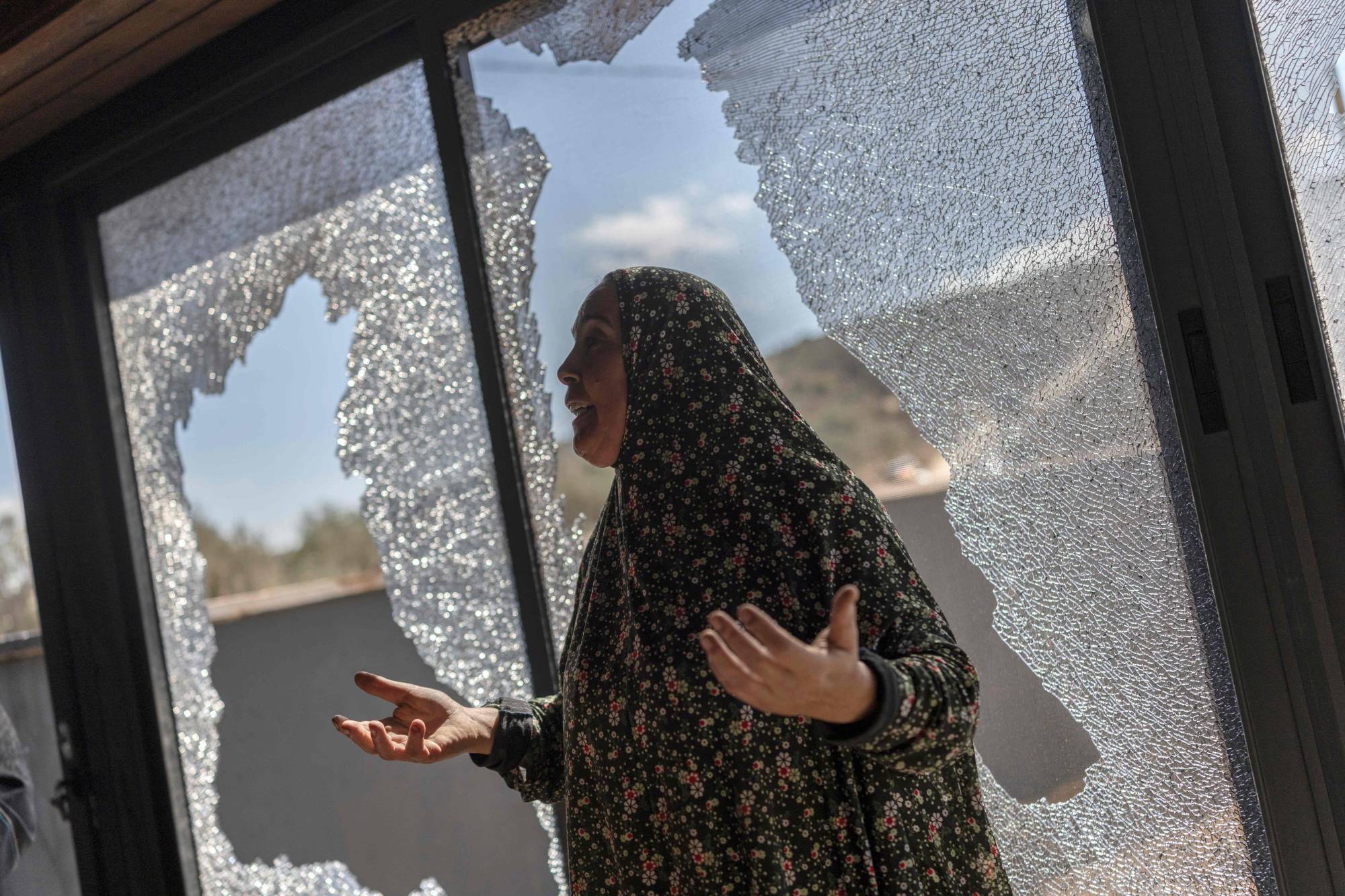
Palestinian Hanan Hamayei gestures as she stands near the shattered glass of her home following a reported attack by Israeli settlers, in the Israeli-occupied West Bank village of Turmus Ayya on October 19, 2026. (AFP)
The process is repeated across the West Bank
Under Netanyahu, settlers have established over 250 rustic camps across the territory, focusing particularly on areas where Palestinian herding communities have dwelled for decades.
The outposts allow the settlers to effectively run Palestinians off vast rural areas by attacking shepherds, taking over water resources and grazing their own herds, all under the eye of Israeli troops.
Dror Etkes, a researcher with an Israeli anti-settlement group, says the outposts have allowed the settlers to seize effective control of around a fifth of the West Bank. Israel captured the territory, along with Gaza and east Jerusalem, in the 1967 Middle East war. The Palestinians want all three territories for their future state.
Since 2023, the strategy has forced at least 127 Palestinian herding communities off their land, according to data gathered by Etkes' organization, known as Kerem Navot, and B'Tselem, another Israeli anti-settlement group.
The departures have cleared nearly the entire eastern flank of the West Bank, along the border with Jordan, of Palestinians. The settlers' explicit goal is to prevent the establishment of a viable Palestinian state.
Netanyahu’s opponents say they will go after the most violent settlers and dismantle outposts, which are illegal under Israeli law. But they will not evacuate the over 100 new settlements Netanyahu's government legalized, including 44 that were formerly outposts. Nor will they remove settlements dating back decades, many of which now resemble fully developed suburbs.
Most of the international community views all Israeli settlements as illegal and an obstacle to a two-state solution. Israel views the West Bank as the biblical and historical heartland of the Jewish people and says its future status should be decided by negotiations, which have not been held in over a decade.
Even if some outposts are removed, many Palestinians seeking to return would find their homes burned and looted, and would continue to face threats from nearby settlers.
“The story is over. There will be no massive dismantlement of settlement,” said Etkes. “It’s now a full and prouder-than-ever apartheid regime.”
Amnesty International and other major rights groups accused Israel of the international crime of apartheid even before the Oct. 7 attack and its aftermath. Israel denies the allegation.
Palestinians harvest their olive trees in the Israeli-occupied West Bank village of Deir Abu Mashal on October 19, 2026. (AFP)
Netanyahu's opponents promise modest change
The politician most likely to replace Netanyahu as prime minister is retired general Gadi Eisenkot, a political centrist. He hopes to form a majority coalition with three other parties spanning Israel's political spectrum and without Arab-led parties advocating a two-state solution.
Beth Oppenheim, an Israel analyst for the European Council on Foreign Relations, said the opposition has “struggled to formulate a convincing alternative" to the right's new security strategy of “aggressively preempting threats, maintaining complete freedom of operation and imposing buffer zones.”
Palestinian attacks, like a shooting on Friday that killed two Israeli soldiers, and efforts on the right to cast the Israeli left as enemy sympathizers, have taken their toll. “The net effect is that talk of ‘peace’ and compromise has become politically toxic,” Oppenheim said.
Eisenkot does not support a Palestinian state, but is open to limited self-rule in the 40% of the West Bank currently administered by the Palestinian Authority under agreements reached in the 1990s. He would allow settlement growth in the other 60% of the territory, which is under direct Israeli military rule.
He has also vowed to empower Israeli troops and paramilitary Border Police to crack down on settler violence.
Eisenkot “is interested in lowering the friction in the West Bank and interested in definitely lowering the sanctions and the intention for sanctions by European countries,” Zonszein said. “He’ll do kind of the minimum necessary to get the maximum effect.”
Eisenkot's prospective allies include left-wing politicians who oppose settlements and have favored a two-state solution, but they have agreed to set those positions aside to form a coalition to oust Netanyahu.
Israeli leaders have long balanced their ambitions in the occupied territories with demands from Washington aimed at resolving the conflict. But they are unlikely to face any significant pressure from US President Donald Trump, who endorsed Netanyahu and has long backed his policies.
لم تشترك بعد
انشئ حساباً خاصاً بك لتحصل على أخبار مخصصة لك ولتتمتع بخاصية حفظ المقالات وتتلقى نشراتنا البريدية المتنوعة